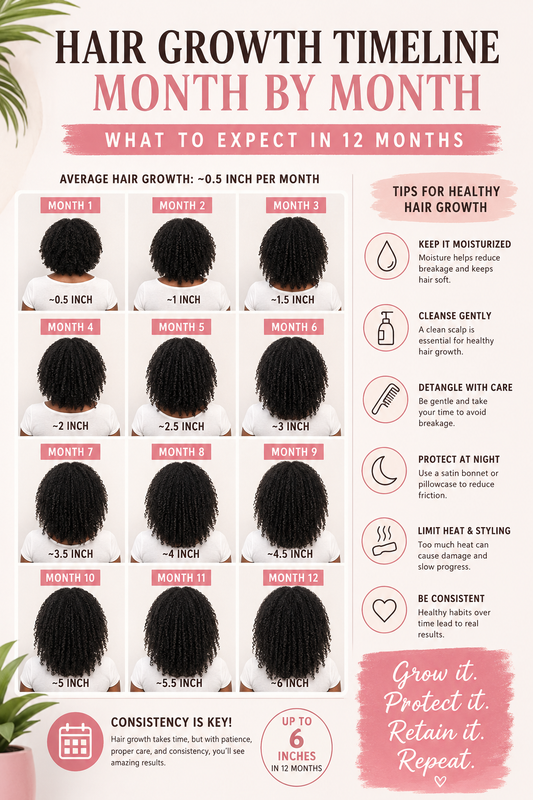
Growing longer, healthier hair is rarely an overnight process. Whether you have natural hair, curly hair, relaxed hair, locs, braids, waves, or another texture or style, one of the most common questions is: How long does it actually take to grow hair?
Understanding a realistic hair growth timeline month by month can make the process much easier. Instead of wondering why your hair doesn't suddenly look several inches longer, you can learn what changes to watch for each month—from new growth at the roots to improved length retention and eventually noticeable changes in overall length.
On average, scalp hair grows roughly half an inch per month, although the actual rate varies from person to person. That means someone who retains most of their growth could potentially gain around six inches of new hair growth in one year.
But there is an important difference between hair growth and length retention.
Your follicles can continue producing new hair while your ends break almost as quickly as your roots grow. In that situation, your hair may appear to have "stopped growing" even though growth is occurring.
That's why a successful hair-growth journey isn't only about stimulating your scalp. It's also about protecting the hair you've already grown.
This complete month-by-month hair growth guide explains what you may notice during Months 1 through 12, how much growth is realistic, what can affect your progress, and how to build a routine that helps you retain more of your length.
How Fast Does Hair Grow?
Human scalp hair generally grows approximately 0.5 inches per month, or roughly 6 inches per year. However, this is an average—not a guarantee.
Some people grow hair somewhat faster, while others grow more slowly.
Your individual growth rate can be influenced by factors including:
- Genetics
- Age
- Hormonal changes
- Nutrition
- Overall health
- Scalp health
- Stress
- Hair-care practices
- Chemical treatments
- Heat styling
- Breakage
- Protective styling
- Hair manipulation
Another major factor is simply perception.
If you have tightly coiled natural hair, shrinkage can make several inches of growth difficult to see when your hair is in its natural state. Someone with straighter hair may notice an extra inch much sooner.
This is why photographs and measurements can be much more reliable than simply looking in the mirror.
Hair Growth vs. Length Retention
Before looking at the month-by-month timeline, it's important to understand these two concepts.
Hair growth happens underneath the scalp as follicles produce new hair.
Length retention refers to keeping that hair after it grows.
Imagine your hair grows six inches during the year but four inches gradually break from your ends.
Your visible length gain would only be about two inches.
This is one reason someone might say:
"My hair grows, but it never gets longer."
In many cases, the problem isn't necessarily slow follicular growth. It may be excessive breakage.
For people with Black, natural, curly, or coily hair, retaining length can be especially important because bends and curves along the strand can make it more vulnerable to dryness, tangling, and mechanical damage.
Your goal should therefore be:
Support healthy growth + minimize unnecessary breakage = retain more length.
12-Month Hair Growth Timeline at a Glance
Using the commonly cited average of approximately half an inch per month, a simplified timeline looks like this:
| Month | Approximate New Growth |
|---|---|
| Month 1 | 0.5 inch |
| Month 2 | 1 inch |
| Month 3 | 1.5 inches |
| Month 4 | 2 inches |
| Month 5 | 2.5 inches |
| Month 6 | 3 inches |
| Month 7 | 3.5 inches |
| Month 8 | 4 inches |
| Month 9 | 4.5 inches |
| Month 10 | 5 inches |
| Month 11 | 5.5 inches |
| Month 12 | 6 inches |
These figures are illustrative averages, not promises.
They represent new hair produced at the scalp—not necessarily six inches of visible length. Trimming, breakage, shrinkage, and individual growth rates can change what you actually see.
Now let's look at what your journey may look like month by month.
Month 1: Building Your Hair Growth Foundation
Potential cumulative growth: approximately 0.5 inch
The first month is about creating consistency.
You probably won't see a dramatic transformation after only four weeks. That's completely normal.
Half an inch of growth can be difficult to notice, especially with curly or coily hair.
Instead of obsessing over length during Month 1, establish your baseline.
Take pictures of your hair from multiple angles, such as:
- Front
- Back
- Left side
- Right side
- Crown
- Hairline
If you want more precise tracking, choose several sections and measure them.
Record the date.
These pictures become extremely valuable several months later because day-to-day growth can be difficult to recognize.
Focus on Scalp Health
A healthy hair routine begins with the scalp.
Regular cleansing helps remove excess oil, dead skin, sweat, and product buildup. Your scalp shouldn't be neglected simply because you're trying to grow longer hair.
At the same time, avoid aggressively scratching or scraping the scalp.
The goal is a clean, comfortable, well-maintained scalp.
Month 1 Goal
Don't chase miraculous results.
Build a routine you can realistically maintain for the next year.
Month 2: Your Roots May Start Telling the Story
Potential cumulative growth: approximately 1 inch
By Month 2, you could have roughly an inch of new growth if your hair grows near the average rate.
This can become particularly noticeable for people who:
- Color their hair
- Relax their hair
- Straighten their natural hair
- Wear certain protective styles
- Maintain locs
- Have closely cropped hairstyles
The contrast between new growth and previously treated hair can make your progress easier to see.
For natural hair, however, shrinkage can still disguise your progress.
Pay Attention to Moisture
At this stage, start evaluating how your hair feels.
Does it constantly feel dry?
Are your ends rough?
Does your hair snap easily during detangling?
If so, your routine may need adjustment.
The objective isn't simply to grow new hair. You need to protect the older portions of the strand as well.
Month 2 Goal
Reduce unnecessary manipulation.
Constantly combing, brushing, pulling, restyling, and touching your hair can contribute to mechanical damage.
Month 3: Your First Major Progress Check
Potential cumulative growth: approximately 1.5 inches
Three months is a much better time to evaluate your progress than three weeks.
At the average growth rate, you could now have around 1.5 inches of new hair.
Take another set of progress photographs using the same:
- Hairstyle
- Camera angle
- Lighting
- Position
- Measurement method
Comparing consistent photographs makes subtle differences much easier to recognize.
Check Your Ends
Month 3 is also a good time to examine your ends.
Watch for:
- Split ends
- Excessive knots
- Roughness
- Thinning ends
- Frequent snapping
- Increased tangling
Damaged ends can gradually travel up the strand or contribute to continued breakage.
Trimming when genuinely needed can support the appearance and manageability of healthier hair, although trimming itself does not make follicles grow faster.
Month 3 Goal
Evaluate whether your routine is helping you retain your new growth.
Month 4: Length Retention Becomes More Important
Potential cumulative growth: approximately 2 inches
Four months of average growth could equal approximately two inches of new hair.
This is where a good retention routine starts paying off.
If your hair has grown but you're seeing little difference in length, investigate possible sources of breakage.
Common culprits include:
- Excessive heat
- Tight hairstyles
- Rough detangling
- Frequent chemical processing
- Sleeping without protecting the hair
- Allowing hair to become excessively tangled
- Constant manipulation
- Neglecting the ends
Protect Your Hair at Night
Your nighttime routine can make a significant difference over many months.
Depending on your hairstyle and texture, consider a satin or silk bonnet, scarf, or pillowcase to reduce friction.
The important word is reduce.
No accessory magically causes hair to grow several inches faster. Its benefit is primarily helping protect the hair you already have.
Month 4 Goal
Identify and eliminate one recurring source of breakage.
Month 5: Your Hair May Begin Looking Noticeably Different
Potential cumulative growth: approximately 2.5 inches
At Month 5, progress may become easier to recognize.
Two and a half inches can create visible differences in:
- Ponytail length
- Twist length
- Braid length
- Afro size
- Loc length
- Curl shape
- Overall volume
But shrinkage still matters.
Someone can have significantly longer natural hair without it appearing dramatically longer when dry.
Try a Length Check
If you have curly or coily hair, gently stretch a small section rather than judging your progress exclusively by its shrunken appearance.
Compare it with your original Month 1 photographs or measurements.
You may be surprised by how much growth has occurred.
Month 5 Goal
Keep doing what works instead of constantly switching routines.
Hair growth requires patience, and changing products every week can make it difficult to determine what's actually benefiting your hair.
Month 6: The Half-Year Hair Growth Milestone
Potential cumulative growth: approximately 3 inches
Six months is a major checkpoint.
At the average rate, your scalp may have produced approximately three inches of new hair.
Three inches can make a substantial difference.
This is the perfect time for a comprehensive assessment.
Ask yourself:
- Is my hair visibly longer?
- Are my ends still reasonably full?
- Am I experiencing excessive breakage?
- Has detangling become easier or harder?
- Is my scalp comfortable?
- Are my hairstyles lasting?
- Have my hair-care habits improved?
- Am I retaining most of my growth?
Why You May Not See Three Inches
Don't panic if your hair doesn't look exactly three inches longer.
Remember that new growth isn't the same as retained visible length.
You may have:
- Trimmed some hair
- Experienced breakage
- Increased shrinkage
- Changed hairstyles
- Measured differently
- Naturally grown at a different rate
Three inches is an estimate based on average growth—not a pass/fail test.
Month 6 Goal
Compare Month 1 and Month 6 photographs.
Six-month comparisons are often much more meaningful than weekly length checks.
Month 7: Protect the Progress You've Made
Potential cumulative growth: approximately 3.5 inches
By Month 7, protecting your older ends becomes increasingly important.
Remember that the ends of your hair are the oldest part.
Depending on your overall length, those ends may have experienced years of:
- Washing
- Detangling
- Sun exposure
- Heat
- Styling
- Friction
- Manipulation
- Product application
Treat them accordingly.
Handle Your Ends Gently
When moisturizing and styling your hair, don't focus exclusively on your scalp.
Your ends often need the most attention because they're typically the most weathered section.
You may benefit from keeping them moisturized and minimizing unnecessary friction and manipulation.
Month 7 Goal
Treat your ends like something you're trying to preserve rather than something you can constantly manipulate.
Month 8: Consistency Starts Compounding
Potential cumulative growth: approximately 4 inches
Eight months could represent roughly four inches of new growth.
This is where consistency begins to outperform short-term "hair growth hacks."
You've potentially spent eight months:
- Cleansing your scalp
- Conditioning your hair
- Detangling carefully
- Protecting your hair overnight
- Reducing excessive heat
- Maintaining moisture
- Minimizing breakage
- Protecting your ends
One individual wash day may not seem important.
But dozens of careful wash days can have a meaningful cumulative effect.
Don't Become Impatient Now
Month 8 can also be when people become bored with their routine and start experimenting.
There's nothing wrong with changing a routine that isn't working.
But avoid abandoning healthy habits simply because you want instant results.
Month 8 Goal
Prioritize consistency over novelty.
Month 9: Your Transformation May Be Easier to See
Potential cumulative growth: approximately 4.5 inches
Nine months is enough time for significant changes to become visible for many people.
Your hair may:
- Hang differently
- Create a larger afro
- Reach a different point on your neck or shoulders
- Form longer twists
- Create a fuller ponytail
- Produce longer locs
- Require more time to detangle
- Need different styling techniques
Your original Month 1 photos can now become especially useful.
Look at More Than Length
Hair progress shouldn't be judged exclusively by inches.
Also consider:
- Fullness
- Breakage
- Manageability
- Scalp comfort
- Moisture retention
- Appearance of the ends
- Styling versatility
Long hair that is constantly breaking or difficult to manage isn't necessarily the only definition of successful progress.
Month 9 Goal
Evaluate the overall condition of your hair—not simply its length.
Month 10: Approaching Five Inches of Potential Growth
Potential cumulative growth: approximately 5 inches
At Month 10, someone growing near the average rate could have produced approximately five inches of new hair.
If you've retained most of that growth, your before-and-after comparison may now be dramatic.
This is especially true when you compare identical hairstyles.
For example, take photographs of the same:
- Two-strand twists
- Wash-and-go
- Ponytail
- Afro
- Braid-out
- Stretched hair
- Loc style
Using consistent comparisons prevents hairstyle differences from misleading you.
Don't Sacrifice Hair Health for Length
Some people avoid trimming severely damaged ends because they don't want to "lose progress."
But keeping badly split or extremely thin ends doesn't necessarily improve the appearance of your hair.
Your ultimate goal should be healthy-looking retained length, not simply the largest possible measurement.
Month 10 Goal
Protect your progress while continuing to monitor the condition of your ends.
Month 11: Stay Consistent
Potential cumulative growth: approximately 5.5 inches
You're almost at the one-year mark.
Month 11 isn't the time to suddenly overhaul everything if your routine has been working.
Continue focusing on the fundamentals:
- Clean scalp
- Gentle cleansing
- Conditioning
- Moisture as needed
- Careful detangling
- Low unnecessary manipulation
- Protection from excessive heat
- Nighttime protection
- Healthy-looking ends
Avoid Comparing Your Hair to Someone Else's
Social media can make hair growth expectations unrealistic.
Someone online may appear to grow hair dramatically faster because of:
- Different genetics
- A looser curl pattern
- Less shrinkage
- Extensions
- Different starting length
- Camera angles
- Styling methods
- Different retention rates
Compare your Month 11 hair to your Month 1 hair.
That's the comparison that matters.
Month 11 Goal
Finish your first year with the same consistency you started with.
Month 12: Your One-Year Hair Growth Results
Potential cumulative growth: approximately 6 inches
You've reached one year.
At an average of approximately half an inch per month, your scalp could have produced around six inches of new hair during the year.
That doesn't necessarily mean your hair will measure exactly six inches longer.
If you retained four inches, that's still meaningful progress.
If you retained five inches, that's excellent retention.
And if you've retained close to the entire six inches, you've done an impressive job protecting your length.
Complete Your Final Length Check
Repeat your original Month 1 process.
Take photographs from the same angles.
Measure the same sections.
Use similar lighting.
Wear the same hairstyle if possible.
Then compare:
Month 1 vs. Month 12.
This gives you a much more accurate picture of your progress.
Month 12 Goal
Determine what worked and build your Year 2 routine around those habits.
What Is a Realistic Hair Growth Goal for One Year?
A realistic goal should recognize individual differences.
The commonly used average is approximately six inches of new scalp hair per year, but your actual results can fall above or below that number.
More importantly, you may not retain all six inches.
Suppose you produce six inches of new hair but lose:
- 0.5 inch through trimming
- 1 inch through gradual breakage
Your net visible gain would be around 4.5 inches.
That's why retention is so important.
Instead of making your only goal:
"I want six inches."
Consider:
"I want to maximize the amount of healthy new growth I retain over the next 12 months."
That gives you a much more productive target.
Why Isn't My Hair Getting Longer?
This question is extremely common, particularly among people with natural and textured hair.
In many cases, hair is growing.
The problem may be that you're losing length at approximately the same rate.
For example:
Growth at roots: +0.5 inch
Breakage at ends: -0.5 inch
Visible length gain: approximately zero
If this continues for a year, your hair can appear stuck at the same length.
This phenomenon is sometimes described as a length plateau.
Common causes can include excessive manipulation, dryness, friction, chemical damage, excessive heat, rough detangling, and damaged ends.
Does Black Hair Grow Slower?
Black hair grows through the same basic biological follicle process as other human scalp hair, but individual growth rates vary.
One reason tightly coiled hair may appear to grow more slowly is shrinkage.
Imagine two people each grow three inches.
One person's hair hangs relatively straight.
The other person's hair coils tightly toward the scalp.
The first person's three inches may be immediately obvious. The second person's growth can be partially hidden within the curl pattern.
Textured hair may also require particular attention to length retention because bends along the strand and the distribution of natural scalp oils can contribute to dryness and vulnerability to breakage.
So don't automatically assume your natural hair isn't growing simply because you can't immediately see the length.
How to Track Natural Hair Growth Accurately
If you're serious about following your hair growth timeline month by month, create a consistent tracking system.
1. Choose Specific Measurement Areas
Measure several sections, such as:
- Front
- Crown
- Left side
- Right side
- Back
Different areas of your scalp may appear to grow or retain length differently.
2. Measure the Same Way Every Time
If you stretch your hair during the first measurement, stretch it during later measurements too.
Don't compare stretched hair one month with completely shrunken curls the next.
3. Take Monthly Photos
Use the same:
- Room
- Lighting
- Background
- Camera position
- Hairstyle
- Angle
Consistency makes comparisons more meaningful.
4. Don't Measure Every Day
Daily measurement won't show meaningful changes and can create unnecessary frustration.
Monthly or quarterly tracking is much more useful.
How to Retain More Hair Growth
You can't control every biological factor affecting your growth rate, but you can control many practices that influence breakage.
Keep Your Scalp Clean
Your scalp is skin and should be cleansed appropriately.
Choose a cleansing frequency that works with your scalp, activity level, hairstyle, and product use.
Don't assume that avoiding shampoo for extremely long periods automatically makes hair grow faster.
Condition Regularly
Conditioning can improve softness, lubrication, and manageability, helping reduce friction during detangling.
Focus particularly on your lengths and ends.
Detangle Gently
Detangling can become one of the biggest sources of breakage when done aggressively.
Work in sections when helpful.
Start near the ends and gradually work upward rather than repeatedly ripping through knots from the roots downward.
Use your fingers or an appropriate detangling tool depending on your hair.
Reduce Excessive Heat
Heat styling doesn't automatically destroy hair, but repeated high-temperature styling can contribute to damage.
If length retention is your priority, be thoughtful about:
- Flat ironing
- Blow drying
- Hot combing
- Curling irons
Use heat carefully and avoid repeatedly passing extremely hot tools over the same strands.
Avoid Excessively Tight Hairstyles
A hairstyle shouldn't require constant pain to look good.
Repeated tension can stress the hair shaft and hairline.
Be especially careful around your edges, which can be more delicate.
Braids, twists, wigs, weaves, ponytails, and other styles should not create excessive pulling.
Protect Your Hair While Sleeping
Friction between your hair and bedding can contribute to tangling and breakage.
Depending on your preferences, consider:
- Satin bonnet
- Satin scarf
- Silk scarf
- Satin pillowcase
- Silk pillowcase
The objective is reducing friction and protecting your hairstyle and strands.
Can Protective Styles Make Hair Grow Faster?
Protective styles don't directly change the biological speed at which follicles produce hair.
Their potential benefit is length retention.
A good protective style can reduce:
- Daily manipulation
- Detangling
- Friction
- Constant styling
- Exposure of fragile ends
However, a poorly installed protective style can have the opposite effect.
Watch out for styles that are:
- Extremely tight
- Heavy
- Left in excessively long
- Neglected underneath
- Constantly pulling on the hairline
A "protective" style isn't protective if it's damaging your hair.
Hair Growth Timeline With Braids
Braids can make new growth especially noticeable.
After several weeks, you may see space developing between your scalp and the original braid installation.
This doesn't necessarily mean braids caused your hair to grow faster.
Instead, the hairstyle makes new root growth easier to observe.
If braids reduce manipulation and help you avoid breaking your ends, however, they may help you retain more of the hair you're already growing.
That distinction matters.
Hair Growth Timeline With Locs
Loc growth can be particularly interesting because the visual changes don't always happen in a straight line.
During the early stages, budding, shrinkage, swelling, and maturation can change the apparent length of the locs.
Your hair may be growing while the loc formation process makes the length appear inconsistent.
Over longer periods—six months, one year, two years—the accumulated length becomes much easier to recognize.
Regular photographs can be extremely helpful for documenting a loc journey.
Hair Growth Timeline After a Big Chop
If you've recently done a big chop, your growth can be easier to monitor because you're starting from a shorter baseline.
Using the half-inch average, someone starting extremely short could theoretically accumulate approximately:
- 1.5 inches by Month 3
- 3 inches by Month 6
- 4.5 inches by Month 9
- 6 inches by Month 12
Again, these are estimates.
Shrinkage can dramatically affect how long natural hair appears.
Six inches of tightly coiled hair may look much shorter than six inches when stretched.
What Can Affect Your Hair Growth Timeline?
Hair growth is biological, so no single oil, shampoo, supplement, or hairstyle can guarantee a specific number of inches.
Several factors can influence the timeline.
Genetics
Genetics plays an important role in characteristics such as growth cycles, density, texture, and maximum attainable length.
Age
Hair characteristics can change as we age, including growth rate, density, and strand diameter.
Nutrition
Hair follicles require nutrients like the rest of the body.
A balanced diet containing adequate protein, vitamins, minerals, and overall calories supports normal bodily functions, including hair production.
Taking large amounts of supplements when you aren't deficient doesn't necessarily mean your hair will grow dramatically faster.
Stress
Significant physiological or emotional stress can affect the hair-growth cycle in some people and contribute to increased shedding.
Hormonal Changes
Pregnancy, postpartum changes, menopause, thyroid conditions, and other hormonal factors can affect hair.
Scalp Conditions
Persistent inflammation, itching, scaling, sores, or other scalp problems shouldn't simply be covered with oils and ignored.
If you're experiencing unexplained hair loss, bald patches, significant thinning, scalp pain, or persistent scalp symptoms, consider consulting a qualified healthcare professional or dermatologist.
Do Hair Oils Make Hair Grow Faster?
Hair oils are popular in natural hair routines, but expectations should remain realistic.
Oil doesn't automatically force follicles to produce several extra inches of hair.
Depending on the oil and how it's used, oils may help with aspects of hair care such as:
- Lubrication
- Reducing friction
- Sealing in moisture
- Improving shine
- Making hair feel softer
- Supporting easier manipulation
Some people also enjoy scalp massage as part of their routine.
The bigger goal should be maintaining healthy hair and reducing avoidable breakage rather than expecting an oil to create overnight growth.
Why Your Ends Matter More Than You Think
Your roots contain your newest hair.
Your ends contain your oldest hair.
If you want waist-length, mid-back-length, or even shoulder-length hair, some strands need to survive for years.
Think about what those strands experience during that time:
Hundreds of wash days.
Hundreds of nights sleeping.
Countless hairstyles.
Detangling sessions.
Sun exposure.
Clothing friction.
Possibly heat styling.
Possibly chemical processing.
That's why long hair requires more than growth.
It requires preservation.
Should You Trim Your Hair While Growing It?
Yes, when trimming is needed.
Cutting your ends doesn't change how quickly hair grows from your scalp because those processes happen in completely different locations.
However, removing damaged, splitting, or severely thinning ends can improve the appearance and manageability of your hair.
There's no universal trimming schedule that works for everyone.
Someone who uses frequent heat or chemical treatments may have different needs from someone who rarely manipulates their hair.
Monitor your own ends.
Signs Your Hair Is Growing Even When You Can't See It
Not seeing dramatic length doesn't automatically mean you're making no progress.
Possible signs of growth include:
- Visible roots after coloring
- Increased new growth after relaxing
- Braids becoming looser at the roots
- Locs showing new root growth
- Twists becoming longer
- Ponytails becoming fuller or longer
- Increased stretched length
- Hair reaching a new body landmark
- More volume in certain styles
Photographs remain one of the easiest ways to confirm progress.
Hair Growth Body-Length Milestones
Many people set goals such as:
- Ear length
- Chin length
- Neck length
- Shoulder length
- Armpit length
- Bra-strap length
- Mid-back length
- Waist length
- Hip length
The time required to reach each milestone depends on your starting point, body proportions, growth rate, shrinkage, trimming, and retention.
For example, gaining 12 inches of retained length could easily require around two years or more.
Longer goals are therefore better approached as multi-year journeys rather than 30-day challenges.
A Simple Monthly Hair Growth Routine
You don't need an extremely complicated routine to work toward healthier, longer-looking hair.
Weekly or As Needed
Cleanse your scalp and hair according to your individual needs.
Follow with conditioning and gentle detangling.
Throughout the Week
Monitor moisture and refresh your hair when necessary.
Avoid repeatedly restyling it simply because you're bored.
At Night
Protect your hair from unnecessary friction.
Monthly
Take progress photographs.
Check your ends.
Evaluate breakage.
Measure your hair if desired.
Every Three Months
Compare your current photographs with your original baseline.
Look for patterns rather than tiny daily changes.
Common Hair Growth Mistakes
Measuring Too Frequently
Hair doesn't grow enough overnight for daily measurements to be useful.
Expecting Products to Perform Miracles
No product should be expected to turn a normal biological process into five inches of growth in a month.
Ignoring Breakage
New growth means very little for length goals if your ends continually snap off.
Wearing Hairstyles Too Tight
Protective styling should reduce damage—not create additional tension.
Using Too Much Heat
Frequent high heat can undermine your retention goals.
Neglecting the Scalp
Healthy hair care includes scalp care.
Comparing Yourself to Social Media
Someone else's 12-month transformation doesn't determine yours.
The Best Way to Approach a 12-Month Hair Growth Challenge
If you're beginning a one-year journey, keep it simple.
Start by taking baseline photographs and measurements.
Then choose a routine that focuses on:
- Maintaining scalp cleanliness.
- Conditioning consistently.
- Keeping hair appropriately moisturized.
- Detangling gently.
- Limiting excessive manipulation.
- Avoiding unnecessary tension.
- Protecting hair at night.
- Minimizing damaging heat practices.
- Monitoring the ends.
- Taking monthly progress pictures.
Then give the routine enough time to work.
The most important ingredient is often the least exciting:
Consistency.
Frequently Asked Questions About the Hair Growth Timeline
How Much Does Hair Grow in One Month?
A commonly cited average is approximately half an inch per month, although individual rates vary.
How Much Can Hair Grow in Three Months?
At half an inch per month, three months would equal approximately 1.5 inches of new growth.
How Much Can Hair Grow in Six Months?
Using the same average, six months could produce around three inches.
How Much Can Hair Grow in a Year?
Approximately six inches is a commonly used annual estimate, but actual growth and retained length vary.
Can Hair Grow One Inch Per Month?
Some people may experience faster-than-average growth, but one inch every month shouldn't be treated as a universal expectation.
Why Does My Hair Grow but Stay the Same Length?
Breakage may be occurring at your ends at a similar rate to new growth at your roots.
How Can I Tell If My Natural Hair Is Growing?
Use stretched measurements, consistent photographs, root growth, and hairstyle comparisons rather than relying only on how long shrunken hair appears.
Does Cutting Hair Make It Grow Faster?
No. Cutting the ends doesn't change the biological growth process occurring inside follicles at the scalp.
Do Braids Make Your Hair Grow Faster?
Braids don't necessarily accelerate follicular growth, but a properly installed and maintained style may help reduce manipulation and support length retention.
Does Oiling Your Scalp Make Hair Grow Faster?
Scalp oil isn't a guaranteed way to increase growth speed. Oils can have useful roles in a hair-care routine, but dramatic growth claims should be viewed cautiously.
Why Is My Hair Growing Slowly?
Your apparent progress can be affected by genetics, age, health, nutrition, stress, hormonal changes, breakage, shrinkage, and hair-care practices.
When Will I Start Seeing Hair Growth Results?
You may notice root changes within the first couple of months, but three to six months generally provides a much more useful comparison. A full year gives you an excellent long-term picture of your growth and retention.
Final Thoughts: Hair Growth Is a Marathon, Not a 30-Day Challenge
A month-by-month hair growth timeline gives you realistic expectations.
You may see around half an inch of new growth after Month 1.
Around 1.5 inches by Month 3.
Around three inches by Month 6.
Around 4.5 inches by Month 9.
And around six inches of total new growth by Month 12 if your hair grows close to the commonly cited average.
But the number that matters isn't simply how much hair grows from your scalp.
It's how much you keep.
That's why your long-term hair growth strategy should focus equally on your scalp, strands, and ends.
Cleanse appropriately. Condition consistently. Detangle gently. Avoid unnecessary tension. Protect your hair from excessive heat and friction. Pay attention to your ends. Take progress pictures instead of checking the mirror every morning.
Most importantly, give yourself enough time.
Your Month 1 hair may not look dramatically different from your Month 2 hair.
But compare Month 1 with Month 6.
Then compare Month 1 with Month 12.
That's when consistent hair care can become much easier to see.
Healthy hair growth isn't about finding one magical product or secret technique. It's about creating an environment that supports normal growth while protecting the hair you already have.
Grow it. Protect it. Retain it. Repeat.