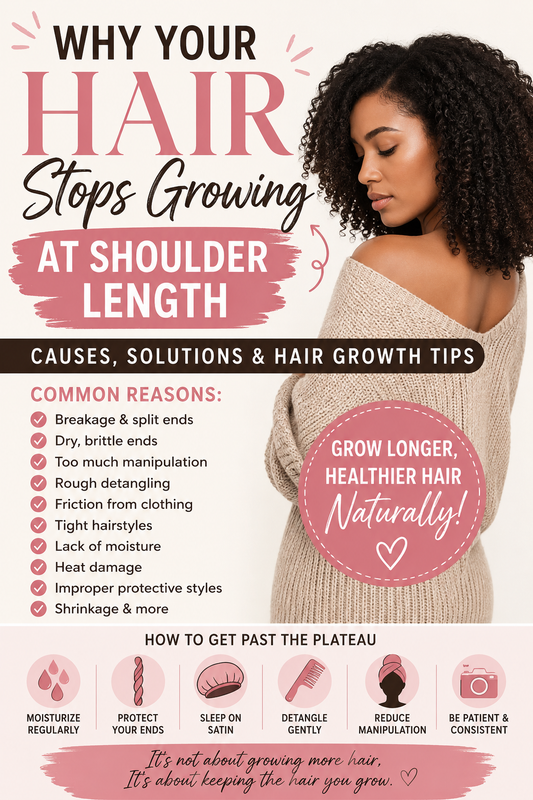
If it seems like your hair grows perfectly fine until it reaches your shoulders—and then suddenly refuses to get any longer—you are not alone. Many people with Black hair, natural hair, curly hair, relaxed hair, locs, or protective styles experience what feels like a shoulder-length hair growth plateau.
You may look at old pictures and realize your hair has been around the same length for months or even years. You trim it, moisturize it, oil your scalp, wear protective styles, and patiently wait for longer hair, but somehow your ends keep hovering around your shoulders.
So, why does your hair stop growing at shoulder length?
In most cases, your hair has not actually stopped growing.
The bigger problem is usually length retention.
Hair continues growing from the scalp, but the oldest and most fragile parts of your strands—the ends—may be breaking at approximately the same rate that new growth is appearing. When this happens, your hair can remain at shoulder length even though your roots are producing new hair.
Understanding this difference can completely change the way you approach your hair-growth journey.
This complete guide explains why hair seems to stop growing at shoulder length, what causes excessive breakage, how to protect your ends, and how to build a healthy hair routine designed to help you retain more of the hair you grow.
Does Hair Really Stop Growing at Shoulder Length?
Usually, no.
Your scalp does not recognize when your hair reaches your shoulders and instruct your follicles to stop producing hair.
Hair grows from follicles located in the scalp. Shoulder length simply happens to be a point where many people's hair begins experiencing significantly more friction, manipulation, dryness, and environmental exposure.
This can create the illusion that hair has reached its "maximum length."
Imagine that your hair grows approximately half an inch during a certain period, but your ends also lose roughly half an inch from breakage.
Your scalp produced new growth.
However, your overall visible length barely changed.
This is why understanding hair growth versus length retention is so important.
Growing hair and keeping hair are two different processes.
Hair Growth vs. Length Retention
Hair growth occurs at the scalp.
Length retention happens at the ends.
You need both if your goal is visibly longer hair.
Your follicles may be functioning normally while your ends continuously split, snap, knot, and break.
For example, imagine your hair grows several inches over the course of a year.
If you retain most of those inches, your hair becomes noticeably longer.
But if several inches break away during that same period, you may finish the year with almost the exact same visible length you started with.
This is why someone can say:
"My hair hasn't grown in two years."
Yet when they wear braids, twists, or another style for several weeks, they clearly see new growth around the roots.
That new growth proves the hair is growing.
The problem is keeping it.
Why Shoulder Length Is Such a Common Hair Plateau
Shoulder length is an interesting stage because this is when your ends begin interacting with your clothing much more frequently.
Your hair may constantly rub against:
- Cotton shirts
- Sweaters
- Jackets
- Hoodies
- Coat collars
- Scarves
- Towels
- Bedding
- Car seats
- Furniture
Your ends are already the oldest portion of your hair.
Now those older strands are repeatedly rubbing against fabric throughout the day.
That combination can contribute to increased breakage.
For tightly textured, curly, coily, or naturally dry hair, this may become especially noticeable because maintaining moisture and protecting fragile ends are already important parts of length retention.
The result can be the infamous shoulder-length plateau.
Fortunately, reaching this stage does not automatically mean your hair cannot become longer.
1. Your Ends Are Breaking Faster Than Your Hair Is Growing
One of the biggest explanations for hair appearing stuck at shoulder length is breakage.
Every strand has a life history.
The hair near your scalp is relatively new.
Your ends are much older.
Over time, those ends may have experienced hundreds of wash days, detangling sessions, hairstyles, nights of sleeping, environmental exposure, heat-styling sessions, and encounters with clothing.
Eventually, weakened strands may break.
If enough breakage occurs, your visible length stops increasing.
Signs of hair breakage can include:
- Short pieces of hair during styling
- Uneven ends
- Excessive tangling
- Split ends
- Rough-feeling ends
- Thin or see-through ends
- Difficulty retaining length
- Numerous single-strand knots
If you continuously see new growth at your roots but your overall length barely changes, retention deserves your attention.
2. Your Hair Is Constantly Rubbing Against Your Shoulders
This is one of the most overlooked reasons for a shoulder-length plateau.
When your hair reaches your shoulders, your ends begin brushing against clothing throughout the day.
Think about how frequently your hair moves.
Every time you walk, turn your head, sit down, or adjust your clothing, the ends may rub against fabric.
Some fabrics create more friction than others.
Repeated friction can roughen the hair's outer surface and contribute to tangles and breakage over time.
Try wearing your ends up more frequently.
Styles such as:
- Buns
- Loose updos
- Twists
- Braids
- Tucked styles
- Pineapples
- Low-manipulation hairstyles
can reduce the amount of time your ends spend rubbing against your shoulders.
The goal isn't to keep your hair hidden permanently.
It is simply to reduce unnecessary wear.
3. Your Ends Are Too Dry
Dryness and breakage frequently go together.
This can be particularly important for naturally curly and coily hair because scalp oils may not travel down bends and curls as easily as they travel along straighter strands.
That means your ends may need additional attention.
Your roots can feel healthy while your ends feel:
- Rough
- Brittle
- Tangled
- Hard
- Crispy
- Extremely dry
Those dry ends may eventually break.
Focus moisture where it is needed most.
When applying your moisturizing products, don't stop halfway down your strands.
Pay attention to the final few inches.
Depending on your hair and product preferences, a routine may involve water or a water-based moisturizer followed by other conditioning or sealing products that help your hair stay manageable.
The ideal routine varies by person.
The important point is simple:
Don't neglect your ends.
4. You're Manipulating Your Hair Too Much
Natural hair can be incredibly versatile.
But versatility sometimes encourages constant manipulation.
Monday: wash-and-go.
Tuesday: puff.
Wednesday: slick-back ponytail.
Thursday: twist-out.
Friday: straighten.
Saturday: braids.
Sunday: detangle everything and start again.
Every styling session creates another opportunity for pulling, stretching, combing, brushing, twisting, separating, or otherwise handling your strands.
Hair is a fiber.
Repeated physical stress can eventually weaken it.
If your primary goal is length retention, you may benefit from reducing unnecessary manipulation.
This doesn't mean you cannot enjoy your hair.
Instead, look for a balance between styling and preservation.
5. You're Detangling Too Aggressively
Detangling is one of the easiest times to accidentally break hair.
Curly and coily strands naturally wrap around one another.
Trying to force a comb through tangled hair can cause strands to snap.
The sound of a comb ripping through knots should not be considered a normal part of detangling.
A gentler detangling approach may include:
- Divide your hair into sections.
- Add water, conditioner, or a product that provides slip.
- Start near the ends.
- Carefully loosen major knots.
- Gradually move upward.
- Hold the section to reduce unnecessary pulling.
- Use your fingers or an appropriate detangling tool.
- Take your time.
The longer your hair becomes, the more important patient detangling can become.
6. You're Ignoring Split Ends
Split ends do not magically repair themselves permanently.
Products may temporarily make damaged ends look smoother, but severely split strands can continue deteriorating.
This can lead to:
- Increased tangling
- Rough ends
- Breakage
- Uneven length
- Thin-looking ends
Some people avoid trims because they are afraid of losing progress.
Ironically, refusing to address badly damaged ends can sometimes make retention more difficult.
The goal is not to cut your hair constantly.
It is to remove damaged ends when necessary while preserving as much healthy length as possible.
7. Your Protective Styles Aren't Actually Protective
Braids, twists, wigs, crochet styles, and other low-manipulation styles can be useful tools for length retention.
But a hairstyle is not automatically protective just because it is labeled a "protective style."
A style can become counterproductive when it is:
- Installed too tightly
- Too heavy
- Left in excessively long
- Constantly pulling around the edges
- Installed on already damaged hair
- Removed aggressively
- Neglected underneath
Your natural hair still needs care.
The real purpose of a protective style should be reducing unnecessary manipulation while protecting your strands.
If the hairstyle causes significant tension or breakage, it is defeating that purpose.
8. You're Wearing Tight Ponytails and Buns Too Often
A bun can help protect your ends.
But there is an important distinction between a protective bun and an extremely tight bun.
Repeatedly pulling your hair into the exact same position can create stress in specific areas.
Hair ties can also repeatedly rub against the same strands.
Rotate your hairstyles and placement.
For example, alternate between:
- High buns
- Low buns
- Loose ponytails
- Twists
- Braids
- Tucked styles
Avoid creating unnecessary tension just for the sake of making a hairstyle appear perfectly smooth.
9. Your Nighttime Routine Is Working Against You
Your hair spends approximately one-third of your life interacting with your sleeping environment.
That makes nighttime hair care extremely important.
If your hair is rubbing against absorbent or high-friction bedding night after night, your ends may experience unnecessary friction and tangling.
Consider using:
- A satin bonnet
- A satin scarf
- A satin or silk pillowcase
Longer hair may also need to be loosely secured before bed.
The goal is to prevent your hair from becoming tangled, matted, dry, or crushed during sleep.
10. You're Using Too Much Heat
Heat styling can provide beautiful results.
But frequent or excessive heat can weaken the hair.
Flat irons, curling irons, blow dryers, hot combs, and other heated tools can contribute to damage when they are used improperly or excessively.
Heat-damaged hair may become:
- Brittle
- Weak
- Rough
- Difficult to moisturize
- Prone to splitting
- More likely to break
If you're struggling to get beyond shoulder length, evaluate how often you use heat and how hot your tools are.
Reducing heat exposure may help preserve vulnerable ends.
11. Chemical Processing May Be Contributing to Breakage
Relaxers, permanent hair color, bleach, and other chemical treatments alter the hair.
That doesn't automatically mean chemically treated hair cannot become long.
Many people successfully maintain long, chemically treated hair.
However, processed strands can require careful maintenance because overlapping chemical treatments, improper application, or combining multiple damaging practices may weaken the hair.
For example, frequently bleaching, relaxing, coloring, and heat styling the same strands may make retention increasingly difficult.
Pay attention to how your hair responds.
12. You May Be Trimming More Than You Grow
Regular trims can be helpful when they're needed.
But trimming does not make hair grow faster from the scalp.
If you remove approximately the same amount of length that you recently gained, your visible length may remain unchanged.
For example, if you gain one inch and cut off one inch, you are back where you started from a length perspective.
Trim according to the condition of your hair rather than automatically removing large amounts on an unnecessarily frequent schedule.
13. You're Not Protecting Your Ends
If you want longer hair, start thinking about your ends as something worth preserving.
Your ends are your length.
You cannot reach waist length while continuously losing the oldest portion of every strand.
Try incorporating more hairstyles where your ends are:
- Tucked
- Twisted
- Braided
- Bundled
- Protected from clothing
- Left alone
You do not need protective styling every day.
But consistently reducing friction and manipulation can make a substantial difference over time.
14. Single-Strand Knots Are Causing Breakage
Single-strand knots are especially common with curly and coily textures.
A strand can curl around itself and create a tiny knot.
These knots can snag on neighboring hairs and make detangling more difficult.
Trying to rip through them can lead to breakage.
Keeping hair moisturized, reducing excessive manipulation, stretching the hair occasionally, protecting the ends, and carefully addressing knots may help reduce the problem.
15. Your Hair May Be Breaking During Wash Day
Wash day should help maintain your hair—not destroy your progress.
Yet rough shampooing and detangling can cause unnecessary tangling.
Avoid aggressively piling all of your hair on top of your head and scrubbing the strands together.
Instead, concentrate cleansing where it matters most: your scalp and buildup-prone areas.
Allow the cleanser and water to move through the rest of the hair while handling your strands carefully.
For longer or very dense hair, washing in sections may help keep tangling under control.
16. You're Drying Your Hair Too Roughly
After washing your hair, what do you do?
If you vigorously rub it with a rough towel, reconsider your technique.
Wet hair should be handled carefully.
Instead of aggressively rubbing your strands, gently squeeze or blot excess water.
Many people prefer microfiber towels or soft cotton T-shirts because they can help reduce rough handling.
The key isn't necessarily buying a particular product.
It's reducing friction.
17. Your Hair Routine Is Too Complicated
More products do not automatically equal more growth.
A complicated routine involving ten different products, constant manipulation, and frequent styling can sometimes create more problems than it solves.
Your hair routine can be relatively simple:
Cleanse → Condition → Moisturize → Style → Protect
You can customize those steps according to your hair.
Consistency usually matters more than constantly changing your routine.
18. You're Constantly Trying New Products
Social media can make hair care feel like an endless experiment.
One week you try a new oil.
Next week it's a new shampoo.
Then a viral conditioner.
Then a DIY treatment.
Then an entirely different styling system.
Constant changes make it difficult to understand what your hair actually responds well to.
Give a reasonable routine enough time to evaluate the results unless a product is clearly causing irritation, buildup, or another unwanted reaction.
19. You're Focusing Only on Your Scalp
A healthy scalp is important.
But growing long hair requires more than scalp care.
Remember:
Growth happens at the roots. Retention happens along the strands and ends.
You can massage your scalp every night and still remain at shoulder length if your ends continuously break.
A complete hair-length strategy considers:
- Scalp care
- Cleansing
- Conditioning
- Moisture
- Detangling
- Styling
- Nighttime protection
- End protection
- Breakage prevention
Think beyond the roots.
20. You're Confusing Shrinkage With Lack of Growth
Shrinkage can make curly and coily hair look dramatically shorter than it actually is.
Your hair may appear shoulder length in its natural state but extend several inches farther when stretched.
That means relying solely on visual appearance can underestimate your progress.
Instead, monitor growth using consistent methods.
You might:
- Take monthly photos
- Measure selected sections
- Compare stretched hair
- Track where your hair reaches on your body
- Photograph the same hairstyle periodically
Take pictures under similar conditions for more meaningful comparisons.
How to Get Past the Shoulder-Length Hair Plateau
Now comes the important part.
If your hair is growing from the scalp but breaking at the ends, your goal should shift from:
"How can I make my hair grow?"
to:
"How can I keep more of the hair I'm already growing?"
That mindset can completely change your routine.
Step 1: Start Tracking Your Hair Growth
Take a photograph today.
Use the same:
- Location
- Hairstyle
- Hair condition
- Camera angle
- Shirt
- Lighting
if possible.
Take another picture every four to eight weeks.
Avoid checking your length every day.
Hair growth is gradual, making short-term changes difficult to notice.
Long-term photographs can reveal progress you might otherwise miss.
Step 2: Inspect Your Ends
Look closely at the final few inches of your hair.
Do they appear healthy and full?
Or are they:
- Thin?
- Transparent?
- Rough?
- Splitting?
- Extremely tangled?
- Covered in knots?
- Breaking easily?
The condition of your ends can provide clues about why you're struggling to retain length.
Step 3: Create a Consistent Wash Schedule
Clean hair and a healthy scalp provide a good foundation for a hair-care routine.
How frequently you wash depends on factors such as:
- Hair type
- Hairstyle
- Scalp condition
- Exercise
- Product use
- Buildup
- Lifestyle
There is no universal wash schedule that works for everyone.
The objective is to cleanse often enough to remove sweat, dirt, oils, and product buildup without handling your hair unnecessarily roughly.
Step 4: Condition Consistently
Conditioning can improve softness, manageability, and detangling.
When your hair is easier to detangle, you may be less likely to rip through knots.
Pay particular attention to your ends.
Use the conditioning stage as an opportunity to gently separate tangles and evaluate the condition of your strands.
Step 5: Moisturize According to Your Hair's Needs
Dryness can make textured hair more difficult to manage.
Your ideal moisturizing frequency depends on your hair, products, climate, and hairstyle.
Instead of blindly following a schedule, learn how your hair feels when it needs attention.
Look for changes in:
- Softness
- Flexibility
- Manageability
- Tangling
- Dryness
The objective isn't to keep your hair soaking wet.
It is to maintain a routine that keeps the strands manageable without excessive buildup.
Step 6: Give Your Ends Extra Attention
When moisturizing, work all the way down the strand.
The last few inches deserve special attention because they are the oldest.
You can gently apply your preferred moisturizing or conditioning product to your ends before placing your hair into a low-manipulation style.
Think of your ends as the "length-retention zone."
Protecting them is one of the most important habits for getting beyond shoulder length.
Step 7: Wear More Low-Manipulation Hairstyles
You don't need to leave your hair untouched for months.
But reducing daily manipulation may help.
Consider styles such as:
- Two-strand twists
- Loose braids
- Buns
- Flat twists
- Tucked hairstyles
- Low-tension updos
Choose styles that don't create excessive pulling.
A hairstyle should protect your hair without sacrificing your hairline or scalp comfort.
Step 8: Stop Letting Your Hair Rub Against Your Clothes Every Day
Once your hair reaches shoulder length, this deserves special attention.
If you're wearing a cotton shirt or rough sweater, consider putting your hair up for part of the day.
This is especially helpful during winter when coats, scarves, sweaters, and jackets can create additional friction around the ends.
You can still wear your hair down.
Just consider balancing those days with styles that keep the ends off your shoulders.
Step 9: Protect Your Hair Every Night
Create a nighttime routine you can realistically follow.
For example:
- Lightly moisturize if needed.
- Put longer hair into loose twists or another low-tension arrangement.
- Cover it with a satin bonnet or scarf.
- Sleep on a satin or silk pillowcase as additional protection.
The routine doesn't have to take 30 minutes.
Consistency is more important.
Step 10: Detangle in Sections
Sectioning can make longer, thicker, and tightly textured hair easier to manage.
Try dividing your hair into four, six, or more sections depending on your density.
Work through one section at a time.
This reduces the temptation to force a comb through a large mass of tangled hair.
After detangling each section, loosely twist or braid it to prevent it from tangling again.
Step 11: Reduce Heat
If you frequently straighten your hair, experiment with reducing the frequency.
You might use:
- Roller sets
- Braid-outs
- Twist-outs
- Banding
- Low-heat stretching
- Heatless stretching techniques
when appropriate for your hair.
If you do use heat, follow the tool manufacturer's directions, avoid unnecessary repeated passes, and consider an appropriate heat-protectant product.
Step 12: Rotate Your Hairstyles
Wearing the same hairstyle every day can repeatedly stress the same sections.
For example, a high ponytail may continuously place tension around certain areas.
Changing placement distributes manipulation more evenly.
You might rotate between:
Week 1: Two-strand twists
Week 2: Low bun
Week 3: Braid-out
Week 4: Loose protective style
Your routine doesn't need to follow this exact schedule.
The point is avoiding constant stress on identical areas.
Step 13: Learn the Difference Between Shedding and Breakage
Hair naturally sheds as part of its growth cycle.
A shed hair typically comes from the root.
Breakage happens somewhere along the strand.
If you're seeing lots of short pieces, you may be dealing with breakage rather than ordinary shedding.
That distinction matters because breakage directly affects length retention.
If you're experiencing sudden, severe, unexplained, or patchy hair loss, or scalp symptoms that concern you, consider consulting a qualified healthcare professional or dermatologist.
A Simple Shoulder-Length Hair Growth Routine
You don't need a complicated 20-step routine.
Here is an example you can customize.
Wash Day
1. Section your hair.
Divide your hair into manageable sections before washing if that helps prevent tangling.
2. Cleanse your scalp.
Focus primarily on removing buildup from the scalp while handling the lengths gently.
3. Condition thoroughly.
Apply conditioner throughout your hair with extra attention to the ends.
4. Detangle carefully.
Work from the ends upward.
5. Rinse.
Keep sections separated when helpful.
6. Apply your preferred leave-in or moisturizing product.
Distribute it throughout your strands.
7. Style with minimal tension.
Choose a hairstyle that doesn't require excessive daily manipulation.
Midweek Hair Care
Check your hair rather than automatically adding more products.
Ask yourself:
Does my hair feel dry?
If yes, refresh it appropriately.
Are my ends rough?
Give them extra attention.
Is my scalp uncomfortable or covered in buildup?
It may be time to cleanse rather than simply adding another layer of oil.
Listen to your hair.
Nightly Hair Routine
Before bed:
- Check your ends
- Moisturize if needed
- Loosely secure your hair
- Put on your satin bonnet or scarf
- Avoid tight overnight styles
This can take only a few minutes.
Monthly Hair Check
Every month, evaluate:
Length
Is your hair gradually getting longer?
Ends
Are they full or becoming increasingly thin?
Breakage
Are you seeing lots of short broken strands?
Scalp
Is your scalp comfortable?
Styling
Are your hairstyles creating excessive tension?
Routine
Are you manipulating your hair too frequently?
This monthly review can help you identify problems before they become major setbacks.
How Long Does It Take to Grow Past Shoulder Length?
There is no single timeline.
Hair-growth rates, shrinkage, breakage, genetics, health, age, hair practices, and starting length all vary.
Instead of obsessing over a specific deadline, focus on consistently retaining more length.
Even small improvements in retention can become significant over time.
Hair growth is cumulative.
Protecting a little more length every month can eventually translate into noticeably longer hair.
Can Black Hair Grow Past Shoulder Length?
Absolutely.
Black hair is capable of growing well beyond shoulder length.
The persistent myth that Black hair "doesn't grow" often confuses visible length with the challenges of retaining fragile ends.
Highly textured hair has unique structural characteristics and may require different handling than straighter textures, particularly when it comes to moisture, detangling, shrinkage, and breakage prevention.
But your curl pattern does not automatically limit you to shoulder-length hair.
Length retention is often the missing piece.
Can 4C Hair Grow Past Shoulder Length?
Yes.
4C hair can grow past shoulder length.
One reason it may appear to grow more slowly is shrinkage.
Highly coiled strands can contract dramatically, hiding a surprising amount of length.
A person may have hair that appears shoulder length but stretches several inches beyond the shoulders.
If you have 4C hair, don't judge your progress exclusively by how long your hair appears when fully shrunken.
Monitor stretched length periodically instead.
Do Protective Styles Help Hair Grow Past Shoulder Length?
Protective styles can support length retention when used correctly.
They do not magically accelerate the biological growth rate of your follicles.
Instead, their value comes from potentially reducing manipulation and protecting vulnerable strands.
For example, keeping your hair in loose twists for several days may mean:
- Less combing
- Less brushing
- Less friction
- Less daily styling
- Less manipulation of the ends
That can help you retain more length.
But tight or excessively heavy protective styles can create their own problems.
The word protective only matters when the hairstyle is actually protecting your hair.
Should You Cut Your Hair to Make It Grow?
Cutting the ends does not cause follicles in your scalp to produce hair faster.
However, trimming damaged or badly split ends can improve the appearance and manageability of your hair and prevent you from holding onto severely compromised ends.
The objective should not be cutting hair simply to stimulate growth.
Instead, trimming should be part of maintaining the quality of your existing length when needed.
Does Oiling Your Scalp Make Hair Grow Faster?
Scalp oils can be useful components of some people's routines, particularly when they improve manageability or help support a comfortable hair-care regimen.
But oil alone cannot overcome poor length retention.
You can oil your scalp consistently while continuing to lose length through:
- Rough detangling
- Excessive heat
- Tight hairstyles
- Dry ends
- Friction
- Split ends
- Over-manipulation
Your entire routine matters.
What About Hair Growth Oils?
Hair oils are popular in natural hair routines.
Depending on the product and your individual hair needs, oils may help lubricate strands, reduce friction, seal in moisture from water-based products, or improve manageability.
Common oils used in hair-care routines include:
- Castor oil
- Coconut oil
- Avocado oil
- Olive oil
- Jojoba oil
- Grapeseed oil
However, oil is not a replacement for water.
If your hair is dry, repeatedly covering dry strands with oil may not address the underlying problem.
Think of oils as one potential component of a complete routine rather than a magical solution.
Nutrition and Healthy Hair Growth
Your hair is part of your body.
That means overall nutrition matters.
A balanced diet containing adequate protein and essential nutrients supports normal body functions, including hair production.
Foods commonly included in a balanced diet include:
- Eggs
- Fish
- Poultry
- Beans
- Lentils
- Leafy vegetables
- Fruits
- Nuts
- Seeds
- Whole grains
- Avocados
Supplements should not automatically replace a balanced diet.
If you suspect a nutritional deficiency or you're experiencing unusual hair loss, speak with an appropriate healthcare professional before relying on high-dose supplements.
Stop Comparing Your Hair Growth to Social Media
One of the fastest ways to become discouraged is comparing your hair to someone else's.
Two people can follow similar routines and still experience different results.
Hair varies in:
- Density
- Diameter
- Curl pattern
- Shrinkage
- Growth cycle
- Breakage susceptibility
- Styling history
- Chemical history
Someone else's three-year journey doesn't establish your timeline.
Measure your progress against your own previous hair.
The Shoulder-Length Hair Growth Challenge
Try this approach consistently for the next several months.
Rule #1: Protect Your Ends
Keep your ends away from rough fabrics more frequently.
Rule #2: Stop Rough Detangling
No ripping through knots.
Rule #3: Reduce Unnecessary Heat
Give your strands time away from high temperatures.
Rule #4: Moisturize Consistently
Pay special attention to your oldest strands.
Rule #5: Protect Your Hair at Night
Use satin or silk accessories that reduce friction.
Rule #6: Reduce Daily Manipulation
Choose styles you don't have to redo constantly.
Rule #7: Monitor Breakage
Pay attention to short broken strands.
Rule #8: Take Monthly Pictures
Track progress objectively.
Rule #9: Be Consistent
Don't completely change your routine every week.
Rule #10: Give It Time
Healthy hair habits work through consistency.
10 Mistakes to Stop Making If You Want Longer Hair
If your hair has been stuck at shoulder length, start by reducing these habits:
- Rough detangling
- Constant heat styling
- Sleeping without protecting your hair
- Ignoring dry ends
- Wearing excessively tight hairstyles
- Constantly manipulating your hair
- Allowing your ends to rub against rough clothing
- Ignoring severe split ends
- Changing products constantly
- Focusing exclusively on scalp growth instead of length retention
Correcting several small problems may produce better long-term results than searching for one miracle product.
Why Consistency Matters More Than the Perfect Product
People often ask:
"What product will make my hair grow past my shoulders?"
The better question may be:
"What habits are preventing me from keeping my length?"
Products can support a routine.
But products cannot completely compensate for damaging habits.
You could own an expensive collection of shampoos, conditioners, oils, creams, masks, and serums.
If you aggressively detangle your hair every week, sleep without protecting it, repeatedly use excessive heat, and allow fragile ends to break, your length may continue to stall.
A simple routine performed consistently can be more effective than an elaborate routine performed inconsistently.
Why Your Ends Determine How Long Your Hair Looks
Imagine your hair strand as a rope.
The section closest to your scalp is the newest.
The section at the bottom has survived years of:
- Washing
- Styling
- Detangling
- Weather
- Friction
- Heat
- Products
- Sleeping
- Manipulation
That older portion naturally deserves careful handling.
Every inch you retain moves you closer to your next length milestone.
Shoulder length becomes armpit length.
Armpit length becomes bra-strap length.
Bra-strap length can eventually become mid-back length.
Progress happens because older hair survives long enough to remain attached.
That is the essence of length retention.
Signs Your Length-Retention Routine Is Working
Don't judge success exclusively by inches.
Look for improvements such as:
- Less breakage
- Fewer knots
- Easier detangling
- Softer ends
- Fuller-looking ends
- Less hair on the floor after styling
- Less snapping during manipulation
- More consistent length measurements
- Better manageability
These improvements may appear before dramatic changes in length become obvious.
When Hair That "Won't Grow" May Need Professional Attention
Most shoulder-length plateaus are discussed in terms of breakage and hair-care practices, but not every hair concern should be treated as a cosmetic problem.
Consider speaking with a dermatologist or other qualified healthcare professional if you experience:
- Sudden significant hair loss
- Bald patches
- Noticeable scalp inflammation
- Persistent scalp pain
- Severe itching
- Unexplained thinning
- Significant changes in your normal shedding pattern
- Hair loss accompanied by other unexplained symptoms
Hair loss can have many possible causes, and an appropriate professional can help determine whether something beyond routine hair care is involved.
Frequently Asked Questions About Hair Stuck at Shoulder Length
Why won't my natural hair grow past my shoulders?
Your natural hair may actually be growing but breaking at the ends. Friction from clothing, dryness, rough detangling, excessive heat, over-manipulation, and poor nighttime protection can all interfere with length retention.
Is shoulder length my terminal hair length?
Not necessarily. Hair follicles have individual growth cycles that influence how long strands can potentially become, but reaching shoulder length alone does not prove that you've reached your biological maximum.
Why does my hair grow underneath but not get longer?
Visible new growth at your roots combined with unchanged overall length often suggests that you are losing length somewhere along the strands or ends.
How can I retain more length?
Focus on reducing breakage. Protect your ends, detangle gently, maintain appropriate moisture and conditioning, reduce excessive heat and tension, and protect your hair while sleeping.
Should I wear protective styles to get past shoulder length?
They can be helpful if they genuinely reduce manipulation and aren't installed too tightly or heavily.
How often should I moisturize my natural hair?
There is no universal schedule. Moisturize according to your hair's needs, hairstyle, climate, and the products you use.
Why are my ends always dry?
Your ends are the oldest portion of your strands and are exposed to years of washing, styling, friction, and environmental stress. Curly and coily textures may also have difficulty distributing natural scalp oils along the entire strand.
Can split ends stop hair from getting longer?
Split and damaged ends can contribute to tangling and breakage, making it harder to retain the length your scalp produces.
Does trimming help hair grow?
Trimming doesn't increase the growth rate at your scalp, but removing badly damaged ends can improve the condition and manageability of your existing hair.
Can my hair grow even if I don't see a difference?
Yes. Shrinkage and breakage can hide growth. Taking consistent monthly photographs or measurements can give you a better picture of your progress.
Final Thoughts: Your Hair May Not Have Stopped Growing
If your hair has been shoulder length for what feels like forever, don't immediately assume that you've reached your maximum possible length.
Look at your roots.
Are you getting new growth?
If the answer is yes, your hair is growing.
Now look at your ends.
Are they breaking?
Are they dry?
Are they constantly rubbing against your clothes?
Are you manipulating them every day?
Are you using excessive heat?
Are you protecting them at night?
Those questions can reveal the real issue.
For many people, the journey from shoulder-length hair to longer hair isn't about finding a magical product that suddenly doubles the growth rate.
It's about retaining more of the hair that's already growing.
Treat your ends like they're valuable—because they are.
Cleanse your scalp consistently. Condition your strands. Keep your hair manageable. Detangle carefully. Reduce unnecessary friction. Protect your hair at night. Avoid excessive tension. Pay attention to damaged ends. And give your routine enough time to work.
Your scalp creates the growth.
Your routine helps determine how much of that growth you keep.