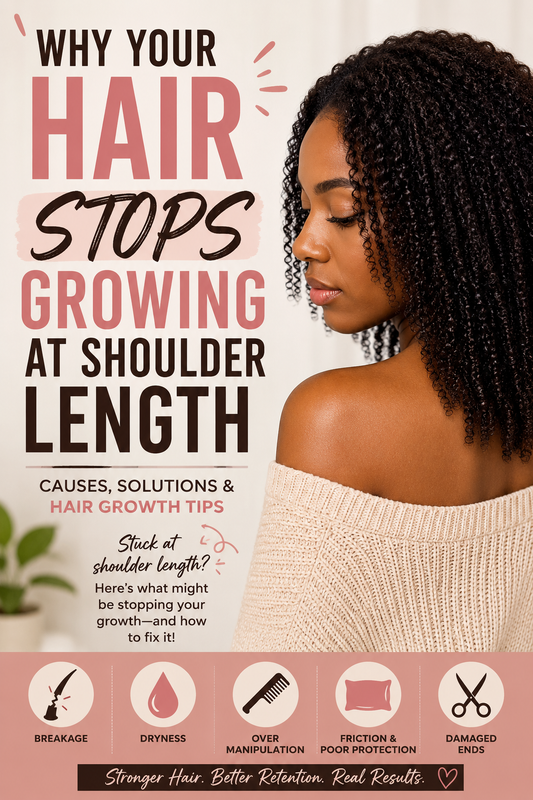
If it feels like your hair grows normally until it reaches your shoulders and then suddenly refuses to get any longer, you are not alone. Many people—especially those with natural, curly, coily, or textured hair—experience what seems like a shoulder-length hair growth plateau.
You may notice new growth at your roots. You may even see your hair getting thicker. But year after year, the overall length seems almost exactly the same.
So, why does your hair stop growing at shoulder length?
In most cases, your hair has not actually stopped growing.
The more common problem is length retention.
Your scalp continues producing new hair, but the ends may be breaking, splitting, tangling, or being trimmed away at approximately the same rate that new length is being produced. The result is hair that appears permanently stuck around shoulder length.
This is especially important for Black hair, natural hair, curly hair, and coily hair because the structure of textured strands can make maintaining moisture and protecting older ends more challenging.
The good news is that reaching longer lengths may be possible when you identify what is causing the breakage and build a hair-care routine focused on protecting the hair you already have.
In this complete guide, we'll explain why hair gets stuck at shoulder length, how hair growth actually works, what causes poor length retention, and what you can do to help your hair become stronger, healthier, and longer over time.
What Does It Mean When Your Hair Is Stuck at Shoulder Length?
When someone says, "My hair won't grow past my shoulders," they are usually describing a situation where their visible hair length remains relatively unchanged for months or years.
There are two very different things that could be happening:
- Hair growth from the scalp has slowed.
- Hair is growing but length is being lost from the ends.
For many people, the second explanation is the bigger issue.
Think of hair growth like filling a bucket with water.
If you continuously pour water into the bucket but there is a hole in the bottom, the water level may never rise. Increasing the amount of water going into the bucket doesn't completely solve the problem if water continues escaping.
Hair can behave similarly.
Your follicles produce new growth at the roots, but breakage removes length from the ends.
If you grow approximately half an inch of hair during a particular month but lose a similar amount through breakage, your visible length may remain unchanged.
That is why achieving longer hair isn't only about asking:
"How can I make my hair grow faster?"
You should also ask:
"How can I keep the hair that grows?"
That change in thinking can completely transform your approach to growing longer natural hair.
Does Hair Actually Stop Growing?
Hair does not grow indefinitely.
Each strand moves through a natural hair-growth cycle consisting of several phases.
The primary stages include:
Anagen Phase
The anagen phase is the active growth stage.
During this period, cells associated with the hair follicle are actively producing the hair shaft.
The length of the anagen phase varies between individuals and is influenced partly by genetics.
Catagen Phase
Catagen is a relatively short transitional phase.
Hair growth slows and the follicle prepares to enter its resting stage.
Telogen Phase
During telogen, the strand rests.
Eventually, the hair is released and another cycle can begin.
Because people have different growth-cycle characteristics, there can be natural differences in maximum achievable hair length.
However, when someone's hair consistently reaches roughly the same length—particularly around the shoulders—breakage and hair-care practices deserve careful attention before assuming genetics have determined the maximum length.
Why Shoulder Length Can Be a Problem Area
Shoulder length is an interesting milestone because your hair begins interacting much more frequently with your clothing and body.
Once your ends reach your shoulders, they may repeatedly rub against:
- Cotton shirts
- Sweaters
- Jackets
- Scarves
- Coats
- Towels
- Bedding
- Seat belts
- Backpack straps
- Purse straps
That constant friction can gradually weaken the ends.
Your ends are already the oldest portion of your hair.
When those older, more fragile strands repeatedly rub against clothing, they can become increasingly vulnerable to splitting and breaking.
This can create what appears to be a "shoulder-length barrier."
Your follicles aren't necessarily aware that your hair has reached your shoulders and deciding to stop producing hair.
Instead, your ends may simply be experiencing more mechanical stress.
1. Breakage Is One of the Biggest Reasons Hair Appears to Stop Growing
If your roots are growing but your length isn't changing, start investigating breakage.
Signs of breakage can include:
- Short pieces of hair during styling
- Split ends
- Uneven ends
- Excessive tangling
- Thin or see-through ends
- Hair snapping during detangling
- Small broken strands on clothing
- Hair becoming progressively thinner toward the bottom
One important distinction is the difference between shedding and breakage.
Shedding involves the release of an entire strand from the follicle as part of the hair cycle.
Breakage happens somewhere along the hair shaft.
When breakage occurs repeatedly, retaining length becomes difficult.
2. Your Ends Are the Oldest Part of Your Hair
Imagine someone with hair that has been growing for several years.
The hair closest to the scalp is relatively new.
The ends may be several years old.
During those years, the ends may have experienced hundreds of:
- Wash days
- Detangling sessions
- Hairstyles
- Nights of sleeping
- Weather changes
- Product applications
- Combing sessions
- Brushing sessions
- Heat-styling sessions
Hair fibers are not living tissue capable of repairing themselves the way skin can heal a wound.
Once significant structural damage occurs, products may temporarily improve the hair's feel or appearance, but they cannot make severely damaged hair biologically new again.
That is why protecting your ends becomes increasingly important as your hair gets longer.
3. Dry Hair Can Make Length Retention More Difficult
Dryness is another common contributor to breakage.
Textured hair can be particularly vulnerable because the natural oils produced by the scalp may have difficulty traveling along curls, coils, bends, and twists.
As a result, the ends may become dry before the roots do.
Extremely dry strands may become:
- Brittle
- Rough
- Tangled
- Less flexible
- More vulnerable to snapping
If you want longer hair, moisture management should be part of your routine.
However, simply piling products onto dry hair isn't necessarily the answer.
A good moisture routine starts with cleansing and conditioning appropriately, followed by products that help your particular hair maintain softness and manageability.
4. You May Be Manipulating Your Hair Too Often
Every time you manipulate your hair, some amount of mechanical stress occurs.
This includes:
- Brushing
- Combing
- Detangling
- Twisting
- Braiding
- Restyling
- Pulling hair into ponytails
- Installing extensions
- Removing protective styles
Your hair can tolerate normal manipulation, but excessive manipulation can increase breakage.
Someone who completely restyles their hair every morning may expose their ends to considerably more mechanical stress than someone who maintains a low-manipulation style for several days.
This doesn't mean you should never style your hair.
The goal is simply to reduce unnecessary manipulation.
5. Your Detangling Technique May Be Breaking Your Ends
Detangling is one of the biggest opportunities either to protect or damage textured hair.
Imagine pulling a comb from your roots directly through a knot near your ends.
The comb becomes stuck.
You pull harder.
Eventually, something gives.
Unfortunately, sometimes that "something" is your hair.
Instead, detangle patiently.
Depending on your hair and product preferences, you may find it easier to detangle when the hair is damp or coated with a conditioner or detangling product that provides slip.
Work in manageable sections.
Begin near the ends and gradually work upward.
When you encounter a knot, avoid immediately ripping through it.
Use your fingers when practical to gently separate tangled strands.
Those extra few minutes during wash day may help preserve months of growth.
6. Split Ends May Be Working Against Your Hair Goals
Split ends develop when the end of the hair shaft becomes damaged and separates.
They can make hair look:
- Frizzy
- Thin
- Rough
- Uneven
- Dry
Damaged ends may also tangle more easily with neighboring strands.
Many people who desperately want longer hair avoid trimming because trimming seems counterproductive.
But keeping severely damaged ends indefinitely does not necessarily help you achieve healthy-looking length.
A strategic trim removes compromised ends so you can focus on maintaining healthier hair.
You do not necessarily need to remove large amounts of hair frequently.
How often you need a trim depends on your hair's condition, styling practices, chemical treatments, heat use, and individual needs.
7. Your Clothes May Literally Be Breaking Your Hair
This factor is frequently overlooked.
When hair reaches shoulder length, your ends begin rubbing against clothing throughout the day.
Think about what happens during winter.
Your hair may rub against:
- Wool coats
- Cotton hoodies
- Sweaters
- Scarves
- Turtlenecks
Thousands of tiny friction events can occur throughout the day.
You probably won't notice an individual strand breaking.
But repeated friction over weeks and months may contribute to damaged ends.
Consider wearing your hair up occasionally or using styles that keep fragile ends from constantly rubbing against rough fabrics.
Smooth fabrics and satin-lined accessories may also reduce friction.
8. Cotton Pillowcases May Increase Friction
Your hair spends hours against your bedding every night.
Traditional cotton pillowcases can create more friction against hair than smoother surfaces.
For curly, coily, and natural hair, nighttime protection may be particularly useful.
Common options include:
- Satin bonnets
- Satin scarves
- Satin pillowcases
You don't necessarily need all three.
The goal is to reduce unnecessary friction and prevent your hair from becoming excessively tangled overnight.
Nighttime hair care is one of the easiest areas to overlook when trying to retain length.
9. Tight Hairstyles Can Cause Problems
Protective styles are popular because they can reduce daily manipulation.
But a hairstyle isn't truly protective when it places excessive tension on the hair.
Braids, ponytails, buns, wigs, sew-ins, twists, and extensions should not cause persistent pain or extreme pulling.
Pay particular attention to the hairline.
If a hairstyle feels painfully tight, don't assume discomfort means the style will last longer.
Repeated tension can damage hair and, in some circumstances, contribute to traction-related hair loss.
A better protective style should protect your hair without excessive tension.
10. Protective Styles Aren't Automatically Protective
Calling something a "protective style" doesn't guarantee that it protects your hair.
A protective style can become damaging when:
- It is installed too tightly.
- Extensions are excessively heavy.
- Hair isn't properly cared for before installation.
- The style is left in far too long.
- Hair becomes severely tangled underneath.
- Removal is rushed.
- The same high-tension style is repeatedly installed.
Protective styling works best as part of an overall healthy-hair strategy.
The goal is not simply to keep your natural hair hidden.
The goal is to reduce unnecessary manipulation while protecting your strands and scalp.
11. Heat Damage Can Make Hair Break Before It Gets Longer
Heat can temporarily transform the appearance and manageability of hair.
But excessive temperatures or frequent heat styling can contribute to damage.
Flat irons, curling irons, hot combs, and blow dryers can all expose hair to significant heat.
The risk depends on factors including temperature, frequency, technique, hair condition, and whether appropriate protection is used.
If you're struggling to get past shoulder length, evaluate your heat routine.
Ask yourself:
How frequently am I using high heat?
Am I repeatedly passing a flat iron over the same section?
Am I using temperatures higher than necessary?
Am I applying heat to already damaged hair?
Reducing unnecessary heat may improve length retention.
12. Chemical Processing Can Affect Length Retention
Relaxers, permanent color, bleach, and other chemical processes intentionally alter the hair.
When used incorrectly, excessively, or on already compromised hair, chemical treatments can increase vulnerability to breakage.
This doesn't mean chemically treated hair cannot grow long.
It means maintaining the condition of the hair becomes especially important.
If you regularly chemically process your hair and can't get beyond shoulder length, evaluate:
- Processing frequency
- Overlapping treatments
- Moisture levels
- Protein needs
- Heat use
- Styling habits
- Condition of your ends
Combining multiple sources of stress can make retention considerably more difficult.
13. You May Be Trimming Away Your Progress
Trimming can support healthy-looking ends.
But trimming more hair than you're growing can prevent visible length gains.
Suppose your hair grows a certain amount over several months.
If approximately the same amount is trimmed every few months, your hair may remain around the same length indefinitely.
That doesn't mean you should stop trimming altogether.
Instead, trim according to your hair's actual condition rather than assuming everyone needs exactly the same trimming schedule.
The goal is a balance between maintaining healthy ends and retaining new length.
14. You're Ignoring Single-Strand Knots
Single-strand knots are common in curly and coily hair.
They occur when an individual strand curls around itself and forms a knot.
Sometimes these knots are unavoidable.
However, excessive knotting can make detangling more difficult and may contribute to breakage.
Ways to reduce excessive tangling may include:
- Keeping hair moisturized
- Detangling regularly but gently
- Stretching hair occasionally
- Keeping ends protected
- Sleeping with hair contained
- Avoiding excessive manipulation
Trying to rip through knots aggressively can cause significantly more damage than the knot itself.
15. Your Wash-Day Routine May Be Too Aggressive
Wash day should clean and care for your hair—not become a weekly battle.
Pay attention to what happens while shampooing.
Do you pile all your hair on top of your head and aggressively scrub it together?
That can create unnecessary tangling.
Instead, focus shampoo primarily on the scalp while allowing the cleansing process to work through the lengths as appropriate.
Work methodically rather than creating a tangled mass.
After cleansing, use conditioner and detangle carefully according to your hair's needs.
The less unnecessary tangling you create, the less detangling force you will need later.
16. Product Buildup Can Interfere With Your Routine
Adding more products is not always the answer to dryness.
Sometimes hair becomes coated with:
- Oils
- Butters
- Gels
- Pomades
- Creams
- Styling products
Heavy buildup can leave hair feeling dull, sticky, coated, or difficult to manage.
Regular cleansing is an important part of healthy hair care.
If your normal shampoo isn't removing significant buildup, periodic clarifying may be useful depending on your products, water quality, and hair needs.
Clean hair provides a better foundation for conditioning and styling.
17. Protein and Moisture Balance Matters
Hair is primarily composed of keratin, a protein.
Many hair products marketed for damaged hair contain proteins or protein-derived ingredients.
These products may help some people improve the temporary strength and feel of damaged strands.
However, more protein is not always better.
Likewise, simply adding moisture endlessly isn't necessarily ideal.
Your routine should be based on how your hair responds.
Hair that feels unusually stiff or brittle may need a different approach than hair that feels overly soft, weak, or fragile.
Instead of following a rigid online schedule, pay attention to your own hair.
18. Shrinkage Can Make You Think Your Hair Isn't Growing
Natural hair can shrink dramatically.
Your hair may actually be getting longer even when its unstretched appearance doesn't change much.
This is especially common with tightly curled and coily textures.
For example, your stretched hair might gain several inches while your curls continue resting around your shoulders because increased length produces additional shrinkage.
Instead of judging progress only by looking in the mirror, consider documenting your length.
Take photographs every few months under similar conditions.
You can also select a small section and compare where it reaches when gently stretched.
Tracking progress prevents shrinkage from disguising your results.
19. Your Hair May Be Growing Unevenly
Different areas of the scalp can appear to grow or retain length differently.
You might notice:
- A longer back section
- Shorter temples
- Faster-growing crown
- Uneven sides
Differences can result from growth patterns, styling habits, friction, sleeping position, tension, breakage, or previous damage.
If one area is dramatically shorter, examine what happens to that specific area during your routine.
For example, if the back of your hair constantly rubs against clothing, you might experience more breakage there.
20. Your Hair Routine May Be Too Complicated
Long hair doesn't necessarily require 15 products and a six-hour wash day.
Complicated routines can sometimes lead to more manipulation.
A basic natural-hair routine might include:
- Cleansing
- Conditioning
- Gentle detangling
- Moisturizing/styling
- Protecting the hair between wash days
Additional steps can be included when they have a clear purpose.
The best routine isn't necessarily the longest routine.
It's the routine you can follow consistently while keeping your hair manageable and minimizing damage.
How to Grow Your Hair Past Shoulder Length
Once you understand the potential causes of a shoulder-length plateau, the next step is improving retention.
Your primary objective is simple:
Protect the oldest parts of your hair long enough for your overall length to increase.
Here is how.
Step 1: Start Paying Attention to Your Ends
Your ends should become one of your biggest priorities.
When applying conditioner, don't forget them.
When detangling, handle them carefully.
When styling, avoid excessive pulling.
When sleeping, protect them from unnecessary friction.
When wearing clothing with rough collars, consider keeping them away from constant rubbing.
Healthy-looking ends make longer hair possible.
Step 2: Develop a Consistent Wash Schedule
There is no universal wash schedule that works for everyone.
Some people wash weekly.
Others need a different schedule based on their scalp, lifestyle, styling routine, and hair type.
The important thing is consistency.
Avoid allowing excessive buildup to accumulate simply because you're afraid washing your hair will cause breakage.
When done properly, cleansing is part of maintaining a healthy scalp and manageable hair.
Step 3: Condition Regularly
Conditioning helps improve manageability and can make detangling easier.
Apply conditioner thoroughly, paying particular attention to your lengths and ends.
Use the opportunity to work through tangles carefully.
Some people also enjoy periodic deep-conditioning treatments, especially when their hair feels particularly dry or difficult to manage.
Step 4: Detangle in Sections
Dividing your hair into sections can make detangling much easier.
Instead of trying to manage your entire head simultaneously, divide your hair into manageable sections.
Then work through each section slowly.
This allows you to see and feel knots before accidentally ripping through them.
For thick natural hair, this simple change can make wash day considerably more manageable.
Step 5: Reduce Daily Manipulation
You don't need a completely different hairstyle every day.
Consider hairstyles that can last several days with minimal manipulation.
Examples may include:
- Two-strand twists
- Flat twists
- Loose buns
- Braids
- Low-manipulation updos
The best choice depends on your texture, length, density, lifestyle, and personal preferences.
Remember that "low manipulation" does not mean "high tension."
Step 6: Protect Your Hair at Night
Develop a simple nighttime routine.
Depending on your hairstyle, you might:
- Put your hair into several loose sections.
- Cover it with a satin bonnet.
- Wrap it with a satin scarf.
- Sleep on a satin pillowcase.
- Keep long ends contained rather than loose.
Consistency matters more than perfection.
If your hair is protected for eight hours every night, that adds up to thousands of hours of reduced friction each year.
Step 7: Reduce Friction at Shoulder Length
This is especially important when you're trying to break through the shoulder-length plateau.
Consider styles that keep your ends above your shoulders periodically.
Pay attention to rough sweaters, coats, scarves, and shirts.
If your hair is down, smoother fabrics may reduce friction compared with rough materials.
You don't have to wear your hair up every day.
Simply become aware of how frequently your ends rub against other surfaces.
Step 8: Be Strategic About Heat
If length is your priority, reconsider unnecessary heat.
You don't necessarily need to eliminate heat completely.
Instead:
- Use an appropriate heat protectant.
- Avoid unnecessarily high temperatures.
- Limit repeated passes.
- Avoid excessive frequency.
- Be cautious when hair is already damaged.
Your goal is to achieve your desired style with the least amount of damage reasonably possible.
Step 9: Trim Based on Condition
Don't become afraid of scissors.
At the same time, don't trim simply because an arbitrary calendar tells you to.
Examine your ends.
If they are severely split, rough, tangled, thin, or damaged, a trim may improve the overall condition and manageability of your hair.
After trimming, focus on preventing the same damage from returning.
Step 10: Track Your Progress
Hair growth happens slowly enough that daily observation can be misleading.
Take a photograph every two or three months.
Wear the same shirt if possible.
Keep your head position similar.
Compare your hair under similar conditions.
You may discover that you're making significantly more progress than you thought.
A Simple Shoulder-Length Hair Growth Routine
If your hair has been stuck at shoulder length for years, consider simplifying your routine.
Wash Day
Cleanse your scalp and hair thoroughly but gently.
Avoid aggressively piling and rubbing your hair together.
Follow with conditioner.
Detangle in sections, starting near the ends and gradually moving upward.
Rinse according to your product directions.
Apply your preferred leave-in or moisturizing/styling products.
Style your hair without excessive tension.
During the Week
Avoid unnecessarily restyling your hair every day.
Monitor your hair's dryness and manageability.
If your hair needs refreshing, focus on the areas that actually need attention rather than completely restarting your routine.
At Night
Protect your hair with satin or another smooth material.
Keep longer hair contained so it doesn't become excessively tangled while you sleep.
Every Few Months
Evaluate your ends.
Look for splitting, thinning, roughness, and excessive knotting.
Trim when necessary.
Take progress pictures.
This simple system can be much more effective than constantly buying new "miracle growth" products while ignoring breakage.
How Long Does It Take to Grow Hair Past Your Shoulders?
There isn't one answer.
Hair-growth rates vary between individuals, and visible progress depends heavily on how much length you're retaining.
If your hair is already at shoulder length, moving several inches beyond your shoulders requires months of growth.
The key is remembering that hair growth is cumulative.
Small improvements in retention add up.
Suppose you previously lost much of your new growth to breakage.
If you improve your routine enough to retain even a little more length each month, the difference can become substantial over a year or two.
Don't evaluate your routine after only two weeks.
Healthy hair growth is a long-term process.
Can Oils Make Hair Grow Past Shoulder Length?
Hair oils are popular in natural-hair routines.
Different oils can be useful for lubrication, shine, reducing friction, or helping hair feel softer depending on how they are used.
Common oils include:
- Castor oil
- Coconut oil
- Olive oil
- Avocado oil
- Jojoba oil
- Argan oil
However, oils should not be treated as magical growth substances.
Applying oil cannot override genetics or solve every cause of breakage.
Think of oils as one possible part of a broader hair-care routine.
Your overall habits—including cleansing, conditioning, detangling, styling, nighttime protection, and minimizing damage—matter tremendously.
Does Scalp Massage Help?
Scalp massage can be an enjoyable addition to your routine.
Using your fingertips rather than scratching aggressively with your nails can help you massage the scalp gently.
Some people combine scalp massage with their favorite hair or scalp oil.
However, scalp massage shouldn't distract you from length retention.
Even if your scalp is producing healthy new growth, damaged ends can prevent you from seeing longer hair.
For someone stuck at shoulder length, protecting existing strands deserves just as much attention as scalp-focused practices.
Why Black Hair May Seem Like It Grows Slowly
A common misconception is that Black hair simply doesn't grow.
It does.
However, tightly curled and coily hair can make growth less visually obvious because of shrinkage.
Additionally, the structure of curly and coily strands can make the hair more vulnerable to certain forms of mechanical damage.
The bends and curves along the strand can create points where breakage is more likely to occur.
Natural scalp oils may also have more difficulty traveling down tightly curled strands.
That combination means successful long-hair routines for textured hair often emphasize:
Moisture + gentle handling + low manipulation + end protection + consistency.
Why Your Hair May Grow Better in Protective Styles
Some people notice their hair appears to "grow faster" when wearing braids or twists.
The hairstyle probably isn't suddenly changing the biological growth rate of the follicles.
Instead, you may simply be retaining more length because you're manipulating your hair less frequently.
If your hair normally experiences daily brushing, combing, heat, or styling, several weeks in a low-manipulation style can dramatically reduce mechanical stress.
When the style is removed, the accumulated growth becomes visible.
This illustrates an important principle:
Retention can look like faster growth.
How to Remove Protective Styles Without Losing Your Progress
Protective-style removal deserves just as much attention as installation.
Don't rush.
Carefully remove extensions.
Once your natural hair is free, don't immediately attack accumulated shed hair with a fine-tooth comb.
Hair naturally sheds while inside the style, so seeing loose strands during removal doesn't automatically mean something is wrong.
Work in sections.
Use your fingers to separate major tangles.
Apply an appropriate detangling product or conditioner if necessary.
Then gently detangle.
You spent weeks accumulating new growth.
Don't lose it during a rushed 30-minute takedown.
Signs Your Length-Retention Routine Is Working
You may notice:
- Fewer broken pieces during styling
- Easier detangling
- Fuller-looking ends
- Less excessive knotting
- Hair gradually reaching new length milestones
- Fewer split ends
- Better manageability
- More visible progress in photographs
Don't judge success exclusively by inches.
Improved hair condition often appears before dramatic length changes.
What If You've Tried Everything and Your Hair Still Won't Grow?
If your hair truly isn't showing normal new growth from the scalp—or you're experiencing unexplained thinning, bald patches, significant shedding, scalp pain, inflammation, or sudden changes—consider speaking with a dermatologist or other qualified healthcare professional.
Hair changes can sometimes be associated with factors that go beyond routine hair care.
A professional evaluation can help distinguish ordinary breakage from an underlying scalp or health issue.
Common Mistakes That Keep Hair at Shoulder Length
If you're determined to grow beyond your shoulders, pay attention to these common habits:
Constantly Switching Products
Changing your entire routine every two weeks makes it difficult to determine what actually works.
Obsessing Over Growth Instead of Retention
Your scalp may already be producing growth.
Focus on keeping it.
Wearing Tight Styles
Pain is not a requirement for a protective hairstyle.
Ignoring Your Ends
The ends are often the most vulnerable part of long hair.
Rough Detangling
One aggressive detangling session can undo a surprising amount of progress.
Excessive Heat
Frequent high-temperature styling can compromise the hair shaft.
Sleeping Without Protecting Your Hair
Nighttime friction occurs for hours at a time.
Leaving Protective Styles in Too Long
Protective styling still requires responsible maintenance and removal.
Avoiding Trims Forever
Damaged ends don't become permanently healthy because you refuse to cut them.
Expecting Overnight Results
Growing long hair requires time.
The 12-Month Shoulder-Length Hair Challenge
If you've been stuck at shoulder length for years, give yourself an entire year to focus primarily on retention.
Months 1–3: Reset
Evaluate your ends.
Trim damaged areas if necessary.
Simplify your routine.
Begin protecting your hair every night.
Take baseline photographs.
Months 4–6: Reduce Breakage
Pay close attention to how much hair you're seeing during detangling.
Reduce unnecessary manipulation.
Limit damaging heat practices.
Protect your ends from clothing friction.
Months 7–9: Stay Consistent
Don't abandon your routine because you aren't seeing dramatic changes every week.
Compare your current photographs with your starting photographs.
Evaluate your ends again.
Months 10–12: Measure Your Results
Compare your hair with your original baseline.
Look at:
- Length
- Thickness
- End condition
- Breakage
- Manageability
- Overall appearance
Even if you haven't reached your ultimate goal, you should have much better information about what your hair needs.
Frequently Asked Questions About Hair Stuck at Shoulder Length
Why won't my hair grow past my shoulders?
Your hair may actually be growing from the scalp but breaking at the ends at approximately the same rate. Friction, dryness, heat damage, chemical processing, aggressive detangling, tight hairstyles, and poor nighttime protection can all contribute to poor length retention.
Is shoulder length my terminal hair length?
Not necessarily. Genetics influence the hair-growth cycle and potential maximum length, but shoulder-length plateaus are often worth investigating for breakage and retention issues before assuming you've reached your genetic maximum.
How do I know whether my hair is growing?
Look at your roots, compare photographs taken several months apart, or gently measure a consistent section under similar conditions.
Why does my natural hair stay the same length?
Shrinkage can disguise growth, while breakage can remove new length. Both factors can make natural hair appear to remain the same length.
How can I retain more length?
Focus on gentle detangling, appropriate moisture and conditioning, reduced manipulation, protecting your ends, minimizing damaging heat and tension, and using nighttime protection.
Should I trim my hair if I'm trying to grow it?
Trimming doesn't make follicles grow faster, but removing severely damaged or split ends can improve the condition and manageability of your hair. Trim based on the condition of your ends rather than expecting trimming itself to accelerate growth.
Can protective styles help hair grow longer?
They can support length retention by reducing daily manipulation when installed, maintained, and removed properly. Styles that are excessively tight or heavy can have the opposite effect.
Why does my hair break when it reaches my shoulders?
The ends begin making frequent contact with clothing, shoulders, scarves, and other surfaces. This added friction can contribute to mechanical damage, particularly when the ends are already dry or fragile.
How often should I moisturize natural hair?
There is no universal schedule. Pay attention to your hair's condition and choose a routine that maintains softness and manageability without creating excessive buildup.
Can I grow long hair without protective styles?
Yes. Protective styles are only one strategy for reducing manipulation. Gentle styling, proper conditioning, nighttime protection, and careful handling can also support length retention.
Shoulder Length Is Not Necessarily the End of Your Hair-Growth Journey
If your hair has been sitting at your shoulders for years, don't automatically assume it has reached its maximum possible length.
Look closely at what is happening to your ends.
Your scalp may be producing new growth perfectly well while your oldest strands are slowly breaking away.
That means the solution isn't necessarily finding a product that promises dramatically faster growth.
Sometimes the most powerful change is learning to retain what you're already growing.
Focus on:
- Gentle detangling
- Regular cleansing and conditioning
- Appropriate moisture
- Low-manipulation styling
- Reduced heat damage
- Avoiding excessive tension
- Nighttime protection
- Protecting your ends from friction
- Strategic trimming
- Consistency
Hair growth is slow.
But slow doesn't mean unsuccessful.
Protect a little more length each month, and those small gains can eventually become several inches of progress.
Your goal shouldn't simply be to make your hair grow.
Your goal should be to grow it, protect it, and keep it.
Final Thoughts
The mystery behind hair that "stops growing" at shoulder length often becomes much easier to understand once you separate hair growth from length retention.
Growth happens at the scalp.
Length is preserved at the ends.
You need both working together to achieve longer hair.
Your follicles can produce new strands month after month, but if your ends continually break from dryness, friction, heat, rough detangling, or excessive manipulation, your visible length may remain unchanged.
That's why your ends deserve just as much attention as your scalp.
Treat them gently.
Protect them while sleeping.
Reduce unnecessary friction.
Keep your hair conditioned and manageable.
Avoid hairstyles that create excessive tension.
And give your routine enough time to work.
Getting past shoulder length isn't about discovering one secret ingredient or miracle technique.
It's about hundreds of small decisions that protect your hair day after day.
Once you stop losing as much of the length you're growing, you may finally begin seeing the progress you've been waiting for.