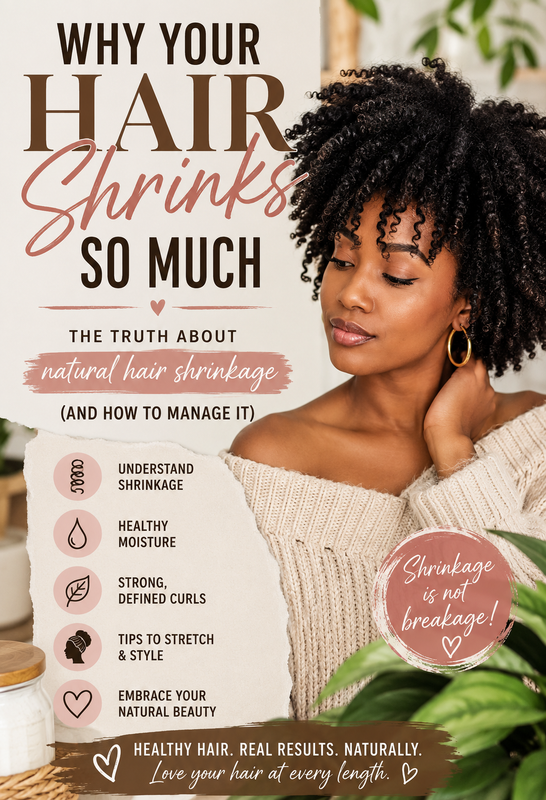
Have you ever washed your hair only to watch it shrink to half—or even one-quarter—of its original length? If you have curly, coily, kinky, or textured hair, you're definitely not alone.
Hair shrinkage is one of the most common concerns among people with natural hair. Many people worry that their hair isn't growing because it looks much shorter after washing. In reality, your hair may be growing perfectly well—it's simply curling back into its natural pattern.
The good news is that shrinkage is actually a sign of healthy, elastic hair.
In this complete guide, you'll learn:
- Why natural hair shrinks
- Which hair types experience the most shrinkage
- What causes excessive shrinkage
- How moisture affects shrinkage
- The difference between healthy and unhealthy shrinkage
- Safe ways to stretch your hair
- Products that help reduce shrinkage naturally
- Daily habits that keep curls healthy
What Is Hair Shrinkage?
Hair shrinkage is the natural reduction in visible hair length caused by curls, coils, or kinks contracting into their natural shape.
For example:
- Hair that measures 20 inches straight may appear only 10 inches long.
- Hair that reaches your shoulders while stretched may sit above your ears when wet.
- Waist-length coils may appear shoulder-length.
Nothing has actually happened to your length.
Your curls are simply doing what they were designed to do.
Why Does Hair Shrink?
Natural hair grows in curves instead of straight lines.
Every bend in the hair strand shortens the visible length.
Imagine taking a spring and stretching it.
When released, it coils back into itself.
Your curls behave exactly the same way.
This is completely normal.
Hair Types That Shrink the Most
Shrinkage increases as curl patterns become tighter.
Wavy Hair (Type 2)
Usually shrinks:
- 5–15%
Curly Hair (Type 3)
Typically shrinks:
- 20–50%
Coily Hair (Type 4)
Can shrink:
- 50–90%
Many people with Type 4 hair experience the greatest amount of shrinkage because each strand contains numerous tight bends and coils.
Shrinkage Is Actually a Good Sign
Many people dislike shrinkage.
However, healthy shrinkage usually means your hair has:
- Excellent elasticity
- Strong protein structure
- Healthy moisture balance
- Flexible strands
- Good curl definition
Hair that no longer shrinks at all may actually have damage.
The Science Behind Shrinkage
Hair is made primarily of keratin protein.
Inside every strand are millions of tiny protein bonds that determine your curl pattern.
When hair absorbs water:
- Hydrogen bonds temporarily break.
- Hair becomes flexible.
- As it dries, new hydrogen bonds form.
- Hair returns to its original curl pattern.
That's shrinkage.
Why Water Makes Hair Shrink
Many people notice maximum shrinkage immediately after washing.
Water activates your natural curl pattern.
As moisture enters the hair:
- Coils tighten
- Curls spring upward
- Hair contracts
- Definition increases
This is perfectly normal.
Humidity Can Increase Shrinkage
Humidity adds moisture from the air.
As hair absorbs that moisture:
- Curl patterns tighten.
- Hair appears shorter.
- Volume increases.
- Frizz may increase.
This explains why your stretched hairstyle sometimes disappears on humid days.
Healthy Shrinkage vs. Unhealthy Shrinkage
Healthy Shrinkage
Healthy shrinkage includes:
- Soft curls
- Elastic strands
- Defined coils
- Moisturized hair
- Minimal breakage
- Strong curl pattern
Unhealthy Shrinkage
Warning signs include:
- Dry hair
- Snapping
- Tangles
- Excessive knots
- Matted sections
- Rough texture
These symptoms suggest your hair needs moisture or protein balance—not less shrinkage.
Does Shrinkage Mean Your Hair Isn't Growing?
Absolutely not.
This is one of the biggest myths in natural hair care.
Your hair can grow several inches each year while appearing the same length because new growth coils tightly.
Many people don't realize how long their hair really is until it's stretched.
Why Some Hair Shrinks More Than Others
Several factors influence shrinkage.
Curl Pattern
Tighter curls naturally shrink more.
Hair Density
Dense hair appears fuller after shrinking.
Hair Elasticity
Healthy elastic hair springs back quickly.
Moisture Level
Well-moisturized curls contract more efficiently.
Product Choice
Certain products define curls, increasing visible shrinkage.
Products That Can Increase Shrinkage
Some styling products encourage curl definition, including:
- Curl creams
- Curl gels
- Custards
- Mousse
- Defining leave-ins
These products aren't bad—they simply enhance your natural pattern.
Products That Help Stretch Hair
If you prefer elongated styles, look for lightweight moisturizing products that soften the hair without weighing it down. A nourishing leave-in conditioner followed by a lightweight hair and scalp booster can help improve softness, reduce dryness, and make stretching techniques more effective while maintaining healthy-looking curls.
Does Hair Oil Stop Shrinkage?
Not entirely.
Hair oils:
- Reduce dryness
- Improve softness
- Add shine
- Seal moisture
However, they do not permanently change your curl pattern.
Why Dry Hair Shrinks Differently
Dry hair often behaves unpredictably.
Instead of soft springy shrinkage, dry hair may become:
- Brittle
- Puffy
- Tangled
- Frizzy
- Difficult to stretch
Moisture helps curls move naturally.
Heat Damage Can Reduce Shrinkage
Many people notice their hair stops shrinking after excessive heat styling.
This isn't improvement.
It's damage.
Heat can permanently weaken curl bonds.
Signs include:
- Loose curls
- Straight sections
- Reduced bounce
- Split ends
- Increased breakage
Chemical Treatments Can Reduce Shrinkage
Relaxers, texturizers, and some chemical treatments alter your curl pattern permanently.
Less shrinkage often comes with:
- Reduced elasticity
- Increased breakage risk
- More maintenance
Healthy natural curls usually shrink more.
Safe Ways to Stretch Your Hair
You don't have to fight your curls to enjoy more length.
Here are healthier alternatives.
Banding Method
Wrap soft bands down sections of damp hair.
This gently stretches curls while drying.
Braiding
Loose braids stretch curls overnight without heat.
Twisting
Two-strand twists create beautiful stretched definition.
African Threading
A traditional stretching technique that creates impressive length without heat.
Roller Sets
Large rollers gently stretch curls while preserving moisture.
Flexi Rods
Flexi rods offer elongation with added curl definition.
Blow-Drying on Cool or Low Heat
Use a heat protectant and keep the dryer moving.
Avoid frequent high heat.
Daily Habits That Reduce Excessive Shrinkage
Moisturize Regularly
Hydrated curls stretch more easily.
Avoid Product Buildup
Heavy buildup can weigh hair down unevenly and reduce manageability.
Deep Condition Weekly
Healthy curls remain flexible.
Sleep With Protection
Use:
- Satin bonnet
- Silk scarf
- Satin pillowcase
These reduce friction.
Can Shrinkage Cause Knots?
Indirectly, yes.
When tightly coiled strands wrap around each other, they become more likely to form:
- Single-strand knots
- Fairy knots
- Tangles
Keeping hair moisturized and stretched can help reduce knot formation.
Should You Fight Shrinkage?
Not necessarily.
Shrinkage protects curls.
It helps distribute stress throughout the strand.
Forcing hair to stay stretched all the time can increase mechanical damage.
Instead, alternate between stretched styles and natural wash-and-go styles.
Hairstyles That Minimize Shrinkage
Popular options include:
- Twist-outs
- Braid-outs
- Flexi rod sets
- Roller sets
- Blowout styles
- Low buns
- Pineapple styles
- Protective twists
- Protective braids
Mistakes That Make Shrinkage Worse
Avoid these habits:
Washing Without Conditioning
Hair becomes harder to manage.
Skipping Leave-In Conditioner
Moisture evaporates quickly.
Using Too Much Heat
Damages elasticity.
Over-Manipulating Hair
Leads to breakage.
Ignoring Regular Trims
Split ends increase tangles.
The Role of Scalp Health
Healthy hair begins with a healthy scalp. Keeping the scalp clean, balanced, and moisturized supports stronger strands from the root. Regular scalp massages and lightweight botanical oils can also improve your hair care routine by helping distribute natural oils and encouraging consistent care habits.
Myths About Hair Shrinkage
Myth: Shrinkage Means No Growth
False.
Hair can grow significantly while appearing short.
Myth: Only Type 4 Hair Shrinks
False.
All curl patterns shrink to some degree.
Myth: Heat Is the Best Solution
False.
Frequent heat can permanently damage curl patterns.
Myth: Oils Eliminate Shrinkage
False.
They improve softness but won't permanently stretch curls.
Myth: Healthy Hair Doesn't Shrink
False.
Healthy curls usually shrink more because they retain elasticity.
Frequently Asked Questions
Is shrinkage bad?
No. Healthy shrinkage is a sign of strong, elastic curls.
How much shrinkage is normal?
Anywhere from 20% to 90%, depending on your curl pattern.
Can I permanently stop shrinkage?
Only by chemically or permanently altering your curl pattern, which may damage your hair.
Why does my hair shrink more after washing?
Water reactivates your natural curl pattern, causing strands to coil tightly as they dry.
Why does my friend's hair shrink less?
Everyone has a unique curl pattern, strand thickness, density, elasticity, and moisture balance.
Does moisturizing reduce shrinkage?
Moisturized hair may still shrink, but it is generally softer, easier to stretch, and less prone to tangles.
Final Thoughts
Hair shrinkage isn't something to fear—it's a natural characteristic of healthy curls, coils, and kinks. In many cases, the more elastic and hydrated your hair is, the more it will spring back into its beautiful natural pattern.
Rather than viewing shrinkage as a problem, think of it as proof that your hair is resilient and full of life. If you enjoy longer-looking styles, choose gentle stretching methods like twists, braids, banding, or roller sets instead of relying on excessive heat. By keeping your hair moisturized, minimizing breakage, and maintaining a healthy scalp, you can enjoy both strong, healthy curls and versatile styling options.