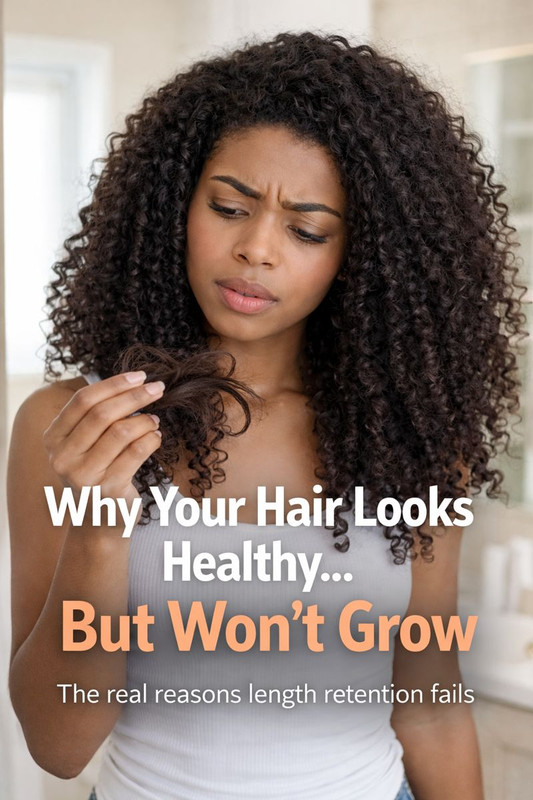
(The Real Reasons Your Length Is Stuck — and How to Fix It Naturally)
If your hair looks shiny, moisturized, and full—but the length never seems to change—you’re not imagining things. This is one of the most frustrating and misunderstood hair growth problems, especially for women with natural, textured, curly, coily, or loc’d hair.
You might hear:
-
“Hair grows half an inch a month.”
-
“Just oil your scalp.”
-
“Protective styles help growth.”
Yet here you are… same length. Same spot. Year after year.
The truth is simple but uncomfortable:
? Your hair may be growing—but you’re losing length just as fast.
This article breaks down exactly why hair can appear healthy but fail to retain length, what’s really happening at the scalp and strand level, and how to fix it with a science-backed, natural approach that supports real growth—not myths.
Table of Contents
-
Hair Growth vs. Length Retention (The Most Missed Concept)
-
Signs Your Hair Is Growing but Not Retaining
-
Breakage: The Silent Length Killer
-
Dry Hair ≠ Dehydrated Hair (And Why That Matters)
-
Your Scalp Might Be Blocking Growth
-
Protective Styles That Secretly Stall Growth
-
Over-Manipulation & Styling Fatigue
-
Protein–Moisture Imbalance
-
Hard Water & Product Buildup
-
Stress, Hormones & Internal Growth Blockers
-
How Long Hair Actually Grows
-
The 90-Day Growth Reset Plan
-
Final Thoughts: Healthy Hair Isn’t Always Growing Hair
1. Hair Growth vs. Length Retention (The Concept That Changes Everything)
Most people think hair growth means getting longer hair.
But biologically, hair growth and hair length are two different processes.
Hair Growth:
-
Happens inside the scalp
-
Controlled by blood flow, hormones, nutrients, and follicles
Length Retention:
-
Happens after hair leaves the scalp
-
Controlled by moisture, handling, friction, and breakage
? You can grow hair perfectly at the scalp and still never see length if your ends keep breaking.
This is why your hair can look healthy but stay the same length.
2. Signs Your Hair Is Growing—But You’re Losing Length
You may be dealing with a retention problem, not a growth problem, if:
-
Your roots feel thick but ends feel thin
-
You see short pieces around your sink or shower
-
Hair looks full in twists but see-through when straightened
-
Your hair grows back quickly after trims—but never past a point
-
You constantly trim “split ends” but length never increases
This means your hair is growing, breaking, and repeating the cycle.
3. Breakage: The #1 Reason Hair Won’t Get Longer
Breakage doesn’t always look dramatic.
It often shows up as:
-
Mid-shaft splits
-
Feathered ends
-
“Dust” when detangling
-
Short hairs that never catch up
Common Causes of Breakage:
-
Dry strands
-
Rough detangling
-
Tight styles
-
Heat misuse
-
Weak protein structure
Even slight daily breakage cancels out monthly growth.
If your hair grows ~½ inch per month but breaks ~½ inch per month…
Your length stays stuck.
4. Dry Hair vs. Dehydrated Hair (Huge Difference)
Most people treat dryness incorrectly.
Dry Hair:
-
Lacks oils
-
Feels rough, dull
-
Needs sealing oils & butters
Dehydrated Hair:
-
Lacks water
-
Feels brittle, stiff
-
Breaks easily even when “oiled”
? Oil does NOT hydrate hair. Water does.
If you’re constantly oiling dry hair without water, you’re sealing in dryness—leading to breakage and stalled length.
Fix:
Start with a water-based leave-in → then seal with oil.
5. Your Scalp Might Be Blocking Growth
Healthy-looking hair can still come from an unhealthy scalp.
Signs of a Growth-Blocked Scalp:
-
Tightness or itching
-
Flakes that return quickly
-
Product buildup at roots
-
Slow regrowth after shedding
When follicles are clogged, inflamed, or poorly nourished, hair strands:
-
Grow weaker
-
Shed earlier
-
Break more easily
A clean, stimulated scalp grows stronger hair—not just more hair.
6. Protective Styles That Secretly Stall Growth
Protective styles are meant to help—but many do the opposite.
Growth-Stalling Styles:
-
Tight braids or cornrows
-
Heavy extensions
-
Styles left in too long
-
No moisture underneath
If your hairline is sore, itchy, or thinning, your style is costing you length.
Protective styles only work if:
✔ Hair is moisturized underneath
✔ Tension is minimal
✔ Style duration is reasonable
7. Over-Manipulation & Styling Fatigue
Healthy hair doesn’t mean strong hair.
Daily manipulation weakens strands over time:
-
Constant brushing
-
Daily buns
-
Re-twisting locs too often
-
Styling edges every day
Each touch creates micro-damage that builds up.
? Low-manipulation beats fancy routines every time.
8. Protein–Moisture Imbalance
Hair needs both strength and flexibility.
Too Much Protein:
-
Hair feels hard
-
Snaps easily
-
Doesn’t stretch
Too Little Protein:
-
Hair feels mushy
-
Over-stretches
-
Breaks when wet
If your hair looks healthy but keeps snapping, your internal structure may be off.
Balanced routines win—extremes lose length.
9. Hard Water & Product Buildup
Minerals from hard water coat hair strands, making them:
-
Resistant to moisture
-
Dull
-
More breakage-prone
Add heavy products, and your hair may look moisturized while being dry underneath.
➡️ Clarifying monthly restores real growth conditions.
10. Stress, Hormones & Internal Growth Blockers
You can do everything right externally and still struggle with growth.
Internal factors that stall length:
-
Chronic stress
-
Poor sleep
-
Hormonal imbalance
-
Nutrient deficiencies
-
Thyroid issues
Stress pushes hair into shedding phases early, shortening the growth cycle.
Healthy hair starts inside the body, not just the bathroom.
11. How Long Hair Actually Grows (Reality Check)
Average hair growth:
-
~½ inch per month
-
~6 inches per year
But retention is what makes growth visible.
If you retain:
-
70% of growth → slow progress
-
90% of growth → noticeable length
-
100% of growth → rare, but powerful
Your goal isn’t faster growth.
? It’s protecting what grows.
12. The 90-Day Hair Growth Reset Plan
Month 1: Reset the Foundation
-
Clarify scalp & strands
-
Trim damaged ends
-
Switch to water-based moisture
-
Massage scalp 3–4x/week
Month 2: Strengthen & Protect
-
Reduce manipulation
-
Moisturize every 2–3 days
-
Seal ends consistently
-
Wear low-tension styles
Month 3: Lock in Retention
-
Maintain scalp health
-
Protect hair at night
-
Minimal trims only if needed
-
Track growth progress
? This is where people finally see length.
13. Final Thoughts: Healthy Hair Isn’t Always Growing Hair
Shiny hair can still:
-
Be dry underneath
-
Break daily
-
Lose growth invisibly
True hair growth requires:
✔ Moisture and strength
✔ Scalp care and strand protection
✔ Consistency over trends
When you stop chasing growth and start protecting it, length shows up naturally.