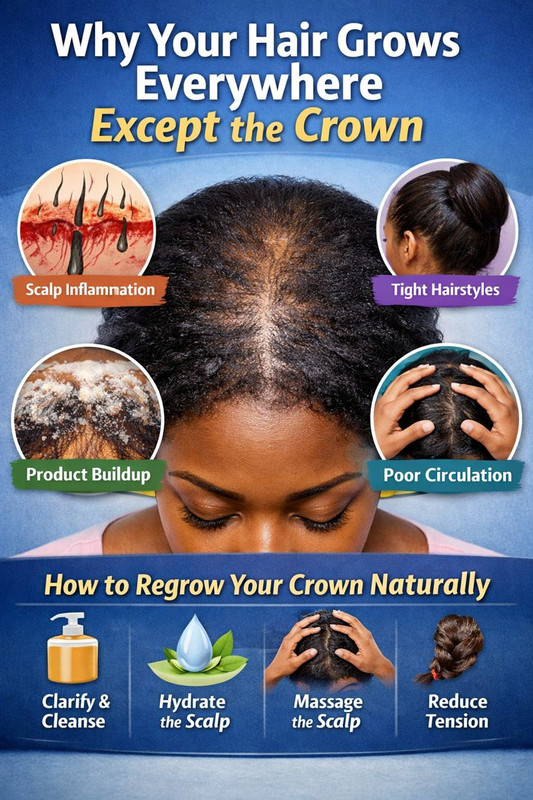
If your hair is thriving at the edges, back, and sides—but the crown refuses to grow, feels thin, or keeps breaking—you’re not imagining things. The crown is one of the most vulnerable areas of the scalp, and it’s often the first place hair growth issues show up.
Many women (and men) assume crown thinning means genetics or permanent hair loss, but in reality, the crown is usually responding to scalp stress, inflammation, circulation issues, tension, or buildup—all of which are fixable when addressed early.
In this article, we’ll break down:
-
Why hair grows everywhere except the crown
-
What’s happening beneath the scalp surface
-
The most common crown-specific growth blockers
-
How to tell the difference between thinning, shedding, and breakage
-
How to restore crown growth naturally and safely
If your crown feels “stuck,” dry, itchy, tender, or sparse—this guide is for you.
Why the Crown Is Different From the Rest of Your Scalp
The crown (also called the vertex) sits at the highest point of the head. Structurally and biologically, it behaves differently from other areas of the scalp.
Here’s why:
-
Blood flow to the crown is naturally weaker than the front and sides
-
Sebum (natural oil) distribution is uneven at the top of the scalp
-
The crown absorbs more heat from the sun and styling tools
-
Hair at the crown is more likely to experience friction from sleep, hats, scarves, and headrests
-
Many hairstyles unknowingly place tension directly on the crown
Because of these factors, the crown is often the first area to:
-
Dry out
-
Accumulate buildup
-
Experience inflammation
-
Enter a prolonged “resting” (telogen) phase
Hair growth doesn’t stop randomly—it stops when the scalp environment becomes hostile.
The #1 Reason Hair Won’t Grow at the Crown: Chronic Scalp Inflammation
Inflammation is the silent killer of crown growth.
When the scalp is irritated—whether from product buildup, tight styles, scratching, or poor circulation—the hair follicles shrink and struggle to push out strong strands.
Signs of crown inflammation include:
-
Tenderness or soreness when touched
-
Itching that returns quickly after washing
-
A shiny or tight-looking scalp
-
Slow regrowth after shedding
-
Hair that snaps instead of shedding naturally
Inflammation disrupts the hair growth cycle, forcing follicles to remain dormant longer than they should.
Product Buildup: The Invisible Crown Blocker
The crown is a buildup magnet.
Why?
-
Shampoo often isn’t worked thoroughly into the crown
-
Conditioners and stylers sit heavier at the top
-
Oils and butters are layered without regular clarifying
-
Sweat dries into the scalp and traps debris
Over time, this creates a film that:
-
Blocks oxygen from reaching follicles
-
Prevents moisture absorption
-
Slows blood circulation
-
Traps bacteria and yeast
Hair follicles buried under buildup simply cannot function properly.
If your crown feels waxy, coated, or never fully “clean,” buildup may be the main reason your hair grows everywhere else—but not there.
Tension You Don’t Realize You’re Putting on Your Crown
Many protective styles unintentionally stress the crown more than any other area.
Common culprits include:
-
High buns and ponytails
-
Tight crochet installs
-
Sew-ins with dense crown braiding
-
Wigs secured tightly at the top
-
Headwraps tied too firmly
Unlike edges, crown tension often goes unnoticed until thinning appears.
Repeated tension causes:
-
Micro-inflammation
-
Follicle fatigue
-
Shortened growth cycles
-
Thinning that looks “see-through” under light
This is how traction alopecia can quietly begin at the crown—without pain or warning.
Poor Blood Circulation to the Crown
Hair follicles require oxygen, nutrients, and blood flow to grow.
The crown naturally receives less circulation, especially if:
-
You rarely massage your scalp
-
You sit for long periods
-
You experience chronic stress
-
Your scalp stays tight or dry
Without stimulation, follicles at the crown remain inactive—even while hair grows elsewhere.
This is why scalp massage, inversion methods, and circulation-boosting oils are so effective for crown regrowth.
Dryness and Moisture Imbalance at the Crown
The crown often suffers from dehydration, not just dryness.
Dry scalp lacks oil.
Dehydrated scalp lacks water.
At the crown, dehydration is common because:
-
Sebum doesn’t travel easily upward
-
Styling products seal without hydrating
-
Wash routines focus more on hair than scalp
A dehydrated crown feels:
-
Tight after washing
-
Flaky without obvious dandruff
-
Rough to the touch
-
Fragile and prone to breakage
Hair cannot grow through a stiff, inflexible scalp.
Hormonal Sensitivity at the Crown
The crown is more sensitive to hormonal fluctuations than other scalp areas.
This includes:
-
Postpartum hair changes
-
Perimenopause and menopause
-
Thyroid imbalances
-
Elevated cortisol from stress
Hormones can:
-
Shorten the growth phase
-
Increase shedding cycles
-
Reduce strand diameter
This doesn’t always mean permanent loss—but it does mean your crown needs extra support during hormonal shifts.
Crown Breakage vs. Crown Thinning: Know the Difference
Many people think their crown “won’t grow,” when in reality it is growing—but breaking off.
Crown breakage signs:
-
Short, uneven strands
-
No visible scalp gaps
-
Hair feels rough or brittle
-
Breakage after styling or washing
Crown thinning signs:
-
Wider part or visible scalp
-
Reduced density over time
-
Slower regrowth after shedding
-
Softer, finer hair texture
Breakage requires moisture and gentler handling.
Thinning requires scalp repair and follicle support.
How to Restore Hair Growth at the Crown (Naturally)
The goal is simple: repair the scalp environment.
1. Clean the Crown Properly
-
Use fingertip pads, not nails
-
Massage shampoo directly into the crown
-
Clarify monthly to remove buildup
2. Rehydrate the Scalp
-
Apply water-based scalp treatments
-
Seal lightly with growth-supporting oils
-
Avoid heavy butters on the scalp
3. Increase Blood Flow
-
Massage the crown daily (2–5 minutes)
-
Use circular motions
-
Focus on warmth, not pressure
4. Reduce Tension Immediately
-
Rotate styles weekly
-
Avoid tight crown braiding
-
Loosen wigs and wraps
5. Support Follicle Recovery
-
Use botanical oils that calm inflammation
-
Apply treatments directly to the scalp, not just hair
-
Stay consistent—regrowth takes time
How Long Does It Take to See Crown Regrowth?
Realistic timelines matter.
-
2–4 weeks: Reduced itching, less tightness
-
6–8 weeks: Less shedding, improved texture
-
3–4 months: Visible regrowth and density
-
6+ months: Noticeable fullness
Crown follicles recover slowly—but they do recover when inflammation and blockage are removed.
When Crown Hair Loss Needs Professional Help
Seek a dermatologist or trichologist if:
-
The crown is smooth and shiny
-
Hair loss is rapidly worsening
-
You experience pain or burning
-
There is no regrowth after 6 months of care
Early intervention prevents permanent follicle damage.
Final Thoughts: Your Crown Isn’t Broken—It’s Overworked
When hair grows everywhere except the crown, it’s not a mystery—it’s a message.
Your scalp is asking for:
-
Less tension
-
More circulation
-
Better hydration
-
Reduced inflammation
The crown responds beautifully when treated intentionally. With the right care, consistency, and patience, regrowth is absolutely possible.