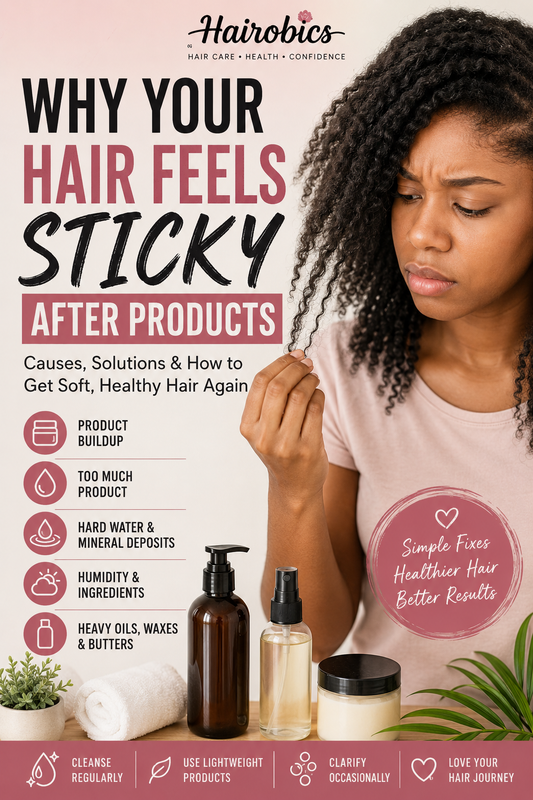
Have you ever applied your favorite moisturizer, leave-in conditioner, oil, gel, or styling cream only to discover that your hair suddenly feels sticky, tacky, or coated? You're not alone.
Sticky hair is one of the most common complaints among people with natural hair, curls, locs, braids, and protective styles. Instead of feeling moisturized and soft, your hair may feel heavy, gummy, difficult to comb, or even dirty shortly after styling.
The good news is that sticky hair is usually fixable. In most cases, it isn't caused by your hair itself—it's caused by the products you're using, how you're layering them, or buildup on the hair shaft.
In this complete guide, you'll learn:
- Why hair feels sticky after products
- Common ingredient combinations that create buildup
- How hard water affects product performance
- Why less product often works better
- How to remove sticky residue safely
- The best routine to prevent sticky hair in the future
- Tips for natural hair, locs, braids, and curly hair
Let's find out what's really happening.
What Does Sticky Hair Feel Like?
Sticky hair often has one or more of these characteristics:
- Hair feels tacky when touched
- Fingers don't glide through strands
- Hair attracts lint or dust
- Curls feel glued together
- Locs remain damp for hours
- Hair feels coated after drying
- Products never seem to absorb
- Scalp feels greasy while hair feels dry
- Hair becomes dull and lifeless
Sticky hair is different from oily hair.
Oily hair usually comes from excess sebum, while sticky hair is usually caused by product residue sitting on top of the hair rather than penetrating it.
The Most Common Cause: Product Buildup
The number one reason hair feels sticky is buildup.
Every styling product leaves behind small amounts of residue.
Examples include:
- Leave-in conditioners
- Curl creams
- Edge controls
- Oils
- Butters
- Gels
- Hair sprays
- Mousse
- Heat protectants
One product isn't usually the problem.
The issue occurs when product is added day after day without thoroughly cleansing the hair.
Over time the layers build up.
Instead of moisturizing the hair, new products sit on top of old products.
The result is sticky, coated hair.
Using Too Much Product
Many people believe:
"If a little works, more must work better."
Hair doesn't work that way.
Once the hair has absorbed what it can, additional product simply sits on the surface.
Signs you're using too much include:
- White residue
- Sticky texture
- Hair taking forever to dry
- Heavy curls
- Limp styles
- Dirty feeling despite washing recently
Often, cutting your product amount in half makes hair feel significantly softer.
Product Layering Problems
Another major cause is layering incompatible products.
For example:
- Oil over heavy butter
- Gel over thick cream
- Wax over moisturizer
- Multiple leave-ins together
- Mixing products from several brands
Each formula contains different ingredients.
Some ingredients don't blend well.
Instead of absorbing into the hair, they create a sticky coating.
Heavy Oils Can Create Stickiness
Natural oils are beneficial—but too much can become a problem.
Heavy oils include:
- Castor oil
- Olive oil
- Avocado oil
- Mineral oil blends
- Thick petroleum-based products
When applied excessively, these oils:
- Trap dirt
- Hold onto lint
- Prevent moisture absorption
- Leave hair tacky
Light application usually works much better than saturating the hair.
Butters May Be Too Heavy
Shea butter, mango butter, cocoa butter, and similar ingredients can be wonderful moisturizers.
However, they don't work well for everyone.
If your hair has:
- Fine strands
- Low density
- Low porosity
Heavy butters may simply coat the outside of the hair.
This creates a sticky feeling instead of softness.
Humidity Makes Products Feel Sticky
Humidity changes how styling products behave.
Ingredients called humectants pull moisture from the air.
Common humectants include:
- Glycerin
- Honey
- Aloe vera
- Sorbitol
- Propylene glycol
On humid days these ingredients may continue attracting moisture long after styling.
Hair can become:
- Sticky
- Puffy
- Frizzy
- Heavy
Reducing humectant-rich products during extremely humid weather may help.
Hard Water Makes Products Less Effective
Minerals found in hard water coat the hair.
These minerals include:
- Calcium
- Magnesium
- Iron
Once mineral deposits accumulate, products struggle to penetrate.
Instead they remain on top of the mineral layer.
This often creates sticky hair.
Installing a shower filter or using a clarifying shampoo occasionally can help remove mineral buildup.
Silicone Buildup
Some silicones provide shine and protection.
However, certain non-water-soluble silicones accumulate over time.
Examples include ingredients ending in:
- Cone
- Conol
- Siloxane
Without occasional clarifying, these ingredients may create:
- Stickiness
- Dullness
- Heavy hair
- Product rejection
Low Porosity Hair Often Feels Sticky
Low porosity hair has tightly closed cuticles.
Water enters slowly.
Products absorb slowly.
Heavy creams often remain sitting on top.
Signs include:
- Water beads on hair
- Products sit on surface
- Hair takes long to get wet
- Hair feels sticky after moisturizing
Low porosity hair usually responds better to:
- Lightweight leave-ins
- Warm water
- Smaller product amounts
- Regular cleansing
High Porosity Hair Can Also Feel Sticky
High porosity hair absorbs products quickly.
But it can also absorb too much.
Over-applying oils and creams repeatedly eventually creates buildup.
Balance is important.
Dirty Hair Cannot Absorb Moisture Properly
Many people continue adding products instead of washing.
Imagine putting lotion over dirty skin every day.
Eventually it becomes coated.
Hair behaves the same way.
A clean scalp allows moisturizers to work properly.
Sweat Can Mix with Products
Exercise is excellent for overall wellness, but sweat combined with styling products may leave hair feeling sticky.
This is especially common with:
- Locs
- Braids
- Protective styles
Regular cleansing helps prevent this combination from building up.
Wax-Based Products Leave Residue
Products containing waxes can be difficult to remove.
Examples include:
- Beeswax
- Microcrystalline wax
- Paraffin wax
These ingredients may provide hold but can also leave sticky buildup, especially when layered repeatedly.
Sleeping Without Protecting Hair
Cotton pillowcases absorb moisture while leaving product residue on the hair.
This creates friction that mixes oils, sweat, and styling products.
Sleeping with a satin bonnet or satin pillowcase helps reduce residue transfer and friction.
How to Remove Sticky Hair
If your hair already feels sticky, don't panic.
A simple reset routine can help.
Step 1: Clarify
Use a clarifying shampoo to remove product buildup.
Focus on:
- Hair
- Scalp
- Roots
Clarify every 3–6 weeks, or as needed if you use many styling products.
Step 2: Deep Condition
Clarifying shampoos remove buildup, but they can also remove some natural oils.
Follow with a moisturizing deep conditioner.
Leave it on for 20–30 minutes.
Step 3: Use Fewer Products
Instead of six products, try using only three:
- Leave-in conditioner
- Moisturizer
- Light sealing oil (if needed)
Many people see better results with a simplified routine.
Step 4: Let Products Absorb
Don't immediately pile product after product onto soaking wet hair.
Allow each layer time to absorb before adding another.
Step 5: Avoid Reapplying Daily
Many styles don't require daily product application.
Instead:
- Mist lightly with water
- Refresh only dry areas
- Add small amounts when necessary
Best Routine for Natural Hair
- Cleanse regularly
- Condition thoroughly
- Apply lightweight leave-in
- Seal only if needed
- Avoid over-layering
- Clarify monthly
Best Routine for Locs
Locs perform best with lightweight products.
Use:
- Water-based moisturizers
- Light oils
- Occasional clarifying shampoo
Avoid heavy waxes that trap lint and residue.
Best Routine for Braids
Braids don't require heavy creams every day.
Instead:
- Cleanse scalp regularly
- Use lightweight moisturizing sprays
- Apply oil sparingly to the scalp if desired
- Remove buildup before reinstalling braids
Best Routine for Curly Hair
Curly hair benefits from lightweight hydration.
Avoid layering multiple gels and creams unless they are compatible.
Experiment with fewer products to see what your curls truly need.
Ingredients That May Cause Sticky Hair
Depending on your hair type and routine, these ingredients may contribute to a tacky feel when overused:
- Heavy waxes
- Thick petrolatum-based products
- Excess mineral oil
- Large amounts of castor oil
- Non-water-soluble silicones
- High concentrations of butters
- Excess glycerin in humid weather
Remember that these ingredients are not inherently bad—they simply may require thoughtful use and proper cleansing.
Healthy Habits That Prevent Sticky Hair
- Wash hair consistently
- Clarify when needed
- Use lightweight products appropriate for your hair type
- Apply products in moderation
- Drink enough water
- Protect hair while sleeping
- Avoid constantly touching your hair
- Read ingredient labels
- Keep styling tools clean
- Replace old products if they have changed in smell or texture
Frequently Asked Questions
Why does my hair feel sticky immediately after applying leave-in conditioner?
You may be using too much product, applying it over buildup, or using a formula that is too heavy for your hair type.
Can sticky hair cause breakage?
Indirectly, yes. Product buildup can make detangling more difficult, increasing friction and the risk of breakage.
How often should I clarify?
For many people, every 3–6 weeks works well. If you use heavy styling products or swim regularly, you may benefit from clarifying a little more often, while always following with a moisturizing conditioner.
Is sticky hair a sign of damaged hair?
Not necessarily. Sticky hair is more often related to product buildup, incompatible product combinations, or mineral deposits rather than permanent damage.
Should I stop using oils?
No. Oils can help seal in moisture for some hair types, but they should be used sparingly and on clean, moisturized hair instead of replacing hydration.
Final Thoughts
If your hair feels sticky after using products, the problem is often not your hair—it's the buildup, layering, or quantity of products being used. By simplifying your routine, cleansing consistently, and choosing products that suit your hair's porosity and texture, you can restore softness, shine, and manageability.
Healthy hair doesn't require the most products—it requires the right products used in the right amounts. Whether you wear natural hair, curls, braids, or locs, a balanced routine that emphasizes clean hair, proper hydration, and moderate product use can help you avoid sticky buildup and enjoy healthier-looking hair every day.
If you're looking to support a healthy hair care routine, consider lightweight, nourishing products made with botanical ingredients that moisturize without leaving a heavy residue. Consistency, patience, and a simple routine are often the biggest keys to long-term hair health.