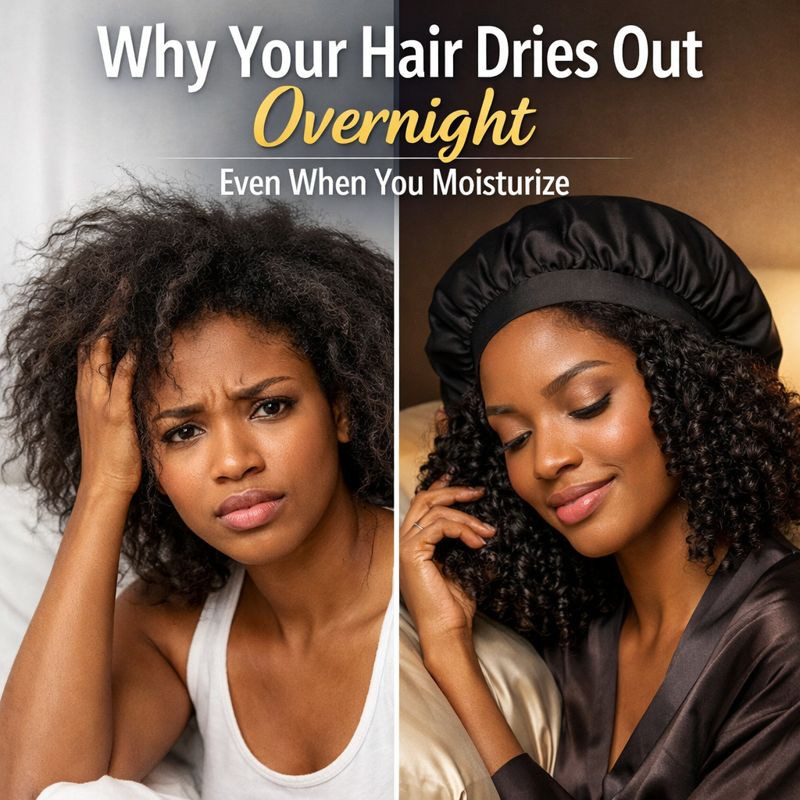
You wash your hair.
You moisturize.
You seal.
You go to bed feeling confident.
Then morning hits… and your hair feels dry, brittle, stiff, or rough — almost like you did nothing at all.
If this sounds familiar, you’re not imagining things. Overnight moisture loss is one of the most common — and misunderstood — hair problems, especially for natural, textured, curly, coily, and chemically treated hair.
The truth?
Your hair isn’t “betraying” you overnight. There are very specific biological, environmental, and routine-based reasons your hair dries out while you sleep.
Let’s break it all down — no myths, no guesswork.
The Short Answer: Hair Loses Moisture Fast When Conditions Are Wrong
Hair dries out overnight because of a combination of:
-
Moisture evaporation
-
Friction
-
Improper sealing
-
Dry indoor air
-
Absorbent bedding
-
Incorrect nighttime routines
-
Scalp-to-strand imbalance
Moisture doesn’t just disappear — it escapes, and sleep is when your hair is most vulnerable.
1. Your Hair Is Losing Moisture to the Air (Yes, Even Indoors)
Hair is hygroscopic — meaning it absorbs and releases moisture based on its environment.
At night:
-
Indoor heating or AC dries the air
-
Humidity drops significantly
-
Hair releases water to “balance” with the environment
This process is called transepidermal water loss, and it affects hair just like skin.
Signs this is your issue:
-
Hair feels fine before bed but dry by morning
-
Happens more in winter or in air-conditioned homes
-
Ends feel especially rough
? Moisturizing without sealing properly makes this worse.
2. Cotton Pillowcases Are Stealing Your Moisture
Cotton is highly absorbent.
When your hair rubs against cotton:
-
Moisture transfers from your hair into the fabric
-
Oils get soaked up
-
Cuticles lift from friction
So even if you moisturized perfectly, your pillow is undoing the work.
Symptoms:
-
Dry hair only in the morning
-
Frizz concentrated at the crown or edges
-
Hair feels softer after re-moisturizing
Switching to satin or silk reduces friction and moisture loss — but it’s only part of the fix.
3. You’re Moisturizing, But Not Actually Hydrating
This is one of the biggest misconceptions in hair care.
Moisture ≠ hydration.
-
Hydration = water entering the hair shaft
-
Moisture = water + oils keeping it inside
If your routine is mostly:
-
Butters
-
Oils
-
Creams
-
Pomades
…but lacks water-based hydration, your hair may feel soft initially, then dry out quickly.
Overnight effect:
Oils alone don’t add water — so by morning, there’s nothing left to retain.
? Hair needs water first, then a sealant.
4. Your Hair Cuticle Is Raised Before Bed
When hair cuticles are lifted:
-
Moisture escapes faster
-
Friction causes dryness
-
Hair tangles more easily
Cuticles lift due to:
-
Hot water washing
-
Harsh shampoos
-
Over-manipulation
-
Not sealing after moisturizing
Going to bed with open cuticles is like leaving windows open during a storm — moisture loss is guaranteed.
5. You’re Sleeping With Your Hair Fully Exposed
Loose hair rubbing against:
-
Pillows
-
Sheets
-
Blankets
-
Clothing
creates constant friction for 6–8 hours straight.
That friction:
-
Roughens cuticles
-
Causes moisture evaporation
-
Leads to breakage over time
This is especially damaging for:
-
Curly hair
-
Coily hair
-
Fine strands
-
High porosity hair
Protective nighttime styles matter more than people realize.
6. High Porosity Hair Dries Out Faster Overnight
If your hair:
-
Absorbs water quickly
-
Dries very fast
-
Feels dry shortly after moisturizing
You likely have high porosity hair.
High porosity hair has:
-
Gaps or damage in the cuticle
-
Difficulty retaining moisture
-
Faster overnight moisture loss
This type of hair requires layering — hydration + sealing + protection.
Without that, dryness by morning is inevitable.
7. Your Scalp Is Dry — and It’s Affecting Your Length
Many people focus only on strands, but your scalp controls moisture distribution.
A dry scalp:
-
Produces less sebum
-
Fails to naturally coat strands
-
Leads to dry mid-lengths and ends
At night, when movement is minimal, dry scalps don’t replenish hair — so strands wake up thirsty.
Signs:
-
Tight scalp feeling
-
Itching at night
-
Dryness starting near roots
8. You’re Using the Wrong Nighttime Oils
Not all oils behave the same overnight.
Some oils:
-
Sit on top of the hair
-
Don’t penetrate
-
Create a false softness
Others:
-
Seal too tightly
-
Prevent hydration
-
Cause hair to feel dry underneath
If you oil dry hair before bed without water, you’re locking in dryness.
9. Your Ends Are Overexposed (And They’re the Oldest Hair)
Ends are:
-
The oldest part of your hair
-
The most porous
-
The first to dry out
Overnight dryness often starts at the ends and travels upward.
If your ends:
-
Feel crispy in the morning
-
Tangle easily
-
Snap instead of stretch
They need extra nighttime protection.
10. Your Night Routine Is Too Aggressive (or Nonexistent)
Common mistakes:
-
Sleeping on damp hair
-
Over-twisting tightly
-
Using tight bonnets
-
Skipping nighttime care entirely
Hair doesn’t need complexity — but it does need intention.
How to Stop Your Hair From Drying Out Overnight (Step-by-Step)
1. Hydrate With Water First
Use a water-based leave-in or light mist before bed.
2. Seal Strategically
Apply a lightweight oil or butter only after hydration.
3. Protect With Low-Friction Materials
-
Satin bonnet
-
Silk scarf
-
Satin pillowcase (backup)
4. Use Loose Protective Styles
-
Loose braids
-
Chunky twists
-
Pineapple for curls
Avoid tight styles that stress strands.
5. Focus on Ends
Apply extra moisture + sealant to ends before bed.
6. Balance Scalp Care
A nourished scalp supports moisture retention along the strand.
Why Morning Re-Moisturizing Feels Necessary (But Shouldn’t Be)
If you have to re-moisturize every morning, your overnight routine isn’t working.
Proper nighttime care should:
-
Reduce frizz
-
Maintain softness
-
Keep hair pliable
Morning refreshes should be light — not damage control.
Is Overnight Dryness a Sign of Damage?
Not always — but chronic overnight dryness can lead to damage.
Over time, repeated moisture loss causes:
-
Cuticle erosion
-
Split ends
-
Breakage
-
Stalled length retention
Fixing overnight dryness is preventative care, not cosmetic.
The Biggest Myth: “My Hair Just Doesn’t Hold Moisture”
Hair that “doesn’t hold moisture” is usually:
-
Under-hydrated
-
Improperly sealed
-
Over-exposed at night
Hair can be trained to retain moisture — with consistency.
Final Thoughts: Nighttime Is When Hair Care Really Happens
Most people think hair care is about wash day.
In reality, nighttime habits determine moisture retention, breakage, and growth.
If your hair dries out overnight, it’s not failing — it’s responding to:
-
Its environment
-
Its structure
-
Your routine
Fix those, and morning dryness becomes a thing of the past.