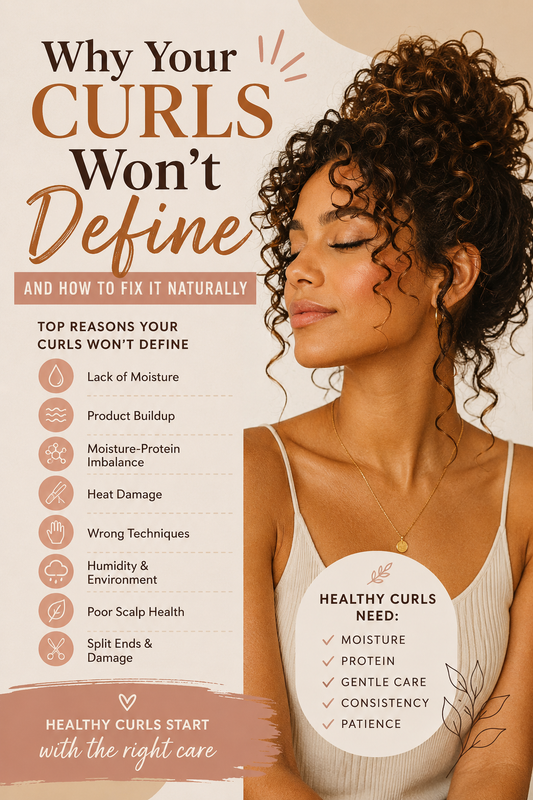
If your curls look frizzy, undefined, dry, puffy, stringy, or inconsistent no matter what products you use, you are not alone. One of the most frustrating parts of having curly hair is spending hours on wash day only to end up with curls that refuse to clump or hold their shape.
The truth is, curl definition is not just about using “good products.” Defined curls depend on moisture balance, hair health, porosity, technique, styling habits, environmental conditions, and even scalp health. Many people unknowingly damage their curl pattern through daily routines that slowly weaken elasticity and hydration over time.
In this complete guide, we’ll break down exactly why your curls won’t define, what causes undefined curls, and how to restore healthy, bouncy, naturally defined curls again.
Whether you have wavy hair, curly hair, coily hair, natural hair, locs transitioning to loose curls, or chemically damaged curls, this guide will help you understand what your hair actually needs.
What Does “Defined Curls” Actually Mean?
Defined curls happen when strands group together naturally into consistent curl clumps or patterns. Healthy definition usually looks like:
- Smooth curl grouping
- Less frizz
- Visible curl pattern
- Elastic bounce
- Moisturized appearance
- Shine and softness
- Reduced puffiness
- Better curl retention
Curl definition does NOT mean your hair has to look wet, crunchy, or heavily gelled.
Healthy definition is really about:
- Proper moisture
- Balanced protein
- Strong elasticity
- Reduced damage
- Correct styling methods
The Biggest Reasons Your Curls Won’t Define
1. Your Hair Is Extremely Dry
Dryness is the #1 reason curls refuse to define.
Curly hair naturally struggles to retain moisture because the bends and coils prevent scalp oils from traveling evenly down the strand.
When curls are dry:
- The cuticle lifts
- Strands separate
- Frizz increases
- Curl clumps break apart
- Hair expands outward instead of coiling
Dry curls almost always appear undefined.
Signs Your Hair Is Too Dry
- Rough texture
- Crunchy ends
- Dull appearance
- Frizz after styling
- Hair absorbs products instantly
- Tangling constantly
- Breakage during detangling
How to Fix It
Focus on:
- Weekly deep conditioning
- Water-based moisturizers
- Leave-in conditioners
- Sealing moisture with oils
- Reducing heat styling
- Avoiding sulfates
Ingredients that help:
- Aloe vera
- Glycerin
- Shea butter
- Jamaican black castor oil
- Coconut oil
- Avocado oil
- Honey
- Marshmallow root
Products like the Hairobics Hair & Scalp Booster can help support moisture retention while reducing scalp dryness and flaking that can interfere with healthy curls.
2. You Have Product Buildup
Too much product buildup suffocates curls.
Heavy oils, silicones, waxes, butters, and old gel layers coat the hair shaft and stop moisture from penetrating properly.
Instead of soft definition, buildup causes:
- Flat curls
- Stringy curls
- Sticky texture
- Frizz
- Dullness
- Greasy roots
- Hair that feels coated
Signs of Buildup
- Water beads on hair
- Products stop working
- Hair feels heavy
- Curls won’t clump
- Scalp feels itchy
- Hair dries slowly
How to Remove Buildup
Use:
- Clarifying shampoo
- Apple cider vinegar rinse
- Detox scalp treatments
- Lightweight leave-ins afterward
Clarify:
- Every 2–4 weeks for most curl types
- More often if using heavy butters or oils
3. Your Hair Is Over-Moisturized
Yes, too much moisture can also ruin curl definition.
This is called moisture overload.
When hair lacks protein structure, curls become:
- Mushy
- Limp
- Puffy
- Weak
- Overly soft
- Difficult to style
The curl pattern loses strength.
Signs of Moisture Overload
- Hair stretches excessively
- Curls fall flat quickly
- Hair feels gummy when wet
- Lack of bounce
- Increased frizz despite moisturizing
How to Fix It
Add protein treatments.
Protein helps rebuild the structure of the hair strand.
Look for:
- Hydrolyzed keratin
- Rice protein
- Silk protein
- Wheat protein
- Collagen protein
Balance is key:
- Too much protein = brittle curls
- Too much moisture = weak curls
Healthy curls need BOTH.
4. Heat Damage Destroyed Your Curl Pattern
Flat irons, blow dryers, curling irons, and excessive heat can permanently loosen curls.
Heat damage weakens the protein bonds responsible for curl formation.
Signs of Heat Damage
- Straight ends
- Uneven curl pattern
- Hair won’t spring back
- Stringy sections
- Frizz that never disappears
- Excessive dryness
How to Recover
Unfortunately, severe heat damage is often permanent.
But you can improve definition by:
- Cutting damaged ends gradually
- Avoiding further heat
- Deep conditioning weekly
- Using protein treatments
- Protective styling
- Air drying
5. You’re Using the Wrong Styling Technique
Sometimes your products are fine — your technique is the problem.
Curly hair responds heavily to application methods.
Common Technique Mistakes
Applying Products to Dry Hair
Curls define best when soaking wet.
Raking Too Aggressively
This separates curl clumps.
Towel Drying with Regular Towels
Cotton towels create friction and frizz.
Touching Hair While Drying
This breaks definition.
Using Too Much Product
Overloading curls reduces bounce.
Best Styling Techniques for Curl Definition
The Praying Hands Method
Smooths product onto curl clumps.
Finger Coiling
Encourages curl formation.
Shingling
Applies product section by section.
Scrunching
Encourages curl pattern formation.
Plopping
Helps curls dry with reduced frizz.
6. Your Hair Porosity Is Working Against You
Hair porosity affects how curls absorb and retain moisture.
Low Porosity Hair
Low porosity hair struggles to absorb moisture because the cuticle is tightly closed.
Symptoms
- Product sits on top
- Hair takes forever to dry
- Buildup happens easily
- Curls look weighed down
Best Solutions
- Use lightweight products
- Apply heat while deep conditioning
- Clarify regularly
- Avoid heavy butters
High Porosity Hair
High porosity hair loses moisture quickly because the cuticle is raised or damaged.
Symptoms
- Hair dries quickly
- Frizz everywhere
- Curls disappear fast
- Tangling
- Dry ends
Best Solutions
- Layer products
- Use sealing oils
- Deep condition weekly
- Avoid over-processing
7. Your Scalp Health Is Poor
Healthy curls begin at the scalp.
An inflamed or unhealthy scalp affects:
- Hair growth
- Moisture balance
- Follicle function
- Curl consistency
Scalp Problems That Affect Curl Definition
- Dandruff
- Dry scalp
- Seborrheic dermatitis
- Product buildup
- Excess oil
- Scalp inflammation
When the scalp is unhealthy, curls often become dull, weak, and harder to define.
Natural oils like tea tree oil, peppermint oil, rosemary oil, and Jamaican black castor oil may help support a healthier scalp environment.
8. You’re Sleeping Without Protecting Your Hair
Cotton pillowcases destroy curl definition overnight.
They create:
- Friction
- Moisture loss
- Frizz
- Tangles
Better Options
- Satin bonnet
- Silk scarf
- Satin pillowcase
- Pineapple method
Protecting curls at night dramatically improves next-day definition.
9. Humidity Is Destroying Your Curls
Humidity can either help curls or completely ruin them depending on your hair type.
Why Humidity Causes Frizz
Hair pulls moisture from the air.
When the cuticle lifts:
- Frizz increases
- Curl clumps separate
- Puffiness grows
Anti-Humidity Tips
- Use gels with hold
- Seal moisture properly
- Avoid excessive glycerin in extreme humidity
- Finish with lightweight oils
10. You Have Split Ends
Split ends prevent curls from forming properly.
Damaged ends:
- Fray apart
- Catch on neighboring strands
- Create frizz
- Prevent smooth curl formation
Signs You Need a Trim
- Knots constantly
- Ends look thin
- Tangles worsen
- Curl pattern disappears at ends
Regular trims improve curl shape dramatically.
11. Hard Water Is Affecting Your Hair
Hard water minerals coat the hair shaft.
This causes:
- Dryness
- Dullness
- Frizz
- Weak curl definition
Signs of Hard Water Damage
- Hair feels stiff
- Products stop working
- Hair looks dull
- Excess shedding
Solutions
- Chelating shampoo
- Shower filter
- Apple cider vinegar rinses
12. Your Hair Is Protein Deficient
Protein gives curls structure.
Without enough protein:
- Curls collapse
- Frizz increases
- Hair stretches too much
Curly hair especially benefits from occasional strengthening treatments.
Protein-Rich Ingredients
- Keratin
- Silk protein
- Rice protein
- Amino acids
- Collagen
13. Hormones and Stress Affect Curl Definition
Stress and hormonal shifts affect:
- Oil production
- Hair shedding
- Texture
- Curl consistency
Many people notice weaker curls during:
- Pregnancy
- Postpartum periods
- Menopause
- High stress
- Illness
Managing stress, sleep, hydration, and nutrition often improves overall hair health.
14. You’re Using Too Much Heat Styling
Even “small amounts” of repeated heat can slowly loosen curls.
Frequent:
- Diffusing on high heat
- Flat ironing
- Hot combs
- Blowouts
can permanently weaken your pattern over time.
Better Options
- Air drying
- Low heat diffusing
- Heat protectants
- Stretching methods without heat
15. Your Curl Routine Lacks Consistency
Healthy curl definition comes from repeated healthy habits.
One good wash day will not permanently fix damaged curls.
Consistency matters more than expensive products.
The Best Routine for Better Curl Definition
Step 1: Cleanse Properly
Use:
- Sulfate-free shampoo regularly
- Clarifying shampoo monthly
Focus on scalp health.
Step 2: Deep Condition Weekly
Deep conditioning restores:
- Moisture
- Elasticity
- Softness
- Curl bounce
Use heat caps for better penetration.
Step 3: Apply Products to Soaking Wet Hair
This helps:
- Clumping
- Moisture retention
- Frizz reduction
Never wait until hair is half dry.
Step 4: Use a Leave-In Conditioner
Leave-ins create the moisture foundation curls need.
Step 5: Add Curl Cream or Gel
Curl creams soften.
Gels hold definition.
Many curl routines need BOTH.
Step 6: Scrunch Gently
Scrunch upward to encourage curl formation.
Step 7: Dry Without Disturbing Curls
Avoid touching hair while drying.
Step 8: Protect Hair Overnight
Satin protection preserves definition longer.
Best Ingredients for Defined Curls
Aloe Vera
Hydrates without heaviness.
Jamaican Black Castor Oil
Supports moisture retention and scalp nourishment.
Shea Butter
Softens coarse curls.
Flaxseed Gel
Natural curl definition support.
Rosemary Oil
May support scalp circulation.
Marshmallow Root
Improves slip and reduces tangles.
Honey
Natural humectant for moisture retention.
Worst Ingredients for Undefined Curls
Some ingredients worsen buildup and dryness.
Heavy Waxes
Can suffocate curls.
Drying Alcohols
May strip moisture.
Excessive Silicones
Can block hydration.
Harsh Sulfates
Strip natural oils aggressively.
How Diet Affects Curl Definition
Hair health reflects internal health too.
Nutritional deficiencies can worsen:
- Dryness
- Shedding
- Weakness
- Brittleness
Important Nutrients
- Protein
- Iron
- Zinc
- Vitamin D
- Omega-3 fatty acids
- Biotin
- Water intake
Hydrated bodies support hydrated curls.
Why Some Curl Products Stop Working
Your hair changes over time.
Factors include:
- Weather
- Humidity
- Damage
- Hormones
- Product buildup
- Water quality
Rotating products occasionally may help.
The Difference Between Frizz and Curl Definition
Frizz is not always bad.
Some frizz is natural and healthy.
But excessive frizz often signals:
- Dryness
- Damage
- Humidity imbalance
- Poor technique
The goal is healthy curls — not perfection.
How Long Does It Take to Restore Curl Definition?
This depends on:
- Damage level
- Consistency
- Hair health
- Products used
General Timeline
1–2 Weeks
- Softer hair
- Reduced dryness
1–2 Months
- Improved clumping
- Less frizz
3–6 Months
- Stronger curl pattern
- Better moisture retention
6–12 Months
- Major transformation possible
Consistency matters.
Best Hairstyles for Maintaining Curl Definition
Wash-and-Go
Best for natural curl expression.
Twist-Outs
Adds stretched definition.
Braid-Outs
Creates fuller texture.
Pineapple Updo
Preserves curls overnight.
Loose Protective Styles
Help reduce manipulation damage.
Mistakes That Instantly Ruin Curl Definition
- Over-touching hair
- Applying products unevenly
- Using dirty brushes
- Skipping trims
- Sleeping without protection
- Heat styling too often
- Using too much product
- Not clarifying
- Brushing dry curls
- Ignoring scalp health
Can Damaged Curls Come Back?
Sometimes.
If the damage is mild:
- Moisture
- Protein balance
- Reduced heat
- Healthy routines
can restore curls significantly.
Severe heat or chemical damage may require trimming.
The Truth About “Perfect Curls”
Social media often shows unrealistic curl expectations.
Many images involve:
- Editing
- Perfect lighting
- Heavy styling
- Curl touch-ups
- Extensions
Healthy curls naturally vary:
- Day to day
- Section to section
- Season to season
Your goal should be healthier curls, not impossible perfection.
Final Thoughts: Why Your Curls Won’t Define
Undefined curls are usually a sign that your hair needs balance — not necessarily more products.
Most curl definition problems come down to:
- Dryness
- Damage
- Poor moisture retention
- Product buildup
- Incorrect styling
- Lack of consistency
Healthy curls thrive when you:
- Moisturize properly
- Protect your hair
- Reduce heat
- Maintain scalp health
- Use the right techniques
- Stay consistent
With patience and the right routine, your curls can become softer, healthier, more defined, and easier to manage naturally.
For many people, the biggest transformation happens not from using dozens of products, but from finally understanding what their curls truly need.