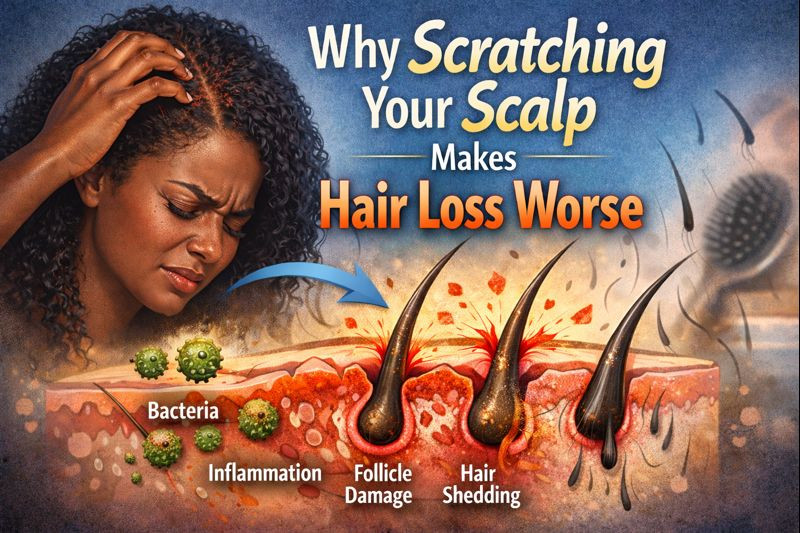
If your scalp itches, scratching feels almost automatic. It’s relief in the moment—until days or weeks later when you notice more hair in the sink, thinning patches, or a tender scalp that just won’t calm down.
What many people don’t realize is that scratching your scalp doesn’t just respond to hair loss—it can actively make it worse.
Whether you’re dealing with flakes, dryness, inflammation, stress-related shedding, or unexplained thinning, excessive scalp scratching quietly damages the very environment your hair needs to grow. And the more you scratch, the harder it becomes for hair follicles to recover.
In this article, we’ll break down exactly why scratching your scalp accelerates hair loss, what’s happening beneath the surface, and how to stop the cycle before permanent damage occurs.
The Scalp Is Living Skin—Not Just a Hair Surface
Your scalp isn’t just “where hair comes out.” It’s a living organ filled with:
-
Blood vessels delivering nutrients to follicles
-
Sebaceous glands producing protective oils
-
Immune cells that respond to irritation
-
Hair follicles anchored deep into the skin
Each hair strand grows from a follicle embedded in this environment. When the scalp becomes irritated, inflamed, or injured, the follicle responds by slowing growth, shedding hair, or shutting down completely.
Scratching disrupts this system in multiple ways.
What Happens When You Scratch Your Scalp?
Scratching isn’t harmless—even if it doesn’t break the skin visibly. Here’s what’s happening every time you dig in:
1. Micro-Tears Form in the Scalp Skin
Your fingernails are sharp enough to cause tiny, invisible cuts in the scalp. These micro-tears:
-
Compromise the scalp’s protective barrier
-
Allow bacteria and yeast to enter
-
Trigger inflammation
Inflammation is one of the top drivers of hair shedding.
2. Inflammation Strangles the Hair Follicle
When the scalp becomes inflamed, blood flow shifts toward healing the skin instead of nourishing hair follicles. Over time:
-
Hair growth cycles shorten
-
More hairs enter the shedding phase (telogen)
-
Regrowth becomes slower and weaker
Chronic inflammation can even cause miniaturization, where hairs grow back thinner each cycle.
3. Scratching Triggers the Stress Response
Pain and irritation activate your body’s stress hormones (like cortisol). Elevated cortisol levels:
-
Disrupt hair growth signals
-
Push follicles prematurely into shedding
-
Worsen conditions like telogen effluvium
Ironically, scratching increases the itch by activating nerve endings—creating a vicious loop.
The Itch–Scratch–Hair Loss Cycle (And Why It’s So Hard to Break)
Here’s how the cycle works:
-
Scalp becomes dry, irritated, or inflamed
-
You scratch to relieve the itch
-
Scratching damages the skin
-
Damage increases inflammation
-
Inflammation worsens hair shedding
-
Hair loss increases scalp sensitivity
-
Sensitivity causes more itching
This loop can continue for months or years unless interrupted.
Common Reasons People Scratch Their Scalp (And How Each Leads to Hair Loss)
Dry Scalp
Dryness makes nerve endings hypersensitive. Scratching removes even more protective oil, worsening dryness and irritation.
Result: brittle hair, breakage, slow regrowth
Dandruff & Flaking
Flakes often come from yeast overgrowth or inflammation—not dryness alone. Scratching spreads yeast and worsens scaling.
Result: inflamed follicles and increased shedding
Product Buildup
Heavy oils, gels, and creams can clog follicles. Scratching tries to “remove” buildup mechanically—but instead pushes debris deeper.
Result: blocked follicles, weak hair anchors
Allergic Reactions
Fragrances, preservatives, or harsh ingredients can cause scalp contact dermatitis. Scratching intensifies the immune response.
Result: redness, soreness, patchy hair loss
Stress & Anxiety
Many people scratch unconsciously during stress. This repetitive trauma can lead to traction-like damage to follicles.
Result: thinning at the crown, edges, or nape
Can Scratching Actually Cause Permanent Hair Loss?
Yes—if it becomes chronic.
While occasional scratching won’t permanently damage follicles, repeated inflammation can lead to:
-
Follicular fibrosis (scar tissue formation)
-
Reduced blood supply
-
Follicle miniaturization
-
In severe cases, scarring alopecia
Once a follicle is scarred, hair cannot grow back from it.
Why Scratching Hits Certain Areas Harder
Crown & Top of Head
These areas have denser nerve endings and are more sensitive to inflammation.
Hairline & Edges
Edges already have smaller follicles and lower blood flow—scratching accelerates thinning here quickly.
Nape of the Neck
Often overlooked, but frequent scratching here disrupts regrowth and causes breakage.
Signs Scratching Is Worsening Your Hair Loss
You may not realize scratching is the culprit until you notice:
-
Increased shedding after itchy episodes
-
Tender or sore scalp
-
Red patches or scabs
-
Hair thinning exactly where you scratch most
-
Hair that grows back weaker or finer
If hair loss improves when itching calms, scratching was part of the problem.
Why “Just Stop Scratching” Doesn’t Work
Telling someone not to scratch is like telling them not to blink. Itching is a neurological response, not just a habit.
To stop scratching, you must:
-
Calm inflammation
-
Repair the scalp barrier
-
Restore moisture balance
-
Reduce microbial overgrowth
Relief—not restraint—is the solution.
How to Calm an Itchy Scalp Without Causing Hair Loss
1. Address Inflammation First
Look for ingredients that soothe, not strip:
-
Aloe vera
-
Witch hazel
-
Tea tree (in low concentrations)
-
Peppermint or menthol (for nerve calming)
2. Restore Moisture Balance
Both dryness and excess oil can cause itching. Use lightweight hydration instead of heavy buildup.
3. Clean the Scalp Gently
Harsh shampoos worsen irritation. Opt for sulfate-free cleansers that don’t disrupt the scalp microbiome.
4. Massage—Don’t Scratch
Use the pads of your fingers, not nails. Gentle massage improves circulation without damaging follicles.
5. Reduce Triggers
Common itch triggers include:
-
Hard water
-
Fragrance overload
-
Tight styles
-
Synthetic fabrics on pillows
Removing triggers often reduces itching dramatically.
How Long Does It Take for Hair to Recover After You Stop Scratching?
-
1–2 weeks: Reduced soreness and itching
-
4–6 weeks: Decreased shedding
-
3–6 months: Stronger regrowth
-
6–12 months: Visible thickness improvement
Consistency matters more than speed.
When to See a Professional
If itching and hair loss persist despite gentle care, consult a dermatologist—especially if you notice:
-
Burning sensations
-
Patches of smooth scalp
-
Oozing or crusting
-
Sudden, rapid thinning
Early treatment can prevent permanent follicle damage.
Final Thoughts: Your Scalp Remembers Everything
Hair follicles don’t forget inflammation. Every scratch sends a signal—and repeated signals tell follicles the environment isn’t safe for growth.
The goal isn’t just to grow hair—it’s to create a calm, protected scalp environment where hair wants to grow.
If you’re serious about stopping hair loss, the first step may not be a growth product or supplement—it may be putting down your nails and healing your scalp instead.