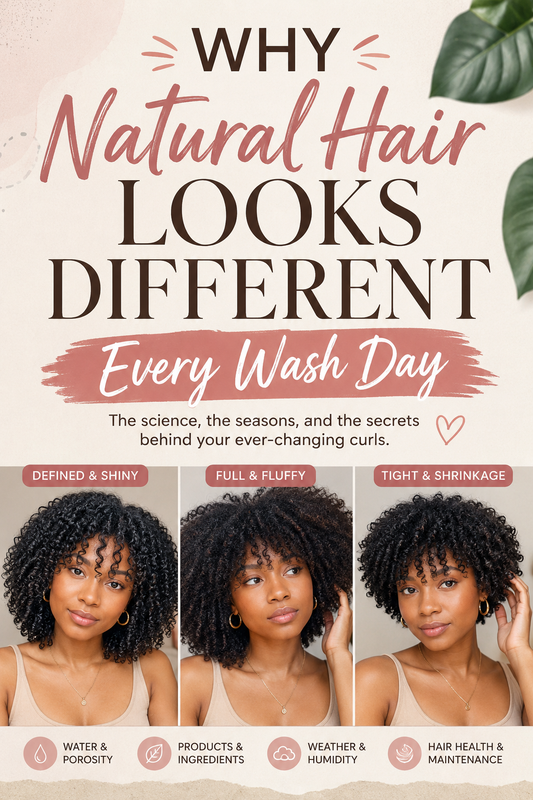
If you have natural hair, you may have experienced something that can feel almost impossible to explain: your hair can look completely different from one wash day to the next.
One week, your curls are defined, soft, shiny, and full of volume. The next wash day, using what seems like the exact same routine, your hair may look frizzy, shrunken, flat, dry, stretched, tangled, or less defined.
You might even find yourself wondering:
“Why does my natural hair never look the same after I wash it?”
The answer is that natural hair is highly responsive to its environment and to the way it is handled. Your hair's appearance isn't determined by your curl pattern alone. Water, humidity, product buildup, cleansing methods, conditioning, styling techniques, drying methods, shrinkage, porosity, weather, and even how much product you apply can influence the final result.
That means two wash days can produce noticeably different hairstyles—even when you think you followed the same routine.
The good news is that variation doesn't automatically mean something is wrong with your hair.
Understanding why natural hair looks different every wash day can help you develop a more predictable routine while also learning how to work with your hair instead of expecting it to behave exactly the same every time.
In this complete guide, we'll explore the biggest reasons natural hair changes from wash day to wash day, what those changes may tell you about your hair, and how to create more consistent results.
Is It Normal for Natural Hair to Look Different Every Wash Day?
Yes.
It is completely normal for natural hair to have some variation between wash days.
Natural hair is incredibly dynamic.
The shape and appearance of your curls, coils, or waves can change depending on:
- How hydrated your hair is
- The products you used
- How much product was applied
- How thoroughly your hair was cleansed
- Water temperature
- Humidity
- Weather
- Your styling method
- How wet your hair was during styling
- How your hair dried
- How much it shrank
- Whether you stretched your hair
- Product buildup
- The condition of your ends
- How long it has been since your last wash
- How much your hair was manipulated
Even small differences can change your final hairstyle.
Natural hair doesn't necessarily produce an identical result every time because the conditions surrounding each wash day aren't identical.
Understanding those variables is the first step toward consistency.
1. Your Hair's Moisture Level Changes
One of the biggest reasons natural hair looks different after every wash is moisture.
Your hair doesn't necessarily begin each wash day in the same condition.
For example, one week your hair may have been properly moisturized throughout the week.
Another week you may have:
- Spent more time outside
- Used more heat
- Worn your hair uncovered at night
- Skipped moisturizing
- Used products that created buildup
- Spent time in dry indoor air
- Exercised more frequently
- Worn a protective style
These differences can affect how your hair responds to shampoo, conditioner, and styling products.
Hair that begins wash day extremely dry may absorb and respond to products differently than hair that is already relatively moisturized.
Signs your hair may need more moisture include:
- Roughness
- Excessive tangling
- Dull appearance
- Increased frizz
- Stiffness
- Difficulty styling
- Less curl definition
Keeping your hair consistently moisturized between wash days can make your wash-day results more predictable.
2. Natural Hair Shrinkage Isn't Always the Same
Shrinkage is one of the most recognizable characteristics of curly, coily, and kinky hair.
Your hair might look shoulder-length one day and several inches shorter after washing.
But the amount of shrinkage isn't necessarily identical every time.
Your hair may shrink differently depending on how wet it becomes, how it is styled, what products are applied, and how it dries.
For example, soaking-wet hair that is allowed to air-dry without stretching may experience significant shrinkage.
Hair that is:
- Banded
- Twisted
- Braided
- Blow-dried
- African threaded
- Put into large sections
may dry in a more stretched state.
That's why your hair can appear considerably longer after one wash day than another even though you haven't lost any actual length.
Shrinkage can also affect volume.
More shrinkage can create a fuller, rounder hairstyle.
Less shrinkage can make hair appear:
- Longer
- Looser
- Flatter
- More elongated
Neither result necessarily indicates a change in your actual curl pattern.
3. Humidity Changes Your Natural Hair
Weather can dramatically affect natural hair.
Humidity refers to the amount of moisture in the air.
When humidity levels change, your hair can behave differently.
On humid days, some natural hair may:
- Expand
- Frizz
- Shrink
- Lose definition
- Become puffier
During dry weather, hair may instead feel:
- Drier
- Stiffer
- Less flexible
- More prone to static
- Less moisturized
Imagine doing the exact same wash-and-go during two different seasons.
Your products may be identical.
Your technique may be identical.
Your hair may still look different because the environment changed.
This is especially noticeable with wash-and-go styles.
A beautifully defined wash-and-go created during moderate weather might become considerably bigger in high humidity.
That's normal.
Your hair is interacting with the environment around it.
4. Your Hair May Have Product Buildup
Product buildup can dramatically change wash-day results.
Natural hair routines frequently involve several products, including:
- Leave-in conditioner
- Curl cream
- Gel
- Oils
- Butters
- Edge control
- Styling foam
- Moisturizing sprays
Over time, residue from these products can accumulate on the hair and scalp.
If your cleansing routine doesn't remove enough buildup, new products may not interact with your hair the same way they did previously.
You might notice that your curls suddenly don't define as well.
Your hair might feel:
- Coated
- Heavy
- Sticky
- Greasy
- Dull
- Limp
- Dry despite using moisturizer
This can sometimes lead people to assume that their favorite product suddenly stopped working.
The problem may actually be buildup.
Consider clarifying periodically.
A clarifying shampoo can provide a deeper cleanse than some gentle moisturizing shampoos.
How often you need clarification depends on your hair, scalp, products, and styling routine.
Someone using heavy butters and gels frequently may need to clarify more often than someone using lightweight products.
After clarifying, follow with conditioning appropriate for your hair because deeper cleansers can leave some hair feeling drier.
5. You May Be Using Different Amounts of Product
You may think you're using the same amount of product every wash day.
But unless you're literally measuring it, the amount probably varies.
One week you might apply a small amount of leave-in conditioner.
The next week you might apply twice as much without realizing it.
That can dramatically change your results.
Too much product may cause:
- Heavy hair
- Reduced volume
- Buildup
- Flaking
- Sticky curls
- Longer drying time
Too little product may cause:
- Frizz
- Dryness
- Poor definition
- Reduced hold
- Shorter-lasting styles
Experiment with product amounts until you understand approximately how much your hair needs.
Consistency makes your results easier to reproduce.
6. How Wet Your Hair Is During Styling Matters
This is an underrated reason natural hair can look different every wash day.
Some hairstyles work best when hair is soaking wet.
Others work better on damp or partially dried hair.
For example, applying gel to soaking-wet curls can create:
- Strong curl clumping
- Greater definition
- Less immediate frizz
- More shrinkage
Applying the same gel to damp hair might produce:
- More volume
- Less shrinkage
- Less curl clumping
- A slightly stretched appearance
Neither technique is automatically better.
They simply create different results.
If you're trying to reproduce a previous hairstyle, remember how wet your hair was when you applied your products.
7. Your Section Sizes Change
Section size has a surprisingly large effect on natural hairstyles.
This is especially true for:
- Twist-outs
- Braid-outs
- Wash-and-gos
- Flexi-rod sets
- Perm rod sets
- Bantu knot-outs
Imagine doing a twist-out with 20 small twists one week.
The following week you create only eight large twists.
Even with identical products, your final hairstyle will probably look different.
Smaller sections often provide greater control and definition.
Larger sections may produce:
- Bigger waves or curls
- More volume
- Less definition
- Faster styling
If you find a section size that creates your favorite results, try to repeat it.
8. Your Detangling Technique Changes Your Results
Detangling isn't only about removing knots.
It can also influence curl formation.
When curls and coils are properly hydrated and detangled, they may clump together more easily.
Hair that isn't thoroughly detangled can appear:
- Frizzier
- Less defined
- Uneven
- More tangled
- Harder to style
But aggressive detangling can create problems too.
Pulling, ripping, or repeatedly brushing through tangled hair may increase mechanical damage and breakage.
A gentler approach is usually better.
Many people find it helpful to:
- Divide hair into sections.
- Apply conditioner or another product that provides slip.
- Begin detangling near the ends.
- Gradually move toward the roots.
- Use your fingers or an appropriate detangling tool.
- Keep finished sections separated.
Consistency during detangling can contribute to more consistent styling results.
9. Your Conditioner Makes a Difference
Not all conditioners create the same results.
Some conditioners focus primarily on moisture and softness.
Others may contain strengthening or protein-related ingredients.
Depending on your hair's needs, the conditioner you use can influence how your hair feels after washing.
A rich moisturizing conditioner may leave hair feeling:
- Soft
- Flexible
- Smooth
- Easier to detangle
A strengthening treatment may temporarily make some hair feel firmer.
That doesn't mean one is universally better than the other.
The important thing is matching your routine to what your hair needs.
10. Your Hair Porosity Influences Wash Day
Hair porosity describes how readily hair takes in and loses moisture.
Porosity is influenced by the condition and structure of the hair's outer layer.
People commonly discuss hair as having:
- Lower porosity
- Medium porosity
- Higher porosity
These aren't perfectly rigid categories, and different parts of the same head can behave differently.
Lower-porosity hair
Lower-porosity hair may resist wetting and product absorption.
Products may sometimes appear to sit on the surface.
Higher-porosity hair
More porous hair may absorb water quickly but can also lose moisture readily.
Hair can become more porous through factors such as:
- Chemical processing
- Heat damage
- Weathering
- Mechanical damage
Porosity can therefore affect how products behave from one wash day to another.
11. Different Parts of Your Head Have Different Textures
Many people don't have one uniform curl pattern.
You might have tighter coils around your crown and looser curls near your nape.
Your front may behave differently from your sides.
One area may shrink more than another.
That's extremely common.
You might notice:
Front: looser curls
Crown: tighter coils
Sides: medium curls
Nape: softer or looser texture
Because of this variation, different sections may respond differently to the exact same product.
Consider styling by section instead of treating your entire head identically.
A section that becomes dry easily might benefit from a little more conditioner or leave-in.
A looser area may need less styling product.
Learning your individual sections can help you create a more balanced finished hairstyle.
12. Water Quality Can Affect Natural Hair
The water coming from your shower can influence how your hair feels.
Hard water contains relatively high concentrations of minerals such as calcium and magnesium.
Over time, mineral deposits can contribute to buildup.
Some people notice:
- Dull-looking hair
- Roughness
- Difficulty lathering shampoo
- Hair that feels coated
- Styling products behaving differently
If you travel frequently, you might notice that your hair behaves differently when washed in another city.
Water quality could be one reason.
A clarifying or chelating shampoo designed to address mineral buildup may be useful when hard-water buildup is a recurring concern.
13. Water Temperature Can Change the Experience
You might wash your hair with very warm water one week and lukewarm water the next without thinking about it.
Very hot water can be drying for the hair and scalp, especially when combined with strong cleansers or frequent washing.
Lukewarm water is generally a practical choice for cleansing.
The goal isn't to perform complicated temperature tricks.
Instead, avoid consistently using water so hot that your scalp or hair feels uncomfortable or excessively dry afterward.
14. Your Shampoo Can Change Your Final Results
Your cleanser establishes the foundation for everything that comes afterward.
A stronger cleanser may remove more:
- Oil
- Dirt
- Styling residue
- Sweat
- Product buildup
A gentler shampoo may preserve more of the hair's natural oils but may not remove heavy buildup as effectively.
That's why your hair may feel incredibly lightweight after one wash and heavier after another.
You may need different cleansers for different situations.
For example:
Regular wash day: gentle cleansing shampoo.
Heavy buildup: clarifying shampoo.
Hard-water buildup: appropriate chelating cleanser.
Your shampoo should match what is actually happening with your hair and scalp.
15. Your Styling Product Combination Matters
Layering products can get complicated.
Suppose you use:
- Leave-in conditioner
- Curl cream
- Oil
- Gel
Changing even one of those products can alter the final result.
Products don't always work perfectly together either.
Certain combinations can create:
- Flaking
- Residue
- Stickiness
- Reduced hold
- Excessive heaviness
If you've found a combination that consistently works, consider keeping track of it.
This makes troubleshooting much easier.
16. The Order You Apply Products Can Matter
Product order can influence the way your hair feels and styles.
Some natural hair routines include methods commonly called:
LOC
Liquid → Oil → Cream
or
LCO
Liquid → Cream → Oil
However, no single layering method works best for everyone.
Your hair may respond better to a much simpler routine, such as:
Leave-in → Gel
or
Leave-in → Styling cream
The important thing is observing what produces the best results for your individual hair rather than feeling obligated to follow a particular acronym.
17. Your Hair Isn't Equally Clean Every Wash Day
Think about everything your hair experiences between washes.
One week might involve:
- Several workouts
- Heavy gel
- Edge control
- Sweating
- Hats
- Frequent moisturizing
Another week might involve very little styling product.
Naturally, those two wash days won't begin with the same amount of buildup.
You may therefore need to adjust your cleansing instead of automatically performing the exact same routine.
18. Your Drying Method Changes Your Hair
How natural hair dries can completely transform its appearance.
Air-drying
Air-drying may produce significant shrinkage depending on your texture and styling method.
Diffusing
A diffuser can help speed drying and may influence curl shape and volume depending on technique.
Hooded dryer
A hooded dryer can provide relatively consistent airflow and is commonly used for sets and defined styles.
Blow-drying
Blow-drying with tension or a comb attachment can stretch natural hair considerably.
The same freshly washed hair can therefore look dramatically different depending on the drying technique.
19. Touching Your Hair While It Dries Can Create Frizz
It's tempting to touch your curls while they're drying.
You want to see whether they're soft.
You want to separate them.
You want to fluff your roots.
But manipulating wet or partially set curls can disturb curl clumps and increase frizz.
If you're trying to achieve maximum definition, try leaving your hair relatively undisturbed until it is dry.
Once dry, you can gently separate or fluff according to your preferred style.
20. Your Hair May Not Be Completely Dry
This is especially important for twist-outs and braid-outs.
Have you ever taken your twists down and thought:
“This looks perfect!”
Then an hour later your definition disappeared?
Your hair may not have been completely dry.
Taking down a set while the inside is still damp can cause the pattern to lose definition quickly.
Whenever possible, allow the style to dry completely before unraveling it.
This single change can make twist-out and braid-out results much more consistent.
21. Your Technique Changes Without You Realizing It
Humans aren't machines.
Even if you believe you're repeating the exact same routine, small changes happen.
You might:
- Twist tighter
- Apply more gel
- Use smaller sections
- Detangle longer
- Use more water
- Spend longer under the dryer
- Separate your curls differently
Each change can influence the final hairstyle.
This is why documenting a particularly successful wash day can be useful.
22. Your Ends Affect the Entire Hairstyle
Damaged, split, or severely weathered ends can affect the overall appearance of natural hair.
Your ends may:
- Tangle easily
- Look thinner
- Feel rough
- Create uneven twist-outs
- Make curls look less polished
Regular trimming or professional assessment when needed can help maintain the appearance and manageability of your hair.
Healthy-looking ends can make the entire hairstyle appear fuller and more uniform.
23. Your Scalp Condition Can Change
Wash day isn't only about your hair strands.
Your scalp matters too.
Sweat, oil, flakes, styling products, and dead skin can accumulate between washes.
If your scalp is particularly oily or has significant buildup, you may need a more thorough cleanse.
If your scalp frequently becomes itchy, painful, inflamed, develops sores, or has persistent severe flaking, consider speaking with a dermatologist rather than repeatedly adding oils or changing shampoos.
Persistent scalp problems aren't something you necessarily need to solve through trial and error.
24. Seasonal Changes Affect Natural Hair
Your summer hair routine may not work exactly the same during winter.
In summer, you may experience:
- Higher humidity
- More sweating
- More swimming
- Greater sun exposure
During winter, you may encounter:
- Cold outdoor air
- Dry indoor heating
- Hats
- Reduced humidity
That means your natural hair routine may need seasonal adjustments.
You might need richer conditioning during dry periods while preferring lighter products when humidity is high.
25. Sleeping Habits Affect Your Next Wash Day
What happens between wash days matters.
Cotton pillowcases can create more friction than smooth satin or silk surfaces.
Friction can contribute to:
- Tangling
- Frizz
- Dry-feeling hair
- Style disruption
Many people with natural hair prefer satin or silk bonnets, scarves, or pillowcases to help reduce friction while sleeping.
This won't guarantee identical wash-day results, but reducing unnecessary friction can make hair easier to manage.
26. Protective Styles Can Change How Your Hair Behaves
If your hair has been in braids, twists, cornrows, wigs, or another protective style, the next wash day may feel different.
Your hair may have been stretched for days or weeks.
Once water reaches it, your natural shrinkage can return quickly.
You may also experience considerable shed hair during detangling.
Remember that shedding occurs naturally every day, but shed hairs can remain trapped inside a long-term style until you remove it.
That can make wash day appear more dramatic than usual.
27. Your Curl Definition Depends on Technique
People often search for the perfect curl-defining product.
But technique matters tremendously.
For wash-and-go styles, methods might include:
- Raking
- Shingling
- Praying hands
- Finger coiling
- Brush styling
Each technique can produce a different curl appearance.
Shingling may produce highly separated definition.
Raking may create larger curl clumps.
Finger coiling can create deliberately shaped curls.
Changing your application technique can therefore make it seem as though your curl pattern changed.
28. Your Hair Density Influences the Final Look
Density refers to how much hair you have growing on your scalp.
People with higher-density hair may naturally achieve substantial volume.
Lower-density hair may appear flatter even when individual strands are healthy.
Density can also vary across the scalp.
Understanding your density helps you choose styling techniques that produce your desired appearance.
If you want more volume, you might:
- Separate curls more
- Fluff the roots
- Use lighter products
- Avoid excessive product application
If you want greater definition, you might:
- Use smaller sections
- Apply styling products thoroughly
- Limit manipulation while drying
29. Your Hair May Become Weighed Down
Sometimes the problem isn't dryness.
It's too much product.
Natural hair can become weighed down by excessive amounts of:
- Oils
- Butters
- Creams
- Leave-ins
- Gels
When this happens, hair may look:
- Flat
- Limp
- Greasy
- Less defined
- Heavy
More product doesn't always equal more moisture.
Water is central to hair hydration; oils and many styling products can help with lubrication, softness, conditioning, or reducing moisture loss, but simply coating hair with more oil isn't the same as adding water.
30. Your Hair Changes Over Time
Your natural hair today may not behave exactly the way it did several years ago.
Hair can change due to:
- Aging
- Hormonal changes
- Chemical processing
- Heat damage
- Haircutting
- Environmental exposure
- Changes in hair-care habits
New growth may also feel different from older, weathered ends.
Pay attention to what your hair is doing now, rather than trying to force it to behave the way it did years ago.
Why Does My Natural Hair Look Better Some Wash Days Than Others?
Usually because several favorable factors happened at the same time.
Your best wash day might have included:
- Thorough cleansing
- Proper conditioning
- Good detangling
- The right amount of product
- Correct section sizes
- Appropriate water level
- Minimal manipulation
- Complete drying
- Favorable weather
That's why recreating a great wash day requires more than remembering which curl cream you used.
You need to remember the entire process.
Why Does My Curl Pattern Look Different After Washing?
Your actual curl pattern doesn't necessarily change every time you wash your hair.
Instead, the appearance of your curls changes.
Water temporarily stretches hair because wet strands become heavier.
As the hair dries, curls contract.
Styling products and techniques then influence how curls group together.
A curl might appear:
- Tighter
- Looser
- Longer
- Smaller
- More defined
- Less defined
depending on how it was styled and dried.
That's why curl appearance alone shouldn't automatically be interpreted as a permanent texture change.
Why Does Natural Hair Look Shorter After Washing?
Usually: shrinkage.
Natural curls and coils contract as they dry.
Depending on your texture, the difference between stretched and shrunken hair can be dramatic.
Hair that appears several inches shorter after washing hasn't necessarily broken off.
You can carefully stretch a section to compare its actual length.
Shrinkage can actually demonstrate that curls are contracting, although the amount of shrinkage alone isn't a reliable measurement of hair health.
Why Is My Hair Defined One Wash Day and Frizzy the Next?
This can happen because of differences in:
- Humidity
- Product application
- Water level
- Buildup
- Drying technique
- Section size
- Gel hold
- Manipulation
For example, you might have styled soaking-wet hair during your defined wash day.
The following week, you may have towel-dried your hair before applying gel.
That seemingly small difference can significantly change the result.
Why Does My Natural Hair Feel Soft One Week and Hard the Next?
Look at your complete routine.
Ask yourself:
Did I clarify?
Did I switch conditioners?
Did I use a strong-hold gel?
Did I use a strengthening treatment?
Did I use significantly more product?
Did I spend more time outdoors?
Was my hair already dry before washing?
Hardness or stiffness can come from many causes, including certain styling products and buildup.
If your hair consistently feels unusually brittle or begins breaking excessively, reduce unnecessary manipulation and evaluate your routine carefully.
How to Make Natural Hair Wash Days More Consistent
You don't need your hair to look identical every week.
But if you're constantly getting wildly unpredictable results, a more consistent system can help.
Step 1: Keep Your Wash Schedule Relatively Consistent
You don't need to wash on exactly the same day every week.
However, allowing drastically different amounts of time between washes can change the amount of buildup you're dealing with.
Choose a schedule that works for your scalp, lifestyle, and hairstyle.
Step 2: Use a Reliable Shampoo
Find a shampoo that cleans your scalp and hair without consistently leaving your hair feeling excessively stripped.
Then keep a clarifying option available when you need deeper cleansing.
This creates a more predictable foundation.
Step 3: Condition Thoroughly
Apply conditioner throughout your hair rather than concentrating it in only one area.
Working in sections can help.
Pay particular attention to areas that tangle easily.
Step 4: Detangle Consistently
If you detangle in four sections one week and 12 sections the next, your results may vary.
Develop a repeatable method.
For example:
- Divide hair into six sections.
- Apply conditioner.
- Finger-detangle.
- Use a detangling brush or wide-tooth comb if desired.
- Twist each finished section.
This makes wash day easier to reproduce.
Step 5: Style at the Same Moisture Level
If your best wash-and-go happens on soaking-wet hair, remember that.
If your best twist-out happens on damp hair, remember that instead.
Don't randomly switch between wet, damp, and nearly dry hair if your goal is consistency.
Step 6: Keep Product Combinations Simple
Using six products can make troubleshooting difficult.
If your style fails, you won't know which product caused the issue.
A simpler routine might include:
- Shampoo
- Conditioner
- Leave-in
- Styler
You can always add products if your hair genuinely benefits from them.
Step 7: Apply Similar Amounts Every Time
You don't necessarily need a measuring spoon.
Simply develop consistency.
For example, divide your hair into the same number of sections and use approximately the same amount of product for each section.
Step 8: Repeat the Same Styling Technique
Don't compare a shingled wash-and-go with a quickly raked wash-and-go and expect identical results.
Technique matters.
When you discover a method you love, repeat it before changing products.
Step 9: Let Your Hair Dry Completely
This is especially important for:
- Twist-outs
- Braid-outs
- Rod sets
- Bantu knot-outs
Taking down damp hair can ruin an otherwise excellent set.
Give yourself enough drying time.
Step 10: Take Pictures
Your phone can become one of your most useful hair-care tools.
Take a picture after each wash day.
Record:
Date:
Shampoo:
Conditioner:
Leave-in:
Styler:
Technique:
Drying method:
Weather:
Final result:
After several weeks, patterns may become obvious.
You might discover that your hair looks best when you:
- Clarify periodically
- Style while soaking wet
- Use less cream
- Use more gel
- Create smaller sections
- Dry completely
That's far more useful than constantly buying new products.
Should You Change Products Every Time Your Hair Looks Different?
Probably not.
One disappointing wash day doesn't necessarily mean a product has stopped working.
Before replacing everything, ask what changed.
Was the weather different?
Did you use more product?
Was your hair completely clean?
Did you rush detangling?
Was your hair wetter or drier during styling?
Did you change your section sizes?
Did you let your hair dry completely?
Constantly switching products can actually make it harder to determine what your hair likes.
Give a routine enough consistency to evaluate it fairly.
How to Build a Simple Natural Hair Wash-Day Routine
A straightforward routine can make natural hair easier to understand.
1. Section Your Hair
Divide your hair into manageable sections before or during washing.
This can reduce tangling and make it easier to distribute products evenly.
2. Cleanse the Scalp and Hair
Apply shampoo according to the product directions and focus on removing sweat, oil, dirt, and buildup.
Rinse thoroughly.
3. Condition
Apply conditioner through the lengths of your hair.
Use this stage to gently detangle when appropriate.
4. Rinse Thoroughly
Leftover conditioner can sometimes interfere with styling products unless the conditioner is specifically designed to remain in the hair.
5. Apply Leave-In Conditioner
Apply an appropriate amount based on your hair's density, length, and needs.
6. Apply Your Styler
Choose your styler based on the hairstyle you want.
For example:
Wash-and-go: gel, mousse, or curl-defining product.
Twist-out: cream, foam, or styling product with suitable hold.
Braid-out: leave-in plus styling cream or foam.
7. Dry Completely
Air-dry, diffuse, or use a hooded dryer depending on the style.
8. Protect Your Hair at Night
Use a satin or silk bonnet, scarf, or pillowcase to reduce friction.
How Often Should You Wash Natural Hair?
There isn't one perfect schedule for everyone.
Your ideal frequency depends on factors including:
- Scalp condition
- Exercise
- Product use
- Hairstyle
- Hair density
- Lifestyle
- Buildup
Many people choose a weekly or every-other-week routine, but your scalp and hair may need something different.
If you're using heavy styling products frequently, waiting too long between cleanses can create substantial buildup.
A clean scalp and manageable hair should be the goal—not following an arbitrary number of days.
Should You Oil Natural Hair After Every Wash?
Oil isn't mandatory for everyone.
Some people enjoy using lightweight oils to add lubrication, reduce friction, or support softness.
Others find that oils make their hair heavy.
Most importantly, remember:
Oil isn't water.
If your hair is dehydrated, adding layer after layer of oil won't replace the water your hair needs.
Think of oil as one optional part of your routine rather than the entire solution to dryness.
How to Get More Defined Natural Curls After Wash Day
If definition is your primary goal, try focusing on technique.
Start with clean, conditioned hair.
Then:
- Work in small sections.
- Keep hair sufficiently wet.
- Apply your styling product evenly.
- Smooth or rake the product through the section.
- Encourage natural curl clumps.
- Avoid excessive touching.
- Allow the hair to dry completely.
- Separate only when necessary.
Remember that maximum definition isn't a requirement for healthy natural hair.
Frizz is a normal characteristic of textured hair.
How to Get More Volume After Wash Day
Maybe your problem isn't frizz.
Maybe your curls are too defined and your hairstyle looks flat.
In that case, consider:
- Using lighter products
- Using less gel
- Creating larger sections
- Separating curls after drying
- Gently lifting your roots
- Drying in a way that encourages volume
Definition and volume often involve a tradeoff.
More curl clumping can mean less volume.
More separation can mean more volume and some additional frizz.
Choose the look you enjoy.
What Your Wash Day Is Trying to Tell You
Instead of seeing every unexpected wash day as a failure, treat it as information.
If your hair feels coated:
You may have buildup.
If your hair feels unusually dry:
Review your cleansing, conditioning, styling, and environmental exposure.
If your curls won't hold:
Check your styling technique, product hold, and drying time.
If your hair suddenly looks shorter:
Consider shrinkage before assuming breakage.
If your hair looks flat:
You may be using too much product or a product that is too heavy for your desired style.
If your style becomes frizzy immediately:
Consider humidity, application technique, product hold, and whether the hair was disturbed while drying.
Your hair provides clues.
The goal is learning how to interpret them.
Stop Comparing Every Wash Day
One of the most frustrating parts of natural hair is expecting every wash day to recreate your favorite hair day.
You remember that one perfect twist-out.
Your curls were shiny.
The shape was perfect.
The volume was incredible.
Then you spend the next month trying to reproduce it.
But natural hair has variation.
Even professional stylists don't necessarily produce a completely identical curl arrangement every time.
Instead of chasing perfection, focus on broader indicators of healthy hair:
- Manageability
- Moisture balance
- Minimal unnecessary breakage
- Healthy-looking ends
- Comfortable scalp
- Elasticity appropriate for your hair
- Consistent care
A little frizz isn't failure.
Shrinkage isn't failure.
Different curl sizes aren't failure.
Your natural hair doesn't have to look identical every week to be beautiful or well cared for.
Frequently Asked Questions About Natural Hair Looking Different After Washing
Why does my natural hair look different every time I wash it?
Natural hair can look different because moisture levels, buildup, humidity, shrinkage, product amounts, styling techniques, drying methods, and other variables change between wash days.
Why are my curls tighter after some washes?
Your curls may appear tighter because of increased shrinkage, different styling techniques, greater water saturation, or less stretching during drying.
Why does my hair look longer after certain wash days?
Your hair may have been stretched more during styling or drying. Less shrinkage makes natural hair appear longer without changing its actual length.
Why is my natural hair sometimes curly and sometimes frizzy?
Humidity, styling product, application technique, water level, buildup, and manipulation can all influence the balance between curl definition and frizz.
Can products change your curl pattern?
Styling products can temporarily change how defined, elongated, or clumped your curls appear, but they don't necessarily permanently change the curl pattern growing from your follicles.
Why doesn't my wash-and-go look the same every time?
Small changes in product quantity, water level, section size, application method, weather, and drying can produce different wash-and-go results.
Does natural hair texture change?
It can change over time. Aging, hormones, chemical treatments, heat damage, and other factors can affect hair characteristics. However, short-term differences from one wash day to another are often related to styling and environmental conditions rather than a permanent texture change.
Why does my natural hair shrink more after some washes?
Hair may shrink more when it is thoroughly saturated and allowed to dry without stretching. Styling methods, products, humidity, and drying techniques can also affect its final appearance.
Is frizz a sign that my natural hair is damaged?
Not necessarily.
Frizz is common with curly and coily hair and can occur even when hair is healthy. Sudden frizz accompanied by significant breakage, roughness, split ends, or other changes may warrant closer attention to your routine.
How can I make my wash-day results more predictable?
Keep the major variables consistent: cleansing, conditioning, section sizes, product quantities, water level during styling, styling technique, and drying method.
Create a Wash-Day Journal
If you're serious about understanding your natural hair, start documenting your routine.
A simple journal can transform the way you approach wash day.
After every wash, write down:
1. How your hair felt before washing
Dry? Soft? Tangled? Oily?
2. Which shampoo you used
Gentle or clarifying?
3. Which conditioner you used
How long did you leave it on?
4. How you detangled
Finger-detangling? Comb? Brush?
5. Which styling products you used
Include the order.
6. How wet your hair was
Soaking wet? Damp? Partially dry?
7. Your styling technique
Twists? Braids? Shingling? Raking?
8. How you dried your hair
Air-dried? Diffused? Hooded dryer?
9. Weather conditions
Humid? Dry? Hot? Cold?
10. Your results
Take pictures.
After six to eight wash days, compare your best results.
You may discover a pattern.
That pattern becomes your personalized natural hair routine.
The Biggest Mistake: Assuming Your Hair Is the Problem
When natural hair produces unpredictable results, it's easy to blame the hair itself.
You may think:
“My texture is impossible.”
“My curls don't cooperate.”
“My hair doesn't know what it wants.”
But natural hair is simply responding to numerous variables.
The more variables you control, the easier your hair becomes to understand.
Instead of asking:
“Why won't my hair cooperate?”
Ask:
“What was different about this wash day?”
That question can completely change your natural hair journey.
Final Thoughts: Why Natural Hair Looks Different Every Wash Day
So, why does natural hair look different every wash day?
Because natural hair responds to moisture, water, products, cleansing, buildup, humidity, shrinkage, manipulation, styling techniques, drying methods, and environmental conditions.
Your hair isn't operating in a controlled laboratory.
Every wash day begins with slightly different circumstances.
One week your hair may be perfectly hydrated.
Another week it may have more buildup.
One wash day you may style soaking wet.
Another time your hair may be only damp.
One day the humidity may be low.
The next may be extremely humid.
All of these seemingly small differences can create noticeably different results.
Instead of trying to make every curl look exactly the same every week, focus on building a consistent, healthy natural hair routine.
Cleanse your scalp appropriately.
Condition your hair.
Detangle gently.
Use products that work well together.
Pay attention to how wet your hair is during styling.
Use consistent section sizes.
Allow your styles to dry completely.
Protect your hair while sleeping.
And most importantly, document what works.
The more you learn about your individual hair, the less mysterious wash day becomes.
Eventually, you'll stop wondering why your hair behaves differently and start recognizing exactly which variables create your favorite results.
Natural hair doesn't need to look identical after every wash to be healthy.
Your curls, coils, volume, shrinkage, and even a little frizz can change from week to week.
That's part of the versatility of natural hair.
Learn your hair, build a consistent routine, and allow your natural texture to do what it does best.