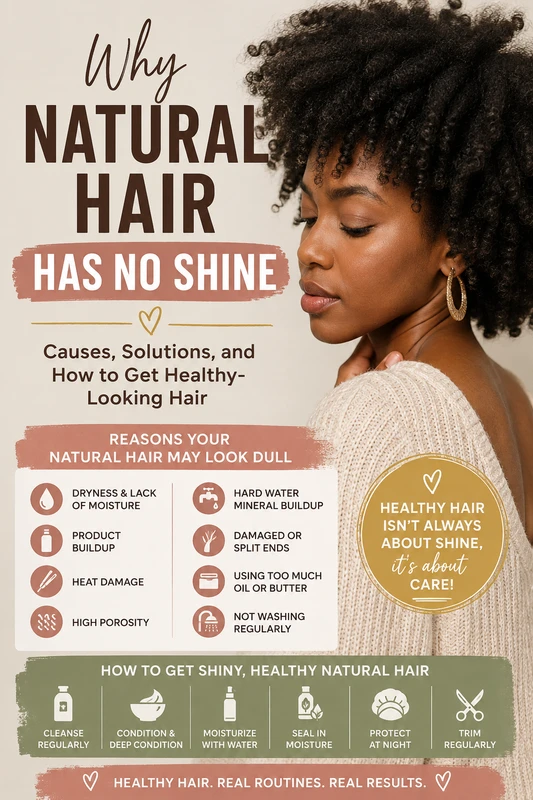
Natural hair can be healthy, strong, moisturized, and growing beautifully—and still not look especially shiny.
For many people with textured hair, especially tightly curled, coily, and kinky hair, shine behaves differently than it does on straight or loosely wavy hair. You may apply oils, conditioners, creams, and moisturizing sprays only to look in the mirror and wonder, “Why does my natural hair look so dull?”
The answer isn't always that your hair is unhealthy.
Natural hair's appearance is affected by the shape of the strands, the condition of the cuticle, moisture levels, product buildup, styling habits, porosity, environmental conditions, and even the way light hits your curls.
The good news is that dull-looking natural hair can often be improved without loading your hair with heavy grease or constantly adding oil.
In this complete guide, we'll explain why natural hair has no shine, what dull natural hair may be telling you, and how to make natural hair look shinier, softer, and healthier.
Why Does Natural Hair Have No Shine?
Natural hair may have less visible shine because its curls and coils prevent light from reflecting evenly across the hair shaft.
Think about a smooth, straight surface. Light can hit that surface and reflect in a relatively uniform direction, creating noticeable shine.
Now imagine that same light hitting hundreds of bends, curves, coils, and twists.
The light scatters in many directions.
That is essentially what happens with highly textured natural hair.
Straight hair can therefore appear extremely glossy even when it isn't necessarily healthier than natural hair. Meanwhile, healthy Type 4 hair can have relatively little visible shine because of its tightly coiled structure.
This is one of the most important things to understand:
Shine is not the same thing as healthy hair.
Healthy natural hair may have more of a soft sheen or glow than the mirror-like shine associated with straight hair.
However, if your hair suddenly becomes significantly duller, rougher, or drier than usual, there may be other factors involved.
1. Your Natural Hair Texture Naturally Reflects Less Light
One of the biggest reasons natural hair doesn't shine is simply its texture.
Curly and coily strands contain bends throughout the hair shaft. Every bend changes the direction in which light reflects.
The tighter your curl pattern, the more scattered the reflection may become.
This is why someone with Type 2 or Type 3 curls might notice more visible shine than someone with tightly coiled Type 4 hair.
But that doesn't mean one texture is healthier.
For Black women with kinky, coily, and Afro-textured hair, expecting your hair to shine exactly like straight hair can create unrealistic expectations.
Instead of chasing extremely glossy hair, look for signs such as:
- Softness
- Flexibility
- Elasticity
- Manageability
- Reduced breakage
- Moisture retention
- Healthy ends
- Comfortable scalp
- Natural sheen
These can tell you much more about the condition of your hair than shine alone.
2. Your Hair May Be Dry
Although natural texture affects shine, dryness can make dullness much more noticeable.
Dry natural hair often appears:
- Ashy
- Rough
- Frizzy
- Brittle
- Lifeless
- Dull
Natural hair is especially susceptible to dryness because scalp oils have difficulty traveling down curly and coily strands.
Sebum produced by your scalp can move relatively easily down straight hair. With curly hair, it must travel around bend after bend.
With tightly coiled hair, reaching the ends becomes even more difficult.
That means your ends—the oldest portion of your hair—may receive very little natural lubrication.
How to improve dry, dull natural hair
Focus on hydration rather than simply adding more oil.
A good routine may include:
- Washing your hair regularly.
- Using a moisturizing shampoo when appropriate.
- Conditioning after shampooing.
- Deep conditioning when your hair needs additional moisture.
- Applying a water-based leave-in product.
- Using a cream or moisturizer when needed.
- Sealing with a small amount of oil if your hair responds well to it.
Remember: oil and water do different things.
Adding more oil to dehydrated hair may make it temporarily greasy without solving the underlying dryness.
3. Product Buildup Can Make Natural Hair Look Dull
Sometimes the problem isn't too little product.
It's too much.
Natural hair routines can involve numerous products, including:
- Leave-in conditioner
- Curl cream
- Styling gel
- Edge control
- Hair butter
- Pomade
- Oil
- Scalp oil
- Moisturizing spray
- Mousse
Over time, residue from these products can accumulate on the strands.
Instead of reflecting light, the buildup creates a coating that makes your hair look dull.
You might think your hair needs another layer of oil when what it really needs is a thorough wash.
Signs of product buildup
Your hair may have buildup if:
- Products seem to sit on top of your hair.
- Your hair feels coated.
- Your curls don't respond like they normally do.
- Your hair looks dull after styling.
- Water seems to have difficulty penetrating your hair.
- Your hair feels greasy and dry at the same time.
- Your usual moisturizing products stop working effectively.
What should you do?
Use an appropriate clarifying shampoo periodically to remove stubborn residue.
How frequently you clarify depends on your hair, scalp, styling habits, and the products you use.
Someone using gels, butters, oils, and edge control frequently may need clarification more often than someone using a very simple routine.
After clarifying, follow with conditioner to restore softness and manageability.
4. Your Hair Cuticle May Be Raised
The cuticle is the outermost protective layer of your hair strand.
You can imagine the cuticle as tiny overlapping scales covering the hair shaft.
When the cuticle lies relatively smooth, the hair's surface can reflect more light.
When the cuticle is rough, raised, or damaged, light becomes more scattered.
The result?
Duller-looking hair.
Raised or damaged cuticles can also contribute to:
- Frizz
- Tangling
- Roughness
- Moisture loss
- Breakage
- Split ends
A healthy hair routine should therefore focus on protecting the cuticle rather than simply creating artificial shine.
5. Heat Damage Can Reduce Natural Hair Shine
Flat irons, blow dryers, curling tools, hot combs, and other heated styling tools can change how your hair looks and feels.
Excessive heat can damage the cuticle and affect the internal structure of the hair.
Heat-damaged natural hair may become:
- Rough
- Dry
- Brittle
- Frizzy
- Dull
- Difficult to moisturize
You might also notice sections of hair that no longer return to their original curl pattern.
How to reduce heat-related dullness
Limit unnecessary heat exposure.
When you do use heat:
- Use an appropriate heat protectant.
- Avoid repeatedly passing a flat iron over the same section.
- Don't automatically use the highest temperature.
- Give your hair breaks between heat-styling sessions.
- Keep your hair conditioned and moisturized.
If the hair has already suffered severe structural damage, products cannot permanently repair the strand to its original condition. You may eventually need to trim damaged sections as healthy hair grows.
6. High-Porosity Hair May Look Dull
Hair porosity describes how easily your hair absorbs and retains moisture.
High-porosity hair typically has a more raised or compromised cuticle structure.
Moisture may enter relatively easily—but it may also escape quickly.
As a result, high-porosity hair can sometimes feel moisturized immediately after wash day and dry again soon afterward.
It may also look less shiny because the rougher cuticle surface doesn't reflect light as evenly.
Signs commonly associated with high-porosity hair
You may notice:
- Hair dries quickly.
- Hair absorbs products quickly.
- Moisture doesn't seem to last.
- Hair tangles easily.
- Hair feels rough.
- Frizz develops quickly.
- Ends become dry easily.
If this sounds familiar, focus on consistent conditioning, gentle handling, reduced heat and chemical exposure, and products that help your hair retain moisture.
7. Your Ends May Be Damaged
Sometimes most of your hair looks fine, but your ends look dull.
Remember that your ends are the oldest part of your hair.
If you have 18 inches of hair, those ends have experienced years of:
- Washing
- Detangling
- Styling
- Clothing friction
- Pillow friction
- Weather
- Heat
- Manipulation
Eventually, ends can become weathered.
Damaged ends may appear:
- Thin
- Frizzy
- Rough
- Split
- Tangled
- Dull
No amount of oil can permanently repair split ends.
If your ends are badly damaged, trimming them can dramatically improve the overall appearance of your natural hair.
8. Hard Water Can Contribute to Dull Natural Hair
Sometimes your hair routine isn't the primary problem.
Your water may be contributing.
Hard water contains higher levels of dissolved minerals such as calcium and magnesium. Mineral deposits can accumulate on hair over time.
This can interfere with the way hair looks and feels.
You may notice:
- Dullness
- Roughness
- Dryness
- Reduced manageability
- Products not working as well
If you've moved to a new area and suddenly notice your natural hair behaving differently, your water quality could be one factor worth considering.
A chelating shampoo designed to remove mineral buildup may be helpful periodically when hard-water deposits are a problem.
9. You're Using Too Much Oil
This sounds strange.
Shouldn't oil make hair shiny?
Temporarily, yes.
But using excessive amounts of oil can eventually work against you.
Heavy oil application can attract dirt and combine with other styling products, creating buildup.
Then you add more oil because your hair looks dull.
Eventually, you're applying oil on top of oil, cream, gel, sweat, dirt, and dead skin.
The solution isn't another layer.
It may be wash day.
Use oil strategically
You don't necessarily need to coat your hair in oil every day.
Depending on your hair, a small amount may be enough to:
- Reduce friction
- Add temporary sheen
- Lubricate strands
- Help seal in moisture
- Improve styling
More isn't automatically better.
10. You May Need to Wash Your Hair
There's a persistent misconception that natural hair should rarely be washed because shampoo causes dryness.
But your hair and scalp need cleansing.
Over time, your hair collects:
- Sweat
- Sebum
- Styling products
- Environmental debris
- Oils
- Dead skin
- Dust
When all of that accumulates, your hair may become dull.
Freshly washed and properly conditioned natural hair often looks brighter because residue has been removed.
The goal is to find a cleansing frequency that keeps your scalp and strands clean without leaving your hair excessively dry.
11. Your Shampoo May Be Too Harsh
While cleansing is important, using a shampoo that leaves your hair excessively stripped can also contribute to dullness.
After shampooing, your hair shouldn't consistently feel like straw.
If every wash leaves your natural hair:
- Extremely tangled
- Rough
- Hard
- Brittle
- Squeaky
- Difficult to detangle
your routine may need adjustment.
Consider alternating between a moisturizing cleanser for routine washing and a stronger clarifying shampoo when deeper cleansing is actually necessary.
12. You're Skipping Conditioner
Conditioner is particularly important for textured hair.
A good conditioner can improve:
- Slip
- Softness
- Manageability
- Detangling
- Smoothness
When strands feel smoother, they can also appear more lustrous.
After shampooing, apply conditioner thoroughly, paying particular attention to your lengths and ends.
Use the opportunity to detangle gently while your hair has adequate slip.
13. Your Hair Needs Deep Conditioning
If your regular conditioner isn't enough, occasional deep conditioning may improve the way your hair feels and looks.
Deep conditioning can be especially useful after:
- Protective styles
- Heat styling
- Swimming
- Excessive sun exposure
- Periods of unusual dryness
- Intense manipulation
Your hair shouldn't necessarily need a deep conditioner every day or every time you touch it.
Use one according to your hair's actual needs.
14. Your Hair May Have Too Much Protein
Protein treatments can be useful for some hair routines, especially when hair has been damaged.
But more protein isn't always better.
If you continually use protein-heavy products when your hair doesn't need them, your hair may begin feeling stiff, hard, rough, or brittle.
That rough texture can make hair appear duller.
Check your product lineup.
You may unknowingly be using protein in your:
- Shampoo
- Conditioner
- Deep conditioner
- Leave-in
- Styling cream
If your hair suddenly feels hard or unusually stiff after introducing several protein products, consider simplifying your routine and focusing on moisture.
15. Chemical Damage Can Make Hair Dull
Chemical services can alter the hair's structure.
These include:
- Relaxers
- Permanent color
- Bleach
- Texturizers
- Certain straightening treatments
Repeated chemical processing can increase porosity and damage the cuticle, particularly when treatments overlap or aren't performed properly.
Chemically damaged hair may look dull because its surface has become rougher.
If you color or chemically process your natural hair, conditioning and minimizing additional damage become especially important.
16. Frizz Can Reduce the Appearance of Shine
Frizz isn't necessarily unhealthy.
Natural hair can be healthy and frizzy.
However, frizz changes how light reflects from the hairstyle.
A smooth twist-out with well-defined sections may appear shinier than the same head of hair after the curls separate and expand.
If your goal is more visible shine, reducing unnecessary friction and preserving definition may help.
Try:
- Satin or silk nighttime protection
- Low-manipulation styling
- Gentle detangling
- Proper conditioning
- Avoiding constant touching
- Using styling products appropriate for your desired look
17. Cotton Pillowcases May Contribute to Dryness and Friction
Your nighttime routine matters.
Natural hair can rub against bedding for hours while you sleep.
Cotton pillowcases can create more friction than smoother satin or silk surfaces and may also absorb some moisture and product from your hair.
Consider sleeping with:
- A satin bonnet
- A satin scarf
- A silk scarf
- A satin pillowcase
- A silk pillowcase
Reducing nighttime friction can help preserve your style, minimize tangling, and maintain a smoother appearance.
18. Your Hair May Need More Water, Not More Grease
When natural hair looks dull, many people immediately grab oil.
But ask yourself:
Does my hair need shine—or does it need moisture?
If the strands feel rough, brittle, stiff, and dry, adding grease to the surface may only disguise the problem temporarily.
Water is central to hydration.
A water-based leave-in or moisturizing product can help replenish moisture, while oils and butters can be used strategically afterward if they work for your hair.
How to Make Natural Hair Look Shinier
Now that you understand why natural hair can look dull, let's put everything together.
You don't need a complicated 15-product routine.
Consistency is usually more valuable.
Step 1: Cleanse Your Hair Properly
Start with clean hair.
Choose a shampoo appropriate for your current needs.
For regular cleansing, you may prefer a moisturizing shampoo. When significant buildup is present, use a clarifying shampoo.
If hard-water minerals are an issue, consider a chelating cleanser periodically.
Clean hair gives your moisturizing and styling products a better opportunity to work effectively.
Step 2: Condition Every Wash Day
Apply conditioner throughout your hair after cleansing.
Focus particularly on your ends.
Work in sections if your hair is thick.
Allow the conditioner to provide enough slip before attempting serious detangling.
Use your fingers or a suitable detangling tool and work gently from the ends upward.
Step 3: Deep Condition When Needed
If your hair is unusually dry, follow with a deep conditioner.
Apply it evenly rather than simply coating the top of your hairstyle.
Divide your hair into sections so every area receives product.
Pay attention to your crown and ends because these areas can sometimes be overlooked.
Step 4: Apply Leave-In Conditioner
After rinsing, apply a water-based leave-in to damp hair.
The goal is to maintain softness and manageability after wash day.
Don't assume that using twice as much product will produce twice as much moisture.
Start with a reasonable amount and adjust according to your hair.
Step 5: Seal in Moisture if Needed
Some natural hair responds well to a light layer of oil or another sealing product after moisturizer.
This may help slow moisture loss and add temporary sheen.
Popular oils used in natural hair routines include:
- Jojoba oil
- Argan oil
- Avocado oil
- Olive oil
- Coconut oil
- Castor oil
Every head of hair is different.
An oil that works beautifully for someone else's curls may feel too heavy or too light for yours.
Step 6: Protect Your Hair at Night
Don't spend an hour styling your hair only to rub it against cotton bedding all night.
Cover your hair with a satin or silk scarf or bonnet.
A satin or silk pillowcase can provide additional protection, especially if your bonnet comes off during the night.
Step 7: Reduce Heat
If your natural hair constantly looks dry and dull despite good moisturizing habits, examine your heat-styling routine.
Frequent high-temperature styling may be contributing to the problem.
Try reducing:
- Flat ironing
- Hot combing
- High-heat blow drying
- Repeated passes with heated tools
When you use heat, use an appropriate protectant and avoid excessive temperatures.
Step 8: Trim Damaged Ends
You don't have to cut healthy hair simply to follow a calendar.
But damaged, split, and severely weathered ends won't become permanently repaired because you apply oil.
Removing damaged ends can make the overall hairstyle appear fuller, smoother, and healthier.
Best Oils for Shiny Natural Hair
Oil can enhance natural sheen when used correctly.
Here are several commonly used options.
Argan Oil
Argan oil is popular because it can provide lubrication and shine without feeling as heavy as some thicker oils.
It can work particularly well as a finishing oil.
Use a few drops, rub them between your palms, and lightly smooth them over your hairstyle.
Jojoba Oil
Jojoba oil is another lightweight option commonly used on natural hair and scalp.
It can be incorporated into a moisturizing routine or used sparingly for additional sheen.
Avocado Oil
Avocado oil is frequently used by people with dry natural hair.
It can provide lubrication and help hair feel softer.
Olive Oil
Olive oil is heavier than some lightweight oils and may work well for people whose hair tolerates richer products.
Use modest amounts to avoid unnecessary buildup.
Castor Oil
Castor oil is thick.
A little goes a long way.
It can help seal the hair and add sheen, but applying too much can leave some hair types sticky or heavily coated.
Why Is My Natural Hair Dull After Washing?
If your natural hair looks particularly dull immediately after wash day, several things could be happening.
Your shampoo may be too stripping.
You may not be conditioning adequately.
You could have mineral buildup.
Your hair may be highly porous.
Your ends may be damaged.
Or you may simply be comparing your natural hair's sheen to the reflective shine of straighter textures.
Try evaluating how your hair feels, not just how shiny it looks.
Does it feel soft?
Can you manipulate it without excessive snapping?
Does it retain moisture reasonably well?
Are your ends healthy?
Those questions provide more useful information.
Why Is My Natural Hair Dull Even After Applying Oil?
Because oil doesn't automatically fix the underlying cause of dull hair.
If your hair has product buildup, putting oil over the buildup can make matters worse.
If your hair is dehydrated, oil doesn't replace the need for water.
If your cuticle is severely damaged, oil may temporarily improve appearance but cannot permanently reconstruct the strand.
And if your natural texture simply reflects less light, adding excessive oil won't transform the fundamental structure of your curls.
Use oil as one tool—not the entire hair-care routine.
Why Does My Hair Look Shiny When Wet but Dull When Dry?
This is extremely common with natural hair.
Water changes the way the hair surface interacts with light. Wet hair may appear darker, smoother, and shinier.
As the water evaporates and your curls contract, individual bends and coils become more visible.
Light begins scattering across the textured surface again.
Therefore, some of that wet-looking shine disappears.
This doesn't automatically mean your hair dried out.
Can Natural Type 4 Hair Be Shiny?
Absolutely.
Type 4 hair can have beautiful natural sheen.
However, its shine may not look like straightened hair.
Healthy Afro-textured hair often has a softer glow rather than an intense reflective shine.
Type 4 hair may look especially lustrous when it is:
- Clean
- Conditioned
- Moisturized
- Smoothly styled
- Free from excessive buildup
- Protected from unnecessary damage
Embrace what healthy shine looks like for your texture.
How to Add Shine to a Twist-Out
A defined twist-out can naturally create the appearance of more shine because strands are grouped together in organized sections.
For a shinier-looking twist-out:
Start with clean, conditioned hair.
Apply your leave-in.
Use a styling cream or mousse that works well with your hair.
Twist in neat sections.
Allow the hair to dry completely.
Before separating, apply a very small amount of lightweight oil to your fingertips.
Gently unravel the twists.
Avoid excessive separation if frizz isn't your goal.
At night, protect the style with satin or silk.
How to Add Shine to Braids
If you're wearing braids, focus on keeping your natural hair and scalp clean and appropriately moisturized.
A lightweight moisturizing spray can be easier to use than repeatedly coating the braids with heavy grease.
If desired, use a small amount of lightweight oil on the exposed hair or scalp.
Avoid saturating your braids with layer after layer of heavy products, which can contribute to buildup.
How to Keep Locs Looking Shiny
Locs require their own approach.
Heavy creams, waxes, and butters can accumulate inside or on the surface of locs, potentially making them look dull over time.
For healthy-looking locs:
- Clean them consistently.
- Rinse shampoo thoroughly.
- Avoid excessive wax and heavy products.
- Keep the scalp comfortable and moisturized as needed.
- Use lightweight oils sparingly.
- Protect locs while sleeping.
- Address buildup when necessary.
Clean locs with minimal residue often have a more natural-looking sheen than locs coated with layers of products.
Common Mistakes That Make Natural Hair Look Dull
If you want more shine, avoid trying to solve every problem with another product.
Some of the most common mistakes include:
Applying Oil Every Day
Daily oiling isn't necessary for everyone and may create buildup.
Rarely Washing Your Hair
A dirty, heavily coated strand may reflect less light.
Using Too Much Butter
Thick butters can be helpful for certain hairstyles but may weigh down hair when overused.
Skipping Conditioner
Cleansing without restoring softness can leave hair feeling rough.
Excessive Heat Styling
Repeated heat can damage the cuticle.
Ignoring Your Ends
Weathered ends can make an otherwise healthy hairstyle look dull.
Sleeping Without Protection
Nightly friction can increase frizz and dryness.
Constantly Touching Your Hair
Frequent manipulation can disrupt curl definition and increase frizz.
A Simple Weekly Routine for Dull Natural Hair
You don't need dozens of steps.
Try building your routine around the basics.
Wash Day
Cleanse your scalp and hair thoroughly.
Condition
Apply conditioner and detangle gently.
Deep Condition
Use a deep conditioner when your hair needs extra moisture.
Moisturize
Apply a water-based leave-in to damp hair.
Style
Choose a low-manipulation style such as twists, braids, a twist-out, braid-out, bun, or another style suitable for your hair.
Seal
If your hair benefits from oil, apply a small amount.
Nighttime
Cover your hair with satin or silk.
Midweek
Refresh only if needed.
Don't automatically pile new products onto your hair every morning and night.
Frequently Asked Questions About Dull Natural Hair
Why doesn't my natural hair shine?
Natural hair may naturally reflect less light because curls and coils scatter light. Dryness, buildup, damage, high porosity, mineral deposits, and styling habits can also reduce visible shine.
Does dull hair mean damaged hair?
Not necessarily.
Healthy tightly coiled hair may have relatively little visible shine. Look at softness, elasticity, breakage, moisture retention, and overall condition before assuming your hair is damaged.
What makes Black hair shiny?
Clean, conditioned, moisturized strands with relatively smooth cuticles typically appear more lustrous. Lightweight finishing oils can add temporary shine.
Which oil makes natural hair shine?
Argan, jojoba, avocado, olive, coconut, and castor oils are commonly used. The best option depends on your hair's texture, porosity, density, and response to different oils.
Why is my 4C hair not shiny?
4C hair contains numerous tight bends and coils that scatter light. It may naturally have more of a sheen than a glossy shine. This is normal and doesn't automatically indicate unhealthy hair.
Can I use oil every day for shine?
You can use oil as needed, but daily application isn't necessary for everyone. Excessive oil can contribute to buildup and eventually make hair appear dull.
Does deep conditioning make hair shiny?
Deep conditioning can improve softness, manageability, and smoothness, which may make hair appear more lustrous. Results depend on the condition of your hair and the products being used.
Why do my curls look dull?
Possible causes include natural curl structure, dryness, buildup, cuticle damage, hard water, weathered ends, excessive heat, or products that aren't suited to your hair.
Shine vs. Healthy Hair: Know the Difference
This distinction is worth repeating.
Extremely shiny hair isn't automatically healthy, and hair with minimal shine isn't automatically unhealthy.
You can coat damaged hair in silicone or oil and temporarily make it look glossy.
Meanwhile, healthy 4C hair without heavy finishing products might have only a subtle sheen.
Judge your natural hair by the complete picture.
Healthy hair should generally demonstrate reasonable:
- Strength
- Elasticity
- Softness
- Flexibility
- Moisture retention
- Manageability
You should also pay attention to changes.
If your hair was previously soft and manageable but suddenly becomes extremely dry, brittle, tangled, and dull, investigate what changed in your routine.
Final Thoughts: Why Natural Hair Has No Shine
If your natural hair has no shine, don't immediately assume something is wrong.
Curly, coily, kinky, and Afro-textured hair naturally interacts with light differently than straight hair. The bends and curves of textured strands scatter light, meaning healthy natural hair may have a subtle sheen rather than a glass-like shine.
However, persistent dullness combined with dryness, roughness, breakage, or excessive tangling can signal that your routine needs attention.
Start with the fundamentals:
Cleanse your hair consistently. Condition thoroughly. Keep your hair appropriately moisturized. Prevent excessive buildup. Limit damaging heat. Protect your hair at night. Trim damaged ends when necessary.
Most importantly, don't drown your hair in oil simply because you want it to shine.
Healthy-looking natural hair starts with healthy hair-care practices.
Once your strands are clean, conditioned, moisturized, and protected, a small amount of the right finishing product can enhance the beautiful natural sheen that's already there.
Your natural hair doesn't need to look like straight hair to look healthy.
Whether you have loose curls, tight coils, 4C hair, an Afro, twists, braids, or locs, the goal should be healthy, strong, moisturized hair—not artificial shine.