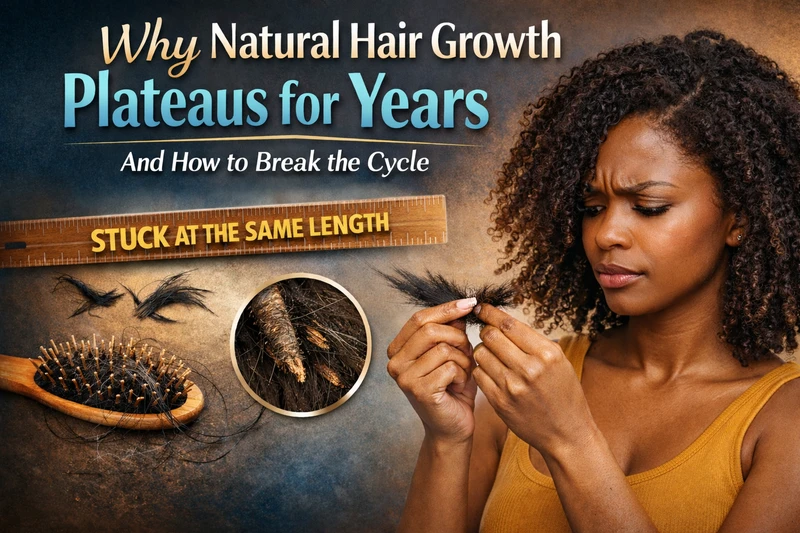
If you’ve been natural for years and your hair seems permanently stuck at the same length, you’re not imagining it. Hair growth plateaus are real—and extremely common in natural hair, especially textured, curly, coily, and kinky hair types.
You moisturize. You protect. You oil your scalp. You avoid heat. Yet somehow, year after year, your hair looks healthy but never longer.
This is one of the most frustrating experiences in the natural hair journey—and it usually has nothing to do with your hair “not growing.”
In this article, we’ll break down:
-
What a hair growth plateau actually is
-
Why natural hair can stay the same length for years
-
The hidden biological, mechanical, and lifestyle reasons growth stalls
-
Why length retention—not growth—is the real issue
-
How to restart visible progress without cutting your hair or starting over
If your hair feels “stuck,” this guide will finally connect the dots.
First: Your Hair Is Probably Growing—Just Not Staying
Let’s clear up the biggest myth first.
Most people experiencing a hair growth plateau are still growing hair. The problem is that the new length is being lost at the same rate it’s being gained.
Natural hair typically grows ¼ to ½ inch per month, regardless of texture. When hair stays the same length for years, it means:
-
New growth = breakage + shedding
-
Growth is canceled out by damage
-
Length retention has failed
So the question becomes: Why does natural hair struggle to retain length long-term?
1. Your Hair Is Breaking Faster Than You Realize
Breakage doesn’t always look dramatic.
Many naturals assume breakage means:
-
Big chunks of hair
-
Snapping sounds
-
Hair all over the sink
In reality, most breakage is microscopic—tiny splits and snapped strands that happen during everyday handling.
Common causes include:
-
Detangling too aggressively
-
Manipulating dry hair
-
Styling without enough slip
-
Constant tension at the same stress points
-
Styling while hair is weak or swollen
When breakage happens slowly but consistently, it creates the illusion of no growth.
2. The Ends Are Older Than You Think
Your ends may be years old.
If your hair is shoulder length, the ends could be 4–6 years old. That means they’ve survived:
-
Hundreds of wash days
-
Thousands of detangling sessions
-
Sun exposure
-
Friction from clothing and pillows
-
Weather changes
-
Protective styles
-
Styling tools
-
Product buildup
Over time, even “healthy” ends become fragile.
Without intentional end protection and trimming, your hair reaches a maintenance length—the maximum length it can retain under your current habits.
3. Moisture Isn’t Lasting—It’s Just Temporary
Many naturals moisturize daily but still have dry hair.
That’s because hydration isn’t the same as moisture retention.
Hair that:
-
Dries out within hours
-
Feels rough the next day
-
Needs constant reapplication
Isn’t retaining water at the cortex level.
When hair repeatedly swells and dries out, it becomes:
-
Weaker
-
More prone to breakage
-
Less elastic
This cycle quietly stalls length over time.
4. Your Routine May Be Too Gentle—or Too Aggressive
Yes, both are possible.
Too aggressive:
-
Over-manipulation
-
Excessive detangling
-
Frequent restyling
-
Styling wet hair without strength support
Too gentle:
-
Rare trimming
-
Avoiding protein entirely
-
Never clarifying
-
Ignoring scalp health
Natural hair needs balance, not extremes. When routines fall out of balance, growth plateaus creep in slowly.
5. Protective Styles Can Still Cause Damage
Protective styles don’t guarantee growth.
In fact, long-term plateaus often happen because of protective styling.
Common issues include:
-
Styles left in too long
-
Dry hair under braids or twists
-
Tension at the same hairline points
-
Skipping proper detangling after take-down
-
Hair matting at the roots
Protective styles protect length only when the hair underneath stays moisturized, clean, and stress-free.
6. Your Scalp Environment May Be Slowing Growth
Hair grows from the scalp—not the ends.
A scalp that is:
-
Inflamed
-
Dry
-
Tight
-
Itchy
-
Covered in buildup
Can slow the growth cycle and increase shedding.
Even mild, unnoticed scalp inflammation can:
-
Shorten the anagen (growth) phase
-
Increase telogen shedding
-
Reduce density over time
When growth slows while breakage continues, plateaus feel permanent.
7. Hormonal Shifts Can Create “Invisible” Plateaus
Natural hair growth is deeply influenced by hormones.
Growth plateaus often appear during:
-
Postpartum years
-
Perimenopause
-
After stopping birth control
-
High-stress seasons
-
Significant weight loss or illness
These shifts don’t always cause bald spots—but they do affect:
-
Growth speed
-
Shedding patterns
-
Strand thickness
The result? Hair grows slower while breaking at the same rate.
8. Aging Changes How Hair Retains Length
As we age, hair doesn’t just grow slower—it behaves differently.
Changes include:
-
Reduced sebum production
-
Lower elasticity
-
Slower cell turnover
-
Increased dryness
-
Weaker cuticle structure
Many naturals hit plateaus in their 30s and 40s because they’re using the same routine they used in their 20s, even though their hair has changed.
9. Stress Can Quietly Cancel Out Growth
Chronic stress raises cortisol, which:
-
Pushes hair into the shedding phase
-
Reduces nutrient delivery to follicles
-
Increases inflammation
-
Slows growth signals
Even if shedding isn’t obvious, stress can keep hair in a low-growth state for years.
This is one of the most overlooked causes of long-term plateaus.
10. You’ve Reached Your “Current” Retention Limit
Every routine has a maximum length it can support.
If your hair always stops at:
-
Shoulder length
-
Armpit length
-
Bra strap length
That’s not random.
It means your current habits can only protect hair up to that point. Beyond it, breakage increases.
Breaking a plateau requires changing how your hair is treated at longer lengths, not just waiting longer.
How to Break a Natural Hair Growth Plateau
Here’s what actually works:
1. Focus on Length Retention, Not Growth
Growth happens naturally. Retention is intentional.
Shift your mindset from:
“How do I grow hair?”
To:
“How do I keep every inch I grow?”
2. Strengthen Hair Before Styling
Weak hair breaks easily—even when moisturized.
Incorporate:
-
Protein balance
-
Strengthening leave-ins
-
Reduced manipulation on wash day
3. Protect Ends Like They’re Fragile (Because They Are)
Your ends should:
-
Stay moisturized
-
Be tucked away
-
Experience minimal friction
-
Be trimmed strategically—not excessively
4. Moisturize for Retention, Not Shine
Shiny hair isn’t always hydrated hair.
Focus on:
-
Water-based hydration
-
Layering moisture
-
Sealing properly
-
Avoiding frequent dryness cycles
5. Reset Your Scalp
Healthy growth needs a clean, calm scalp.
That means:
-
Gentle exfoliation
-
Reducing buildup
-
Supporting circulation
-
Addressing inflammation early
6. Reduce Daily Manipulation
The more you touch your hair, the more opportunities for breakage.
Simpler routines retain length faster.
7. Adjust Your Routine as Your Hair Gets Longer
Long hair needs different care than short hair.
As length increases:
-
Detangling must be slower
-
Sections must be smaller
-
Protection must increase
The Truth About Natural Hair Plateaus
A growth plateau isn’t a failure.
It’s feedback.
It’s your hair telling you:
“This routine got you here—but not further.”
Once you understand what’s really stopping retention, progress becomes predictable again.
Hair that has plateaued for years can start retaining length within 3–6 months of the right adjustments.
Final Thoughts
If your natural hair hasn’t grown past the same length in years:
-
You’re not broken
-
Your hair isn’t stubborn
-
Growth isn’t impossible
You’re simply at a point where strategy matters more than time.
When moisture lasts longer, breakage slows, scalp health improves, and manipulation decreases—growth becomes visible again.
And that’s when natural hair finally starts moving forward instead of standing still.