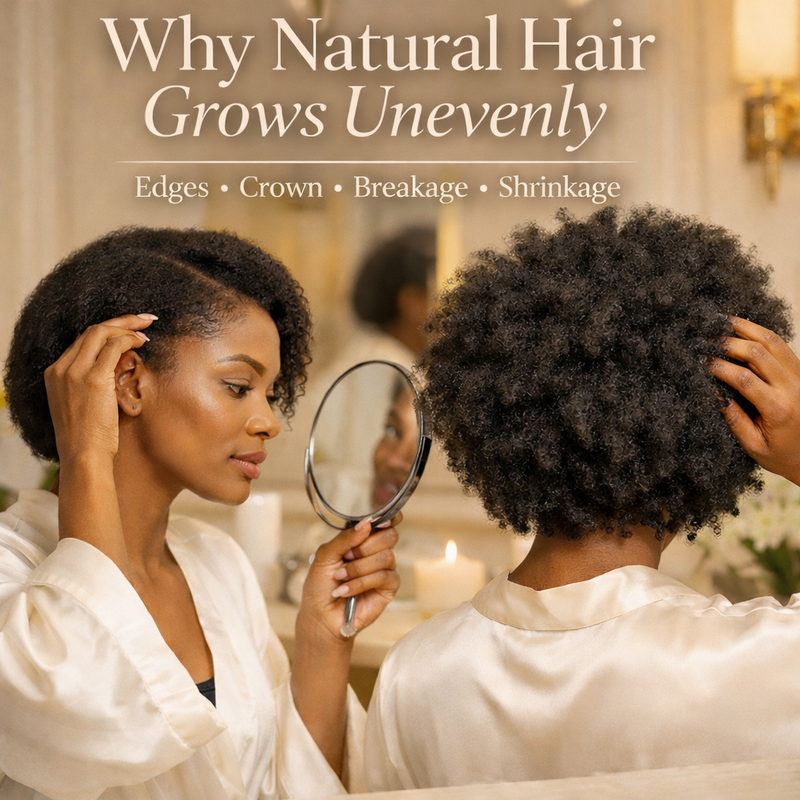
If you’ve ever stretched your natural hair and noticed one side longer than the other… or realized your crown grows faster than your edges… you’re not alone.
Uneven natural hair growth is one of the most common frustrations in the Black hair community. One section thrives. Another seems stuck. The back flourishes while the front barely moves. It can feel confusing, discouraging, and even unfair.
But here’s the truth: natural hair rarely grows perfectly evenly. And once you understand why, you can fix it.
In this in-depth guide, we’ll break down:
-
Why natural hair grows unevenly
-
The science of hair growth patterns
-
The most common causes of uneven length
-
Why edges grow slower
-
How protective styles affect balance
-
How to create a growth plan that evens everything out
Let’s get into it.
The Truth: Hair Does Not Grow at the Same Speed Everywhere
Every strand on your head grows independently. Hair grows in cycles, not all at once.
Each follicle operates on its own timeline, moving through three key phases:
-
Anagen (growth phase) – Active growth
-
Catagen (transition phase) – Growth slows
-
Telogen (resting phase) – Hair sheds
At any moment, different sections of your scalp are in different phases. That means:
-
One area may be actively growing
-
Another may be shedding
-
Another may be resting
This alone can create visible unevenness over time.
But that’s just the beginning.
1. Genetics: Your Blueprint Matters
Genetics determine:
-
Hair density
-
Growth speed
-
Hairline shape
-
Follicle strength
-
Anagen phase length
Some people naturally have:
-
Faster-growing crowns
-
Slower-growing temples
-
Naturally thinner edges
This doesn’t mean something is wrong. It means your scalp has regional differences.
For many Black women, the crown area grows fastest, while the edges and temples grow slower and are more fragile.
2. Your Edges Are Structurally Different
Let’s talk about edges.
Edges grow unevenly because:
-
The follicles are smaller
-
The hairs are finer
-
The growth cycle is shorter
-
The area experiences more friction
Edges are biologically more delicate than the rest of your hair.
Add in:
-
Tight ponytails
-
Braids
-
Edge control
-
Head wraps
-
Constant manipulation
And you have the perfect storm for slower growth.
This is why your back may be waist-length while your edges struggle.
3. Protective Styles Can Create Uneven Growth
Protective styles are meant to help growth — but if done improperly, they can cause imbalance.
Common issues:
-
Braids too tight at the front
-
Uneven tension across the scalp
-
Heavy extensions pulling on certain areas
-
Repeated styles in the same section
Over time, tension damages follicles. Damaged follicles enter prolonged resting phases or miniaturize — which slows growth.
If one section constantly carries more tension, it may lag behind the rest.
4. Breakage Is Mistaken for Slow Growth
This is one of the biggest misunderstandings.
Hair grows about 0.5 inches per month on average. If one section appears shorter, it may not be growing slower — it may be breaking faster.
Breakage causes uneven appearance.
High-breakage zones:
-
Nape (from scarves, collars, friction)
-
Edges (manipulation)
-
Crown (dryness)
-
One side (sleeping habits)
If you sleep mostly on your right side, your right side may be shorter due to friction.
5. Sleeping Position Affects Growth Retention
Yes — your pillow matters.
Cotton pillowcases pull moisture from hair and create friction. If you consistently sleep on one side, that side may:
-
Experience more breakage
-
Lose moisture faster
-
Shed more
Over months and years, this leads to visible imbalance.
Switching to satin or silk can dramatically reduce this effect.
6. Heat Damage Causes Uneven Length
Flat ironing certain sections more often can:
-
Weaken curl pattern
-
Thin strands
-
Increase breakage
Many naturals straighten the front more frequently than the back. That repeated heat exposure weakens those strands, causing them to snap before they retain length.
Even minimal heat damage can create long-term unevenness.
7. Hormonal Changes Impact Specific Areas
Hormones influence follicle behavior.
Areas most sensitive to hormonal shifts:
-
Edges
-
Crown
-
Temples
Hormonal changes from:
-
Birth control
-
Pregnancy
-
Stress
-
Thyroid imbalance
-
Aging
Can shorten the growth phase in certain regions.
This explains why some women notice thinning primarily in the crown or hairline.
8. Scalp Health Is Not Even Everywhere
Your scalp is skin — and like skin, it varies by area.
Some zones may be:
-
Drier
-
More inflamed
-
Oilier
-
More product-clogged
If buildup accumulates more heavily in one region, it can:
-
Block follicles
-
Slow growth
-
Increase shedding
Scalp massage and regular cleansing help balance this.
9. Trimming Patterns Can Create Illusions
If you trim unevenly — or avoid trimming certain sections — it can exaggerate imbalance.
Example:
-
You trim your back regularly.
-
You avoid trimming your front to “save length.”
Over time, the back stays healthy while the front becomes thin and wispy.
Even if lengths are similar, thickness differences create the illusion of uneven growth.
10. Curl Pattern Variations Make Hair Look Uneven
Many naturals have multiple curl patterns on one head.
Example:
-
4A in the front
-
4B in the middle
-
4C in the crown
Tighter curls shrink more.
So even if your crown is the same length as the front, it may appear shorter due to shrinkage.
Stretch your hair before comparing lengths.
11. Stress Impacts Certain Regions First
Chronic stress elevates cortisol levels.
Cortisol disrupts:
-
Blood circulation
-
Nutrient delivery
-
Follicle cycling
The crown and edges are often the first areas to reflect stress-related thinning.
If uneven growth started during a stressful period, this may be a factor.
12. Nutrition Deficiencies Show Up Unevenly
Low levels of:
-
Iron
-
Vitamin D
-
Protein
-
B vitamins
Can cause diffuse thinning — but sometimes certain areas appear worse.
Why? Because genetically weaker areas show stress first.
If your edges are naturally finer, they’ll react faster to deficiency.
13. Over-Manipulation of Certain Sections
Think about your styling habits.
Do you:
-
Play with your edges often?
-
Re-twist the front more?
-
Pick out the crown repeatedly?
-
Brush one side more frequently?
Repeated manipulation leads to micro-breakage — which accumulates.
14. Scar Tissue or Past Damage
Old damage can permanently affect growth in certain spots.
Examples:
-
Chemical burns
-
Tight braid damage
-
Relaxer overlap
-
Severe scalp inflammation
Once follicles are damaged deeply, growth may slow permanently in that zone.
How to Fix Uneven Natural Hair Growth
Now let’s talk solutions.
1. Focus on Retention, Not Just Growth
Your hair is growing.
Your job is to help each section retain length equally.
-
Deep condition weekly
-
Minimize heat
-
Reduce tension
-
Moisturize consistently
2. Baby the Weakest Section
Identify your shortest or thinnest area.
Give it extra care:
-
More moisture
-
Less tension
-
Looser styling
-
Gentle detangling
Treat it like fragile silk.
3. Improve Scalp Circulation
Scalp massage increases blood flow to follicles.
-
Massage 5 minutes daily
-
Use lightweight natural oils
-
Focus on slower-growing zones
Better circulation supports stronger growth cycles.
4. Rotate Protective Styles
Avoid repeating styles that stress the same sections.
Alternate:
-
Low buns
-
Loose twists
-
Flat twists
-
Wigs with breaks
Give your edges rest periods.
5. Trim Strategically
Instead of trimming everything evenly, try:
-
Dusting longer sections
-
Leaving shorter areas alone temporarily
This allows lagging sections to catch up.
6. Protect Hair at Night
-
Satin bonnet
-
Silk pillowcase
-
Loose pineapple
Reduce friction to prevent uneven breakage.
7. Check Your Nutrition
Balanced diet supports even growth.
Prioritize:
-
Protein
-
Leafy greens
-
Healthy fats
-
Hydration
If thinning is severe, consult a healthcare provider.
How Long Does It Take to Even Out?
Realistically?
3–12 months depending on:
-
Damage level
-
Breakage control
-
Health
-
Genetics
Consistency matters more than quick fixes.
When to See a Professional
Consider a dermatologist if you notice:
-
Bald patches
-
Rapid thinning
-
Scalp pain
-
Excessive shedding
Conditions like traction alopecia or hormonal disorders require medical attention.
The Emotional Side of Uneven Hair
Uneven natural hair can feel frustrating.
But remember:
-
Growth is happening
-
Your scalp isn’t broken
-
Most unevenness is fixable
-
Patience beats panic
The goal isn’t perfection.
It’s health.
Final Thoughts: Your Hair Is Growing — It Just Needs Balance
Natural hair grows unevenly for many reasons:
-
Genetics
-
Tension
-
Breakage
-
Hormones
-
Stress
-
Manipulation
-
Scalp health
The solution is not harsh products or extreme trimming.
It’s consistency, protection, moisture, and care.
With time, your shorter sections can catch up.
Healthy hair growth is a journey — not a race.
And uneven growth is not a failure.
It’s information.
Now that you understand it, you can correct it.