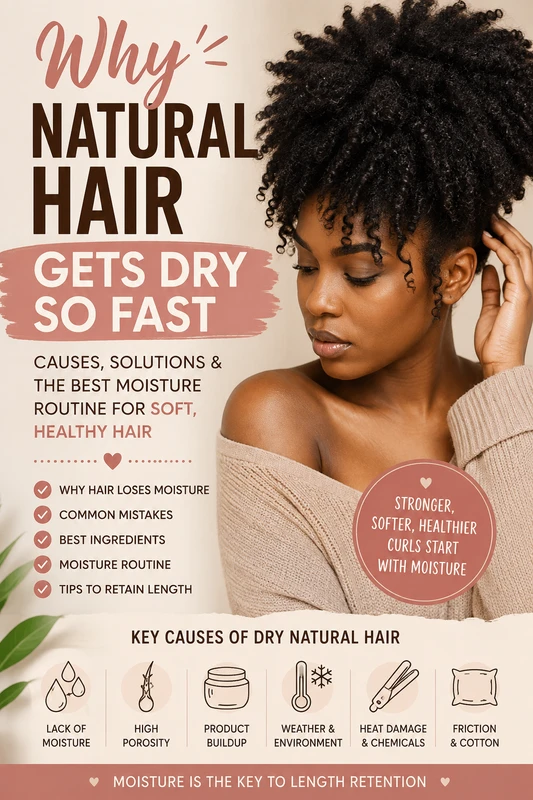
If you have natural hair, you may know the frustration of spending time moisturizing your curls, coils, or kinks only to discover that your hair feels dry again a few hours later—or by the next morning. You apply water, leave-in conditioner, cream, or oil, and your hair feels soft at first. Then suddenly, the softness seems to disappear.
So, why does natural hair get dry so fast?
Natural hair can become dry quickly because its curl pattern makes it harder for the scalp's natural oils to travel down the entire hair shaft. Tighter curls and coils have more bends and curves, which can leave the ends with less natural lubrication. Porosity, weather, product buildup, washing habits, heat, chemical treatments, friction, and your moisturizing routine can also influence how quickly your hair loses moisture.
The good news is that constantly dry natural hair doesn't necessarily mean you need to pile on more products. In many cases, improving how you cleanse, condition, moisturize, seal, and protect your hair can make a major difference.
In this complete guide, we'll explain why natural hair gets dry so quickly, how to recognize dehydrated hair, what mistakes may be making dryness worse, and how to build a natural hair moisture routine that helps your curls stay softer and more manageable.
What Does Dry Natural Hair Feel Like?
Before changing your routine, it helps to understand what dryness actually looks and feels like.
Dry natural hair may:
- Feel rough or straw-like
- Lose softness quickly after moisturizing
- Become difficult to detangle
- Tangle easily
- Look dull
- Feel brittle
- Develop knots frequently
- Snap during manipulation
- Have dry, fragile ends
- Produce excessive frizz
- Lack elasticity
- Feel crunchy after products dry
- Become harder to style
- Require frequent re-moisturizing
One important distinction is that dryness and breakage are not exactly the same thing. Hair can feel dry without immediately breaking, but chronically dry, poorly conditioned hair may become less flexible and more vulnerable to mechanical damage.
That is why maintaining a good moisture-and-conditioning routine is such an important part of retaining healthy-looking natural hair.
Why Does Natural Hair Get Dry So Fast?
There isn't usually one single cause. Several factors can contribute at the same time.
Understanding these causes makes it much easier to determine what your hair actually needs instead of continuously buying new products.
1. The Shape of Natural Hair Makes Oil Distribution More Difficult
One of the biggest reasons natural hair can feel dry is its structure.
The scalp naturally produces sebum. On straighter hair, these oils may move down the hair shaft relatively easily.
Curly and coily hair follows a much less direct path.
Every bend, curl, coil, and kink makes it more difficult for scalp oils to coat the entire strand evenly.
The tighter your curl pattern, the more noticeable this effect may be.
Your scalp might have plenty of natural oil while the middle and ends of your hair still feel dry.
This is also why applying excessive oil directly to the scalp isn't necessarily the solution. Your hair may need water-based moisture and conditioning, particularly through the lengths and ends.
2. Your Hair May Be Highly Porous
Hair porosity describes how readily hair interacts with and retains water and products.
High-porosity hair tends to take in moisture quickly but may also lose it relatively quickly.
This can happen naturally or become more pronounced after repeated damage from:
- Bleaching
- Coloring
- Relaxing
- Excessive heat
- Rough manipulation
- Chemical processing
- Environmental exposure
Someone with highly porous natural hair may experience a frustrating cycle:
Apply moisture → hair feels amazing → several hours pass → hair feels dry again.
If this sounds familiar, porosity may be an important part of the problem.
High-porosity hair often benefits from regular conditioning and products that provide enough lubrication and film-forming ingredients to slow moisture loss.
3. You May Be Using Oil Instead of Moisture
This is one of the most common natural hair mistakes.
Oil and water are not the same thing.
Applying oil to dry hair may improve shine and reduce friction, but oil alone does not necessarily provide the hydration that dry hair needs.
Think about your routine.
If your hair feels dry and your first response is:
"I need more oil."
You may be skipping an important step.
Many people get better results by starting with a water-based moisturizer or leave-in conditioner and then, when appropriate for their hair, applying a cream or small amount of oil to help reduce moisture loss and improve softness.
A simple routine could look like:
Water/water-based leave-in → moisturizing cream → optional oil or butter
You don't have to follow this exact order. The best sequence depends on your hair, porosity, density, climate, and products.
The key point is simple:
Don't expect oil alone to replace water-based moisture.
4. You're Not Using Enough Water
Natural hair routines can sometimes become extremely product-heavy.
Leave-in.
Cream.
Butter.
Oil.
Gel.
Styling foam.
Serum.
But one of the most important components of hydration is often overlooked:
Water.
Water temporarily enters and interacts with the hair fiber, while conditioners and styling products can help improve softness, lubrication, manageability, and moisture retention.
If you're applying thick products to completely dry hair every day, you may simply be coating hair that still feels dehydrated underneath.
Try applying your moisturizing products to damp hair instead.
For many people, freshly washed and conditioned hair provides an ideal starting point.
5. Your Shampoo May Be Too Harsh for Your Routine
Cleansing is necessary.
The goal isn't to stop using shampoo.
The goal is to use a cleanser and washing schedule that remove sweat, oil, buildup, and styling products without leaving your hair consistently rough and difficult to manage.
Some stronger cleansers can leave certain natural hair types feeling especially dry when used too frequently.
After shampooing, pay attention to how your hair feels.
Does it feel:
- Extremely tangled?
- Rough?
- Squeaky?
- Stiff?
- Difficult to separate?
- Unusually brittle?
Your cleanser, frequency, technique, or follow-up conditioning routine may need adjustment.
Clarifying shampoos can be extremely useful when you have heavy buildup, but they generally don't need to be your only cleanser.
You can alternate between cleansing approaches based on how much product you use and how your scalp and hair respond.
6. Product Buildup Can Make Hair Seem Dry
Here's an interesting problem:
Sometimes hair that feels dry actually has too much product sitting on it.
Repeated layers of:
- Oil
- Butter
- Gel
- Edge control
- Cream
- Silicone-containing products
- Styling products
can accumulate over time.
Eventually, your usual moisturizer may not seem to work as well.
You apply more product.
Your hair still feels dry.
So you apply even more.
Now the hair feels both dry and coated.
That is a strong sign that cleansing may be needed.
A proper wash can remove accumulated residue and give your conditioner and styling products a cleaner surface to work with.
7. You're Skipping Conditioner
If you have naturally dry hair, conditioner can be one of the most valuable parts of your wash-day routine.
Shampoo primarily cleanses.
Conditioner helps improve properties such as:
- Softness
- Slip
- Detangling
- Manageability
- Smoothness
- Flexibility
Skipping conditioner may leave natural hair feeling rougher, especially if your shampoo provides a deeper cleanse.
After shampooing, apply conditioner throughout your hair, concentrating particularly on the lengths and ends.
Use the slip from the conditioner to detangle carefully rather than aggressively pulling through dry tangles.
8. You're Not Deep Conditioning When Your Hair Needs It
Not everyone needs to deep condition at every wash.
However, natural hair that repeatedly feels rough, tangles easily, or has been exposed to heat or chemical processing may benefit from periodic intensive conditioning.
A deep conditioner may help improve softness and manageability, depending on the formula.
Consider incorporating deep conditioning when your hair consistently feels:
- Rough
- Difficult to detangle
- Less flexible
- Overprocessed
- Hard to manage
Follow the manufacturer's directions rather than leaving a treatment on for hours simply because "longer must be better."
More time doesn't always mean better results.
9. Your Ends Are Older and More Vulnerable
The ends are the oldest part of your hair.
If your hair is several years long, those ends have survived years of:
- Washing
- Combing
- Detangling
- Styling
- Weather
- Clothing friction
- Sleeping
- Manipulation
- Heat exposure
Naturally, they often require extra attention.
This is why your roots might feel moisturized while your ends become dry extremely quickly.
When moisturizing your hair, don't stop at the roots.
Work your moisturizing product carefully through the lengths and ends.
If the ends are severely split, thin, or damaged, moisturizing products cannot permanently repair them. A trim may be necessary.
10. You May Be Waiting Too Long Between Wash Days
There's a common misconception that natural hair should be washed as little as possible.
But extending wash day for too long isn't automatically healthier.
After enough time, your hair can accumulate:
- Sweat
- Oil
- Dead skin
- Dust
- Styling products
- Environmental debris
Your scalp may become uncomfortable, and your hair may become increasingly difficult to moisturize effectively.
Some people thrive with weekly washing. Others prefer a different schedule.
The right schedule depends on your scalp, activity level, hairstyle, product use, and hair needs.
Instead of following a universal rule, observe how your own hair responds.
11. You're Moisturizing Without Sealing or Protecting
You moisturize your hair.
It feels wonderful.
Then it feels dry again later.
In some cases, the problem isn't getting moisture into your routine.
The problem is keeping your hair feeling conditioned and protected afterward.
After applying a water-based moisturizer or leave-in, some natural hair types respond well to a cream, butter, serum, or small amount of oil.
These products can reduce friction and form a coating over the strand.
However, more isn't always better.
If you apply so much oil or butter that your hair feels greasy, heavy, or coated, reduce the amount.
The goal is soft, manageable hair—not hair saturated with product.
12. You're Using Too Much Heat
Heat can transform natural hair quickly.
Blow dryers, flat irons, curling irons, and hot combs can all be useful styling tools.
But repeated high-temperature styling can damage the hair fiber.
Over time, excessive heat exposure may contribute to:
- Increased breakage
- Roughness
- Split ends
- Changes in curl pattern
- Reduced manageability
If your hair has suddenly become much harder to keep moisturized after frequent straightening, heat damage may be contributing.
Try reducing the temperature and frequency.
Use a heat protectant when appropriate.
And avoid repeatedly passing a flat iron over the same section.
13. Your Hair Is Constantly Rubbing Against Cotton
You can have a great daytime moisture routine and still wake up with dry-feeling hair.
Why?
Your nighttime routine matters.
Hair repeatedly rubbing against rough fabrics can experience friction.
Cotton pillowcases can also absorb some moisture and oils from the surface.
Many people with natural hair prefer sleeping with:
- Satin bonnets
- Satin scarves
- Satin pillowcases
- Silk pillowcases
These smoother surfaces can help reduce friction while you sleep.
Less friction can also help preserve hairstyles and reduce tangling.
14. You Wear Your Hair Out Constantly
There's nothing wrong with wearing your natural hair loose.
Afros, wash-and-gos, twist-outs, and braid-outs can be beautiful ways to enjoy your texture.
But loose hair is also more exposed to:
- Wind
- Clothing
- Dry indoor air
- Sun
- Manipulation
- Tangling
If you're struggling with persistent dryness and breakage, periodically wearing low-manipulation styles may help.
Examples include:
- Two-strand twists
- Braids
- Buns that aren't excessively tight
- Flat twists
- Tucked styles
Protective styling should still be comfortable.
A hairstyle that causes excessive tension isn't truly protective.
15. Weather Can Dry Out Natural Hair
Your environment matters.
Hair behaves differently depending on humidity and temperature.
Winter can be particularly challenging because you may encounter:
- Cold outdoor air
- Low humidity
- Indoor heating
- Wind
These conditions can leave natural hair feeling rougher or drier.
During particularly dry seasons, you may need to adjust your routine.
That could mean using a richer conditioner, moisturizing more frequently, wearing low-manipulation styles, or protecting your hair from harsh wind.
16. Swimming Can Contribute to Dryness
Do you swim frequently?
Pool water and repeated chlorine exposure can leave hair feeling dry or rough, particularly without proper preparation and aftercare.
Before swimming, it can help to wet your hair thoroughly with clean water.
After swimming, rinse your hair well and cleanse as appropriate.
Follow with conditioner.
Frequent swimmers may need to pay closer attention to conditioning than people who rarely enter chlorinated pools.
17. Chemical Processing Can Increase Dryness
Relaxers, permanent color, bleaching, and other chemical services alter the hair structure.
Depending on the treatment and condition of your hair, processed strands may become more porous and vulnerable to damage.
If your natural hair became significantly drier after coloring or bleaching, your routine may need additional conditioning and gentler handling.
Processed hair can also require a better balance between conditioning, strengthening treatments, and moisture.
Avoid assuming that every rough strand needs protein, though.
Too many strengthening treatments can sometimes leave hair feeling stiff.
18. You May Be Using Too Much Protein
Protein treatments can be useful for some damaged hair.
But using protein-heavy products constantly isn't automatically better.
Hair that feels stiff, hard, rough, or unusually inflexible after repeated protein treatments may need a change in routine.
Read your ingredient labels.
If your shampoo, conditioner, leave-in, mask, and styling cream all emphasize protein or strengthening, consider whether you're overdoing it.
A balanced routine matters.
19. You're Handling Your Hair While It's Bone Dry
Manipulating very dry natural hair can increase friction and make detangling difficult.
Imagine trying to separate a tightly tangled section with no lubrication.
The more you pull, the greater the chance of unnecessary breakage.
Before major detangling, many people benefit from adding water and a product with good slip.
Then work in sections.
Start near the ends.
Gradually work upward.
Be patient.
Your fingers and tools should work through the hair rather than rip through it.
20. You're Not Moisturizing in Sections
Natural hair can be incredibly dense.
You may think you're moisturizing your entire head when the product is really sitting mostly on the outer layer.
This happens especially with thick, dense natural hair.
Try dividing your hair into four, six, or eight sections.
Apply product to each section individually.
Work it through from roots to ends.
Pay extra attention to:
- Crown
- Nape
- Hairline
- Ends
These areas can easily be missed.
Low-Porosity Hair and Fast Dryness
Low-porosity hair deserves special attention because it can create a different problem.
Instead of absorbing water and products quickly, low-porosity hair may resist wetting at first.
You might notice:
- Water beading on the hair
- Products sitting on top
- Heavy buildup
- Hair taking time to become fully saturated
- Thick products weighing the hair down
The solution isn't necessarily adding more product.
In fact, that can make the problem worse.
Low-porosity hair may respond better to lighter layers of water-based products and regular cleansing to prevent excessive buildup.
Warm water during wash day can also help thoroughly wet the hair before conditioning.
You don't need extremely hot water.
High-Porosity Hair and Fast Dryness
High-porosity hair presents almost the opposite challenge.
It may become wet very quickly and then seem to lose that hydrated feeling quickly.
Signs may include:
- Hair gets wet quickly
- Hair dries relatively fast
- Frequent tangles
- Roughness
- Products seem to disappear
- Ends feel especially dry
- History of bleach, color, or heat damage
High-porosity hair may benefit from richer conditioners and styling products that leave behind a protective film.
Reducing further heat and chemical damage is also important.
How to Keep Natural Hair Moisturized Longer
Now that we've covered the causes, let's build a better routine.
Step 1: Cleanse Your Hair Regularly
Healthy moisture routines begin with clean hair.
Wash often enough to prevent excessive buildup.
For many people, somewhere around every 7–14 days is a practical starting point, although individual needs vary considerably.
People who exercise frequently, sweat heavily, swim, or use lots of styling products may prefer more frequent cleansing.
Pay attention to your scalp.
Step 2: Condition Every Wash Day
After shampooing, apply a moisturizing conditioner.
Work in sections.
Focus on the lengths and ends.
Allow the product to remain on the hair for the recommended amount of time.
Then rinse.
This creates a better foundation for your leave-in and styling products.
Step 3: Deep Condition as Needed
If your hair is particularly dry or difficult to manage, incorporate a deep conditioner periodically.
You might start with once every few wash days and adjust according to your results and the product directions.
Don't assume you need to deep condition every day or leave treatments on overnight.
Consistency is more important than excess.
Step 4: Moisturize While Hair Is Damp
After washing, don't necessarily wait until your hair is completely dry.
Working with damp hair often makes product distribution easier.
Apply your leave-in or moisturizer section by section.
Make sure you're actually reaching the interior layers of dense hair.
Step 5: Apply a Leave-In Conditioner
A good leave-in can provide:
- Slip
- Softness
- Manageability
- Easier styling
- Reduced friction
Look for a formula that works with your hair rather than simply choosing the heaviest product available.
Fine natural hair may prefer lighter leave-ins.
Thicker or highly porous hair may prefer richer formulas.
Step 6: Add a Cream if Needed
After your leave-in, you can apply a styling cream if your hair needs additional softness or hold.
This can be especially useful for:
- Twist-outs
- Braid-outs
- Two-strand twists
- Protective styles
Don't overload the hair.
Start with a small amount and increase only when necessary.
Step 7: Seal or Finish With Oil if It Works for You
Some people like finishing their moisturizing routine with a small amount of oil.
Popular hair oils include:
- Jojoba oil
- Coconut oil
- Olive oil
- Avocado oil
- Castor oil
- Argan oil
Different oils behave differently, and not every oil works equally well for every person's hair.
Oil should complement your routine—not replace cleansing, conditioning, or water-based moisture.
The LOC Method for Dry Natural Hair
One popular technique is the LOC method.
LOC stands for:
L – Liquid or Leave-In
O – Oil
C – Cream
The idea is to layer products strategically.
For example:
- Dampen the hair or apply leave-in.
- Apply a small amount of oil.
- Finish with cream.
Some people love this method.
Others find it too heavy.
There is no rule saying every person with natural hair must use LOC.
The LCO Method
Another popular option is LCO:
L – Liquid or Leave-In
C – Cream
O – Oil
In this version, oil goes last.
Some people prefer this order because the cream provides moisture and softness before the final oil layer.
Try both methods if you're unsure.
The best routine is the one that keeps your hair manageable without causing excessive buildup.
How Often Should You Moisturize Natural Hair?
There is no universal answer.
Some people need additional moisture every few days.
Others can go nearly a week after wash day.
The frequency depends on:
- Porosity
- Density
- Hair length
- Climate
- Hairstyle
- Product choice
- Chemical processing
- Heat use
Instead of automatically moisturizing every morning and night, touch and observe your hair.
If it still feels soft and flexible, adding more products may be unnecessary.
If it feels rough and dehydrated, a light refresh may help.
How to Refresh Dry Natural Hair Between Wash Days
You don't necessarily need another full wash every time your hair starts feeling dry.
Try a simple refresh.
Quick Natural Hair Moisture Refresh
- Divide hair into sections.
- Lightly mist each section with water or a water-based moisturizing spray.
- Apply a small amount of leave-in if needed.
- Smooth the product through the section.
- Concentrate on dry ends.
- Add a tiny amount of oil or cream if your hair responds well to it.
- Retwist or braid the section if desired.
- Cover your hair with satin at bedtime.
Avoid completely saturating your hair every night unless your routine or style requires it.
Why Does Natural Hair Feel Dry the Next Morning?
If your hair feels great at night but dry every morning, investigate your sleep routine.
Ask yourself:
Are you sleeping directly on cotton?
Is your bonnet constantly falling off?
Are your ends exposed?
Is your bedroom extremely dry?
Are you going to sleep with already-dry hair?
A satin bonnet or scarf can reduce friction.
If your bonnet frequently comes off, consider using a satin pillowcase as a backup.
You can also loosely twist or braid your hair before bed to reduce tangling.
Why Does Natural Hair Feel Dry After Washing?
Hair shouldn't consistently feel extremely rough immediately after every wash.
If it does, investigate the entire wash-day routine.
Possible causes include:
- Shampoo is too harsh for your needs
- Too much shampoo is being used
- Shampoo isn't being rinsed completely
- Conditioner doesn't provide enough slip
- Hair has significant buildup
- Hard water is affecting the hair
- Heat or chemical damage is present
- Hair is being handled too roughly
Experiment with one variable at a time.
Changing six products simultaneously makes it difficult to determine which change actually helped.
Can You Over-Moisturize Natural Hair?
Yes, balance matters.
Keeping hair hydrated and conditioned is beneficial, but repeatedly soaking and coating the hair without allowing it to dry properly can create other problems.
Hair that is constantly wet for prolonged periods may also create an undesirable scalp environment.
You don't need to drench your hair several times every day.
A good moisture routine should make your hair easier to manage—not create a never-ending cycle of applying more and more product.
Why Your Natural Hair Is Dry Even After Using Expensive Products
Price doesn't determine whether a product is right for your hair.
A $40 moisturizer isn't automatically better than a $10 moisturizer.
The formula matters.
So does your routine.
You could purchase the most expensive natural hair products available and still struggle with dryness if you're:
- Applying products over buildup
- Skipping conditioner
- Using excessive heat
- Sleeping without protecting your hair
- Ignoring damaged ends
- Using too much protein
- Applying oil without water-based moisture
- Over-cleansing
- Not distributing products thoroughly
Technique matters just as much as product choice.
A Weekly Routine for Very Dry Natural Hair
If your hair dries out quickly, try using a structured routine.
Wash Day
1. Cleanse the scalp and hair
Use a shampoo appropriate for your hair and buildup level.
2. Condition
Apply conditioner generously enough to coat the hair and provide slip.
3. Detangle
Detangle carefully in sections.
4. Deep condition when needed
Use a moisturizing treatment according to its instructions.
5. Apply leave-in
Work through damp hair.
6. Apply styling cream
Use enough to soften and style without creating heavy buildup.
7. Finish as needed
Apply a small amount of oil or finishing product if your hair benefits from it.
8. Style
Choose a low-manipulation style when possible.
Midweek
Check your hair.
If it still feels soft, leave it alone.
If the ends feel dry, lightly mist them and apply a small amount of moisturizer.
Don't automatically coat your entire head with heavy products.
Nighttime
Protect your hair with satin or silk.
Keep long hair contained so the ends aren't constantly rubbing against bedding.
Best Hairstyles for Keeping Natural Hair From Feeling Dry
Low-manipulation hairstyles can make moisture maintenance easier.
Good options may include:
- Two-strand twists
- Flat twists
- Loose braids
- Mini twists
- Tucked buns
- Cornrows without excessive tension
- Other comfortable protective styles
The hairstyle itself isn't magic.
The benefit comes partly from reducing daily combing, brushing, detangling, and environmental exposure.
Your hair still needs cleansing and conditioning while wearing long-term protective styles.
Don't Forget Your Scalp
Dry hair and a dry scalp are different issues.
Your scalp is skin.
Your hair strands are fibers.
If your scalp is flaky, itchy, irritated, painful, or developing persistent scaling, simply applying more hair oil may not address the underlying issue.
Avoid automatically assuming every flaky scalp means "dry scalp."
Product buildup, dandruff, skin conditions, and irritation can produce similar symptoms.
Persistent or severe scalp problems are worth discussing with a dermatologist.
Does Drinking More Water Fix Dry Natural Hair?
Hydration is important for overall health, but drinking extra water isn't a direct replacement for a proper hair-care routine.
If you're already adequately hydrated, dramatically increasing water intake won't necessarily transform chronically dry strands overnight.
External hair care still matters.
Focus on:
- Proper cleansing
- Conditioning
- Gentle handling
- Heat protection
- Reducing damage
- Appropriate moisturizing products
- Nighttime protection
Does Oil Moisturize Natural Hair?
This question deserves a clear answer.
Oil is not the same thing as water-based moisture.
Oils can provide lubrication, shine, reduce friction, and help form a protective coating around the strand.
But if your hair is dehydrated, simply adding layer after layer of oil may leave you with hair that feels greasy while still feeling dry underneath.
Start with water or a water-based moisturizing product.
Then decide whether your hair benefits from oil afterward.
How to Know If Your Natural Hair Routine Is Working
Don't judge your routine only by how your hair looks immediately after styling.
Watch how your hair behaves over several weeks.
Signs your routine may be working include:
- Hair stays softer longer
- Detangling becomes easier
- Less snapping during manipulation
- Ends feel smoother
- Hair tangles less
- Styles remain manageable longer
- You need fewer emergency moisture sessions
- Hair feels more flexible
Healthy hair care is usually about consistent habits rather than overnight transformations.
10 Common Mistakes That Make Natural Hair Dry Faster
If your hair seems impossible to keep moisturized, check whether you're making any of these mistakes:
- Applying only oil to dry hair
- Skipping conditioner
- Using excessive heat
- Sleeping without satin or silk protection
- Ignoring split or damaged ends
- Allowing excessive product buildup
- Overusing protein treatments
- Manipulating hair while extremely dry
- Applying moisturizer only to the surface
- Using the exact same routine year-round despite weather changes
Correcting even two or three of these habits can significantly improve how your hair feels.
Frequently Asked Questions About Dry Natural Hair
Why is my natural hair always dry?
Natural hair may feel persistently dry because scalp oils have a more difficult time traveling down curly and coily strands. Porosity, damage, cleansing habits, weather, product buildup, heat, and your moisturizing routine can also contribute.
Why does my natural hair dry out so quickly after moisturizing?
Your hair may have higher porosity, your products may not provide enough conditioning or film-forming benefits, or your hair may be exposed to conditions that increase moisture loss. Applying products over heavy buildup can also make moisturizers seem ineffective.
Should I moisturize natural hair every day?
Not necessarily. Some hair needs refreshing every few days, while other hair remains soft much longer. Moisturize according to how your hair feels rather than automatically applying multiple products every day.
Is water good for natural hair?
Yes. Water is fundamental to hair hydration, but constantly wetting hair isn't necessary. Water-based leave-ins and moisturizers can be useful between wash days.
Should I oil my natural hair every day?
Usually, daily oiling isn't necessary for everyone. Too much oil may lead to buildup without solving the underlying cause of dryness. Use an amount and frequency appropriate for your hair and scalp.
What is the best oil for dry natural hair?
There isn't one universally best oil. Popular choices include jojoba, argan, coconut, avocado, olive, and castor oils. Hair responds differently to each one.
Why are my ends always dry?
Your ends are the oldest and often most weathered portion of your hair. They experience years of manipulation and environmental exposure. Give them extra conditioning and protection, and trim severely split or damaged ends when necessary.
Why is my natural hair dry after deep conditioning?
Possible reasons include buildup, damage, an unsuitable conditioner, excessive protein use, incomplete product distribution, or a cleansing routine that is too harsh for your hair.
Is dry natural hair unhealthy?
Occasional dryness doesn't automatically mean your hair is unhealthy. However, chronically rough, brittle hair may be more vulnerable to tangling and breakage, so improving your routine can help protect length.
Can dry natural hair still grow?
Yes. Hair growth occurs at the scalp, so dry strands don't necessarily mean your follicles have stopped producing hair. However, excessive breakage can prevent you from retaining length, making it seem as though your hair isn't growing.
Dryness vs. Hair Growth: Why Length Retention Matters
This distinction is extremely important for anyone trying to grow long natural hair.
Your hair can be growing normally from the scalp while breaking at the ends.
Imagine your hair grows at the roots, but fragile ends repeatedly snap off.
You may look in the mirror six months later and think:
"My hair isn't growing."
The problem may actually be length retention.
A moisture-conscious routine can help support length retention by improving manageability and reducing unnecessary mechanical damage.
Combine that with:
- Gentle detangling
- Regular cleansing
- Conditioning
- Limited high heat
- Comfortable hairstyles
- Nighttime protection
- Appropriate trims
The goal isn't simply to "make hair grow."
The goal is to protect the hair you've already grown.
Build a Routine Instead of Chasing Products
One of the biggest lessons in natural hair care is that you don't necessarily need a bathroom cabinet full of products.
You need a routine you can follow consistently.
A simple routine might include:
Shampoo → Conditioner → Leave-In → Styler → Optional Oil → Protective Night Routine
That's enough for many people.
The exact products can change.
The principles remain similar.
Clean the hair and scalp.
Condition the strands.
Provide water-based moisture.
Reduce friction.
Protect the ends.
Minimize unnecessary damage.
Repeat consistently.
Final Thoughts: Why Natural Hair Gets Dry So Fast
Natural hair tends to experience dryness more easily because curls and coils make it harder for natural scalp oils to travel from the roots to the ends. Porosity, heat damage, chemical processing, product buildup, weather, washing habits, nighttime friction, and improper moisturizing techniques can make the problem even more noticeable.
If your natural hair gets dry extremely fast, don't immediately reach for another layer of oil.
Look at your entire routine.
Are you cleansing buildup regularly?
Are you conditioning after shampooing?
Are you using water-based moisture?
Are you protecting your ends?
Are you using too much heat?
Are you sleeping on satin or silk?
Are you applying products thoroughly in sections?
Small changes can make a major difference over time.
Natural hair doesn't have to feel perfectly moisturized every second of every day. The goal is to create a healthy routine that helps your curls and coils remain soft, manageable, flexible, and protected from unnecessary breakage.
When you stop focusing only on adding more products and start focusing on cleansing, conditioning, moisture, protection, and consistency, keeping natural hair moisturized becomes much easier.