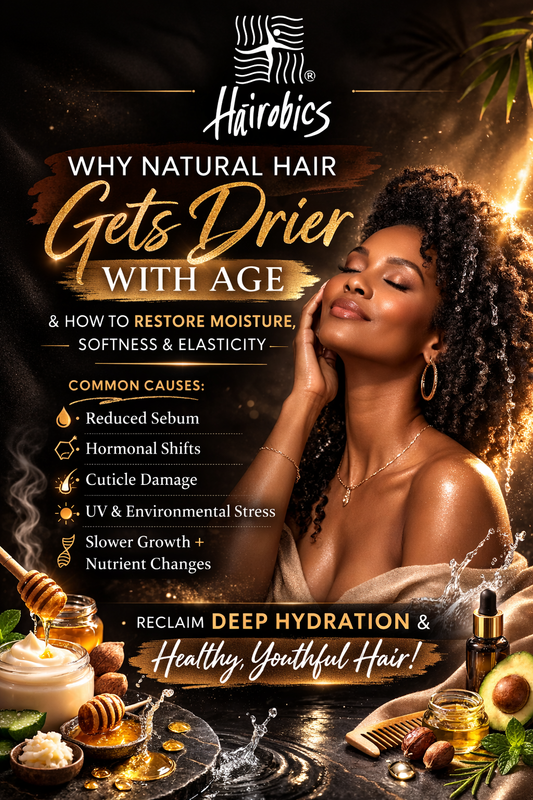
Natural hair is dynamic. It shifts with hormones, stress levels, environment, and lifestyle. But one change many women don’t expect is this:
Natural hair often gets drier with age.
If your curls feel rougher, your coils look duller, your scalp flakes more easily, or your once-soft twist-outs now feel brittle — you are not imagining it.
Let’s break down why natural hair becomes drier over time and exactly how to restore softness, elasticity, and long-term hydration.
What “Dry Hair” Really Means
Before we talk about aging, we need clarity.
Dry hair is not just hair that “feels dry.”
It means:
-
The hair shaft lacks adequate moisture and internal hydration.
-
The cuticle layer is lifted or damaged.
-
The scalp may be producing less natural oil.
-
The hair has reduced elasticity and flexibility.
Natural hair (especially Type 3 and Type 4 textures) is already more prone to dryness because the spiral shape makes it harder for scalp oils to travel down the hair shaft.
As we age, that natural challenge becomes amplified.
1. Reduced Sebum Production With Age
Your scalp produces a natural oil called sebum. Sebum lubricates the hair shaft and protects it from moisture loss.
As you get older:
-
Sebaceous glands slow down.
-
Oil production decreases.
-
The scalp barrier weakens.
-
Hair becomes less naturally conditioned.
This change often begins in your 30s and becomes more noticeable in your 40s and beyond.
Why This Matters for Natural Hair
Curly and coily hair already struggles to distribute oil evenly. When oil production declines, the ends suffer the most.
You may notice:
-
Rough ends
-
Increased split ends
-
Hair that tangles more easily
-
Loss of shine
-
Increased breakage
The dryness isn’t just cosmetic — it affects hair retention and growth.
2. Hormonal Shifts and Moisture Loss
Hormones significantly impact hair texture and hydration.
Key Hormones That Affect Hair Moisture
-
Estrogen
-
Progesterone
-
Testosterone
-
Thyroid hormones
-
Cortisol (stress hormone)
During major life transitions such as:
-
Postpartum recovery
-
Stopping birth control
-
Perimenopause
-
Menopause
Estrogen levels drop. Estrogen helps hair stay fuller, softer, and more hydrated.
When estrogen declines:
-
Hair strands become thinner.
-
Moisture retention decreases.
-
Scalp dryness increases.
-
Hair may feel coarser.
This is one of the biggest reasons women notice texture changes after 35 or 40.
3. Cuticle Layer Weakening Over Time
The hair cuticle is the outer protective layer of each strand.
With age:
-
The cuticle becomes thinner.
-
Repeated washing and styling cause wear.
-
UV exposure degrades protein bonds.
-
Chemical treatments weaken structure.
When the cuticle is compromised:
-
Moisture escapes faster.
-
Hair becomes porous.
-
Strands lose elasticity.
-
Breakage increases.
Aging hair often becomes more porous, meaning it may absorb water quickly — but it also loses it just as fast.
4. Environmental Damage Compounds Over Time
By the time you reach your 30s and 40s, your hair has experienced:
-
Years of sun exposure
-
Heat styling
-
Protective styles
-
Tight braids
-
Chemical relaxers (if previously used)
-
Hard water mineral buildup
-
Urban pollution
The cumulative damage weakens the hair’s moisture barrier.
UV radiation alone can degrade keratin proteins and dry the cuticle layer.
5. Slower Hair Growth Cycles
Hair growth phases change with age.
The anagen (growth) phase shortens.
The telogen (resting) phase increases.
This means:
-
Hair grows more slowly.
-
Strands may be thinner.
-
The hair cycle becomes less efficient.
Thinner strands hold less moisture.
And because natural hair depends heavily on elasticity for styling (twist-outs, braid-outs, wash-and-gos), reduced elasticity can make dryness feel more intense.
6. Scalp Barrier Weakening
Healthy hair starts with a healthy scalp.
As we age:
-
The scalp microbiome shifts.
-
Barrier function weakens.
-
Inflammation increases.
-
Sensitivity becomes more common.
You might notice:
-
Flakes
-
Itchy scalp
-
Tightness after washing
-
Increased dryness between wash days
A compromised scalp cannot effectively support hydrated strands.
7. Diet and Nutrient Absorption Changes
With age, the body’s ability to absorb nutrients changes.
Key nutrients for moisture retention include:
-
Omega-3 fatty acids
-
Vitamin E
-
Vitamin A
-
Biotin
-
Zinc
-
Iron
-
Protein
If nutrient levels decline, hair may:
-
Lose shine
-
Become brittle
-
Shed more easily
-
Feel dry even when moisturized
Internal hydration is just as important as topical moisture.
8. Increased Porosity Over Time
Hair porosity often increases with age due to:
-
Cuticle damage
-
Environmental stress
-
Heat styling history
-
Hormonal shifts
High porosity hair:
-
Absorbs moisture quickly
-
Loses moisture quickly
-
Requires sealing
-
Needs consistent deep conditioning
If you feel like you moisturize but your hair still feels dry the next day — porosity may be the issue.
Signs Your Natural Hair Is Drying Due to Age
Here are common indicators:
-
Hair feels rough even after conditioning.
-
Moisture doesn’t last.
-
Increased breakage.
-
Ends thin out quickly.
-
Hair shrinks more than usual.
-
Curls lack definition.
-
Scalp feels tight or flaky.
If multiple signs apply, age-related moisture decline may be the cause.
How to Restore Moisture to Aging Natural Hair
Now let’s focus on solutions.
Dryness with age is manageable. You just need a more strategic approach.
1. Upgrade Your Moisture Routine
As sebum production declines, you must replace what your scalp once provided naturally.
Essential Moisture Routine
-
Hydrating shampoo (no harsh sulfates)
-
Deep condition weekly
-
Leave-in conditioner
-
Cream moisturizer
-
Lightweight oil to seal
Layering moisture becomes essential after 35.
2. Increase Deep Conditioning Frequency
Aging hair benefits from:
-
Protein + moisture balance
-
Steam treatments
-
Longer conditioning times
-
Warm towel wraps
Look for ingredients like:
-
Aloe vera
-
Glycerin
-
Honey
-
Shea butter
-
Ceramides
-
Panthenol
3. Support the Scalp Directly
If your scalp produces less oil, nourish it manually.
Use lightweight scalp oils that:
-
Support circulation
-
Reduce inflammation
-
Protect the barrier
Massage your scalp 3–4 times weekly to stimulate blood flow and oil distribution.
4. Protect Hair From UV Damage
UV rays weaken aging hair faster.
Solutions:
-
Wear hats
-
Use UV-protectant sprays
-
Avoid prolonged direct sun exposure
5. Reduce Heat Styling
Heat accelerates moisture loss in aging hair.
Limit:
-
Flat ironing
-
Frequent blow drying
-
High-temperature styling tools
If using heat:
-
Apply heat protectant.
-
Use lowest effective temperature.
6. Focus on Ends
Your ends are the oldest part of your hair.
Trim regularly.
Seal ends at night.
Use satin or silk pillowcases.
7. Internal Hydration
Drink adequate water.
Increase omega-3 intake.
Eat protein-rich foods.
Support gut health.
Your hair reflects internal balance.
A Long-Term Moisture Strategy for Natural Hair
Moisture isn’t a one-time fix. It’s a system.
For women navigating aging hair, the strategy should include:
-
Consistent scalp care
-
Weekly deep conditioning
-
Layered hydration
-
Protective styling without tension
-
Reduced manipulation
-
Stress management
Hair thrives when inflammation is low and circulation is high.
Why Aging Hair Requires a Mindset Shift
Many women attempt to use the same routine they used in their 20s.
But hair changes.
What worked before may not work now.
The solution isn’t more products — it’s smarter moisture management.
The Emotional Side of Hair Dryness
Hair is identity.
Hair is femininity.
Hair is confidence.
When texture shifts unexpectedly, it can feel discouraging.
But dryness with age is not a failure.
It’s a signal.
Your hair is asking for:
-
More care
-
More nourishment
-
More intention
And with the right routine, it can still thrive.
Final Thoughts: Natural Hair Can Thrive at Any Age
Natural hair does get drier with age — but dryness is manageable.
Understanding the root causes:
-
Reduced sebum production
-
Hormonal shifts
-
Cuticle thinning
-
Environmental buildup
-
Slower growth cycles
-
Nutrient absorption changes
… allows you to respond strategically.
Aging natural hair requires:
-
Intentional moisture layering
-
Scalp-focused care
-
Gentle handling
-
Internal nourishment
When you adapt your routine to your season of life, your hair responds.
Your curls can remain soft.
Your coils can remain strong.
Your scalp can remain balanced.
Age is not the end of healthy natural hair.
It’s simply a new chapter that requires a new strategy.