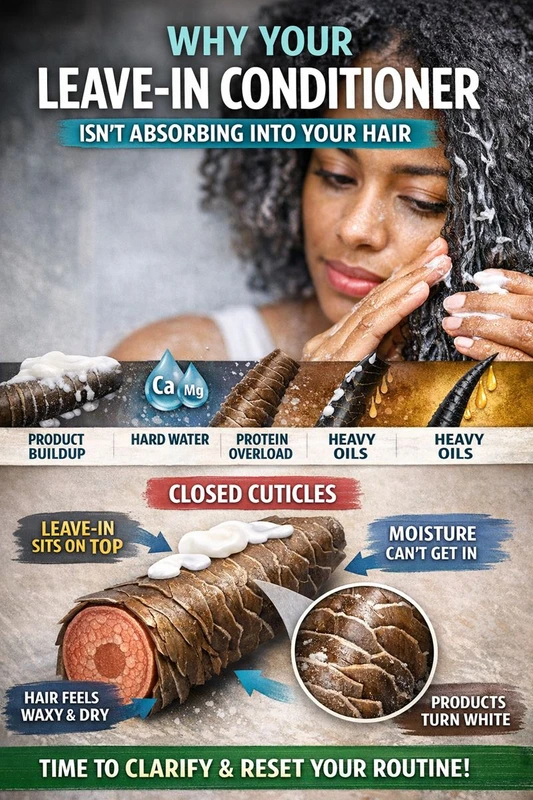
If you’ve ever applied your favorite leave-in conditioner only to watch it sit on your hair, turn white, feel sticky, or make your strands stiff instead of soft — you’re not imagining things.
Many people assume the product is “bad” or that their hair suddenly became “high porosity,” but in reality, leave-ins stop absorbing for very specific reasons, and most of them have nothing to do with the product itself.
This guide breaks down why your hair suddenly rejects moisture, what’s actually happening at the cuticle level, and how to fix it so your leave-ins absorb again — without switching products every month.
What a Leave-In Conditioner Is Supposed to Do
A leave-in conditioner is designed to:
-
Deliver lightweight moisture
-
Help water move into the hair shaft
-
Soften and lubricate the cuticle
-
Improve manageability, elasticity, and slip
-
Support long-term moisture retention
When absorption stops, it means something is blocking that process.
Hair does not randomly stop absorbing products. It responds to environmental buildup, internal imbalance, or cuticle dysfunction.
The #1 Reason Leave-Ins Stop Absorbing: Buildup You Can’t See
Product buildup isn’t always visible
Your hair can look clean and still be coated.
Invisible buildup comes from:
-
Heavy oils and butters
-
Silicone residue
-
Wax-based edge controls
-
Protein layering
-
Hard water minerals
-
Styling products applied on top of each other
Over time, these form a film around the hair shaft, preventing water and conditioning agents from penetrating.
Signs buildup is blocking absorption
-
Leave-in sits on top instead of soaking in
-
Hair feels coated, waxy, or stiff
-
Products foam or turn white on application
-
Hair takes forever to dry
-
Moisture disappears within hours
If water can’t enter the strand, neither can your leave-in.
Hard Water: The Silent Absorption Killer
Hard water deposits minerals like:
-
Calcium
-
Magnesium
-
Iron
-
Lime
These minerals bind to the hair shaft and repel moisture, even if you deep condition weekly.
How hard water affects leave-ins
-
Prevents water from entering the cortex
-
Causes leave-ins to bead or sit on hair
-
Makes hair feel dry right after washing
-
Leads to chronic dryness despite “good products”
If your hair only absorbs leave-ins right after clarifying — hard water is often the culprit.
Protein Overload Makes Hair Reject Moisture
Protein strengthens hair — until there’s too much.
When protein builds up:
-
Hair becomes rigid
-
Cuticles tighten
-
Flexibility decreases
-
Moisture can’t move freely into the strand
Signs of protein overload
-
Hair feels hard or straw-like
-
Leave-ins make hair stiff instead of soft
-
Hair snaps easily when stretched
-
Products that once worked suddenly don’t
Many leave-ins contain:
-
Hydrolyzed proteins
-
Amino acids
-
Keratin derivatives
Layering protein unintentionally can make hair moisture-resistant, not moisture-loving.
Low Porosity Hair Isn’t the Villain — But It Changes the Rules
Low porosity hair has tightly bound cuticles, which means:
-
Water enters slowly
-
Products need help penetrating
-
Heavy formulas sit on top
This becomes a problem when:
-
Leave-ins are too thick
-
Hair is applied dry instead of damp
-
No heat or steam is used
-
Cuticles are already sealed with oil
Low porosity hair absorbs moisture best when:
-
Hair is clean
-
Hair is warm
-
Products are lightweight
-
Application happens on damp hair
Applying Leave-In to Dry Hair Is a Common Mistake
Leave-ins are water-based conditioners, not moisturizers on their own.
If your hair is dry when you apply them:
-
There’s no water to carry ingredients inward
-
Product sits on the surface
-
Hair feels greasy but still dry
Best application method
-
Apply leave-in to damp or wet hair
-
Smooth in sections
-
Follow with a light sealant only if needed
Moisture always starts with water first.
Your Hair Cuticle May Be Sealed Shut
Hair cuticles open and close based on:
-
pH
-
Temperature
-
Product residue
-
Environmental exposure
If cuticles are sealed shut, absorption slows down dramatically.
Causes of sealed cuticles
-
Cold water rinses only
-
Heavy oils layered repeatedly
-
Acidic product overload
-
Protein buildup
-
Environmental damage
This is why some people notice:
“My leave-in only works on wash day — never after.”
Over-Oiling Blocks Leave-In Absorption
Oils don’t moisturize — they seal.
If oil is already sitting on your hair:
-
Leave-ins can’t penetrate
-
Water can’t enter
-
Hair feels greasy but dry
This is especially common with:
-
Castor oil
-
Shea butter
-
Grease-based products
-
Daily oiling routines
Leave-ins should go on before oils, not after.
Clarifying Is Missing From Most Routines
If your leave-in hasn’t absorbed properly in weeks, your hair likely needs clarification, not more moisture.
Clarifying removes:
-
Product buildup
-
Mineral residue
-
Silicone film
-
Wax and oil layers
Without regular clarification:
-
No product will absorb correctly
-
Deep conditioners stop working
-
Hair becomes moisture-resistant
Most people need to clarify every 2–4 weeks, depending on product use and water quality.
The Wrong Leave-In for Your Hair Type
Not all leave-ins are created equal.
Some are:
-
Protein-heavy
-
Silicone-based
-
Butter-dominant
-
Designed for sealing, not penetration
If your hair needs hydration but your leave-in is heavy or occlusive, absorption will always be poor.
Look for leave-ins with:
-
Water as the first ingredient
-
Humectants like glycerin or aloe
-
Lightweight oils (if any)
-
Minimal protein (unless repairing damage)
A well-formulated leave-in should disappear into the hair, not sit on top.
Scalp Health Affects Leave-In Performance
Hair grows through the scalp — and a compromised scalp can:
-
Produce imbalanced sebum
-
Cause inconsistent moisture levels
-
Lead to chronic dryness or buildup
If your scalp is:
-
Inflamed
-
Over-oily
-
Flaky
-
Product-clogged
Hair struggles to retain moisture long-term, even with a good leave-in.
Healthy absorption starts at the scalp, not just the ends.
How to Fix Leave-In Absorption (Step-by-Step Reset)
Step 1: Clarify
Use a clarifying shampoo to remove buildup and minerals.
Step 2: Follow with a Moisturizing Conditioner
Restore slip and flexibility.
Step 3: Apply Leave-In on Damp Hair
Not soaking wet, not dry.
Step 4: Use Light Heat or Steam (Optional)
Warmth helps cuticles open slightly for better penetration.
Step 5: Seal Lightly (If Needed)
Only if hair loses moisture quickly.
Step 6: Reduce Product Layering
More products ≠ more moisture.
How Often Should Leave-In Be Applied?
Leave-in does not need daily reapplication if:
-
Hair is properly hydrated
-
Scalp is balanced
-
Moisture is sealed correctly
Over-applying leave-in can create the very buildup that stops absorption.
For most people:
-
1–3 times per week is enough
-
Focus on hydration, not constant layering
When a Leave-In Suddenly Stops Working
If a leave-in worked for months and then stopped:
-
Your hair changed
-
Your water changed
-
Your routine changed
-
Buildup accumulated
It doesn’t mean the product is bad — it means your hair environment shifted.
Final Thoughts: Absorption Is a Hair Health Signal
When leave-ins stop absorbing, your hair is telling you something important.
It’s not asking for:
-
More products
-
Heavier creams
-
Stronger oils
It’s asking for:
-
A reset
-
Balance
-
Clean hair
-
Proper moisture flow
Once absorption is restored, every product in your routine works better, and moisture actually lasts.
Want Your Leave-Ins to Absorb Better Long-Term?
Focus on:
✔ Clean scalp
✔ Minimal buildup
✔ Correct layering order
✔ Lightweight hydration
✔ Scalp-to-strand moisture balance
When hair can breathe, it can finally absorb.