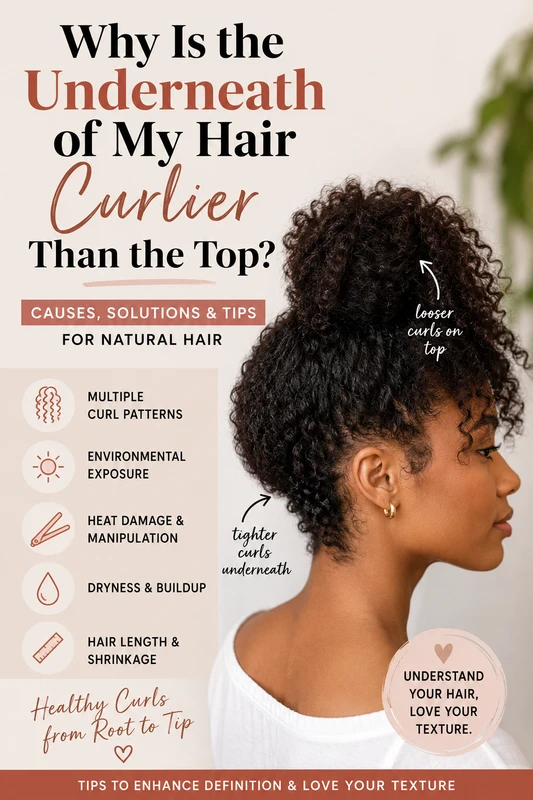
If you have ever looked closely at your natural hair and noticed that the underneath of your hair is curlier than the top, you are definitely not imagining it. You may have tight, springy, well-defined curls around the nape and underneath layers while the crown and top of your hair appear looser, straighter, frizzier, or less defined.
This difference can be especially noticeable after washing your hair. The underneath may immediately form beautiful curls or coils, while the top seems to need much more product, water, finger-coiling, or styling to achieve the same level of definition.
So, why is the underneath of your hair curlier than the top?
The most common explanation is that it is completely normal to have multiple curl patterns on the same head of hair. However, environmental exposure, heat styling, manipulation, dryness, product buildup, hair length, and even the way you sleep can make the difference between your top and underneath layers even more noticeable.
In this complete guide, we'll explain why different parts of your hair can have different textures, what may cause the top to become looser, and what you can do to encourage healthier, more defined curls from your crown to your nape.
Is It Normal for the Underneath of Your Hair to Be Curlier?
Yes. It is extremely common for curly, coily, and natural hair to have more than one curl pattern.
You might have:
- Tight coils at your nape
- Loose curls around your temples
- A tighter texture in the middle
- Looser curls at the crown
- More shrinkage underneath
- Less curl definition on top
- Different strand thicknesses throughout your head
Your hair does not have to fit perfectly into one curl category.
Someone who considers herself to have Type 4 hair, for example, may notice characteristics of several different curl patterns throughout her head. Similarly, someone with predominantly Type 3 curls can have tighter coils underneath and much looser curls on top.
This variation is one reason natural hair can behave so differently depending on the section you are styling.
The products and techniques that work beautifully at the back of your head may not produce exactly the same results at the crown.
Understanding this can make your natural hair routine much easier.
12 Reasons the Underneath of Your Hair May Be Curlier Than the Top
Several factors can contribute to noticeable differences between the underneath and top of your hair.
1. You Naturally Have Multiple Curl Patterns
The simplest explanation may be your genetics.
Different follicles on your scalp can produce hair with slightly different characteristics. That means one section can naturally grow tighter curls than another.
You may notice that your underneath hair has:
- Smaller curls
- Tighter coils
- More shrinkage
- Better definition
- Greater density
Meanwhile, the top may have:
- Larger curls
- Looser waves
- Less shrinkage
- More frizz
- A softer curl pattern
If your hair has always behaved this way, there may be absolutely nothing wrong with it.
It could simply be your natural texture.
Trying to force every section of your hair to look identical can sometimes create unnecessary frustration.
Instead, learning how each section behaves allows you to customize your styling techniques.
2. The Top of Your Hair Gets More Sun Exposure
Think about which part of your hair is exposed to the environment the most.
Usually, it is the top.
The underneath layers are partially protected by the hair above them, while your crown receives much more direct exposure to sunlight.
Repeated UV exposure can contribute to changes in the hair fiber. Hair that becomes weathered may feel:
- Drier
- Rougher
- More brittle
- Frizzier
- Less manageable
When the top becomes dry or damaged, curls may not clump together as easily.
The underneath remains relatively protected and may therefore retain its curl definition better.
If you spend a lot of time outdoors, environmental exposure could be one reason your crown looks different from the hair underneath.
3. The Top Gets Manipulated More Frequently
Your crown and front sections often receive much more attention than the underneath of your hair.
Think about how often you:
- Brush the top
- Smooth your edges
- Create ponytails
- Make buns
- Part your hair
- Restyle your crown
- Pull the top into protective styles
- Touch the front of your hair throughout the day
All of this creates manipulation.
Repeated tension and manipulation can contribute to breakage and weathering over time, particularly if the hair is already dry.
The underneath layers are often left relatively untouched.
As a result, those curls may remain tighter and more defined.
4. Heat Styling Can Loosen the Top
Heat damage is another possible explanation when the top of your natural hair suddenly appears much looser than the underneath.
Flat irons, curling irons, hot combs, blow dryers, and other heated tools can affect your curl pattern when excessive heat is used.
The crown and front are sometimes exposed to more heat because these are the sections people focus on when styling.
Signs of possible heat damage can include:
- Hair staying straight after washing
- Sections becoming significantly looser
- Reduced shrinkage
- Difficulty forming curls
- Increased breakage
- Roughness
- Split ends
If your underneath hair springs back into tight curls when wet but certain sections on top remain unusually straight, previous heat exposure may be contributing to the difference.
Unfortunately, permanently heat-damaged hair generally cannot be restored to its original curl pattern. You can improve its condition and appearance, but severely damaged sections usually need to grow out and eventually be trimmed.
5. The Top of Your Hair May Be Drier
Natural hair needs adequate moisture to remain flexible and manageable.
Your crown can sometimes become particularly dry because it is exposed to:
- Sun
- Wind
- Indoor heating
- Air conditioning
- Frequent styling
- Hats
- Scarves
- Friction
Dry curls often appear less defined because individual strands have difficulty grouping into smooth curl clumps.
Meanwhile, the underneath of your hair may retain moisture better because it is protected by the outer layers.
This can create an interesting situation where your underneath curls appear healthier and tighter even though all the hair is growing from the same head.
6. Product Buildup May Be Affecting Your Crown
Sometimes the problem isn't a lack of products.
It is too much product.
If you regularly apply:
- Leave-in conditioner
- Curl cream
- Gel
- Oils
- Edge control
- Mousse
- Hair butter
- Styling cream
without thoroughly cleansing your hair, residue can gradually accumulate.
Heavy buildup can weigh curls down.
The crown can be particularly susceptible because many people repeatedly apply products there when refreshing their hairstyles.
Eventually, the top may appear:
- Flat
- Limp
- Greasy
- Frizzy
- Undefined
- Less curly
A good cleansing routine can sometimes reveal curls you didn't realize were there.
7. Your Top Layers May Be Longer
Hair length can dramatically affect how curls look.
The longer a curl becomes, the more weight it carries.
That additional weight can stretch the curl downward.
Imagine a short spring compared with a long spring being pulled by gravity.
This is why someone may have extremely tight curls after a short haircut but notice that their curl pattern appears much looser as their hair grows.
If your top layers are longer than your underneath layers, they may naturally look less curly.
The shorter underneath sections can spring upward more easily.
This doesn't necessarily mean your texture changed.
Your curls may simply be stretched by their own length.
8. The Underneath of Your Hair May Shrink More
Shrinkage is one of the defining characteristics of curly and coily hair.
Some sections can shrink significantly more than others.
Your underneath hair might shrink into tight curls while your top sections remain relatively elongated.
This difference can make the curl-pattern contrast appear much greater than it actually is.
Remember:
Shrinkage is not the same thing as curl health.
Hair that shrinks dramatically isn't automatically healthier than hair that doesn't.
However, strong shrinkage generally indicates that the strand retains elasticity and is able to contract after being stretched or wet.
9. Friction May Be Affecting the Top
Friction is easy to overlook when discussing curl patterns.
Your hair rubs against numerous surfaces every day, including:
- Pillowcases
- Hats
- Hoodies
- Towels
- Car headrests
- Furniture
- Scarves
Repeated friction can roughen the hair's surface and encourage tangling, frizz, and breakage.
Cotton pillowcases can be especially problematic for some natural hairstyles because hair moves against the fabric throughout the night.
Using a satin or silk bonnet, scarf, or pillowcase can help reduce unnecessary nighttime friction.
10. Your Styling Technique May Work Better Underneath
Sometimes your hair isn't actually significantly curlier underneath.
Your styling technique may simply create better curl definition there.
For example, you may apply more water or product to the back because you work in smaller sections.
Meanwhile, you may rush through your crown.
Small differences in technique can produce dramatically different results.
When styling, try dividing your hair into multiple sections and treating each section individually.
Make sure every section receives enough water and styling product without becoming overloaded.
11. Chemical Processing Can Change Curl Patterns
Relaxers, texturizers, permanent color, bleach, and other chemical processes can alter the structure or condition of your hair.
If the top has received more chemical processing than the underneath, you might see a noticeable texture difference.
Coloring is a common example.
People often apply color most heavily to the visible sections of their hair. Repeated processing can eventually leave those areas more porous and fragile.
Highly processed curls may become:
- Looser
- Frizzier
- Drier
- More prone to breakage
- Difficult to define
Keeping chemical treatments to a minimum and maintaining a consistent conditioning routine can help protect your curls.
12. Your Hair May Simply Grow Differently at the Crown
Natural hair doesn't always behave uniformly.
The crown is actually one of the areas where many people notice differences in:
- Density
- Curl pattern
- Porosity
- Strand thickness
- Growth direction
You might therefore have a naturally looser crown and tighter nape.
This can remain consistent throughout your life.
If that is the case, your goal shouldn't necessarily be to "fix" your crown.
Instead, focus on keeping both textures healthy.
Why Is My Hair Straight on Top and Curly Underneath?
A dramatic difference—such as relatively straight hair on top and tight curls underneath—deserves a little more investigation.
Ask yourself:
Has your hair always looked this way?
If yes, multiple natural textures may be the explanation.
If no, consider what changed.
Think about whether you recently started:
- Flat ironing more frequently
- Blow drying on higher temperatures
- Bleaching your hair
- Coloring your hair
- Wearing tight ponytails
- Spending more time outdoors
- Using different styling products
- Applying chemical treatments
A sudden curl-pattern change can indicate damage rather than natural variation.
Why Is My Hair Curlier at the Nape?
The nape is one of the most common areas to have a noticeably different texture.
For some people, the nape is actually looser.
For others, it contains the tightest coils on their entire head.
Your nape may be curlier because that is simply how your follicles produce hair in that region.
The area is also partially protected by the rest of your hair, which can reduce certain forms of environmental exposure.
However, the nape has its own challenges.
It frequently rubs against:
- Shirt collars
- Jackets
- Scarves
- Pillowcases
So although your nape may be naturally curlier, it can still be vulnerable to breakage.
Why Is the Top of My Natural Hair So Frizzy?
Frizz and curl pattern aren't necessarily the same thing.
Your crown might actually be just as curly as other areas, but frizz prevents you from seeing the definition.
Frizz can be influenced by:
- Dryness
- Humidity
- Damage
- Rough handling
- Product buildup
- Lack of hold
- Excessive touching
- Improper drying techniques
- Hair porosity
Try soaking your crown thoroughly during wash day and applying your styling products while the hair is still very wet.
Then avoid repeatedly touching your curls as they dry.
You may discover that the top has considerably more curl definition than you thought.
How to Make the Top of Your Hair Curlier
You cannot safely change the natural curl pattern produced by your follicles without chemical or styling manipulation.
However, if your top curls have become less defined because of dryness, buildup, styling habits, or minor damage, you can take steps to encourage their natural definition.
1. Give Your Crown Extra Attention
Instead of treating your entire head exactly the same, pay attention to what each section needs.
If your crown is consistently drier, apply your moisturizing products carefully to that section.
Divide the crown into smaller sections so you can reach every strand.
Don't simply smooth products over the surface.
2. Style on Wet Hair
Water can make a tremendous difference in curl definition.
For many natural hair textures, styling on damp-to-wet hair helps curls clump together.
Try:
- Saturating the section with water.
- Applying leave-in conditioner if needed.
- Adding your preferred curl cream or moisturizer.
- Applying gel or mousse for hold.
- Smoothing the product through the section.
- Scrunching, shingling, or finger-coiling as needed.
Experiment to determine how wet your hair needs to be for maximum definition.
3. Finger-Coil Looser Sections
Finger-coiling is useful when certain curls don't cooperate.
Take a small section, apply styling product, and wrap the strand around your finger following its natural curl direction.
Release it gently.
You don't necessarily need to finger-coil your entire head.
Focus on the crown or other sections that need extra definition.
4. Try Shingling
Shingling involves smoothing styling product through small groups of strands to encourage individual curls to form.
This technique can be particularly helpful for wash-and-go styles.
Working in smaller sections takes longer, but it often produces significantly more consistent definition.
5. Clarify Your Hair Occasionally
If your hair feels coated or unusually heavy, product buildup may be interfering with your curls.
A clarifying shampoo can help remove accumulated:
- Oils
- Butters
- Gels
- Silicone-containing products
- Styling creams
- Environmental residue
How often you need to clarify depends on your products, hair, scalp, and wash schedule.
You don't necessarily need to clarify every wash day.
Pay attention to how your hair feels.
6. Deep Condition Regularly
A good deep-conditioning routine can improve softness, flexibility, and manageability.
Concentrate on sections that tend to become particularly dry.
Apply your conditioner thoroughly from roots to ends and follow the manufacturer's directions.
Remember that more isn't always better.
Leaving a conditioner on much longer than recommended doesn't automatically produce healthier hair.
7. Reduce Excessive Heat
If you want to preserve your natural curl pattern, limit excessive heat exposure.
When you do use heat:
- Use an appropriate heat protectant.
- Avoid unnecessarily high temperatures.
- Don't repeatedly pass a flat iron over the same section.
- Avoid straightening excessively.
- Give your curls time between heat-styling sessions.
The goal isn't necessarily to eliminate heat forever.
It is to use it carefully.
8. Protect Your Hair at Night
Nighttime protection can make your morning routine much easier.
Consider using:
- A satin bonnet
- A satin scarf
- A silk scarf
- A satin pillowcase
- A silk pillowcase
You can also loosely pineapple longer curls at night if that works for your texture and hairstyle.
Reducing friction can help preserve curl definition and minimize tangling.
Can You Make Different Curl Patterns Look More Uniform?
Yes—to an extent.
You may not be able to make every strand naturally grow with exactly the same curl pattern, but styling can create a more uniform finished appearance.
Some of the best options include:
Finger Coils
Excellent for manually defining looser areas.
Twist-Outs
Two-strand twists can create a more consistent curl pattern throughout the hair.
Braid-Outs
Braids stretch the hair while creating a uniform wave pattern.
Flexi Rod Sets
Rod sets can help multiple textures appear more similar.
Perm Rod Sets
Perm rods allow you to choose the approximate curl size you want.
Wash-and-Go Styling
Strategic product application, shingling, and finger-coiling can make natural curl patterns look more cohesive.
Should You Use Different Products on Different Sections?
You can.
In fact, customizing your routine may be exactly what your hair needs.
Suppose your underneath hair forms tight curls with almost no effort while your crown is dry and frizzy.
Using exactly the same amount of styling product everywhere might not produce the best results.
Your crown might benefit from:
- More water
- A slightly richer moisturizer
- More styling gel
- Smaller styling sections
- Finger-coiling
Meanwhile, the underneath may only need a small amount of product.
The goal is not necessarily to use dramatically different routines.
It is to respond to how your hair behaves.
Does Hair Porosity Affect Curl Pattern?
Porosity can affect how your curls respond to products and moisture, although porosity itself doesn't determine your curl type.
Hair porosity describes how easily your hair absorbs and retains water.
Different sections of your head can sometimes behave as though they have different porosity levels, particularly when some areas have experienced more damage than others.
For example, chemically processed or heat-damaged sections may become more porous.
This can affect:
- Moisture retention
- Drying time
- Frizz
- Product absorption
- Curl definition
If the top of your hair dries significantly faster than the underneath, feels rougher, or reacts differently to products, damage or porosity differences may be contributing factors.
Why Does the Underneath of My Hair Look Healthier?
Protection is a major factor.
The underneath layers essentially have a natural shield: the rest of your hair.
The top layers take the brunt of:
- UV exposure
- Wind
- Manipulation
- Styling
- Heat
- Brushing
- Environmental conditions
Over several years, those small differences can become visible.
This is why protecting the outer layers of your hair should be an important part of your natural hair routine.
How to Protect the Top Layer of Natural Hair
If your crown seems to suffer more breakage or dryness, consider changing how you handle it.
Avoid Extremely Tight Hairstyles
Constantly pulling your hair into tight buns or ponytails can create unnecessary tension.
Alternate your hairstyles and give heavily manipulated sections time to recover.
Moisturize Based on Need
Don't assume every section needs moisture on exactly the same schedule.
Check the crown regularly.
Protect Your Hair While Sleeping
Use satin or silk to minimize friction.
Be Gentle While Detangling
Detangle slowly, especially around areas prone to breakage.
Reduce Unnecessary Touching
Once your curls are styled, leave them alone as much as possible.
Constantly separating and touching curls can create frizz.
What If My Top Hair Won't Curl Anymore?
If your crown previously curled tightly and suddenly won't curl after washing, consider the possibility of damage.
Compare your current texture with older photos.
Look for sections that are:
- Permanently straight
- Significantly looser
- Rough
- Weak
- Breaking
- Splitting
- Unable to shrink
Think about your recent styling history.
Have you frequently used a flat iron?
Did you recently bleach your hair?
Did you leave a chemical treatment on too long?
These clues can help you determine whether you're dealing with your natural texture or damaged hair.
If you are experiencing unexplained thinning, patchy hair loss, scalp pain, inflammation, or a sudden major texture change, consider speaking with a dermatologist or qualified healthcare professional.
Should You Cut the Looser Parts?
Not automatically.
If the looser sections are healthy and naturally grow that way, there is no reason you have to cut them.
They are simply part of your unique curl pattern.
If those sections are severely damaged, trimming may eventually be necessary.
You don't necessarily have to do a dramatic big chop.
Some people prefer gradually trimming damaged ends while allowing healthier new growth to come in.
How Long Does It Take for Heat-Damaged Curls to Grow Back?
New hair growing from an undamaged follicle should grow according to its natural characteristics.
However, the damaged portion of the existing strand does not simply transform back into brand-new hair.
That means restoring your overall curl pattern can take time.
Hair grows gradually, so transitioning away from significant heat damage may take many months or longer depending on:
- Your hair length
- How much hair is damaged
- Your trimming schedule
- Your desired final length
Patience is important.
Focus on protecting the healthy new growth rather than constantly trying to force damaged ends to curl.
How to Style Hair With Multiple Curl Patterns
Having several textures doesn't mean you can't achieve beautiful, consistent hairstyles.
In fact, many natural hairstyles work exceptionally well for multi-textured hair.
Consider:
- Two-strand twists
- Twist-outs
- Braid-outs
- Flat twists
- Flexi rod sets
- Perm rod sets
- Bantu knot-outs
- Wash-and-go styles
- High puffs
- Low puffs
- Frohawks
- Protective updos
For styles where you want uniform definition, setting techniques such as twist-outs and rod sets are particularly useful because they create a temporary pattern throughout the hair.
A Simple Routine for a Looser, Drier Crown
If your underneath hair is beautifully curly but your crown struggles with definition, try this routine.
Step 1: Cleanse
Wash your scalp and hair thoroughly with an appropriate shampoo.
If you have significant product buildup, consider clarifying when needed.
Step 2: Condition
Apply conditioner throughout your hair.
Give extra attention to dry sections without excessively overloading them.
Step 3: Detangle in Sections
Divide your hair into four to eight sections.
Gently detangle from the ends upward.
Step 4: Re-Wet the Crown
Before styling, make sure your crown hasn't started drying.
Add water as necessary.
Step 5: Apply Leave-In
Use a moderate amount of leave-in conditioner if your hair responds well to it.
Step 6: Add Your Styler
Apply gel, mousse, curl cream, or another styling product appropriate for your desired hairstyle.
Step 7: Define
Finger-coil or shingle stubborn areas.
Step 8: Dry Without Excessive Manipulation
Allow your hair to air-dry or use a diffuser appropriately.
Avoid constantly touching your curls during the drying process.
Step 9: Protect Overnight
Use a satin or silk scarf, bonnet, or pillowcase.
Following the same general process consistently can help you understand exactly what your crown responds to.
Frequently Asked Questions
Why is the bottom layer of my hair curlier?
Your bottom layer may naturally have a tighter curl pattern, experience less environmental exposure, have shorter strands, or retain definition differently than the top layers.
Why is my hair curly underneath but frizzy on top?
The top layer may experience more dryness, environmental exposure, manipulation, or friction. Product application and styling technique can also contribute to frizz.
Why is my hair wavy on top but curly underneath?
Multiple natural textures are common. Your top follicles may simply produce a looser pattern than the underneath follicles. Hair length and previous damage can also make the difference more noticeable.
Can my curl pattern be different throughout my head?
Absolutely. Many people have two or more curl patterns on the same head.
Can heat damage make my top layer less curly?
Yes. Excessive heat can damage hair and cause previously curly sections to remain unusually loose or straight after washing.
Will cutting my hair make it curlier?
Cutting doesn't change the curl pattern produced by your follicles. However, removing damaged ends or reducing the weight of long hair can make curls appear tighter and more springy.
Why does my crown have less definition?
Your crown may be naturally looser, or dryness, buildup, damage, length, or styling technique may be affecting definition.
Is uneven curl pattern a sign of unhealthy hair?
Not necessarily. Multiple textures are normal. The more important signs to watch for are sudden changes accompanied by excessive breakage, thinning, roughness, or an inability of previously curly hair to return to its normal pattern.
How to Learn Your Hair's Different Textures
One of the best things you can do for natural hair is stop expecting every section to behave identically.
On your next wash day, examine your hair without styling products.
Look at your:
- Front
- Temples
- Crown
- Middle
- Nape
- Underneath layers
Notice where curls are tightest.
Notice which sections shrink the most.
See which areas dry fastest.
Pay attention to which sections become tangled.
Then watch how each area responds when you add water and styling products.
You may discover that what you thought was "difficult hair" is simply a section that requires a different technique.
Understanding those differences can help you build a much more effective natural hair routine.
The Bottom Line: Why Is the Underneath of My Hair Curlier Than the Top?
If the underneath of your hair is curlier than the top, there is usually no reason to panic. Multiple curl patterns are extremely common, especially among people with curly, coily, and natural hair.
Your genetics may naturally give you tighter curls underneath and looser curls at the crown.
At the same time, the top of your hair receives significantly more exposure to sunlight, manipulation, heat, styling products, and environmental conditions. Over time, those factors can make your crown appear drier, frizzier, or less defined than the protected hair underneath.
Hair length, shrinkage, porosity differences, product buildup, chemical processing, and styling techniques can make the contrast even more noticeable.
Instead of trying to force your entire head into one curl pattern, learn what each section needs.
Give your crown extra moisture when necessary. Reduce excessive heat. Clarify when buildup becomes an issue. Protect your curls while sleeping. Work in smaller sections during styling. And use techniques such as finger-coiling, shingling, twist-outs, braid-outs, or rod sets when you want a more uniform finished look.
Most importantly, remember that different textures do not automatically mean damaged hair.
Your tight underneath curls, looser crown, springy nape, and frizz-prone sections can all be part of your natural hair.
Healthy natural hair does not have to look exactly the same from root to tip—or from the top of your head to the bottom.
The goal isn't perfectly identical curls.
The goal is healthy, moisturized, strong, manageable hair in every section of your head.