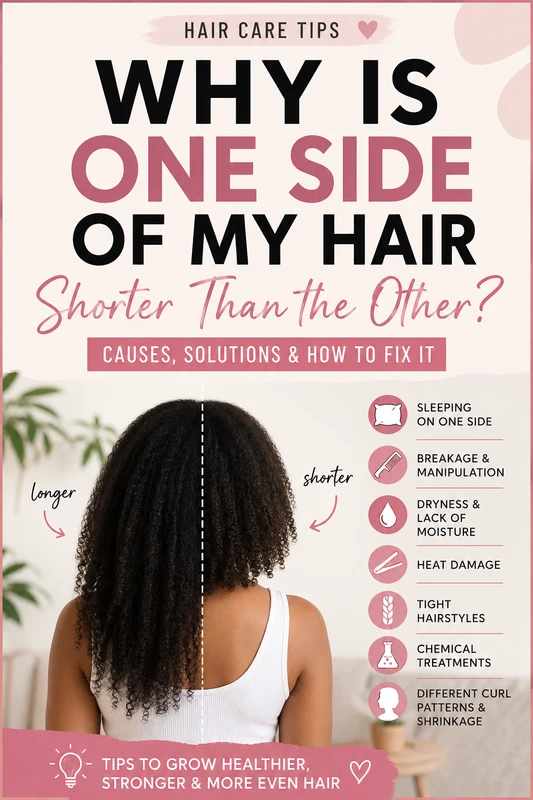
Have you ever looked closely at your hair and noticed that one side seems noticeably shorter than the other? Maybe the hair on your left side reaches your shoulders while the right side stops an inch or two higher. Perhaps one side of your natural hair appears full and healthy while the other side seems thinner, shorter, or more prone to breakage.
You are definitely not the only person who notices this.
Uneven hair length is extremely common, especially among people with natural hair, curly hair, coily hair, relaxed hair, braids, locs, or other textured hairstyles. And although it can sometimes seem like one side of your hair simply refuses to grow, the actual explanation is often more complicated.
In many cases, your hair may be growing perfectly normally from the scalp. The difference happens because one side is retaining less length than the other.
Breakage, sleeping habits, styling techniques, shrinkage, heat damage, chemical treatments, scalp conditions, and even the way you handle your hair every morning can contribute to uneven-looking hair.
The good news is that once you figure out what is causing the difference, you can usually make changes that help protect the shorter side and encourage more balanced length retention.
In this complete guide, we'll explain why one side of your hair may be shorter than the other, how to determine whether it is growth or breakage, and what you can do to help your hair become healthier and more even over time.
Is It Normal for One Side of Your Hair to Be Shorter?
Yes. A small difference in hair length from one side of the head to the other can be completely normal.
Human bodies are not perfectly symmetrical. Hair density, curl pattern, growth cycles, and even the direction in which individual hairs grow can vary across different areas of the scalp.
The difference may be so small that you never notice it until your hair becomes longer.
However, if one side is dramatically shorter, thinner, or constantly breaking, it is worth looking more closely at your hair-care routine.
The key question is:
Is the shorter side actually growing more slowly, or is it breaking faster?
For many people, breakage and poor length retention are the bigger issues.
Hair can continue growing from the scalp while simultaneously breaking at the ends. When this happens, it can appear as though the hair has stopped growing.
12 Reasons One Side of Your Hair May Be Shorter Than the Other
There isn't one universal explanation for uneven hair length. Your daily habits often provide the biggest clues.
Here are some of the most common causes.
1. You Sleep on the Same Side Every Night
Your sleeping position may have more influence on your hair than you realize.
If you sleep on the same side of your head every night, that section of hair repeatedly rubs against your pillow for several hours.
Night after night, this friction can contribute to:
- Dryness
- Tangling
- Frizz
- Split ends
- Weak strands
- Breakage
Cotton pillowcases can be particularly problematic for hair that is already dry or fragile because the rougher surface creates more friction than smoother materials.
Imagine sleeping eight hours every night on your right side.
That is roughly eight hours of repeated contact between your right-side hair and your pillow. Over weeks, months, and years, those small amounts of friction can add up.
This doesn't mean everyone who sleeps on one side will experience uneven hair. But if the shorter side happens to be the same side you normally sleep on, your sleeping habits deserve attention.
What Can You Do?
Consider protecting your hair at night with a satin or silk bonnet, scarf, or pillowcase.
You can also loosely secure longer hair before bed so it isn't constantly trapped underneath your head and shoulders.
2. One Side of Your Hair Is Breaking More
Breakage is one of the biggest reasons people believe one side of their hair isn't growing.
Your scalp may be producing new hair normally. The problem occurs farther down the strand.
Suppose both sides of your hair grow approximately the same amount during a certain period.
If the left side retains most of that growth but the right side repeatedly loses length through breakage, the right side eventually looks shorter.
This is why hair growth and length retention are not the same thing.
Growth occurs from the follicle.
Length retention depends on keeping the existing hair strand healthy enough that it doesn't continually snap.
Signs that the shorter side may be breaking include:
- Numerous short pieces of hair
- Split ends
- Rough or brittle strands
- Excessive tangling
- Thin or see-through ends
- Hair snapping during detangling
- Different lengths throughout the same section
If you notice these signs predominantly on one side, breakage could explain the difference.
3. You Style One Side More Than the Other
Think about your favorite hairstyles.
Do you always part your hair on the same side?
Do you sweep your hair toward the same direction?
Do you repeatedly tuck one side behind your ear?
Do your ponytails pull harder on one section?
These seemingly harmless habits can create uneven stress.
For example, if you always create a side part in exactly the same location, the hair surrounding that part may experience more manipulation than the rest of your hair.
Repeated manipulation can eventually weaken strands.
The same issue can occur with:
- Ponytails
- Buns
- Slick-back hairstyles
- Braids
- Twists
- Wigs
- Sew-ins
- Hair clips
- Edge styling
- Headbands
Changing your hairstyle periodically can help distribute tension and manipulation across your hair rather than repeatedly stressing the same section.
4. You Detangle One Side More Aggressively
Most people don't consciously detangle every part of their hair with exactly the same amount of pressure.
Maybe you are right-handed and naturally handle one side differently.
Perhaps you become impatient by the time you reach the final section.
Or one side may simply tangle more easily.
Aggressive detangling can cause mechanical breakage, especially when textured hair is dry.
You may notice little broken hairs around your sink, shoulders, or clothing after detangling.
Try dividing your hair into manageable sections and working carefully from the ends upward.
If you encounter a knot, avoid forcing a comb directly through it.
Apply additional moisture or slip and gently work through the tangle.
5. Your Curl Pattern Is Different on Each Side
Sometimes your hair isn't actually shorter.
It just looks shorter because of shrinkage.
Natural and curly hair can contain several curl patterns on the same head.
For example, one side might have looser curls while the other has tighter coils.
The tighter side can shrink significantly more after drying.
When stretched, the two sides may actually be similar in length.
This is an important test.
Before assuming your hair is growing unevenly, gently stretch comparable strands from both sides.
If they are relatively close in length when stretched, curl pattern and shrinkage may explain the visual difference.
This is particularly common with:
- Type 3 curls
- Type 4 hair
- Mixed-texture natural hair
- Transitioning hair
Uneven shrinkage isn't necessarily a problem that needs fixing. It may simply be part of your natural texture.
6. Heat Damage Is Worse on One Side
Frequent heat styling can gradually weaken the hair's structure.
Flat irons, curling irons, hot combs, blow dryers, and other heated tools can all contribute to damage when temperatures are too high or heat is used excessively.
But why would only one side become shorter?
Your technique may not be identical on both sides.
For instance, you may pass a flat iron over one side several times because it is harder for you to reach. You might also hold the dryer closer to a particular section.
Over time, the more heavily exposed area may experience increased:
- Dryness
- Split ends
- Loss of elasticity
- Breakage
- Changes in curl pattern
If one side feels significantly rougher or behaves differently when wet, heat damage may be contributing.
Reducing direct heat and using appropriate heat protection can help prevent additional damage.
7. Tight Hairstyles Are Putting Stress on One Side
Protective hairstyles can be extremely useful for reducing daily manipulation, but they still need to be installed carefully.
Braids, twists, cornrows, ponytails, buns, and loc styles that create excessive tension can stress the hair and scalp.
Sometimes tension isn't evenly distributed.
One side may be braided tighter.
A ponytail may pull harder around one temple.
A bun may consistently sit toward one side.
Repeated tension can contribute to breakage, especially around vulnerable areas such as the temples and hairline.
Your hairstyle should not cause persistent:
- Pain
- Throbbing
- Headaches
- Scalp tenderness
- Red bumps
- Excessive pulling
If a hairstyle feels painfully tight, don't assume that discomfort is necessary for the style to last.
8. You Touch One Side More Often
This is an easy habit to overlook.
You may subconsciously:
- Twist one section
- Pull on curls
- Scratch your scalp
- Play with your ends
- Tuck your hair behind one ear
- Run your fingers through one side
Occasional touching isn't likely to cause dramatic problems.
But repetitive manipulation can gradually wear down fragile hair, particularly at the ends.
If you are trying to determine why one side keeps breaking, pay attention to your habits throughout the day.
You may discover that your hands constantly gravitate toward the shorter side.
9. Your Hair Rubs Against Clothing
Once hair reaches shoulder length, clothing becomes another possible source of friction.
Your ends may repeatedly rub against:
- Cotton shirts
- Sweaters
- Jackets
- Coats
- Scarves
- Hoodies
If your hair naturally falls more heavily toward one side, that section could experience more friction.
The issue can become more noticeable during colder months when people wear heavier fabrics, scarves, and coats.
Keeping the ends moisturized and occasionally wearing hairstyles that keep them away from rough fabrics may help with length retention.
10. Chemical Processing Has Weakened One Side
Relaxers, permanent color, bleach, and other chemical treatments alter the hair.
When chemical processing is performed unevenly, one section may become more fragile than another.
For example, overlapping relaxer onto previously processed hair can increase the risk of breakage.
Bleaching one side more heavily can have a similar effect.
Chemically processed hair often requires extra attention to conditioning, moisture, protein balance, detangling, and heat usage.
If one side suddenly became shorter following a chemical service, consider whether that area may have been overprocessed.
11. Your Ends Need Trimming
Damaged ends do not always break evenly.
One section may have more:
- Split ends
- Single-strand knots
- Weathering
- Rough ends
- Breakage
When damaged ends continue splitting upward, the hair can gradually lose length.
Trimming damaged ends can make your overall hair shape look more balanced while helping prevent splits from progressing farther up individual strands.
However, trimming does not make hair grow faster from the scalp.
Its main purpose is to remove damaged portions of the hair.
12. There Could Be an Underlying Hair or Scalp Issue
Most mild unevenness is related to texture, breakage, or styling habits.
However, significant or sudden changes deserve more attention.
If one area is experiencing actual thinning, bald patches, scalp irritation, inflammation, or unusual shedding, it may not simply be a length-retention issue.
Hair loss can have many possible causes, and determining the exact cause requires proper evaluation.
Consider speaking with a dermatologist or qualified healthcare professional if you notice:
- Sudden hair loss
- Bald patches
- Significant thinning on one side
- Persistent scalp pain
- Burning or intense itching
- Scaling or sores
- Scarring
- Rapidly worsening hair loss
Early evaluation can be particularly important for some forms of hair loss.
Is My Hair Growing Unevenly or Breaking?
This distinction is important.
Signs That Suggest Breakage
You may be dealing with breakage if you notice:
- Short strands throughout the section
- Split ends
- Rough ends
- Hair snapping while styling
- Increasingly thin ends
- Lots of small hair pieces after detangling
Signs That Suggest Shrinkage
Shrinkage may be responsible if:
- The shorter side has tighter curls
- Both sides become similar when stretched
- The difference becomes more noticeable after your hair dries
- Your hair has multiple textures
Signs That Deserve Professional Evaluation
Consider professional advice if you notice:
- A visible reduction in density
- A widening area of scalp
- Smooth bald patches
- Scalp inflammation
- Unexplained shedding
- Progressive thinning
Knowing which situation you're dealing with will help you choose a more appropriate solution.
How to Fix Hair That Is Shorter on One Side
Once you identify likely causes, your goal should be to protect the shorter side while maintaining the health of the rest of your hair.
Here are practical steps.
1. Give the Shorter Side Extra Attention
Don't completely change your entire routine immediately.
Start by examining the shorter side.
Ask yourself:
- Does it feel drier?
- Does it tangle more?
- Are there more split ends?
- Does it break during combing?
- Is the curl pattern tighter?
- Is that the side I sleep on?
- Do I constantly touch that side?
Your answer may reveal exactly where the problem is occurring.
2. Keep Your Hair Properly Moisturized
Dry hair is often more vulnerable to breakage, particularly tightly curled and coily textures.
Develop a consistent moisturizing routine that works for your hair.
Depending on your hair's needs, this may involve:
- Starting with water or a water-based moisturizing product.
- Applying a leave-in conditioner.
- Following with an appropriate cream, butter, or oil when desired.
- Paying particular attention to your ends.
Your exact routine does not need to match someone else's.
Some hair responds beautifully to lightweight products, while other textures prefer richer formulas.
The goal is manageable, flexible hair—not hair that feels permanently coated with product.
3. Protect Your Hair While Sleeping
Nighttime protection is especially important when the shorter side corresponds with your favorite sleeping position.
Try using a:
- Satin bonnet
- Satin scarf
- Silk scarf
- Satin pillowcase
- Silk pillowcase
If your bonnet frequently comes off while you sleep, a satin pillowcase can provide an additional layer of protection.
Longer hair can also be loosely secured before bed to prevent excessive rubbing and tangling.
4. Stop Over-Manipulating the Shorter Side
If you want to retain more length, give fragile hair a chance to rest.
Reduce unnecessary:
- Combing
- Brushing
- Twisting
- Pulling
- Edge styling
- Heat styling
- Tight ponytails
- Constant restyling
You don't have to avoid touching your hair completely.
Simply be intentional about how frequently and aggressively you manipulate it.
5. Detangle More Carefully
Detangling technique can make an enormous difference in length retention.
For curly and coily hair, many people find it easier to detangle when the hair has adequate moisture and slip.
Divide your hair into sections.
Start at the ends and gradually work toward the roots.
Hold the section above the area you're detangling when possible so that less pulling reaches the scalp.
Most importantly, don't rush.
A knot that takes 20 seconds to carefully separate may represent strands that took years to grow.
Should You Cut the Longer Side to Match?
Not necessarily.
This comes down to your goals.
If the difference is minor, you can leave the longer side alone while focusing on protecting the shorter side.
Over time, the difference may become less noticeable if the shorter side begins retaining more length.
However, if you prefer an even shape immediately, a professional trim can create a more balanced appearance.
You have several options:
Option 1: Leave both sides alone.
Allow the shorter side time to catch up while protecting both sides.
Option 2: Gradually trim the longer side.
Take off small amounts during regular trims rather than removing all of the difference immediately.
Option 3: Even everything at once.
If the unevenness bothers you aesthetically, trim the longer side to create a uniform shape.
There is no universal right answer.
Healthy hair doesn't have to be perfectly even.
How Long Will It Take for the Shorter Side to Catch Up?
This depends on how large the difference is and whether you eliminate the cause of the breakage.
Hair grows gradually, so dramatic changes won't happen overnight.
More importantly, both sides are continuing to grow.
For example, suppose one side is two inches shorter than the other.
If both sides continue growing and retaining exactly the same amount of length, the two-inch difference remains.
For the shorter side to truly "catch up," either:
- The longer side must be trimmed,
- The shorter side must begin retaining more length than it previously did,
- Or a combination of both must occur.
This is why focusing solely on faster hair growth can be misleading.
Length retention is often the real goal.
Can Protective Styles Help Even Out Hair Length?
They can help when used correctly.
Low-manipulation and protective hairstyles can reduce the amount of daily handling your hair receives.
Potential options include:
- Two-strand twists
- Loose braids
- Buns
- Flat twists
- Cornrows
- Wigs with proper hair care underneath
But a style is only protective when it actually protects your hair.
Extremely tight braids or ponytails can do the opposite.
Your protective style should minimize manipulation without creating unnecessary tension on your hairline or scalp.
Why Is One Side of My Natural Hair Shorter?
For natural hair specifically, three factors are particularly important:
Shrinkage, breakage, and manipulation.
Natural hair can shrink significantly, and different sections of the same head can have different curl patterns.
That means one side can visually appear several inches shorter without actually being dramatically different in stretched length.
Natural hair is also more susceptible to mechanical damage when strands repeatedly twist around each other and form knots.
A consistent routine centered on gentle detangling, moisture, nighttime protection, and low manipulation can make a noticeable difference in length retention.
Why Is One Side of My Curly Hair Shorter?
Curly hair can appear uneven because curls don't necessarily form identically.
One side may create elongated spirals while another forms tighter ringlets.
Humidity, styling products, drying technique, sleeping habits, and previous damage can all influence how curls behave.
Before cutting your hair because one side looks shorter, compare the sections while they are wet and gently stretched.
You may discover that the difference is primarily curl formation rather than actual length.
Why Is One Side of My Relaxed Hair Shorter?
With relaxed hair, breakage deserves special consideration.
Relaxers alter the structure of the hair, which means improper processing or overlapping chemicals can leave sections vulnerable.
One side may break more if it has experienced:
- Relaxer overlap
- Excessive heat
- Frequent combing
- Tight wrapping
- Dryness
- Chemical color treatments
If the shorter section feels extremely thin or fragile, reducing heat and manipulation while improving conditioning may help prevent additional damage.
Why Is One Side of My Hairline Shorter?
Hairline differences are particularly common.
The hair around your temples and edges can be more vulnerable to tension and manipulation.
Common contributors include:
- Tight ponytails
- Braids
- Wigs
- Wig adhesive
- Edge brushes
- Headbands
- Bonnets that are too tight
- Frequent edge control use combined with brushing
- Constant pulling or styling
If one temple is noticeably thinner, consider how your regular hairstyles interact with that particular area.
Avoid repeatedly pulling already fragile edges into tight styles.
If hairline thinning continues or worsens despite changing your routine, consider seeing a dermatologist.
Can Stress Make One Side of Your Hair Shorter?
Stress can influence hair and shedding, but a dramatic difference isolated to one side is not something you should automatically attribute to stress.
When only one section is affected, first consider localized factors such as friction, styling tension, chemical damage, heat, or scalp problems.
If you're experiencing significant shedding or sudden changes in your hair, professional evaluation can help determine the underlying cause.
A Simple Routine for Uneven Natural Hair
If breakage seems to be the problem, consistency is more useful than constantly switching products.
Wash Day
Cleanse your scalp and hair according to your needs.
Use conditioner to improve manageability and make detangling easier.
Divide your hair into sections and detangle gently.
Follow with your preferred moisturizing products.
During the Week
Monitor moisture levels, especially on the shorter side.
Avoid unnecessary daily combing.
Keep styles relatively loose.
Pay attention to the ends.
At Night
Protect your hair with satin or silk.
Avoid sleeping with loose hair trapped underneath your body.
Loosely twist, braid, pineapple, or secure your hair depending on your texture and hairstyle.
Every Few Weeks
Inspect your ends.
Look for knots, splitting, thinning, or breakage.
Also compare photos rather than relying entirely on your memory.
Track Your Progress With Pictures
One of the easiest ways to determine whether your routine is working is to photograph your hair.
Take pictures approximately once a month under similar conditions.
Try to use:
- The same hairstyle
- Similar lighting
- The same angle
- Similar stretching method
Take pictures of the:
- Front
- Back
- Left side
- Right side
You can also choose a small section on each side and compare its stretched length.
Daily changes are difficult to notice.
Photos taken several months apart make progress much easier to evaluate.
Mistakes to Avoid When Trying to Fix Uneven Hair
One of the biggest mistakes is becoming so focused on the shorter side that you start manipulating it constantly.
Avoid repeatedly pulling on it to check the length.
Also avoid:
- Measuring your hair every few days
- Applying excessive amounts of oil
- Constantly switching products
- Trimming healthy hair unnecessarily
- Using more heat to make both sides look even
- Installing tighter protective styles
- Ignoring persistent scalp problems
Hair health usually improves through consistent habits rather than extreme treatments.
Frequently Asked Questions
Why does one side of my hair grow faster?
Hair growth can vary somewhat across the scalp, but apparent uneven growth is frequently influenced by breakage, shrinkage, styling habits, or friction. Compare both sides while gently stretched and look for signs of breakage before concluding that one side grows much faster.
Why is the side I sleep on shorter?
Repeated friction between your hair and bedding may contribute to tangling and breakage. Protecting your hair with satin or silk can reduce friction while you sleep.
Can one side of your hair grow slower?
Hair follicles don't all operate on perfectly synchronized schedules, so some variation is possible. However, significant differences in visible length may have more to do with length retention than scalp growth.
Should I cut my hair if one side is shorter?
Only if you want a more even appearance or the longer side has damaged ends. You don't necessarily need to cut healthy hair simply because the opposite side is shorter.
Can my shorter side catch up?
It may become more balanced over time, especially if breakage was responsible and you correct the problem. Gradually trimming the longer side can also reduce the difference.
Why is my right side shorter than my left?
Consider whether you sleep on your right side, style that side more frequently, expose it to more heat, or detangle it differently. The location itself isn't as important as the habits affecting that section.
Why is my left side shorter than my right?
The same principles apply. Examine friction, curl pattern, breakage, styling tension, chemical processing, and manipulation on the shorter side.
Why is one side of my hair thinner too?
If the section isn't simply shorter but actually has noticeably lower density, pay closer attention. Styling tension and breakage may contribute, but persistent or worsening thinning can also warrant evaluation by a dermatologist.
Does oil make the shorter side grow faster?
Oil alone doesn't magically make one section grow faster. Oils may be useful as part of a hair-care routine for lubrication or reducing moisture loss, depending on the product and your hair, but solving uneven length requires identifying the underlying cause.
Can wearing a bonnet help?
A satin or silk bonnet can reduce friction between your hair and bedding, potentially helping you retain length—especially if nighttime friction has been contributing to breakage.
How to Prevent Uneven Hair Length in the Future
Once your hair begins looking more balanced, prevention becomes the priority.
Pay attention to repeated habits.
Try rotating where you place your part.
Avoid excessively tight hairstyles.
Use gentle detangling techniques.
Protect your hair at night.
Keep your ends manageable and trim them when necessary.
Limit excessive heat.
Most importantly, pay attention to what your hair is telling you.
If one area repeatedly feels dry, tangled, or fragile, don't wait until several inches have broken away before adjusting your routine.
The Bottom Line: Why Is One Side of My Hair Shorter Than the Other?
If one side of your hair is shorter than the other, it doesn't automatically mean something is wrong with your hair growth.
Some of the most common explanations include breakage, sleeping on one side, uneven shrinkage, different curl patterns, styling habits, heat damage, chemical processing, aggressive detangling, and repeated tension.
For many people, the most important concept is the difference between hair growth and length retention.
Your hair may be growing from the scalp just fine.
The shorter side may simply be losing length faster than the longer side.
Start by comparing both sides while stretched. Examine the shorter section for split ends, knots, broken strands, dryness, or thinning. Then think carefully about your sleeping, detangling, and styling habits.
If breakage is the issue, focus on gentle handling, adequate moisture, nighttime protection, low-manipulation hairstyles, careful detangling, and healthy ends.
Give your hair time.
Length differences that developed over many months are unlikely to disappear in a few weeks.
With consistent care, however, you can give the shorter side a better opportunity to retain its new growth and gradually create a healthier, fuller, and more balanced appearance.
And remember: perfectly symmetrical hair isn't the definition of healthy hair. Your goal should be strong, manageable hair that retains length and thrives on both sides of your head.