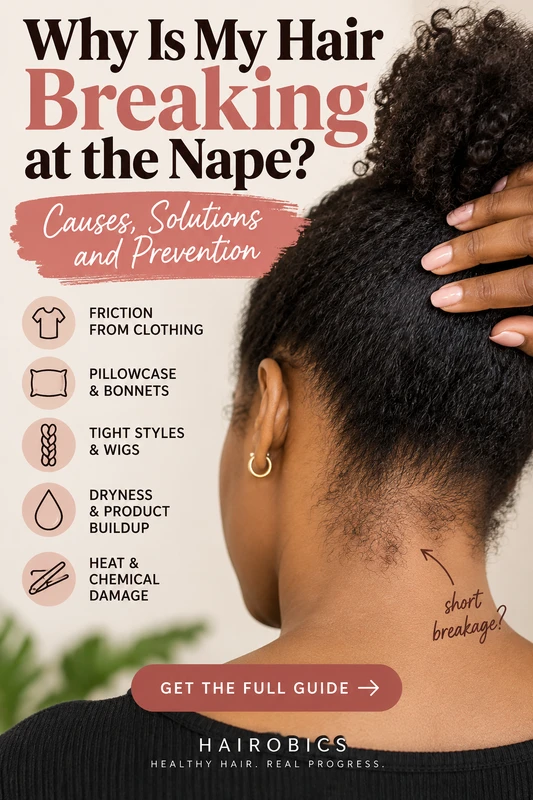
Hair breakage can happen anywhere, but the nape of the neck is one of the most common areas for breakage, especially for people with natural, curly, coily, relaxed, braided, or loc’d hair. You may notice that the hair at the back of your head seems shorter than the rest of your hair, refuses to retain length, feels dry and rough, or continually snaps no matter how much the rest of your hair grows.
If you have been wondering, “Why is my hair breaking at the nape?”, there usually is not just one possible explanation.
The nape is constantly exposed to friction from clothing, pillows, scarves, wigs, protective styles, sweat, manipulation, and environmental conditions. Because the hair in this area can also have a different texture or density than the rest of your head, it may require a slightly different hair-care approach.
The good news is that nape breakage can often be reduced once you identify what is causing it.
In this guide, we will look at the most common causes of hair breakage at the nape, how to recognize the difference between breakage and shedding, how to care for a fragile nape, and what you can do to help your hair retain more length.
What Does Nape Hair Breakage Look Like?
Your nape is the lowest section of hair at the back of your head, just above your neck.
Nape breakage can look different from person to person. Some people develop a small patch of short hairs. Others notice that the entire bottom section of their hair is significantly shorter than the rest.
Common signs include:
- Short hairs around the back hairline
- Uneven length at the nape
- Excessive tangling
- Tiny broken hairs on your clothing
- Split or rough ends
- Hair that repeatedly grows to a certain length and breaks
- A nape that feels much drier than the rest of your hair
- Hair snapping during detangling
- Thinning around the back hairline
- Difficulty retaining length in the lower section of the hair
You may initially think the hair simply grows slower in this area.
That is possible, but often the bigger problem is length retention.
Your hair can be growing normally at the scalp while breaking farther down the strand. When this happens repeatedly, it appears as though the nape is not growing.
Why Is My Hair Breaking at the Nape?
There are numerous potential causes. Identifying the most likely cause is the first step toward changing your routine.
1. Friction From Clothing
One of the most overlooked causes of nape breakage is your clothing.
The ends of your hair may constantly rub against:
- Sweaters
- Hoodies
- Jackets
- Coat collars
- Cotton shirts
- Scarves
- Turtlenecks
- Wool clothing
This friction can gradually wear down the hair's outer protective layer.
Curly and coily hair may be particularly vulnerable because bends and curves along the strand can create areas where mechanical stress is concentrated.
If your hair rests directly against rough clothing every day, the ends at your nape can become dry, tangled, split, and eventually break.
What Can You Do?
Try keeping your hair away from rough fabrics when possible.
Protective hairstyles such as buns, twists, braids, or other low-manipulation styles can prevent your ends from constantly rubbing against clothing.
You can also choose smoother fabrics around the neck whenever practical.
This becomes especially important during fall and winter when sweaters, coats, hoodies, and scarves are worn more frequently.
2. Sleeping on Cotton Pillowcases
Your nighttime routine can affect your nape more than you realize.
Traditional cotton pillowcases can absorb moisture and create friction as your head moves throughout the night.
The nape may receive significant friction because it frequently makes direct contact with the pillow.
Over time, this can contribute to:
- Dryness
- Tangling
- Frizz
- Split ends
- Breakage
A satin or silk pillowcase provides a smoother surface for your hair.
You can also protect your hair with a satin bonnet or scarf.
For maximum protection, some people prefer using both.
3. Your Bonnet May Be Causing the Problem
A bonnet is designed to protect your hair, but it can sometimes contribute to nape breakage.
The problem is usually the elastic band.
If the bonnet is extremely tight or the elastic sits directly on the same section of your nape every night, repeated rubbing and tension may stress those fragile hairs.
Pay attention to where your bonnet sits.
If the band rests directly over the area experiencing breakage, try adjusting it or switching to a bonnet with a wider, smoother, more comfortable band.
Your protective accessories should protect your hair rather than constantly pull against it.
4. Tight Ponytails and Buns
Do you frequently pull your hair into a high ponytail, low ponytail, slick-back bun, or puff?
Repeated tension can contribute to breakage.
When you pull your hair tightly, the strands around the perimeter—including the nape—may experience considerable stress.
You may notice short hairs directly where the style creates the most tension.
Try loosening your hairstyles and changing their placement.
For example, if you always wear a low bun, rotate between different low-tension hairstyles rather than stressing the exact same hairs every day.
5. Braids That Are Too Tight
Braids are commonly used as a protective hairstyle, but a style is only protective when it actually protects your hair.
Braids installed too tightly around the nape can place unnecessary tension on delicate strands.
The problem may be particularly noticeable along the perimeter because these hairs can be finer or more fragile than hair in other areas.
If your braids cause:
- Persistent pain
- Bumps
- Excessive tenderness
- Pulling
- Redness
- Headaches
the style may be too tight.
You should not have to endure significant pain because you were told your braids will eventually “loosen up.”
Repeatedly installing extremely tight hairstyles can damage hair and may contribute to traction alopecia in some people.
6. Wigs and Wig Combs
Wigs can help reduce daily manipulation, but improper wig use can also create problems around the nape.
Wig combs, clips, bands, and adhesives may repeatedly stress the same areas.
A tight wig band sitting directly against the back hairline can create friction every time you move your head.
If you wear wigs regularly, examine the areas where the wig makes contact with your natural hair.
Make sure your hair underneath remains moisturized and avoid placing excessive pressure on your nape.
7. Your Hair Is Too Dry
Dryness and breakage frequently go together.
Hair needs enough flexibility to bend and move without snapping easily.
When hair becomes excessively dry, it can feel:
- Rough
- Brittle
- Hard
- Tangled
- Straw-like
The nape may become particularly dry because it is easily forgotten during your hair-care routine.
When applying your moisturizer, leave-in conditioner, or other conditioning products, intentionally divide your hair into sections.
Make sure the nape receives attention instead of simply applying product to the outer surface of your hair.
8. You're Not Moisturizing Your Nape Separately
One of the simplest changes you can make is to treat your nape as its own section.
Many people divide their natural hair into four sections while washing, conditioning, moisturizing, and detangling.
But if your nape is breaking, consider creating a fifth section specifically for it.
This allows you to monitor:
- Moisture
- Tangling
- Breakage
- Split ends
- Product buildup
- Length retention
You can then determine whether the area needs more frequent moisturizing or gentler handling.
9. Rough Detangling
Detangling can cause considerable mechanical breakage when done aggressively.
The nape often tangles easily because of friction, sweat, shrinkage, clothing, and movement.
Trying to force a comb through these tangles can snap the hair.
Instead, use a product that provides enough slip and work in small sections.
Begin near the ends and gradually work toward the roots.
Your fingers can also help locate larger knots before you use a detangling tool.
Most importantly, avoid rushing.
If you hear your hair constantly snapping while detangling, reconsider your technique.
10. Detangling Hair When It Is Too Dry
For many people with tightly curled or coily hair, trying to aggressively detangle completely dry hair increases the likelihood of breakage.
Dry strands may have less flexibility and lubrication.
A detangling product, conditioner, leave-in, or water-based product can help provide slip.
However, hair responds differently from person to person.
The goal is to find the condition in which your hair can be separated with the least resistance.
11. Heat Damage
Flat irons, hot combs, curling irons, blow dryers, and other heat tools can weaken hair when they are used too frequently or at excessive temperatures.
The nape may be especially vulnerable if you repeatedly straighten it to make a hairstyle look smooth.
You might constantly run a flat iron over the short hairs at the back because they revert faster than other sections.
That repeated exposure can eventually contribute to breakage.
Try reducing heat frequency and avoid repeatedly passing a hot tool over the same strands.
When you do use heat, follow appropriate heat-protection practices.
12. Chemical Processing
Relaxers, permanent hair color, bleaching, and other chemical processes alter the structure of the hair.
Improper application or overprocessing can weaken the strand.
One common issue with relaxers is overlapping previously relaxed hair.
If relaxer is repeatedly applied to already processed hair instead of primarily focusing on new growth, those strands may become progressively weaker.
The nape can be particularly vulnerable if the chemical process is applied there first or left on too long.
If you chemically process your hair, carefully follow product instructions or work with an experienced professional.
13. Sweat at the Nape
The back of the neck can become sweaty, especially during:
- Exercise
- Hot weather
- Sleeping
- Physical work
- Wearing hats
- Wearing wigs
Sweat itself does not automatically mean your hair will break.
However, repeated cycles of sweat, drying, friction, product buildup, and tangling may make nape maintenance more difficult.
If you exercise frequently, pay extra attention to cleansing, drying, detangling, and moisturizing your nape as needed.
14. Product Buildup
More product is not always better.
Repeatedly applying oils, creams, gels, edge controls, butters, pomades, and sprays without adequate cleansing can leave buildup on the hair and scalp.
Buildup can make the hair feel coated and interfere with how it responds to your regular conditioning routine.
Use an appropriate shampoo or clarifying routine when your hair needs it.
Signs that buildup may be developing include hair that feels coated, unusually dull, sticky, heavy, or difficult to moisturize despite repeated product application.
15. Wearing the Same Hairstyle Constantly
Your favorite hairstyle could be stressing the same section of hair every day.
Consider someone who wears a low ponytail 300 days per year.
Even if the style is not extremely tight, the same hair experiences repeated tension and manipulation.
Changing your hairstyle periodically can redistribute stress.
Your hair does not necessarily need complicated styling. Sometimes rotating among several simple, low-tension styles is enough.
16. Protective Styles Left in Too Long
Protective styles can reduce manipulation, but they are not maintenance-free.
As your hair remains in braids, twists, extensions, or other long-term styles, shed hair, oils, products, and environmental debris can accumulate.
Hair can also become tangled around the roots.
The nape may become particularly vulnerable when you finally remove the style.
Take your time during takedown.
Do not rip through tangles simply because you are tired of removing your braids.
One rushed takedown can undo weeks of length retention.
17. Improper Shampooing
You don't need to aggressively scrub your hair to get it clean.
Using your fingernails or rubbing the strands together vigorously can create unnecessary tangling.
Concentrate primarily on cleansing your scalp while allowing the shampoo and water to move through the rest of your hair.
Be especially gentle around your nape if it is already fragile.
18. Skipping Conditioner
Conditioning can improve manageability, lubrication, softness, and flexibility.
If your nape constantly tangles, skipping conditioner may make detangling harder.
Apply conditioner throughout your hair, paying special attention to the driest or most vulnerable sections.
Use this opportunity to gently separate tangled strands.
19. Split Ends Traveling Up the Hair
Split ends do not repair themselves permanently.
Products may temporarily make damaged ends feel smoother, but severely split strands often need to be trimmed.
If damaged ends remain on your nape for too long, splitting and breakage can continue.
Regularly inspect your ends.
You do not necessarily need an aggressive haircut every few weeks, but removing damaged ends when necessary can help prevent the area from becoming increasingly difficult to manage.
20. Your Nape May Have a Different Texture
Not every strand on your head has exactly the same curl pattern, diameter, density, or behavior.
You may notice that your nape is:
- Finer
- Coarser
- Straighter
- Curlier
- Softer
- More fragile
than the rest of your hair.
That is normal.
The mistake is assuming every section requires identical treatment.
If your nape consists of finer strands, for example, heavy manipulation and tight styles may affect it differently.
Learn how that particular section behaves.
Is My Nape Breaking or Just Growing Slowly?
This is an important distinction.
Look closely at the hair.
If the strands are noticeably shorter but you can see lots of uneven lengths, rough ends, split ends, or tiny broken pieces, breakage may be involved.
If the area remains healthy but simply appears to grow more slowly, you may be dealing with natural differences in growth rate or the appearance created by different curl patterns and shrinkage.
Taking photographs every four to eight weeks can help.
Use approximately the same:
- Lighting
- Hairstyle
- Angle
- Hair condition
- Camera distance
This makes your progress easier to compare.
Breakage vs. Shedding at the Nape
Shedding and breakage are not the same thing.
Shedding generally involves the entire strand releasing from the follicle as part of the hair's natural cycle.
Breakage occurs when the strand snaps somewhere along its length.
A shed strand may have a small club-shaped bulb at one end, whereas broken strands can be considerably shorter than your full hair length and generally do not have that club root attached.
Seeing some shed hair is normal.
But large amounts of breakage, sudden thinning, bald patches, scalp symptoms, or unexplained hair loss deserve closer attention.
How to Stop Hair Breakage at the Nape
Once you identify likely triggers, simplify your routine.
Step 1: Give Your Nape a Break
Temporarily reduce hairstyles that put tension on the damaged area.
Avoid excessively tight:
- Braids
- Ponytails
- Buns
- Wigs
- Extensions
- Drawstring styles
Your nape needs an opportunity to grow without repeatedly being stressed.
Step 2: Keep the Area Clean
Maintain a regular cleansing schedule appropriate for your scalp, activity level, and styling routine.
Do not assume avoiding shampoo will make your hair grow faster.
A healthy hair-care routine includes keeping the scalp and hair adequately clean.
Step 3: Condition Regularly
Apply conditioner throughout your hair and make sure the nape receives enough product.
If the area is particularly tangled, work slowly.
Give your conditioner time to provide slip before detangling.
Step 4: Moisturize Intentionally
Do not forget the back of your head.
Apply your preferred moisturizing products to the nape in small sections.
For natural hair, a water-based leave-in or moisturizing product may help improve softness and manageability.
Depending on your hair, you may follow it with another product that helps reduce moisture loss.
The exact combination matters less than how your hair responds.
Your nape should feel flexible and manageable—not coated with endless layers of product.
Step 5: Protect Your Hair at Night
Nighttime protection is one of the easiest improvements you can make.
Consider using:
- A satin bonnet
- A satin scarf
- A silk scarf
- A satin pillowcase
- A silk pillowcase
Make sure your bonnet or scarf is not creating excessive tension around the nape.
Step 6: Reduce Friction During the Day
Pay attention to what touches the back of your hair.
If your ends constantly rub against your sweater or coat, put your hair into a loose protective style.
This is especially useful once your hair reaches shoulder length.
Ironically, reaching shoulder length can create a new challenge because your ends begin rubbing directly against clothing.
Protecting those ends can improve length retention.
Step 7: Detangle Gently
Use smaller sections around your nape.
Add enough slip and slowly work through tangles.
Avoid pulling a comb straight through a knot.
When you encounter resistance, stop and loosen the tangle rather than forcing your way through it.
Step 8: Limit Heat
If the nape is damaged, reducing heat gives you one less source of stress.
When using heat, avoid repeatedly touching up the same section.
Remember that short nape hairs do not need to be perfectly straight for your hairstyle to look good.
Step 9: Trim Damaged Ends When Needed
If your nape is filled with severely split or damaged ends, holding onto every millimeter of length may actually make detangling more difficult.
A strategic trim can give you a healthier starting point.
You can then focus on retaining the new growth.
A Simple Nape Hair-Care Routine
You do not need 15 products.
Consistency matters more than complexity.
Wash Day
Cleanse your scalp and hair according to your normal schedule.
Pay attention to the nape without aggressively scrubbing it.
Condition
Apply conditioner generously enough to provide slip.
Separate the nape into its own section.
Detangle
Start near the ends and gradually move upward.
Use your fingers or your preferred detangling tool.
Moisturize
Apply a leave-in or moisturizing product.
Make sure the strands actually receive the product instead of simply coating the surface.
Style
Choose a low-tension hairstyle.
Avoid pulling the nape tightly.
Night
Protect your hair using satin or silk.
Check that your bonnet or scarf is comfortable around your hairline.
Can Nape Hair Grow Back?
If the follicles remain healthy and the problem is primarily breakage, the hair can often regain length once the cause of the damage is reduced.
Remember, however, that visible progress takes time.
Hair growth occurs gradually.
Instead of checking your nape every morning, photograph it periodically.
Look for improvements such as:
- Fewer broken hairs
- Less tangling
- Softer strands
- More even length
- Reduced thinning
- Better length retention
Your first sign of progress may actually be less breakage, not dramatically longer hair.
How Long Does It Take to Grow a Broken Nape?
There is no universal timeline.
Hair growth and length retention vary considerably among individuals.
If your hair continues to break as quickly as it grows, you may see little change.
Once you reduce the cause of breakage, however, you may gradually begin retaining more of your new length.
Think in terms of months rather than days.
Taking monthly photographs can make subtle progress easier to see.
Should You Use Oil on a Breaking Nape?
Oil can be useful in a hair-care routine, but oil should not be treated as a cure for every type of breakage.
Hair oils can help lubricate strands and may help reduce moisture loss depending on how they are used.
However, applying more oil will not fix breakage caused by extremely tight braids, excessive heat, chemical damage, or constant friction.
Address the underlying problem first.
If you use an oil, apply a reasonable amount rather than saturating the area every day.
Can Scalp Massage Help?
Gentle scalp massage can be an enjoyable part of your routine and may help you distribute products across the scalp.
The important word is gentle.
Aggressively rubbing fragile hair can create additional friction.
Use the pads of your fingertips rather than scratching with your fingernails.
What Hairstyles Are Good for a Breaking Nape?
The best hairstyle is one that does not place excessive stress on the damaged area.
Possible options include:
- Loose twists
- Loose buns
- Low-manipulation natural styles
- Larger braids installed without excessive tension
- Tucked styles that protect the ends
There is no single perfect protective style.
A hairstyle that causes pain, pulling, bumps, or excessive tension is not protective for your hair simply because it contains braids or twists.
Why Does My Nape Keep Breaking Even Though I Moisturize It?
Moisture is only one part of preventing breakage.
You could moisturize your nape every day and still experience problems if you are:
- Wearing tight hairstyles
- Sleeping on rough fabrics
- Using excessive heat
- Roughly detangling
- Overprocessing with chemicals
- Allowing your hair to rub against clothing
- Using tight wig bands
- Wearing tight bonnets
- Leaving damaged ends untrimmed
This is why simply buying another moisturizer may not solve the problem.
Look at your entire routine.
Ask yourself:
What repeatedly touches, pulls, rubs, heats, or stresses my nape?
The answer may reveal the real cause.
Why Is My Nape Hair Shorter Than the Rest?
Shorter nape hair does not automatically indicate damage.
Hair can naturally vary in texture, curl pattern, density, shrinkage, and growth behavior across the scalp.
However, if your nape was previously longer and has progressively become shorter, breakage deserves consideration.
Look for changes in:
- Density
- Texture
- Length
- Scalp appearance
- Tenderness
- Breakage
- Shedding
Sudden changes are particularly important to pay attention to.
When Should You See a Dermatologist?
Not every case of short nape hair can be solved with a different moisturizer or protective hairstyle.
Consider consulting a dermatologist—ideally one experienced with hair and scalp disorders—if you notice:
- Sudden or rapidly worsening hair loss
- Smooth bald patches
- Significant thinning
- Persistent scalp pain
- Burning
- Intense itching
- Scaling
- Sores
- Pus or drainage
- Scarring
- Significant redness
- Hair loss that continues despite changing your routine
Medical conditions and forms of alopecia can sometimes resemble ordinary breakage.
Early evaluation can be important, particularly when scarring hair loss is involved.
How to Prevent Nape Breakage Long Term
The secret to growing your nape is often less about finding a miracle product and more about eliminating repeated damage.
Think about everything your nape experiences during an average week.
Your hair may encounter a pillow for eight hours every night, a hoodie for several hours during the day, a tight ponytail during your workout, and a bonnet band every night.
Individually, each source of friction may seem insignificant.
Combined over hundreds of days, however, they can make a noticeable difference.
Focus on protecting your hair consistently.
Your Nape Breakage Checklist
If your nape keeps breaking, review these questions:
- Is my bonnet too tight?
- Do I sleep on satin or silk?
- Do my braids pull at my nape?
- Does my wig band rub the same area?
- Do I constantly wear tight ponytails?
- Does my hair rub against my clothing?
- Am I detangling too aggressively?
- Is my nape dry?
- Do I apply conditioner directly to my nape?
- Am I using too much heat?
- Is my hair chemically overprocessed?
- Are my ends badly split?
- Am I leaving protective styles in too long?
- Does my nape need to be treated as a separate section?
- Am I seeing actual breakage or hair loss from the scalp?
Your answers can help narrow down the problem.
Frequently Asked Questions About Nape Breakage
Why does the back of my hair keep breaking?
The back of your hair can break because of friction, dryness, tight hairstyles, aggressive detangling, heat, chemical processing, protective styles, rough fabrics, or a combination of these factors.
Because the nape frequently touches clothing and bedding, it may experience more mechanical stress than you realize.
Why won't my nape hair grow?
Your nape may actually be growing but failing to retain length.
If hair grows from the scalp and then continually snaps farther down the strand, the overall length appears unchanged.
Reducing breakage can allow you to retain more of your growth.
Should I cut my nape hair if it's damaged?
You do not necessarily need to cut all of it.
However, trimming severely split, thin, or damaged ends may make the section easier to manage and prevent you from trying to preserve strands that continue tangling and breaking.
Can braids cause nape breakage?
Yes. Braids installed with excessive tension can stress the nape and hairline.
The risk may increase if heavy extensions are attached to very small sections of hair.
Protective styles should feel secure but comfortable.
Can wigs cause nape breakage?
They can if tight bands, combs, clips, adhesives, or friction repeatedly stress the same area.
Proper fit and protection of your natural hair underneath are important.
Can a bonnet cause nape breakage?
A tight elastic band can potentially create repeated friction and tension.
If you notice breakage exactly where your bonnet rests, consider a different design or adjust how you wear it.
Should I moisturize my nape every day?
Not necessarily.
How frequently your hair needs moisture depends on your hair, environment, hairstyle, and products.
Rather than automatically applying more product every day, monitor how the hair feels.
The goal is soft, flexible, manageable hair without excessive buildup.
Can my nape have a different hair texture?
Yes.
It is common to have multiple textures or curl patterns on one head.
Your nape may therefore need slightly different handling from other sections.
Final Thoughts: Why Is My Hair Breaking at the Nape?
If your hair keeps breaking at the nape, start by examining friction, tension, dryness, and manipulation.
Your nape is one of the easiest areas to overlook during a hair-care routine while simultaneously being one of the areas exposed to the most daily stress.
A tight bonnet, rough pillowcase, hoodie, wig band, ponytail, braid, flat iron, or rushed detangling session may seem harmless on its own. But repeated week after week, these habits can prevent fragile hair from retaining length.
Treat your nape like its own section.
Keep it clean, conditioned, moisturized, gently detangled, and protected from unnecessary friction. Reduce tight hairstyles and excessive heat, and give damaged strands time to recover.
Most importantly, focus on length retention rather than chasing overnight growth.
Healthy hair growth is gradual. If you can reduce the amount of hair breaking off, the length you are already growing has a much better chance of staying on your head.
With patience, consistent care, and less manipulation, you may begin to notice fewer broken strands, a fuller nape, and steadily improving length retention.