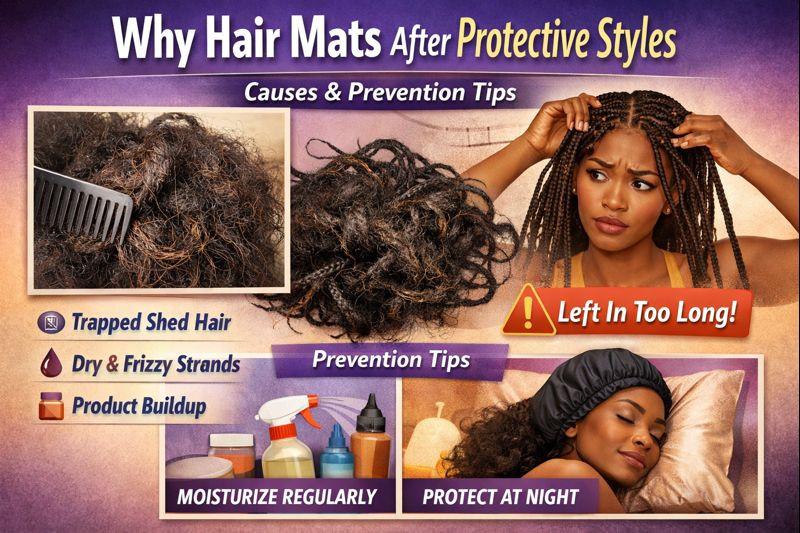
Protective styles are supposed to protect your hair. So why does your hair sometimes come out matted, tangled, or knotted after braids, twists, wigs, or sew-ins?
If you’ve ever taken down a “protective” style only to find your hair fused together, shedding excessively, or impossible to detangle—you’re not imagining it. Hair matting after protective styles is common, preventable, and often misunderstood.
This article breaks down exactly why hair mats after protective styles, what’s happening at a strand level, which styles cause the most damage, and how to stop matting before it starts—without giving up protective styling altogether.
What Does Hair Matting Actually Mean?
Hair matting occurs when shed hairs, product residue, friction, and dryness cause strands to interlock tightly, forming clumps or knots that won’t easily separate.
Unlike regular tangles, matting:
-
Feels dense and compact
-
Resists finger-detangling
-
Gets worse when dry
-
Often leads to breakage if forced apart
Matting is not the same as shedding, but excessive shedding trapped inside a style is one of its biggest triggers.
The Real Reason Hair Mats After Protective Styles
Hair matting is rarely caused by one thing. It’s usually the result of multiple stressors stacking over time.
Here are the biggest culprits.
1. Shed Hair Has Nowhere to Go
Every head sheds 50–100 hairs per day. When your hair is loose, shed strands fall away naturally.
When your hair is in a protective style:
-
Shed hairs remain trapped
-
They wrap around healthy strands
-
They tighten over time
-
They form knots at the root or mid-shaft
The longer the style stays in, the more shed hair accumulates.
This is the #1 reason hair mats after protective styles.
2. Dry Hair Creates Velcro-Like Friction
Protective styles don’t moisturize your hair—you do.
When hair becomes dry:
-
Cuticles lift
-
Strands catch onto each other
-
Friction increases
-
Tangling accelerates
Dry hair behaves like Velcro. Once strands interlock, they don’t release easily.
If you’re not moisturizing regularly while styled, matting is almost guaranteed.
3. Product Buildup Acts Like Glue
Heavy creams, gels, edge controls, and waxes can bond strands together, especially when layered repeatedly.
Over time:
-
Products harden
-
Dust and lint stick
-
Shed hair gets trapped
-
Hair clumps fuse
This is especially common under wigs, sew-ins, and crochet styles where the scalp isn’t cleansed properly.
4. Styles That Are Too Small or Too Tight
Micro-braids, tiny twists, or overly tight installs increase:
-
Root stress
-
Friction
-
Shed hair tangling
Small sections leave less room for shed hair to release, causing it to coil tightly around neighboring strands.
Tight styles also inflame the scalp, increasing shedding—fueling the matting cycle even more.
5. Neglecting the Hair Under the Style
Protective styles often create a false sense of security.
Common mistakes:
-
Not washing the scalp
-
Skipping detangling for weeks
-
Not moisturizing the hair underneath
-
Leaving styles in too long
Hair thrives on gentle manipulation, not total neglect.
6. Sleeping Without Protection
Cotton pillowcases and uncovered styles cause:
-
Moisture loss
-
Friction
-
Tangling at the crown and nape
Nighttime friction is one of the most overlooked causes of matting—especially under wigs and braids.
7. Leaving Styles in Too Long
Protective styles have an expiration date.
General guideline:
-
Braids/twists: 4–6 weeks
-
Wigs/sew-ins: cleanse and detangle weekly
-
Crochet styles: 3–5 weeks
The longer hair stays immobilized, the more shed hair builds up—and the harder detangling becomes.
Which Protective Styles Cause the Most Matting?
Not all protective styles are equal.
Higher Risk Styles
-
Small box braids
-
Micro twists
-
Crochet styles
-
Wigs worn daily without detangling
-
Sew-ins without scalp access
Lower Risk Styles
-
Medium to large twists
-
Loose cornrows under wigs
-
Flat twists
-
Chunky braids
The key factor isn’t the style—it’s maintenance.
Why Hair Mats More at the Roots
If your matting is concentrated at the roots, here’s why:
-
New growth is coarser
-
Shed hairs collect near the scalp
-
Product buildup is highest there
-
Sweat and oil mix with residue
Roots need just as much attention as ends—sometimes more.
The Difference Between Matting and Breakage
This matters because the solution changes.
Matting:
-
Dense knots
-
Caused by friction + shed hair
-
Can often be reversed with patience
Breakage:
-
Short, snapped strands
-
Caused by force, dryness, or damage
-
Cannot be reversed
Many people cause breakage trying to fix matting too aggressively.
How to Detangle Matted Hair Without Losing Length
If your hair is already matted, don’t panic.
Step-by-Step Safe Detangling
-
Add moisture first
Use a water-based spray or leave-in. Never detangle dry hair. -
Apply slip
Oils or conditioners reduce friction. -
Work in sections
Smaller sections = less tension. -
Finger-detangle first
Fingers feel knots better than combs. -
Start from the ends
Always work upward toward the roots. -
Use a wide-tooth comb last
Only after most tangles are removed.
If hair refuses to release, cutting the knot may save the rest of the strand—not a failure, just smart hair care.
How to Prevent Hair Matting Before It Starts
This is where protective styles actually become protective.
1. Moisturize on a Schedule
-
Light mist every 2–3 days
-
Focus on roots and exposed hair
-
Avoid heavy layering
2. Cleanse Your Scalp
-
Use diluted shampoo or scalp cleanser
-
Focus on buildup zones
-
Rinse thoroughly
Clean hair tangles less.
3. Detangle While Styled
-
Finger-detangle roots weekly
-
Gently separate sections
-
Don’t wait until takedown day
4. Choose Larger Sections
Bigger parts = less friction + easier shedding release.
5. Limit Style Duration
Set a calendar reminder if needed. No style is worth losing hair.
6. Protect Hair at Night
-
Satin bonnet or scarf
-
Satin pillowcase as backup
This alone can cut matting in half.
The Role of Hair Type and Texture
Hair matting can happen to any texture, but some are more prone:
-
Coily and kinky hair (tighter curl patterns)
-
High-density hair
-
Dry or low-lubrication hair types
This doesn’t mean your hair is “bad” or “hard”—it means it needs consistent moisture and gentle care.
Why “Low Manipulation” Doesn’t Mean “No Manipulation”
Hair needs:
-
Moisture
-
Airflow
-
Gentle separation
Protective styles should reduce stress—not eliminate interaction entirely.
Think maintenance, not abandonment.
When to Take the Style Down Immediately
Remove the style if you notice:
-
Painful tightness
-
Scalp itching that won’t stop
-
Hard clumps forming at roots
-
Excessive shedding around edges
Ignoring early signs almost always leads to matting or breakage.
Final Thoughts: Protective Styles Should Protect—Not Punish
Hair matting after protective styles isn’t a mystery—it’s a maintenance mismatch.
Protective styles work when:
-
Hair is moisturized
-
Shed hair is managed
-
Scalp is cleansed
-
Styles aren’t worn too long
If your hair keeps matting, it’s not failing you—you’re just missing a few key steps.
Once you fix those, protective styles can finally do what they’re meant to do: retain length, protect your ends, and support healthy growth.