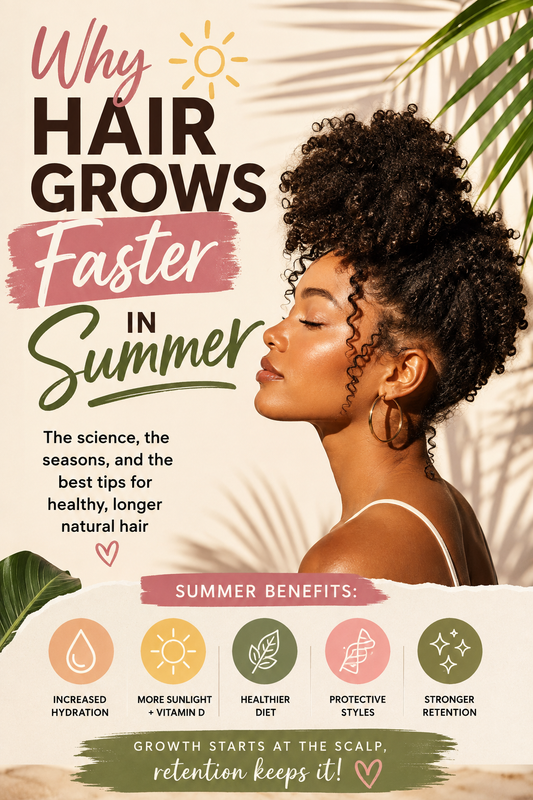
Have you ever noticed that your hair seems to grow faster during the summer? Maybe your roots become noticeable sooner, your braids seem to loosen faster, your locs show new growth more quickly, or you suddenly realize that your natural hair has gained more length than expected.
You may not be imagining it.
Hair growth can be influenced by seasonal changes, and some research suggests that the human hair-growth cycle may fluctuate throughout the year. However, summer itself is not a magical hair-growth treatment. Several factors—including circulation, sunlight exposure, activity levels, nutrition, scalp conditions, and normal changes in the hair-growth cycle—may contribute to the appearance or reality of increased growth during warmer months.
For people with Black hair, natural hair, curly hair, braids, twists, and locs, summer can also make new growth particularly noticeable. At the same time, heat, humidity, swimming, sun exposure, and frequent styling can increase dryness and breakage.
That creates an important distinction:
Growing hair and retaining hair are not the same thing.
Your follicles may be producing new strands, but if your ends are constantly breaking, your overall length may barely change.
In this complete guide, we'll explore why hair may grow faster in summer, how much hair normally grows, what seasonal changes may mean for Black and natural hair, and how to create a summer hair routine that helps you retain as much healthy length as possible.
Does Hair Really Grow Faster in Summer?
Hair may grow slightly faster or appear to grow faster during warmer months for some people, but the difference isn't dramatic or universal.
Human hair grows in cycles, and these cycles are influenced by genetics, hormones, age, overall health, nutrition, stress, and potentially seasonal changes.
On average, scalp hair grows approximately:
- 0.5 inch per month
- About 6 inches per year
Some people naturally grow more or less than this.
Your individual rate matters much more than trying to match someone else's hair-growth timeline.
During summer, several things may make growth more noticeable:
- Changes in the hair-growth cycle
- Increased physical activity and circulation
- More sunlight exposure
- Changes in vitamin D status
- Greater scalp visibility from protective styles
- Increased washing
- Changes in humidity
- More frequent observation of new growth
For example, if you install box braids at the beginning of June, you may clearly see an inch or more of new growth by late summer. Because the braided hair remains relatively stationary while the roots grow outward, the difference becomes especially obvious.
That doesn't necessarily mean braids caused your hair to grow faster. They simply made the new growth easier to see.
Understanding How Hair Actually Grows
Before discussing summer hair growth, it helps to understand what's happening underneath your scalp.
Hair grows from follicles located within the skin.
The visible strand of hair is primarily made of keratin. While the strand itself is not living tissue, the follicle beneath your scalp contains living cells responsible for producing new hair.
Hair generally moves through several phases.
1. The Anagen Phase
Anagen is the active growth phase.
During this period, cells inside the follicle rapidly divide and produce the hair strand.
Scalp hair can remain in the anagen phase for several years.
The length of your anagen phase is one reason some people can naturally grow extremely long hair while others seem to reach a certain length more easily.
Genetics plays an important role.
The longer your follicles remain actively producing hair before transitioning into another phase, the greater your potential maximum length may be—assuming you retain the hair.
2. The Catagen Phase
Catagen is a short transitional stage.
During this phase, active growth slows and the follicle begins preparing for its resting period.
Only a relatively small percentage of your scalp hairs should normally be in this stage at one time.
3. The Telogen Phase
Telogen is commonly described as the resting phase.
The follicle temporarily stops actively producing length before eventually transitioning toward shedding and a new cycle.
4. The Exogen Phase
Exogen refers to the shedding portion of the cycle.
Old strands are released while follicles prepare for or begin producing new hair.
Normal shedding is part of healthy hair biology.
Finding strands in your comb, shower, brush, or fingers does not automatically mean you're experiencing hair loss.
The key is recognizing what is normal for you and noticing major changes.
Why Does Hair Seem to Grow Faster in Summer?
There probably isn't one single explanation.
Instead, summer creates a collection of biological, environmental, and lifestyle changes that may influence the scalp and make growth more noticeable.
Let's look at the major factors.
1. Seasonal Changes in the Hair-Growth Cycle
One of the most interesting explanations involves seasonal changes in the percentage of follicles occupying different stages of the growth cycle.
Humans do not have dramatic seasonal coats like many animals, but our hair follicles may still show subtle seasonal patterns.
That means the number of hairs actively growing, resting, or preparing to shed may fluctuate during different times of the year.
These changes aren't necessarily large enough for everyone to notice.
But when combined with other summer factors, you might feel like your hair is growing significantly faster.
This also helps explain why some people notice changes in shedding during certain seasons.
2. Increased Blood Circulation
Blood circulation plays an important role in supporting your follicles.
Blood delivers oxygen and nutrients to tissues throughout your body, including your scalp.
During summer, many people naturally become more physically active.
You may:
- Walk more
- Swim
- Exercise outdoors
- Travel
- Spend more time outside
- Participate in sports
- Go hiking
- Dance
- Perform yard work
Physical activity temporarily increases circulation throughout the body.
Regular exercise also supports overall cardiovascular health.
This does not mean that exercising for an hour will suddenly make your hair grow dramatically faster. Hair growth is far more complicated than circulation alone.
However, supporting your overall health also supports the biological systems responsible for healthy hair production.
3. More Sunlight Exposure
Summer usually means longer days and more opportunities for sunlight exposure.
Sunlight helps your skin produce vitamin D.
Vitamin D has several important biological functions and is also involved in normal hair-follicle biology.
However, this doesn't mean that sitting in direct sunlight for hours will make your hair grow faster.
Excessive ultraviolet exposure can actually damage your hair and scalp.
The goal should be balance.
If you suspect a vitamin D deficiency, the appropriate approach is to speak with a healthcare professional rather than attempting to treat it through excessive sun exposure.
4. Warmer Temperatures May Change Scalp Conditions
Warm weather changes your scalp environment.
During summer, you may experience increased:
- Sweating
- Sebum production
- Washing
- Physical activity
- Humidity exposure
These factors can change how your scalp feels and how often you cleanse it.
For some people, a more consistent cleansing routine during summer removes sweat, dirt, oils, and product buildup more regularly.
A clean scalp doesn't magically accelerate follicle activity, but maintaining healthy scalp conditions is an important part of an overall healthy hair routine.
Follicles do not need thick layers of grease or product buildup to grow.
Keeping the scalp reasonably clean is usually a better strategy.
5. You May Eat Differently During Summer
Hair is built from nutrients obtained through your diet.
During summer, many people eat more fresh fruits and vegetables.
Popular seasonal foods include:
- Watermelon
- Strawberries
- Blueberries
- Peaches
- Mangoes
- Tomatoes
- Cucumbers
- Avocados
- Leafy greens
- Bell peppers
These foods provide vitamins, minerals, antioxidants, water, and other nutrients important for general health.
Protein is especially important because hair is primarily composed of keratin, which is a protein.
Good protein sources can include:
- Eggs
- Fish
- Chicken
- Beans
- Lentils
- Greek yogurt
- Nuts
- Seeds
- Tofu
Again, no single food can force your hair to grow several inches overnight.
A balanced diet simply gives your body the building blocks it needs to function normally.
6. Hydration Habits May Improve
Hot weather makes many people more conscious of drinking fluids.
Adequate hydration is essential for normal body function.
Your hair won't suddenly stop growing because you forgot one glass of water, and drinking excessive water won't make your hair grow twice as fast.
But chronic dehydration isn't beneficial for your overall health.
Think of hydration as part of your entire wellness routine rather than a standalone hair-growth treatment.
7. Protective Styles Make New Growth Easier to See
This may be one of the biggest reasons people believe their hair grows faster during summer.
Summer is peak season for protective hairstyles.
Popular summer styles include:
- Box braids
- Knotless braids
- Cornrows
- Two-strand twists
- Mini twists
- Crochet styles
- Loc styles
- Flat twists
When your hair is left in a relatively stable hairstyle for several weeks, new growth becomes extremely noticeable around the roots.
Imagine installing braids on June 1.
By July 1, you may have around half an inch of growth.
By August 1, you could have approximately an inch.
That new growth becomes very obvious because your braid originally started close to your scalp.
The hairstyle creates a visual measuring system.
When you're wearing your natural hair loose every day, shrinkage and manipulation can make the same amount of growth much harder to notice.
8. Humidity Can Make Hair Look Fuller
Humidity doesn't necessarily increase your actual growth rate.
However, it can dramatically change the appearance of curly and natural hair.
Hair can absorb moisture from humid air, causing strands to swell and curls to expand.
Natural hair may appear:
- Fuller
- Thicker
- Bigger
- More voluminous
This can sometimes create the impression that you've experienced a major growth spurt.
Unfortunately, humidity can also create:
- Frizz
- Shrinkage
- Tangling
- Single-strand knots
So summer humidity can be both helpful and challenging.
Summer Hair Growth and Black Hair
Black hair deserves special attention when discussing growth because one of the biggest misconceptions about tightly curled hair is that it doesn't grow.
Black hair grows.
The issue is often length retention rather than growth.
Tightly curled strands have numerous bends and curves. These areas can become vulnerable to mechanical stress, especially when hair is dry or handled aggressively.
That means your scalp may produce several inches of healthy new hair while your ends break at nearly the same rate.
The result?
Your hair looks like it's staying the same length.
This is why summer hair care should focus on two separate goals:
Goal #1: Support healthy growth from the scalp.
Goal #2: Protect existing length from breakage.
The second goal is frequently overlooked.
Hair Growth vs. Length Retention
Suppose your hair grows six inches during the year.
If you lose four inches through breakage, you've only retained two inches.
If you lose six inches, you may believe your hair "didn't grow."
But your follicles were producing hair the entire time.
Your ends simply didn't survive.
This distinction is especially important for natural hair.
Common causes of poor length retention include:
- Excessive manipulation
- Dryness
- Tight hairstyles
- Rough detangling
- Excessive heat
- Chemical damage
- Split ends
- Friction
- Sleeping without hair protection
- Leaving protective styles in too long
If your goal is longer natural hair, protecting your ends is just as important as focusing on your scalp.
Does Sweat Make Hair Grow Faster?
Sweating itself doesn't make hair grow.
Sweat is primarily your body's method of regulating temperature.
However, activities that cause sweating—such as exercise—can be beneficial for your overall health.
The problem is that sweat can also accumulate on your scalp.
Sweat mixed with:
- Sebum
- Hair products
- Dirt
- Dead skin
- Environmental debris
can leave your scalp feeling uncomfortable.
If you're exercising frequently during summer, you may need to adjust your cleansing schedule.
That doesn't always mean shampooing your hair every single day.
The right frequency depends on your scalp, hairstyle, activity level, and products.
The goal is to prevent excessive buildup while avoiding unnecessary manipulation.
Does Sunlight Make Hair Grow Faster?
This is another popular summer hair-growth question.
Sunlight itself should not be treated as a hair-growth treatment.
Although sunlight contributes to vitamin D production, excessive UV exposure can damage hair fibers and your skin.
Prolonged sun exposure can contribute to:
- Dryness
- Color fading
- Rough texture
- Weakened hair
- Scalp sunburn
If you'll be outside for long periods, consider protecting your hair with a hat, scarf, or other suitable covering when practical.
Your scalp may also need sun protection, especially along exposed parts or areas of thinning hair.
Does Heat Open Your Hair Follicles?
You've probably heard someone say:
"Heat opens your pores and makes your hair grow faster."
That's an oversimplification.
Hair follicles aren't doors that open in summer and close during winter.
Warmth may affect blood flow and scalp sensation, but it does not create unlimited follicle activity.
The rate at which your follicles produce hair is influenced primarily by your biology.
That's why sitting underneath a hair dryer for hours won't make your hair grow faster.
In fact, excessive heat can increase dryness and damage.
Why Your Braids Grow Out So Fast During Summer
If you wear braids, summer can make new growth feel incredibly fast.
You may install knotless braids and notice loose roots within two or three weeks.
Several things may contribute.
First, normal new growth is simply easy to see in braids.
Second, sweating can cause the roots to become frizzy.
Third, water exposure from pools, beaches, showers, and workouts can make the hairstyle loosen.
Fourth, humidity can cause natural hair around the roots to expand.
So what looks like one inch of new growth may actually be a combination of:
- Real new growth
- Frizz
- Swelling
- Slippage
- Loosening
That doesn't mean your hair isn't growing.
It simply means appearance alone isn't always an accurate measurement.
Why Locs Show So Much New Growth in Summer
People with locs may also notice significant root growth during warmer months.
Locs make growth easy to observe because new loose hair appears at the base of each loc.
After several weeks, you may see noticeable new growth between your scalp and the mature portion of the loc.
However, don't assume you need a retwist every time you see new growth.
Retwisting too frequently—especially tightly—can place unnecessary tension on your roots.
Healthy loc maintenance should prioritize the strength of the hair rather than keeping every root perfectly neat at all times.
Can Summer Help You Grow Longer Hair?
Summer can be an excellent opportunity to focus on length retention.
But summer can also damage your hair if you ignore environmental stress.
Your hair may face:
- UV exposure
- Chlorinated pools
- Salt water
- Increased sweating
- Frequent washing
- Humidity
- Heat
- Friction
- Protective-style tension
So the goal isn't simply to "grow hair."
The goal is to create an environment that supports healthy hair while minimizing damage to the length you already have.
The Best Summer Hair Growth Routine
A good summer routine doesn't need to contain 20 products or take three hours every day.
Consistency matters more than complexity.
Here's a practical routine.
Step 1: Keep Your Scalp Clean
Healthy hair care starts with scalp care.
During hot weather, sweat and product buildup may accumulate more quickly.
Cleanse your scalp according to its needs.
Pay attention to signs that you may need a wash:
- Heavy buildup
- Excessive oiliness
- Unpleasant odor
- Persistent flakes
- Sweat accumulation
When shampooing, concentrate primarily on the scalp.
Use your fingertips rather than scratching aggressively with your nails.
Allow the shampoo and water to flow down the length as you rinse.
Step 2: Condition Regularly
Natural and curly hair often benefits from regular conditioning because the hair's bends and curls can make it harder for natural scalp oils to travel down the entire strand.
After shampooing, apply conditioner primarily through the lengths and ends.
Give extra attention to your oldest hair.
Remember:
Your ends have been exposed to months or years of:
- Washing
- Styling
- Weather
- Friction
- Heat
- Detangling
Protect them.
Step 3: Moisturize According to Your Hair's Needs
There's no universal rule saying every person must moisturize every day.
Some people need frequent moisture.
Others don't.
Watch your hair.
If it feels:
- Rough
- Brittle
- Tangled
- Extremely dry
it may be time to refresh your moisture routine.
Focus especially on the ends.
Step 4: Seal or Protect Your Ends
Your ends are the oldest part of your hair.
They determine how much length you retain.
Depending on your hair and styling preferences, you may use a small amount of oil, butter, pomade, or another suitable product to reduce friction and help keep your ends protected.
The goal isn't to coat your hair with excessive product.
Use enough to meet your hair's needs.
Step 5: Reduce Manipulation
You don't need to restyle your hair every day.
Constant:
- Combing
- Brushing
- Pulling
- Twisting
- Detangling
- Tight ponytails
can increase mechanical damage.
Try hairstyles that allow your hair to remain relatively undisturbed for several days.
Examples include:
- Two-strand twists
- Mini twists
- Loose buns
- Braids
- Cornrows
- Flat twists
Protective doesn't mean painful.
If your hairstyle hurts, feels extremely tight, or creates bumps around your hairline, tension may be excessive.
Step 6: Protect Your Hair at Night
Your nighttime routine matters all year.
Cotton bedding can create friction as you move during sleep.
Consider using:
- A satin bonnet
- Satin scarf
- Satin pillowcase
This is especially helpful for curly, natural, braided, and loc'd hair.
Nighttime protection may reduce:
- Frizz
- Tangling
- Dryness
- Mechanical breakage
Small habits repeated every night can make a major difference in length retention.
How to Protect Natural Hair at the Pool
Swimming is one of the biggest summer hair challenges.
Chlorinated water can leave hair feeling dry and rough, especially with repeated exposure.
Before swimming, consider thoroughly wetting your hair with clean water.
Hair that's already saturated may absorb less pool water.
You can also consider applying an appropriate conditioner or protective product, depending on pool rules and your hairstyle.
A swim cap can provide additional protection, although no cap necessarily keeps every strand completely dry.
After swimming:
- Rinse your hair thoroughly.
- Cleanse when necessary.
- Condition.
- Detangle carefully.
- Restore moisture.
Don't repeatedly allow heavily chlorinated water to dry into your hair without eventually cleansing it.
How to Protect Hair at the Beach
Salt water can also leave hair feeling dry.
If you're spending the day at the beach, keep your routine simple.
Before entering the ocean, wet your hair with clean water when possible.
Afterward, rinse out the salt.
Follow with cleansing and conditioning as needed.
If you're wearing braids or locs, make sure the hair dries thoroughly afterward.
Constantly leaving thick hairstyles damp for extended periods isn't ideal.
Should You Oil Your Scalp During Summer?
Scalp oiling is popular in natural hair routines, but more oil doesn't automatically mean more growth.
Your scalp already produces sebum.
Some people enjoy applying a small amount of oil because it helps with their styling routine or reduces feelings of dryness.
Others experience buildup when they oil frequently.
During summer, sweating combined with heavy oils may make buildup happen even faster.
If you use scalp oil, start with a small amount.
Pay attention to how your scalp responds.
You do not need to soak your scalp in oil every day to grow healthy hair.
Does Scalp Massage Help Hair Grow Faster?
Scalp massage is another popular practice.
A gentle massage may promote relaxation and temporarily increase local circulation.
You can massage your scalp with your fingertips for several minutes.
Avoid scratching.
You don't necessarily need oil.
Try using the pads of your fingers and moving your scalp gently rather than rubbing aggressively across the hair.
This is especially important around your edges, where strands may be finer and more vulnerable.
Think of scalp massage as one supportive habit rather than a miracle solution.
The Importance of Protein for Summer Hair Growth
If you're serious about healthy hair, don't focus only on what you apply externally.
Your body needs adequate nutrition to produce hair.
Protein is particularly important.
Include appropriate sources such as:
- Fish
- Eggs
- Chicken
- Turkey
- Beans
- Lentils
- Nuts
- Seeds
- Yogurt
- Tofu
Your nutritional needs are individual, so major dietary changes should be based on your overall health rather than a desire for faster hair growth alone.
Important Nutrients for Healthy Hair
Hair biology is connected to overall nutritional status.
Nutrients commonly associated with normal hair health include:
Protein
Hair contains keratin, a protein.
Iron
Iron is important for many body functions, and iron deficiency can be associated with hair shedding.
Zinc
Zinc supports numerous cellular processes.
Vitamin D
Vitamin D has important roles throughout the body and is associated with normal follicle biology.
B Vitamins
B vitamins support normal cellular metabolism.
Essential Fatty Acids
Healthy fats support overall nutrition and normal body function.
Don't assume that taking massive doses of supplements will make your hair grow faster.
Too much of certain nutrients can actually be harmful.
If you're concerned about a deficiency, speak with a qualified healthcare professional.
Summer Hair Growth for Men
Men can also notice faster-looking hair growth during summer.
This may be especially obvious if you wear:
- Waves
- Fades
- Low cuts
- Braids
- Cornrows
- Locs
- Twists
A fresh haircut can make growth easy to measure.
If you normally need a haircut every two weeks but suddenly feel like your cut looks grown out sooner, seasonal and lifestyle changes may contribute.
Men with waves should be especially careful about excessive brushing.
Consistent brushing is part of wave training, but aggressive brushing can irritate the scalp and damage hair.
Use appropriate pressure and keep the scalp clean.
Summer Hair Growth for Kids
Children's hair needs gentle care.
Parents may notice that their child's braids or twists seem to grow out quickly during summer vacation.
Children may also spend more time:
- Swimming
- Playing outside
- Sweating
- Traveling
This means their hair may need extra attention.
Keep children's routines simple.
Focus on:
- Gentle cleansing
- Conditioning
- Moisture
- Easy detangling
- Low-tension hairstyles
- Nighttime protection
Avoid extremely tight braids simply because you want the style to last all summer.
Hairline health is more important than hairstyle longevity.
Why Your Hair May Still Feel Like It Isn't Growing in Summer
What if everyone talks about summer hair growth, but your hair still looks the same length?
Don't immediately assume something is wrong.
There are several possibilities.
Shrinkage
Natural hair can shrink dramatically.
Your hair may have gained an inch while looking nearly identical when dry.
Stretch a small section gently and compare it with an earlier measurement.
Breakage
Your hair may be growing from the scalp while breaking at the ends.
Look for:
- Short broken pieces
- Split ends
- Excessive tangling
- Rough ends
- Uneven areas
If breakage is occurring, focus on retention rather than trying to force faster growth.
Heat Damage
Frequent flat ironing, blow-drying at excessive temperatures, or other high-heat styling can weaken hair.
Summer is a great time to reduce unnecessary heat if you're trying to retain length.
Tight Hairstyles
Protective styles can become damaging when installed too tightly.
Watch for:
- Pain
- Bumps
- Redness
- Headaches
- Excessive pulling
- Thinning edges
Your hairstyle should not require several days of pain before it "loosens up."
Excessive Manipulation
Changing hairstyles every day may be sabotaging your retention.
Sometimes the best thing you can do is leave your hair alone.
How to Measure Your Summer Hair Growth
Instead of guessing, track your progress.
Choose a small section of hair and measure it at the beginning of summer.
For example:
June 1: 10 inches
Measure the same section approximately once a month.
You might record:
July 1: 10.5 inches
August 1: 11 inches
September 1: 11.5 inches
Photographs are also useful.
Take pictures:
- From the front
- From the back
- From both sides
- With your hair in the same state
- Under similar lighting
Consistency makes comparisons much more accurate.
Avoid measuring your hair every few days.
Hair grows too slowly for tiny short-term differences to be meaningful.
How Much Can Hair Grow During Summer?
If your hair grows around half an inch per month, you might gain approximately:
- 1.5 inches in three months
- 2 inches in four months
Individual results vary.
Some people grow faster.
Some grow slower.
The bigger opportunity may be retention.
If you normally lose much of your growth to breakage but protect your hair carefully during summer, you could finish the season with noticeably more retained length.
Can You Grow 3 Inches of Hair in One Month?
For most people, three inches of scalp-hair growth in a single month would be far beyond the typical rate.
Be cautious about products promising:
- 3 inches in one week
- 5 inches in one month
- Overnight hair growth
- Guaranteed instant regrowth
Hair growth is a biological process.
No shampoo, oil, cream, or conditioner can override your genetics and hair cycle overnight.
Hair products can help you care for your scalp and strands, reduce breakage, improve moisture, and support healthier-looking hair.
That's different from magically changing your natural growth rate.
What Happens When Summer Ends?
You don't have to lose all your progress when fall arrives.
The biggest mistake is treating healthy hair care as a temporary challenge.
Instead, take the habits that worked during summer and continue them throughout the year.
If your summer routine helped you retain length, keep doing the fundamentals:
- Cleanse consistently
- Condition regularly
- Moisturize as needed
- Protect your ends
- Minimize unnecessary manipulation
- Avoid excessive tension
- Protect your hair at night
- Eat a balanced diet
- Stay active
- Manage stress
Seasonal conditions change.
Healthy hair principles remain surprisingly consistent.
Frequently Asked Questions About Summer Hair Growth
Does hair grow faster when it's hot?
Some people may experience seasonal differences in hair growth, but heat itself should not be considered a direct hair-growth treatment. Genetics, hormones, health, nutrition, and the natural follicle cycle have much greater influence.
What month does hair grow fastest?
There is no universal month when everyone's hair suddenly reaches maximum growth speed. Research suggests seasonal patterns can occur in the human hair cycle, but individual experiences vary.
Does sweating help your hair grow?
Sweat itself does not make hair grow. Exercise that causes sweating supports overall health, but sweat buildup should still be removed appropriately from the scalp.
Does drinking water make hair grow faster?
Adequate hydration supports normal body function, but drinking excessive amounts of water will not dramatically accelerate hair growth.
Does vitamin D help hair growth?
Vitamin D is involved in normal biological processes associated with hair follicles. Deficiency can be relevant to hair health, but supplementation should be based on your individual needs and professional guidance.
Do braids make hair grow faster in summer?
Braids don't directly force your follicles to produce hair faster. They can reduce daily manipulation when installed and maintained correctly, potentially helping you retain more of the hair you grow.
Why do braids get loose so quickly in summer?
New growth, sweat, humidity, water exposure, frizz, and hair swelling can all make braids appear loose sooner.
Do locs grow faster in summer?
Locs may show new growth very clearly, making seasonal growth especially noticeable. Avoid excessive retwisting simply because new growth is visible.
Should I oil my scalp every day during summer?
Not necessarily. Daily oiling can create buildup for some people, particularly when combined with sweat. Adjust oil use according to your scalp and hairstyle.
How can I make my natural hair grow faster this summer?
Rather than trying to dramatically change your biological growth rate, focus on creating healthy conditions and retaining length. Maintain a clean scalp, reduce breakage, protect your ends, eat a balanced diet, minimize tension, and handle your hair gently.
10 Summer Hair Growth Tips to Remember
If you want to make the most of summer, keep these ten principles in mind:
- Keep your scalp clean.
- Condition your hair consistently.
- Pay extra attention to your ends.
- Reduce unnecessary manipulation.
- Avoid painfully tight protective styles.
- Protect your hair before and after swimming.
- Use nighttime protection.
- Eat enough protein and maintain a balanced diet.
- Track your growth monthly instead of daily.
- Focus on length retention as much as growth.
These habits may not produce overnight results, but they can make a significant difference over several months.
Final Thoughts: Why Hair Grows Faster in Summer
So, why does hair grow faster in summer?
The answer is more complicated than simply saying "because it's hot."
Hair growth may show seasonal variation, and summer also brings changes in physical activity, sunlight exposure, nutrition, hydration habits, scalp conditions, and styling routines. Protective hairstyles such as braids, twists, and locs can make new growth especially easy to see.
But the most important summer hair-growth lesson is this:
Don't focus only on how fast your hair grows. Focus on how much of that growth you keep.
Your follicles can produce healthy new hair every month, but dryness, excessive heat, rough detangling, tight hairstyles, swimming damage, and breakage can erase much of your visible progress.
For Black hair, natural hair, curly hair, braids, and locs, a successful summer routine should prioritize both healthy scalp care and length retention.
Keep your scalp clean. Maintain moisture. Protect your ends. Handle your hair gently. Avoid unnecessary tension. Protect your hair at night. Eat a balanced diet and give your hair time.
By the end of summer, don't judge your success only by the amount of new growth around your roots.
Look at the bigger picture:
Is your hair stronger?
Are you experiencing less breakage?
Are your ends healthier?
Have you retained more length?
Those are signs that your routine is working.
And when healthy hair habits continue beyond summer, the results can continue accumulating throughout fall, winter, spring—and into the next summer.