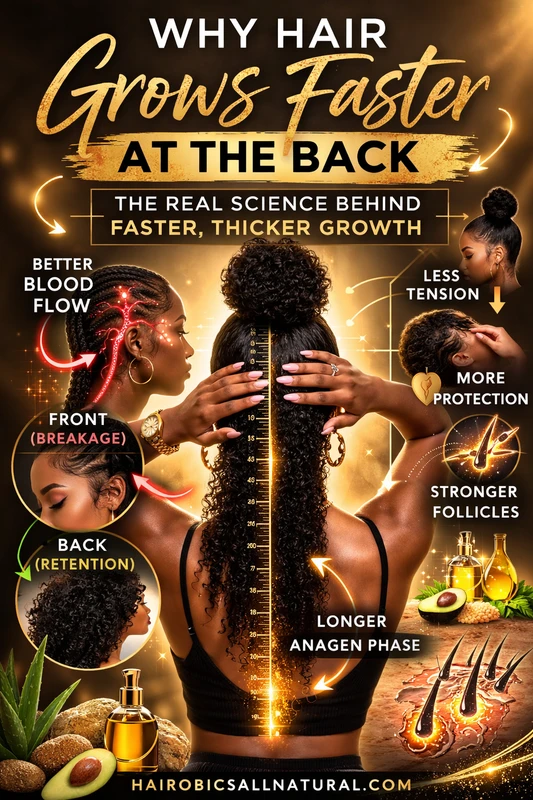
If you've ever noticed that the back of your hair seems longer, thicker, or stronger than the front — you're not imagining it.
Many people, especially those with natural or textured hair, say:
-
“The back of my hair grows so fast.”
-
“My crown won’t grow, but the back is thriving.”
-
“Why is my nape longer than my edges?”
-
“Why is the back of my hair thicker?”
This isn’t random.
There are real biological, mechanical, and behavioral reasons why hair often grows faster — or at least appears to grow faster — at the back of the head.
In this guide, we’re breaking down:
-
Hair growth science
-
Blood flow differences
-
Breakage patterns
-
Protective styling effects
-
Texture variations
-
Hormonal influence
-
How to balance growth across your entire head
If you’re serious about long-term healthy hair growth, understanding this difference is powerful.
First: Does Hair Actually Grow Faster in the Back?
Technically?
All healthy scalp follicles grow at roughly the same rate — about:
½ inch per month (on average)
But growth rate and growth retention are two different things.
Most people don’t have slower growth in the front.
They have higher breakage in the front.
That creates the illusion that the back grows faster.
The real question isn’t:
“Why does my hair grow faster in the back?”
It’s:
“Why does the back retain more length?”
The Hair Growth Cycle (Quick Refresher)
Hair grows in 3 main phases:
-
Anagen (Growth Phase) – 2–7 years
-
Catagen (Transition Phase) – 2–3 weeks
-
Telogen (Resting Phase) – 3–4 months
Different areas of your scalp can have slightly different anagen durations.
The back of the head often has:
-
Longer anagen cycles
-
Denser follicle clusters
-
Stronger strand diameter
That alone can create noticeable differences.
But that’s only part of the story.
1. The Back of the Head Has Better Blood Circulation
One major factor? Blood flow.
The back of the scalp (occipital region) receives strong circulation from the occipital artery.
Better circulation means:
-
More oxygen delivery
-
Better nutrient transport
-
Stronger follicle support
-
Longer growth phases
The front hairline and temples, however, are more sensitive to:
-
Hormonal changes
-
Stress
-
Tension
-
DHT sensitivity
That’s why edges are often the first area to thin.
2. Less Manipulation = More Length Retention
Think about how you style your hair daily.
You probably:
-
Touch the front more
-
Brush the front more
-
Lay your edges
-
Pull it into ponytails
-
Slick it down
-
Re-style it for appearance
The back?
Usually left alone.
Less manipulation means:
-
Less friction
-
Less tension
-
Less breakage
-
Less split ends
Over time, that adds up.
Hair that isn’t constantly disturbed retains length better.
3. The Back Is More Protected From Environmental Damage
Your front hair is exposed to:
-
Sunlight
-
Wind
-
Friction from hats
-
Pillow friction (if you sleep on your side)
-
Hands constantly adjusting styles
The back of your hair is often:
-
Covered
-
Shielded
-
Less exposed to UV damage
UV radiation weakens hair protein over time.
More exposure = more brittleness.
Less exposure = stronger strands.
4. Edges and Crown Are More Tension-Prone
For many Black women and men especially, styling practices impact growth patterns.
Common tension areas:
-
Edges
-
Temples
-
Crown
-
Hairline
Styles that stress these areas:
-
Tight braids
-
Tight ponytails
-
Lace fronts
-
Sew-ins
-
Glue installs
-
Slicked buns
-
Edge control daily use
The back of the head is usually not pulled as tightly.
Chronic tension can cause:
-
Traction alopecia
-
Thinning
-
Miniaturization
-
Shorter anagen phase
This makes it seem like the back grows faster — but really, the front is under stress.
5. Natural Hair Texture Variations
Many people don’t realize:
Different parts of your head can have different textures.
Common pattern:
-
Back: looser curl or thicker density
-
Crown: tighter coil
-
Edges: finer strands
Finer hair breaks easier.
If your edges are finer, they won’t retain length like thicker nape hair.
That difference in strand diameter alone can create visible growth differences.
6. Hormones Affect the Front More Than the Back
Hair follicles are sensitive to hormones like:
-
Estrogen
-
Cortisol
-
DHT (dihydrotestosterone)
The front hairline and crown are more androgen-sensitive.
That’s why:
-
Male pattern baldness starts at the front
-
Female thinning often starts at the crown
-
Stress shedding shows at the hairline
The back is often hormonally resilient.
This makes it a “safer zone” for long-term growth.
7. Sleep Patterns & Friction
If you sleep on your back, your pillow creates friction at the crown.
If you sleep on your side, your edges rub.
Rarely does someone sleep in a way that equally stresses the entire head.
Over years, micro-friction matters.
Satin or silk protection reduces uneven retention.
8. Product Buildup Patterns
We tend to apply:
-
Edge control at the front
-
Gel at the front
-
Sprays at the front
Heavy product layering can:
-
Clog follicles
-
Cause scalp inflammation
-
Reduce oxygen flow
The back often gets lighter product concentration.
Healthier scalp = better retention.
Is It Possible the Back Actually Grows Faster?
Yes — in some people.
Due to:
-
Genetic follicle density
-
Longer anagen cycles
-
Better vascular support
-
Lower androgen sensitivity
But most cases are retention differences — not growth rate differences.
Why the Crown Sometimes Grows Slower
The crown is a unique zone.
It often has:
-
Tighter coils
-
Higher shrinkage
-
More dryness
-
More breakage
-
More tension from styles
Shrinkage can make it look shorter.
You might have 6 inches there — but it coils tighter than the back.
That visual illusion is common in textured hair.
The Retention Equation
Hair growth is simple math:
Growth Rate – Breakage = Retained Length
If:
Back breaks 5%
Front breaks 30%
Even if both grow ½ inch monthly…
The back will look longer over time.
How To Even Out Growth Across Your Head
If your goal is balanced growth, focus on:
1. Reduce Tension in Front Styles
Loosen ponytails.
Alternate part placements.
Avoid daily slick styles.
2. Improve Blood Circulation Everywhere
Scalp massage 3–5 minutes daily.
Increase hydration.
Exercise regularly.
3. Strengthen Finer Areas
Use protein treatments carefully.
Focus on moisture retention.
Seal ends consistently.
4. Protect Your Hairline at Night
Satin bonnet.
Silk scarf.
Satin pillowcase.
5. Stop Over-Manipulating the Front
Less brushing.
Less combing.
Less touching.
Why Black & Textured Hair Shows This Difference More
Textured hair:
-
Has bends in the strand.
-
Has weaker cuticle layers at each curve.
-
Is more prone to breakage.
So any additional tension or friction in the front causes faster visible damage.
The back — if thicker — handles stress better.
That’s why this question is especially common in natural hair communities.
Signs Your Front Isn’t Growing — It’s Breaking
Look for:
-
Short, uneven pieces
-
White dots at ends
-
Split ends
-
Thinning temples
-
Short halo hairs
If you see those, it’s breakage — not slow growth.
When to Be Concerned
If you notice:
-
Sudden crown thinning
-
Bald patches
-
Rapid shedding
-
Inflammation
-
Scalp tenderness
That may indicate:
-
Traction alopecia
-
Hormonal imbalance
-
Stress-related shedding
-
Nutritional deficiency
If it’s extreme or sudden, consult a dermatologist.
Can You Make the Front Grow Like the Back?
You can improve retention dramatically.
Focus on:
-
Low tension styling
-
Gentle detangling
-
Balanced moisture/protein
-
Scalp health
-
Reduced edge manipulation
Consistency is key.
Hair grows slowly — but damage happens fast.
The Truth About “Slow Growing Edges”
Edges are:
-
Finer
-
More fragile
-
More manipulated
-
More hormonally sensitive
They’re not doomed.
But they require gentler treatment than the back.
Final Takeaway: It’s Not Faster Growth — It’s Better Retention
In most cases:
The back doesn’t grow faster.
It just:
-
Breaks less
-
Gets manipulated less
-
Gets exposed less
-
Has stronger strands
When you treat your entire scalp like the back of your head…
That’s when you see full-head length retention.
FAQ Section
Does hair grow faster at the nape?
Not necessarily faster — but it often retains length better.
Why is the back of my hair thicker?
Genetic follicle density differences and strand diameter variations.
Why won’t my edges grow?
Likely breakage from tension or friction.
Is it normal for the crown to grow slower?
Yes, due to shrinkage and higher breakage patterns.
Growth Is About Strategy, Not Speed
Hair grows.
Retention is earned.
When you understand how different areas behave, you can adjust your routine and finally see balanced length across your head.