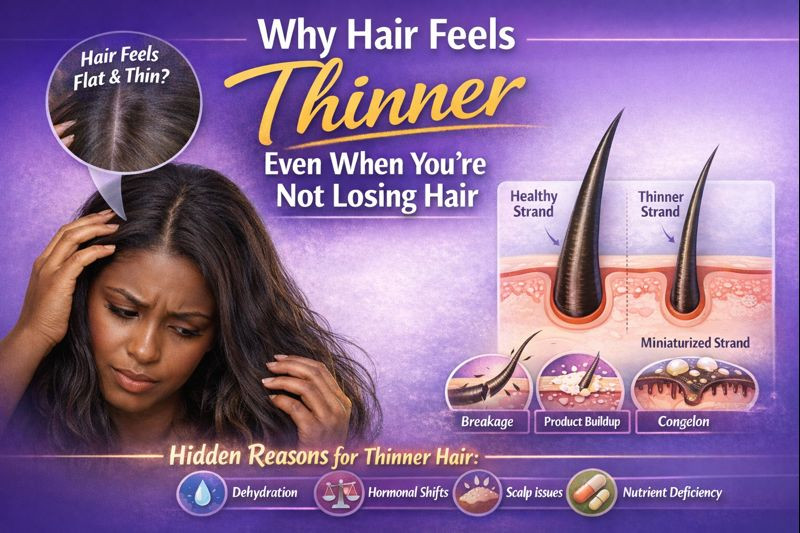
You run your fingers through your hair and something feels… off.
Your ponytail doesn’t feel as full.
Your curls don’t clump the way they used to.
Your hair looks healthy, but it doesn’t feel dense anymore.
Yet when you check the drain, your brush, or your pillow — there’s no unusual shedding.
So what’s going on?
The truth is: hair can feel thinner without actual hair loss. And in many cases, the issue is happening inside the hair shaft, on the scalp, or within the growth cycle — long before follicles stop producing hair.
This article breaks down all the hidden reasons hair loses fullness, how to tell what’s affecting your hair, and exactly what to do to restore thickness.
Hair Thinning vs. Hair Loss: The Key Difference
First, let’s clear up a major misconception.
Hair loss = fewer hairs growing from the scalp
Hair thinning = hair strands become weaker, finer, flatter, or less voluminous
You can have the same number of hairs on your head — but if each strand is compromised, your hair will feel thinner overall.
Most people dealing with this issue are experiencing structural thinning, not follicle death.
1. Your Hair Shaft Is Shrinking (Even If Follicles Are Fine)
One of the most overlooked causes of thinning-feeling hair is hair shaft miniaturization.
This happens when:
-
Hair strands grow in narrower
-
The cuticle layers are thinner
-
Each strand holds less internal moisture and protein
The result?
-
Less body
-
Less weight
-
Less fullness
Even though the hair count hasn’t changed.
What causes shaft thinning?
-
Chronic dryness
-
Repeated protein overload
-
Heat styling damage
-
UV exposure
-
Chemical processing
-
Aging
Over time, hair grows in lighter and weaker — not shorter or missing.
2. Your Hair Is Breaking Faster Than It Grows
This one tricks a LOT of people.
If your hair:
-
Breaks at the mid-shaft or ends
-
Snaps when detangling
-
Loses length retention
It can feel thinner without visible shedding, because the hairs never reach their full diameter or length.
Signs breakage is the culprit:
-
Hair won’t grow past a certain point
-
Ends feel wispy
-
Density looks better at the roots than the lengths
-
Hair feels thin when gathered, not at the scalp
Breakage silently robs you of fullness.
3. Low Porosity Hair Can Feel Thin When It’s Actually Dehydrated
Low porosity hair is notorious for this.
When moisture sits on top of the strand instead of penetrating:
-
Hair feels dry and coated
-
Strands feel stiff, not plush
-
Hair collapses instead of expanding
Dehydrated low-porosity hair often shrinks inward, reducing volume even when strand count is normal.
This is why hair can feel thinner right after moisturizing — the water never made it inside.
4. Product Buildup Is Flattening Your Hair
You don’t need heavy products for buildup to be a problem.
Even “light” products can:
-
Coat the cuticle
-
Weigh hair down
-
Reduce natural expansion
-
Block moisture entry
When buildup accumulates:
-
Hair loses lift
-
Curls stop springing
-
Strands clump less
-
Hair feels thinner to the touch
And because buildup doesn’t cause shedding, it often goes unnoticed.
5. Your Scalp Is Congested — Not Balding
A scalp issue doesn’t always mean hair loss.
If your scalp has:
-
Excess sebum
-
Dead skin buildup
-
Product residue
-
Inflammation
Hair can grow slower, weaker, or narrower, even if follicles remain active.
Congested scalps:
-
Reduce oxygen to follicles
-
Slow down growth cycles
-
Produce weaker strands
The hair is still growing — just not growing strong.
6. Hormonal Shifts Can Change Hair Density Without Causing Shedding
Hormones don’t always trigger dramatic hair loss.
Subtle shifts in:
-
Estrogen
-
Progesterone
-
Thyroid hormones
-
Cortisol (stress hormone)
Can cause hair to grow in:
-
Finer
-
Softer
-
Less pigmented
-
Less resilient
Common triggers include:
-
Stress
-
Postpartum changes
-
Perimenopause
-
Birth control changes
-
Thyroid imbalance
The hair is still there — it just doesn’t behave the same.
7. Aging Changes Hair Texture Before It Changes Hair Count
Hair aging starts earlier than most people think — sometimes as early as the late 20s or early 30s.
As we age:
-
Hair cuticles become less compact
-
Protein production decreases
-
Natural oils decline
This leads to:
-
Reduced diameter
-
Less elasticity
-
Less bounce
Hair feels thinner even though follicles are still producing hair normally.
8. Hard Water Slowly Weakens Hair Structure
Hard water deposits minerals like calcium and magnesium onto the hair shaft.
Over time, this causes:
-
Cuticle roughness
-
Reduced moisture absorption
-
Increased brittleness
-
Flat, lifeless strands
Hard water doesn’t cause shedding — it causes structural thinning, which changes how hair feels in your hands.
9. Styling Habits Can Compress Hair Over Time
Even “gentle” styling can contribute.
Examples:
-
Tight buns or ponytails
-
Constant slick styles
-
Excessive brushing
-
Repeated stretching while wet
These habits:
-
Compress the hair shaft
-
Increase internal damage
-
Reduce natural volume
Hair loses its ability to expand, which is key to fullness.
10. Nutrient Deficiencies Can Affect Strand Quality, Not Quantity
You don’t need to be deficient enough to lose hair for nutrition to impact thickness.
Low levels of:
-
Iron
-
Zinc
-
Biotin
-
Vitamin D
-
Protein
Can cause hair to grow in:
-
Thinner
-
Weaker
-
Slower
The hair grows — just not at full strength.
How to Tell What’s Causing Your Hair to Feel Thinner
Ask yourself:
-
Does my hair feel thin mostly in the lengths? → likely breakage
-
Does it feel thin right after styling? → buildup or dehydration
-
Does my scalp feel itchy, tight, or oily? → congestion
-
Did this start after stress, illness, or hormonal changes? → internal shift
-
Does my hair look fine but lack body? → shaft thinning
Hair usually tells the truth — you just have to listen.
How to Restore Thickness (Without Waiting for Hair Loss)
1. Clarify Regularly — Gently
Remove buildup so hair can expand naturally.
2. Focus on Moisture Penetration, Not Just Application
Use lightweight hydration that actually absorbs into the strand.
3. Balance Protein
Too much protein stiffens hair. Too little weakens it. Balance matters.
4. Improve Scalp Health
Cleanse, stimulate, and nourish the scalp so follicles produce stronger strands.
5. Reduce Mechanical Stress
Looser styles, gentler detangling, and less tension go a long way.
6. Support Hair Internally
Manage stress, eat enough protein, and address deficiencies if needed.
When to Be Concerned
If thinning feeling is accompanied by:
-
Widening parts
-
Visible scalp
-
Sudden shedding
-
Bald patches
That may indicate true hair loss, and it’s time to consult a professional.
But if your hair feels thinner without shedding, you’re likely dealing with a reversible issue — not permanent loss.
The Bottom Line
Hair can feel thinner even when you’re not losing hair because fullness depends on strand strength, hydration, scalp health, and structure — not just hair count.
In many cases, this is your hair sending an early warning signal — not a final verdict.
And the good news?
Early signals are the easiest to fix.