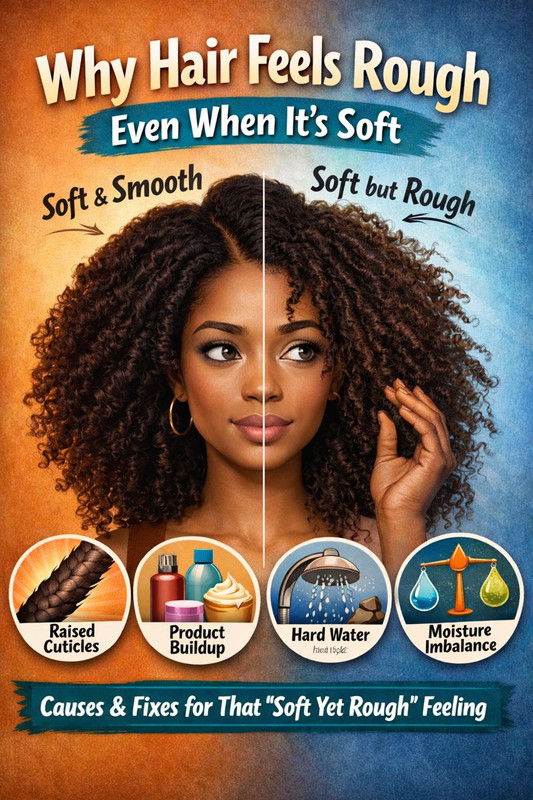
You run your fingers through your hair and feel two completely different things at once.
It’s soft, but somehow it’s also rough.
Not dry exactly. Not brittle. Just… off.
This confusing texture mismatch is more common than most people realize, especially in natural, textured, chemically treated, or heat-styled hair. And the reason it happens isn’t always obvious — because softness and smoothness are not the same thing.
Let’s break down why hair can feel soft to the touch yet still feel rough, gritty, or uneven — and what you can do to fix it for good.
Soft Hair vs. Smooth Hair: The Key Difference Most People Miss
Before fixing the problem, it’s important to understand what’s actually happening.
-
Soft hair refers to how pliable and flexible the strands feel
-
Smooth hair refers to how flat and sealed the hair cuticle is
Your hair can be:
-
Soft but rough
-
Smooth but stiff
-
Rough and dry
-
Or soft and smooth (the goal)
When hair feels soft but rough, it usually means the inner moisture balance is okay, but the outer cuticle layer is compromised.
1. Raised or Damaged Cuticles Are the #1 Cause
Each strand of hair is covered in tiny overlapping scales called the cuticle.
When these scales lie flat, hair feels smooth.
When they lift, chip, or fray, hair feels rough — even if it’s moisturized underneath.
What causes raised cuticles?
-
Frequent washing
-
Hot water
-
Heat styling
-
Chemical treatments
-
Harsh shampoos
-
Friction from towels, pillowcases, or clothing
Your hair may feel soft because it has moisture inside, but the outside is uneven — like a peach instead of glass.
Translation: Moisture without cuticle protection = soft but rough hair.
2. You’re Over-Moisturizing Without Sealing
Moisture alone doesn’t equal healthy texture.
If you’re constantly applying:
-
Leave-ins
-
Creams
-
Mists
-
Water-based products
…but not sealing with oils or butters, moisture escapes quickly. The strand swells and contracts repeatedly, lifting the cuticle each time.
This leaves hair feeling:
-
Soft
-
Puffy
-
Rough
-
Undefined
-
Frizzy when touched
This is especially common in:
-
Low-porosity hair
-
Fine strands
-
Hair that air-dries often
3. Product Buildup Creates a Coated-But-Rough Feel
Buildup doesn’t always make hair hard or greasy.
Sometimes it creates a soft but gritty texture, especially when:
-
Silicones aren’t properly clarified
-
Heavy butters pile up
-
Proteins accumulate unevenly
Your fingers feel softness from product layers, but the actual strand underneath is coated, dull, and uneven.
Signs buildup is the issue:
-
Hair feels soft but looks dull
-
Hair tangles easily
-
Hair never feels “clean” even after washing
-
Roughness worsens when dry
4. Mineral Deposits From Hard Water
Hard water is a silent texture killer.
Minerals like calcium and magnesium:
-
Stick to the cuticle
-
Prevent moisture absorption
-
Create a chalky, rough feel
Hair affected by hard water often feels:
-
Soft when wet
-
Rough when dry
-
Coarse at the ends
-
Hard to detangle
This happens even with great products because minerals block them from working properly.
5. Protein Imbalance (Too Much or Too Little)
Protein affects strength, not softness — but imbalance affects texture.
Too much protein:
-
Hair feels rough
-
Hair feels stiff when dry
-
Hair snaps instead of stretches
Too little protein:
-
Hair feels mushy when wet
-
Hair feels soft but weak
-
Hair tangles easily
Both imbalances can cause that strange soft-yet-rough sensation because the strand lacks proper structure.
6. Cuticle Damage From Friction (Not Just Heat)
You don’t need heat tools to damage your cuticle.
Constant friction from:
-
Cotton pillowcases
-
Hoodies and scarves
-
Rough towels
-
Frequent manipulation
…gradually erodes the cuticle.
Hair remains soft due to moisture but feels rough because the outer layer is physically worn down.
This is extremely common around:
-
Ends
-
Crown
-
Hairline
-
Nape
7. pH Imbalance From Hair Products
Hair thrives at a slightly acidic pH (around 4.5–5.5).
Products that are:
-
Too alkaline
-
Poorly formulated
-
Overused
…cause the cuticle to remain lifted even after styling.
Your hair might feel soft right after moisturizing, but rough once it dries because the cuticle never fully closed.
8. Weather & Humidity Effects
Humidity causes hair to:
-
Absorb moisture from the air
-
Swell unevenly
-
Lift the cuticle
This leads to hair that feels:
-
Soft
-
Puffy
-
Rough when touched
Even well-conditioned hair can feel rough in humid conditions if it’s not properly sealed.
9. Mechanical Damage at the Ends
Ends are the oldest, weakest part of your hair.
When ends are:
-
Split
-
Thinned
-
Frayed
They often feel soft because they’re worn down — but rough because the cuticle is gone.
No product can permanently smooth severely damaged ends. Trimming is sometimes the only fix.
10. Low Porosity Hair That Looks Healthy but Feels Rough
Low porosity hair:
-
Resists moisture entry
-
Builds product easily
-
Has tightly packed cuticles
This can cause hair to feel soft from surface products while remaining rough underneath due to poor absorption.
It often needs:
-
Heat or steam during conditioning
-
Lightweight oils
-
Occasional clarifying
How to Fix Hair That Feels Rough But Soft
Here’s how to actually correct the issue — not just mask it.
1. Clarify First
Use a clarifying or chelating shampoo to remove:
-
Buildup
-
Hard water minerals
-
Old product layers
This resets the hair so treatments can actually work.
2. Deep Condition With Heat
Heat helps the cuticle open temporarily so moisture can penetrate evenly.
Use:
-
A hooded dryer
-
Warm towel
-
Steamer
This reduces internal dryness that contributes to rough texture.
3. Seal Moisture Properly
After moisturizing:
-
Apply a lightweight oil
-
Focus on ends
-
Avoid over-layering products
Sealing smooths the cuticle and locks in softness.
4. Balance Protein Strategically
If hair feels rough and weak:
-
Add light protein treatments
If hair feels rough and stiff:
-
Pause protein and focus on moisture
Listen to how your hair responds, not just the label.
5. Reduce Friction
-
Sleep on satin or silk
-
Use microfiber towels or cotton T-shirts
-
Minimize daily manipulation
Cuticle protection matters as much as moisture.
6. Adjust Wash Water Temperature
-
Wash with warm water
-
Rinse with cool water
Cool water helps flatten the cuticle and reduce roughness.
7. Trim When Necessary
If roughness is concentrated at the ends and never improves, trimming is likely overdue.
Healthy ends = smoother overall texture.
Why This Problem Keeps Coming Back for So Many People
Most routines focus on adding moisture, not protecting structure.
Softness without cuticle health is temporary.
Smoothness comes from:
-
Balanced moisture
-
Proper sealing
-
Low friction
-
Clean strands
When all four work together, hair finally feels soft and smooth, not confusingly rough.
Final Thoughts
If your hair feels rough even when it’s soft, your hair isn’t “bad” or “damaged beyond repair.”
It’s giving you information.
Roughness is a sign that your cuticle needs:
-
Protection
-
Balance
-
Less buildup
-
More intention
Once you stop chasing softness alone and start focusing on cuticle health, your hair texture will finally make sense — and stay that way.