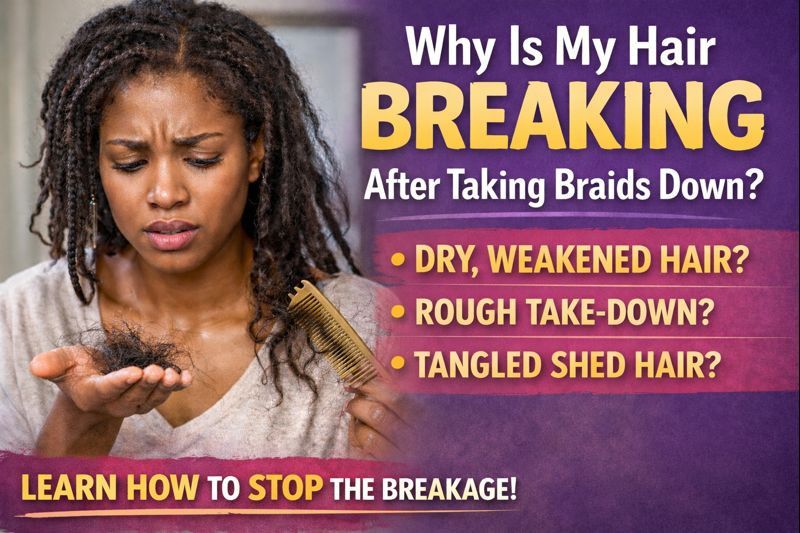
Taking your braids down should feel like freedom day.
Instead, for many people, it turns into a mini nightmare: broken strands everywhere, short pieces all over the sink, thinning edges, and hair that suddenly feels weaker than it did before the style.
If you’ve ever thought:
-
“My hair was fine before these braids…”
-
“Why is my hair breaking so badly after take-down?”
-
“Are braids actually damaging my hair?”
You’re not imagining things.
Hair breaking after braids is extremely common, but it’s also highly preventable—once you understand what’s actually happening to your hair underneath that protective style.
This article breaks it all down:
the real reasons hair breaks after taking braids down, what most people get wrong, and how to prevent breakage permanently—without giving up braids.
The Truth About Braids and Breakage
Braids themselves are not the enemy.
The damage comes from what happens before, during, and after the style—especially during removal.
Hair that breaks after braids usually isn’t breaking because of the braids alone.
It’s breaking because:
-
The hair was weakened underneath
-
Moisture balance was disrupted
-
The take-down process was too aggressive
-
The scalp environment was ignored for weeks
Braids don’t magically damage healthy hair.
They expose weak hair.
1. Your Hair Was Dehydrated Under the Braids
The #1 reason hair breaks after braids
Hair that lacks water is brittle.
Brittle hair snaps instead of bending.
When hair is braided for weeks (or months), many people stop moisturizing properly because:
-
Hair is “put away”
-
Access feels limited
-
Scalp care gets more attention than hair care
But here’s the problem:
Braided hair still needs water.
Oils alone do not hydrate hair.
They seal—but they don’t moisturize.
What happens under dry braids:
-
Cuticles lift
-
Cortex weakens
-
Elasticity drops
-
Hair snaps during manipulation
So when you finally take the braids down, the hair doesn’t gently release—it breaks under tension.
Key takeaway:
Dry hair + tension = breakage.
2. Product Buildup Weakened Your Hair Shaft
Braids often lead to product overload.
People tend to layer:
-
Oils
-
Creams
-
Sprays
-
Edge control
-
Scalp treatments
…without properly cleansing.
Over time, buildup forms on the hair shaft, which:
-
Prevents moisture from entering
-
Makes hair stiff and inflexible
-
Creates friction during take-down
When hair is coated instead of conditioned, it behaves like straw.
That’s why breakage often happens during detangling, not days later.
3. Your Hair Lost Elasticity While Braided
Healthy hair stretches slightly and springs back.
Hair that breaks:
-
Doesn’t stretch
-
Feels crunchy or rough
-
Snaps quickly under tension
Long-term braids can reduce elasticity if:
-
Protein and moisture are out of balance
-
Hair is not periodically softened
-
The scalp environment is compromised
Elasticity loss is silent—you don’t feel it until removal day.
Then suddenly:
-
Hair snaps during finger-detangling
-
Ends break while unraveling braids
-
Small broken pieces appear everywhere
4. The Take-Down Process Was Too Aggressive
This is where most breakage happens.
Rushing braid removal causes:
-
Mechanical stress
-
Forced separation
-
Hair snagging on shed strands
Common mistakes:
-
Using dull scissors
-
Cutting too close to natural hair
-
Pulling braids apart dry
-
Detangling without slip
-
Skipping finger detangling
Hair that’s been braided is compressed and tangled by shed hair.
Yanking it apart guarantees breakage.
5. Shed Hair Was Mistaken for Breakage (But Caused More Breakage)
It’s normal to shed 50–100 hairs per day.
If you keep braids in for 6–8 weeks, that shed hair stays trapped.
When you take braids down:
-
Shed hair tangles around growing hair
-
Knots form
-
Detangling becomes aggressive
If shed hair isn’t gently removed first, it acts like a net, causing healthy strands to snap during detangling.
6. Your Ends Were Already Weak Before Braiding
Braids hide problems—they don’t fix them.
If your ends were:
-
Split
-
Thin
-
Dry
-
Overdue for a trim
Braids simply delay the damage, not prevent it.
When the style comes out, weakened ends can’t survive detangling and manipulation.
That’s why many people feel like braids “destroyed” their ends—even though the damage existed beforehand.
7. Scalp Issues Reduced Hair Strength
A neglected scalp affects hair integrity.
Under braids, the scalp can become:
-
Dry
-
Inflamed
-
Clogged
-
Imbalanced
A compromised scalp produces weaker hair strands, which break more easily when manipulated.
Healthy hair starts at the scalp—protective styles don’t change that rule.
8. Braids Were Too Tight (Even If They Didn’t Hurt)
Tension doesn’t have to be painful to be damaging.
Constant low-grade tension:
-
Stresses follicles
-
Weakens strands near the root
-
Causes micro-breakage
Hair weakened at the root is more likely to snap during removal and detangling.
How to Stop Hair Breakage After Braids (For Good)
Now let’s talk solutions—the part that actually grows hair.
1. Hydrate Hair While It’s Braided
Hair in braids still needs water-based moisture.
Best approach:
-
Light, water-based sprays
-
Focus on length and ends
-
Seal lightly with oil
This keeps hair flexible, elastic, and resilient.
2. Cleanse Your Scalp and Hair While Braided
You don’t need to fully shampoo every week, but you do need:
-
Scalp cleansing
-
Buildup control
-
A clean environment for growth
A clean scalp supports stronger hair production—period.
3. Prep Hair Before Take-Down (This Is Huge)
Never remove braids on dry hair.
Before removal:
-
Lightly mist hair with water or leave-in
-
Add slip (aloe-based or conditioning product)
-
Let hair soften for 10–15 minutes
Soft hair breaks less.
4. Finger Detangle First—Always
Finger detangling:
-
Removes shed hair safely
-
Prevents knot tightening
-
Reduces snapping
Do not reach for a comb first.
Your fingers feel resistance before damage happens.
5. Detangle in Sections
Work in small sections:
-
One braid row at a time
-
One section fully detangled before moving on
This alone can reduce breakage by 50% or more.
6. Wash Gently After Take-Down
After braids, hair is vulnerable.
Use:
-
Sulfate-free shampoo
-
Gentle scalp massage
-
No rough scrubbing
Follow with:
-
Deep conditioner
-
Slip-heavy formula
-
Low manipulation
7. Restore Moisture + Strength Balance
Post-braids is the perfect time to:
-
Rehydrate deeply
-
Reinforce weak areas
-
Improve elasticity
This is where consistent leave-ins, scalp oils, and lightweight sealants matter most.
Hairobics-style routines focus on:
-
Scalp health
-
Water-first hydration
-
Lightweight oils that don’t suffocate hair
That combination helps hair bounce back instead of snap.
8. Trim Strategically (Not Emotionally)
You don’t need a drastic cut—but:
-
Dust weak ends
-
Remove splits
-
Shape hair for even tension
Healthy ends survive protective styles longer.
Are Braids Bad for Hair Growth?
No—but mismanaged braids are.
Braids support growth when:
-
Hair is hydrated
-
Scalp is clean
-
Tension is controlled
-
Removal is gentle
They damage hair when:
-
Hair is dry
-
Scalp is neglected
-
Take-down is rushed
-
Breakage is ignored
The Real Goal of Protective Styles
Protective styles should:
-
Reduce daily manipulation
-
Preserve moisture
-
Protect ends
-
Support scalp health
They should not:
-
Dry hair out
-
Replace hair care
-
Be an excuse to neglect your routine
Braids are a tool—not a guarantee.
Final Thoughts: Breakage After Braids Is Preventable
If your hair keeps breaking after taking braids down, it’s not bad luck.
It’s a signal.
Your hair is telling you:
-
It needs more water
-
It needs gentler handling
-
It needs scalp support
-
It needs balance—not just protection
When you respect what your hair is doing under the braids, removal day stops being scary—and starts being satisfying.
Healthy hair doesn’t fear take-down day.