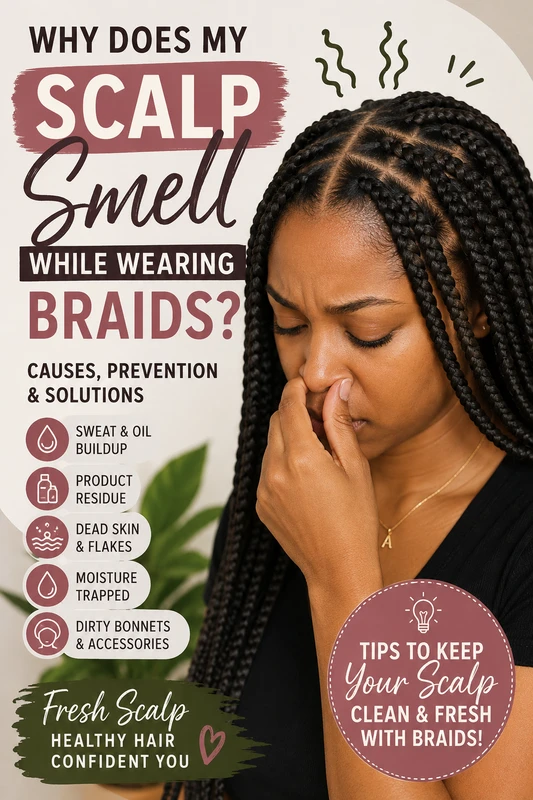
Braids are one of the most popular protective hairstyles for natural hair. They can save time, protect your ends, reduce daily manipulation, and give you a break from constant styling. But there is one problem that many people experience and rarely talk about: a scalp that starts to smell while wearing braids.
You may have noticed that your braids looked perfectly fine, but when you touched your scalp, scratched your head, or took your bonnet off, there was an unpleasant odor. Sometimes the smell is slightly sweaty. Other times it can smell sour, musty, oily, or even similar to damp clothes.
So, why does my scalp smell while wearing braids?
In most cases, scalp odor while wearing braids develops because sweat, scalp oil, dead skin cells, hair products, dirt, and microorganisms accumulate on the scalp. Braids can make it more difficult to thoroughly cleanse and dry the scalp, allowing odor-producing buildup to develop.
The good news is that you usually don't have to choose between having fresh braids and keeping your scalp clean. With the right braid-care routine, you can maintain your protective style while keeping your scalp much fresher.
In this complete guide, we'll explain what causes scalp odor with braids, how to get rid of it, how often you should clean your scalp, and how to prevent your braids from developing an unpleasant smell in the first place.
Why Does My Scalp Smell While Wearing Braids?
Your scalp is skin, and just like the skin on the rest of your body, it produces oil and sweat.
Your scalp also constantly sheds dead skin cells.
Normally, regular shampooing removes much of this material. But when your hair is braided, you may go considerably longer between thorough washes.
During that time, several things can accumulate:
- Sweat
- Sebum (natural scalp oil)
- Dead skin cells
- Styling products
- Environmental dirt
- Lint
- Residue from moisturizers and oils
Microorganisms naturally live on the scalp as well. When sweat, oil, moisture, and buildup remain on the scalp, odor can become more noticeable.
Braids themselves don't automatically cause a bad-smelling scalp.
The problem is usually the environment underneath and between the braids.
12 Reasons Your Scalp May Smell While Wearing Braids
Understanding what's causing the odor is the first step toward fixing it.
1. Sweat Is Trapped Around Your Braids
Sweat is one of the most common reasons a scalp starts smelling while wearing braids.
This is especially likely if you:
- Exercise frequently
- Work outdoors
- Live in a hot climate
- Sweat heavily at night
- Wear hats frequently
- Spend a lot of time in humid environments
Sweat itself isn't always strongly odorous. However, once it mixes with scalp oils, dead skin, product residue, and microorganisms, an unpleasant smell can develop.
Braids may make the situation more noticeable because sweat can remain around the roots instead of being quickly washed away.
If you exercise several times per week while wearing braids, your scalp may need to be cleaned more frequently than someone who doesn't sweat heavily.
2. You're Going Too Long Without Washing Your Scalp
One of the biggest misconceptions about protective styles is that you shouldn't wash your hair while wearing them.
You can wash many braided hairstyles.
Your scalp doesn't stop needing cleansing simply because your hair is braided.
Going several weeks without cleansing can allow sweat, sebum, dead skin cells, and styling products to accumulate.
Eventually, that buildup may start producing an odor.
How frequently you need to wash depends on your scalp, activity level, braid type, and products.
Some people may be comfortable cleansing every one to two weeks, while someone who exercises frequently or has an oily scalp may need more frequent scalp cleansing.
Pay attention to your scalp rather than following one rigid schedule.
3. Your Braids Aren't Drying Completely
This is an extremely important and sometimes overlooked cause.
If you wash your braids and they remain damp for a long time, they can develop a musty smell.
Thick or long braids can hold a surprising amount of water.
The outside of your braids might feel dry while the hair closer to the roots or inside thicker sections remains damp.
This can create the familiar wet-hair or damp-towel smell.
That's why drying your braids thoroughly after washing is just as important as cleansing them.
Never intentionally cover soaking-wet braids with a bonnet and go to sleep.
Whenever possible, wash your braids early enough in the day to give them plenty of time to dry.
4. You're Using Too Much Hair Oil
Scalp oil can be useful in a braid-care routine, particularly when your scalp feels dry.
But more oil isn't necessarily better.
Applying large amounts of oil every day without cleansing the scalp can contribute to buildup.
Remember that your scalp naturally produces sebum.
When you continuously add:
- Heavy oils
- Pomades
- Butters
- Grease
- Thick serums
they can combine with sweat and dead skin cells.
Instead of automatically oiling your scalp every day, pay attention to what your scalp actually needs.
A light application may be sufficient.
5. Too Much Styling Product Is Accumulating
Oil isn't the only potential source of buildup.
Many products may be used during braid installation, including:
- Edge control
- Braiding gel
- Mousse
- Leave-in conditioner
- Styling cream
- Hair spray
- Scalp oil
- Moisturizing sprays
Each individual product may be perfectly fine, but repeatedly layering products without cleansing can eventually leave residue.
This residue can attract dirt and combine with sweat and oil.
You may notice white, gray, sticky, or flaky buildup around the base of your braids.
When you can visibly see residue around your roots, it's often a sign that your scalp and braids could benefit from cleansing.
6. You Put Your Bonnet On While Your Hair Was Damp
Your nighttime routine can also contribute to odor.
Imagine exercising in the evening.
Your scalp becomes sweaty.
You come home and immediately put your braids into a satin bonnet.
The moisture now has less opportunity to evaporate.
The same thing can happen after showering if your braids become wet.
Whenever your scalp or braids are damp, allow them to dry thoroughly before covering them for an extended period.
Your bonnet should protect your hairstyle—not trap unnecessary moisture against your scalp.
7. Your Bonnet or Scarf Needs Washing
Sometimes the odor isn't coming entirely from your hair.
It could be your bonnet.
Your bonnet comes into contact with:
- Scalp oil
- Sweat
- Hair products
- Skin oils
- Moisturizers
Night after night, these substances can transfer onto the fabric.
Then you place the same bonnet back over freshly cleaned hair.
Wash your bonnet, scarf, pillowcase, and other frequently used hair accessories regularly.
Having several satin bonnets can make this easier because you can rotate them while others are being washed.
8. You Work Out Frequently
Exercise is excellent for your overall health, but frequent workouts can make braid maintenance more challenging.
Your scalp can sweat significantly during activities such as:
- Running
- Cycling
- Weight training
- Basketball
- Dancing
- Hiking
- High-intensity workouts
If you exercise five days a week, waiting several weeks to clean your scalp may not work for you.
You may need to adjust your braid-care routine around your workout schedule.
After exercising, avoid immediately covering a sweaty scalp.
Give your scalp time to air out and dry.
Then cleanse it as needed based on how much you sweat and how your scalp feels.
9. Your Scalp Naturally Produces More Oil
Some people simply have oilier scalps than others.
If your scalp becomes oily quickly when your hair isn't braided, it will probably continue producing oil when your hair is in braids.
The difference is that you may not shampoo as frequently while wearing the protective style.
That means oil can accumulate.
An oily scalp isn't necessarily a dirty scalp, but excess sebum combined with sweat and buildup can contribute to odor.
If you're naturally oily, you may need more frequent scalp cleansing while wearing braids.
10. Dead Skin Is Building Up
Your scalp constantly sheds skin cells whether your hair is loose, twisted, braided, or loc'd.
When you wash and manipulate loose hair, many of these cells are removed.
Braids limit how much you can physically manipulate the scalp.
As a result, dead skin may collect around the roots.
You might notice:
- Small flakes
- White buildup
- Crusty residue
- Itching
If flakes are accompanied by significant redness, pain, sores, persistent scaling, or inflammation, however, don't simply assume it's normal buildup.
A dermatologist can help determine whether a scalp condition is involved.
11. Your Braids Have Been Installed Too Long
Protective styles aren't intended to stay installed forever.
Even if the braids still look decent, the scalp underneath may be telling a different story.
As weeks pass, you accumulate more:
- Shed hair
- New growth
- Product residue
- Oil
- Dead skin
- Sweat
- Dirt
At some point, refreshing the surface of the hairstyle won't be enough.
Your hair may need to be taken down, detangled, shampooed thoroughly, conditioned, and allowed to rest before another installation.
Don't keep braids installed solely because they still look acceptable.
Your scalp health should be the priority.
12. There Could Be an Underlying Scalp Problem
Not every unusual scalp smell is caused by poor cleansing.
Persistent odor accompanied by other symptoms may deserve professional attention.
Watch for symptoms such as:
- Severe itching
- Burning
- Tenderness
- Open sores
- Pus
- Significant redness
- Swelling
- Thick crusting
- Unusual patches
- Persistent heavy flaking
- Hair loss around affected areas
These symptoms may indicate a scalp or skin condition that needs proper diagnosis.
Removing the braids may also be necessary so the scalp can be examined.
If an odor is strong, persistent, suddenly different, or doesn't improve after proper washing and drying, consider seeing a dermatologist or healthcare professional.
What Does Scalp Buildup Smell Like?
Scalp odor isn't identical for everyone.
People describe it in several ways.
It might smell:
- Sour
- Sweaty
- Musty
- Oily
- Stale
- Damp
- Slightly cheesy
- Similar to an old hat
- Similar to damp laundry
The type of smell may provide clues, but smell alone usually isn't enough to diagnose the cause.
For example, a musty odor immediately after washing may suggest your braids aren't drying completely.
An oily, stale smell that develops after several weeks may be more consistent with accumulated sweat, oil, and product residue.
Why Does My Scalp Smell After Only a Few Days of Braids?
If your scalp starts smelling shortly after installation, look at what happened before and during the braiding process.
Ask yourself:
Was my scalp thoroughly shampooed before installation?
Starting with an already dirty scalp makes buildup appear faster.
Was a large amount of braiding gel used?
Heavy product around every part can contribute to residue.
Have I been sweating heavily?
Hot weather or exercise can create odor quickly.
Is my scalp naturally oily?
Some people need more frequent cleansing.
Did the braids get wet?
Damp braids that weren't completely dried can develop an unpleasant smell.
Ideally, protective styling begins with clean hair and a clean scalp.
Why Do My Braids Smell Musty?
A musty smell is particularly associated with moisture.
Your braids may have become wet from:
- Washing
- Swimming
- Showering
- Heavy sweating
- Rain
- Moisturizing sprays
If thick braided hair stays damp for hours—especially when covered—it may begin smelling stale or musty.
This is why drying is one of the most important steps in braid maintenance.
Can You Wash Your Scalp With Braids?
Yes.
In many cases, you can cleanse your scalp without completely ruining your braided hairstyle.
The key is being gentle.
Aggressive scrubbing can cause excessive frizz and potentially place unnecessary tension on the braids.
Instead, focus shampoo primarily on the scalp and roots.
Use your fingertips—not your fingernails—to gently massage your scalp.
Then rinse thoroughly.
Don't leave shampoo trapped around the base of your braids.
How to Wash Your Scalp While Wearing Braids
Here's a simple approach.
Step 1: Dilute Your Shampoo If Necessary
Depending on the shampoo, diluting a small amount with water can make it easier to distribute between braided sections.
You can use an applicator bottle to help direct the mixture toward your scalp.
The goal isn't to soak your scalp in an excessive amount of product.
You simply want enough cleanser to loosen oil, sweat, and buildup.
Step 2: Apply Shampoo Between the Parts
Work section by section.
Apply shampoo along your visible scalp and between your braids.
Pay extra attention to areas that become particularly oily or sweaty, such as:
- Hairline
- Crown
- Behind the ears
- Back of the head
Step 3: Massage Gently
Use the pads of your fingertips.
Avoid scratching aggressively with your fingernails.
Massage the scalp gently to loosen buildup.
You don't need to scrub your scalp as though you're washing a floor.
Gentle but thorough cleansing is usually enough.
Step 4: Rinse Thoroughly
This step is critical.
Shampoo residue can become another source of buildup if it isn't completely removed.
Allow clean water to flow through your scalp and braids until the cleanser has been thoroughly rinsed away.
Step 5: Remove Excess Water
Gently squeeze water from the length of your braids.
Don't aggressively twist or wring them.
A clean towel or microfiber towel can help absorb excess water.
Step 6: Dry Your Braids Completely
Don't stop because the outside feels dry.
Pay special attention to your roots.
If possible, give your braids several hours to air-dry.
You can also use a hooded dryer or blow dryer on an appropriate low or moderate setting, depending on your hairstyle and hair.
Avoid excessive heat.
The goal is simply to prevent your hair from remaining damp for a prolonged period.
How Often Should You Wash Your Scalp With Braids?
There isn't one schedule that works for everyone.
For many people, cleansing approximately every one to two weeks may be a reasonable starting point while wearing braids.
However, you may need to wash more frequently if you:
- Exercise frequently
- Sweat heavily
- Have an oily scalp
- Use numerous styling products
- Live in hot or humid weather
- Develop buildup quickly
You might need less frequent cleansing if your scalp remains clean, comfortable, and relatively buildup-free.
Instead of focusing only on the calendar, watch your scalp.
If it smells, itches, feels excessively oily, or has obvious buildup, those are signs that cleansing may be needed.
How to Get Rid of Scalp Smell Without Taking Your Braids Out
If the odor is caused by ordinary sweat and buildup, you may not necessarily have to remove the hairstyle immediately.
Try this routine.
1. Clean Your Scalp
A proper wash is usually more effective than trying to cover the smell.
2. Rinse Thoroughly
Make sure no cleanser remains trapped around your roots.
3. Dry Completely
This is essential.
4. Wash Your Bonnet
Don't put freshly washed braids under a dirty bonnet.
5. Change Your Pillowcase
Hair products and scalp oils can accumulate on bedding.
6. Reduce Heavy Products
Give your scalp a break from unnecessary layers of oil, grease, and styling products.
7. Let Your Scalp Breathe
Avoid constantly wearing hats, scarves, and bonnets when they aren't necessary.
If the smell returns very quickly despite proper washing and drying, removing the braids and thoroughly cleansing your natural hair may be the better option.
Can I Spray Perfume on Smelly Braids?
This isn't the best solution.
Perfume may temporarily cover an odor, but it doesn't remove the sweat, oil, dead skin, or product residue causing the smell.
Think of it like spraying fragrance on sweaty clothing.
The fragrance doesn't make the clothing clean.
Your scalp is the same way.
Instead of masking odor, address the source.
Clean and thoroughly dry your scalp.
Can Dry Shampoo Help With Smelly Braids?
Some people use dry shampoo between regular washes because it can absorb some excess oil.
However, it shouldn't become a permanent substitute for proper scalp cleansing.
Dry shampoo itself can accumulate if repeatedly applied without being removed.
If you're already dealing with significant product buildup, adding another product may make matters worse.
Use it cautiously and remember that your scalp still needs actual cleansing.
Should I Oil My Scalp When Wearing Braids?
You don't automatically need to oil your scalp every day.
This is particularly important if you're already experiencing odor or buildup.
If your scalp feels comfortable, constantly adding oil may be unnecessary.
If your scalp feels dry, a small amount of an appropriate scalp oil may help reduce that dry feeling.
Focus on moderation.
You don't want your scalp saturated in oil.
Remember:
Moisturizing and cleansing work together.
Adding more products to an unclean scalp doesn't replace washing.
How to Keep Your Scalp Smelling Fresh With Braids
Prevention is much easier than dealing with strong odor after it develops.
Start With Clean Hair
Wash your natural hair and scalp thoroughly before getting braids.
Don't install a long-term protective style over significant product buildup.
A clean foundation gives your hairstyle a better start.
Use Less Braiding Gel
Braiding products can create beautiful, smooth parts, but excessive gel may leave buildup.
Ask your stylist to use only what is necessary, particularly if you know your scalp is sensitive to heavy products.
Clean Your Scalp Regularly
Don't automatically wait until braid takedown day.
Develop a cleansing schedule based on your scalp.
Dry Your Roots Thoroughly
After every wash, swim, or heavy sweating session, make sure your roots dry completely.
This single habit can make a major difference.
Avoid Excessive Product Layering
Your braid routine doesn't necessarily need six products every day.
A simpler routine can often keep your scalp cleaner.
Wash Your Hair Accessories
Regularly clean anything that frequently touches your scalp or braids, including:
- Bonnets
- Scarves
- Durags
- Headbands
- Hats
- Pillowcases
Clean hair accessories are an overlooked part of scalp hygiene.
How to Care for Braids If You Exercise
You shouldn't have to avoid working out just because you're wearing braids.
Instead, modify your routine.
After exercising:
- Remove hats or head coverings.
- Allow your scalp to cool.
- Let sweat evaporate.
- Gently blot excessive moisture if necessary.
- Clean your scalp when buildup becomes noticeable.
- Make sure your roots are dry before covering your hair for bed.
People who work out frequently may need more frequent cleansing than people who don't.
That's completely normal.
Your hair-care schedule should fit your lifestyle.
Why Does My Scalp Itch and Smell With Braids?
Itching plus odor often suggests that sweat, oil, product residue, or dead skin has accumulated.
However, itching shouldn't automatically be dismissed as "dirty scalp."
Persistent or severe itching could also be related to:
- Irritation from hair products
- Sensitivity to synthetic braiding hair
- Excessive braid tension
- Dandruff-related scalp conditions
- Other skin conditions
If itching becomes severe or you notice sores, swelling, significant redness, drainage, or hair loss, remove unnecessary tension and consider getting professional medical advice.
Why Does My Scalp Smell Even After Washing My Braids?
If you've washed your braids but the odor remains, consider several possibilities.
You Didn't Rinse Thoroughly
Product and shampoo residue may still be present.
Your Braids Are Still Damp
The odor may actually become more noticeable as wet braids sit for hours.
The Buildup Wasn't Fully Removed
A very dirty scalp may require a more thorough cleansing.
Your Bonnet Is Dirty
The smell could be transferring back onto your clean hair.
The Braids Are Too Old
Sometimes it's simply time for the protective style to come down.
There May Be a Scalp Condition
Persistent unusual odor combined with irritation deserves professional evaluation.
When Should You Take Smelly Braids Out?
A mild sweaty smell doesn't necessarily mean your hairstyle has to be removed immediately.
Cleaning and drying may solve the problem.
However, consider taking your braids down if:
- The smell keeps returning immediately after washing.
- Your scalp has heavy buildup that you can't adequately remove.
- Your scalp is extremely itchy.
- You notice sores or scabs.
- The braids have become excessively loose or matted.
- Your roots remain difficult to clean.
- Your hair has been braided much longer than intended.
- You notice excessive tension or breakage.
- Your scalp feels painful or inflamed.
Protective styling should protect your hair.
Keeping a hairstyle for an extra week isn't worth compromising your scalp or edges.
How Long Should You Keep Braids In?
The ideal length of time depends on the type of braids, your hair, installation method, new growth, and scalp condition.
Many braided protective styles are worn for several weeks, but longer isn't automatically better.
Pay attention to your hair.
If your roots are heavily matted, scalp buildup is difficult to remove, or your scalp is consistently uncomfortable, it may be time for takedown.
Your scalp should ultimately determine your schedule—not how much you paid for the hairstyle.
What Should You Do After Taking Smelly Braids Down?
Takedown day is your opportunity to thoroughly reset your hair and scalp.
1. Take the Braids Down Carefully
Don't rush.
Your hair has accumulated naturally shed strands while it has been braided.
Seeing shed hair during takedown is normal.
2. Detangle Before Shampooing
Gently remove shed hair and tangles before soaking the hair.
This can help reduce matting.
3. Shampoo Thoroughly
Concentrate on the scalp.
If there is substantial buildup, you may need a more thorough cleansing than usual.
4. Condition Your Hair
Follow shampooing with a conditioner appropriate for your hair.
5. Examine Your Scalp
This is easier once the extensions are gone.
Look for unusual irritation, sores, heavy scaling, or thinning.
6. Give Your Hair a Break If Necessary
You don't always need to go directly from one set of braids into another.
If your scalp feels irritated, allow it time to recover.
A Simple Weekly Braid-Care Routine
Keeping braids fresh doesn't have to be complicated.
During the Week
Monitor your scalp for sweat, oil, itching, and buildup.
Use moisturizing products only when needed instead of automatically layering them every day.
After Exercise
Let your scalp dry before covering it.
At Night
Sleep with a clean satin or silk bonnet or scarf.
Every 1–2 Weeks
Consider cleansing your scalp, adjusting the frequency based on your individual needs.
After Washing
Dry your roots and braids thoroughly.
Throughout the Style
Pay attention to changes in your scalp.
If something doesn't feel right, don't ignore it simply to preserve the hairstyle.
Common Mistakes That Can Make Braids Smell
Even people with excellent natural hair routines sometimes make mistakes when wearing protective styles.
Here are several to avoid:
Mistake #1: Never Washing Your Scalp
Protective style doesn't mean "don't cleanse."
Mistake #2: Applying Oil Every Day
More oil can mean more buildup.
Mistake #3: Sleeping With Wet Braids
Dampness trapped for hours can contribute to musty odors.
Mistake #4: Covering Sweaty Hair Immediately
Give moisture an opportunity to evaporate.
Mistake #5: Never Washing Your Bonnet
Your hair accessories need cleaning too.
Mistake #6: Trying to Cover Odor With Fragrance
Masking odor doesn't remove its cause.
Mistake #7: Keeping Braids Installed Too Long
Sometimes your scalp simply needs a complete wash and reset.
Frequently Asked Questions
Why does my scalp smell bad under my braids?
The most common causes are accumulated sweat, natural scalp oil, dead skin, product residue, and insufficient cleansing. Braids that stay damp for too long can also develop a musty odor.
Is it normal for braids to smell?
A slight odor after sweating can happen, but persistent or strong odor shouldn't simply be ignored. Clean and thoroughly dry your scalp and investigate other symptoms if the smell keeps returning.
How do I make my scalp smell better with braids?
Focus on cleaning rather than masking the odor. Gently shampoo your scalp, rinse thoroughly, dry your roots completely, wash your bonnet and pillowcase, and avoid excessive product buildup.
How often should I wash braids?
There isn't one universal schedule, but many people may find cleansing every one to two weeks works well. People who sweat heavily, exercise frequently, or have oily scalps may need more frequent cleansing.
Why do my braids smell after getting wet?
The braids may not have dried completely. Thick or long braids can retain moisture for hours, particularly around the roots.
Can sweat make braids smell?
Yes. Sweat can mix with scalp oil, dead skin, dirt, and product residue, making odor more noticeable.
Should I oil my scalp if it smells?
Adding more oil usually won't solve scalp odor caused by buildup. Clean your scalp first. Once it is clean and dry, use scalp products in moderation according to your needs.
Can I wash box braids?
Yes, box braids can generally be washed carefully. Concentrate primarily on cleansing the scalp, rinse thoroughly, avoid excessive manipulation, and dry the braids completely afterward.
Why does my scalp smell sour?
A sour smell may occur when sweat, oil, moisture, and buildup remain on the scalp. If the odor persists despite proper cleansing or is accompanied by irritation, sores, or other concerning symptoms, consider speaking with a dermatologist.
Why does my scalp smell when I scratch it?
Scratching can transfer oil, sweat, dead skin, and buildup from the scalp onto your fingertips, making the odor easier to notice. It's a good indication that you should examine your scalp and determine whether it needs cleansing.
The Bottom Line: Why Does My Scalp Smell While Wearing Braids?
If you've been wondering, "Why does my scalp smell while wearing braids?", the answer is usually related to what's accumulating underneath your protective style.
Your scalp continues producing oil, shedding skin cells, and sweating while your hair is braided.
When you combine those natural processes with styling products, infrequent cleansing, heavy exercise, and moisture that doesn't dry completely, unpleasant scalp odor can develop.
Fortunately, prevention can be fairly simple:
Start with clean hair, keep your scalp clean, don't overload it with products, wash your hair accessories, and thoroughly dry your braids whenever they become wet.
Most importantly, listen to your scalp.
Braids are supposed to make caring for your hair easier—not force you to ignore itching, buildup, odor, or discomfort.
If your scalp repeatedly smells shortly after washing, becomes painful or inflamed, develops sores, or shows other unusual symptoms, take the braids down and consider having your scalp evaluated by a dermatologist.
Healthy protective styling starts with a healthy scalp.