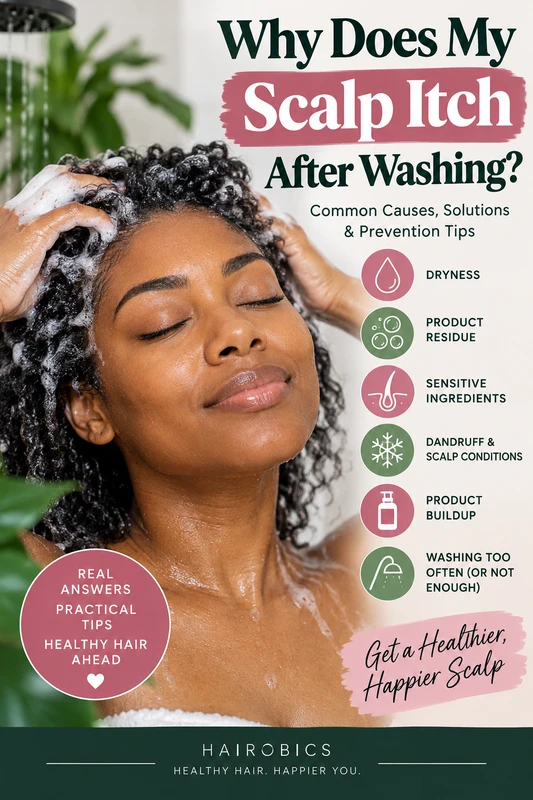
You just finished washing your hair. Your scalp should feel clean, fresh, and comfortable—but instead, it starts itching.
For some people, the itching begins almost immediately after shampooing. For others, their scalp feels fine while their hair is wet, but several hours later the itching starts. You may also notice dryness, tightness, flakes, redness, or the urge to scratch certain areas of your scalp.
So, why does your scalp itch after washing?
An itchy scalp after washing can happen for several reasons, including dryness, shampoo residue, sensitivity to hair products, washing too frequently, product buildup, dandruff, scalp conditions, or simply using products that are too harsh for your scalp.
For people with natural, curly, coily, braided, or loc'd hair, finding the right balance can be especially important. You want your scalp clean enough to remove sweat, oil, and buildup without stripping away so much moisture that your scalp becomes dry and irritated.
In this guide, we'll break down the most common reasons your scalp may itch after washing, what you can do about it, and how to build a wash-day routine that leaves your scalp feeling clean and comfortable.
Is It Normal for Your Scalp to Itch After Washing?
Occasional mild itching after washing doesn't necessarily mean something is seriously wrong.
Your scalp is skin, and like the skin on the rest of your body, it can react to changes in moisture, temperature, ingredients, friction, and cleansing.
However, washing your hair shouldn't consistently leave your scalp extremely itchy.
If you're regularly thinking:
"Why is my scalp itchier after I wash it?"
that's worth investigating.
The key is figuring out whether the itching comes from dryness, residue, irritation, buildup, dandruff, or another scalp issue.
Pay attention to what happens alongside the itching.
For example:
- Does your scalp feel tight?
- Do you see small white flakes?
- Does the itching happen immediately after shampooing?
- Does it start after your hair dries?
- Do you have redness or sore areas?
- Does your scalp feel oily and itchy?
- Does scratching create more flakes?
- Did you recently switch shampoos or conditioners?
These clues can help you narrow down the cause.
1. Your Shampoo May Be Drying Out Your Scalp
One of the most common reasons your scalp itches after washing is simple: your cleanser may be removing too much of your scalp's natural oil.
Shampoo is designed to remove dirt, sweat, excess oil, styling products, and other buildup.
But cleansing too aggressively can leave your scalp feeling stripped.
When your scalp becomes excessively dry, it may feel:
- Tight
- Itchy
- Rough
- Flaky
- Sensitive
This is particularly important for curly and coily hair because natural scalp oils don't always travel down tightly curled strands as easily as they do on straighter hair.
That means moisture retention is often a major part of maintaining comfortable natural hair and scalp.
Signs your shampoo may be too harsh
Pay attention to how your hair and scalp feel immediately after rinsing.
If your scalp feels extremely tight and your hair feels squeaky, rough, tangled, or unusually dry, your cleanser may be stronger than you need for every wash.
That doesn't necessarily mean you should never use a stronger cleansing shampoo.
Clarifying shampoos can be useful when you have significant buildup.
The problem is using a strong cleanser too frequently when your scalp doesn't need that level of cleansing.
2. You're Washing Your Hair Too Often
If washing once makes your scalp feel clean, it might seem logical that washing more frequently would make it even healthier.
Not necessarily.
Washing your scalp more often than it needs can contribute to dryness and irritation, particularly if you're using a strong shampoo each time.
Every person's ideal washing schedule is different.
Someone who exercises heavily, sweats frequently, or produces more scalp oil may need to wash more often than someone whose scalp naturally stays relatively dry.
Your hairstyle matters too.
Someone wearing a loose natural hairstyle may have a different routine from someone wearing:
- Box braids
- Cornrows
- Twists
- Locs
- Crochet styles
- Sew-ins
Rather than following an arbitrary rule, pay attention to your scalp.
If frequent washing consistently leaves your scalp dry and itchy, experiment with slightly increasing the time between washes or switching to a gentler cleanser.
3. Shampoo or Conditioner May Be Left on Your Scalp
Sometimes the problem isn't the shampoo itself.
It's the shampoo that didn't completely rinse out.
Product residue left behind on your scalp can cause irritation and itching.
This is surprisingly easy to do, especially when you have thick, dense, curly, coily, braided, or loc'd hair.
Water needs to reach your entire scalp.
If you're quickly standing underneath the shower and rinsing only the surface of your hair, product can remain around your roots.
How to rinse your scalp thoroughly
Separate your hair into sections if necessary.
Allow water to flow directly onto the scalp while gently moving your fingers through the roots.
Pay special attention to areas where hair is thickest.
Commonly missed areas include:
- The crown
- Behind the ears
- The nape
- The center of the scalp
- Around dense roots
Spend longer rinsing than you think you need.
A thorough rinse can make a noticeable difference.
4. Conditioner Is Getting Too Close to Your Scalp
Conditioner can make your hair feel soft and manageable, but not every conditioner is designed to sit directly on the scalp.
Some formulas contain heavier conditioning ingredients intended primarily for the hair strands.
If you apply a large amount directly to your scalp and don't rinse thoroughly, residue may remain.
That residue can contribute to itching or buildup in some people.
If you suspect your conditioner is causing problems, try concentrating it mainly on the mid-lengths and ends of your hair.
Your ends are typically the oldest and most vulnerable part of your hair anyway, so they often need the most conditioning.
5. You May Be Sensitive to an Ingredient
If your scalp starts itching almost immediately after you apply or rinse out a product, consider whether your skin may be reacting to an ingredient.
Shampoos, conditioners, treatments, gels, oils, and other hair products contain many ingredients.
Even products labeled "natural" can cause irritation in some people.
Natural doesn't automatically mean irritation-free.
Essential oils, botanical extracts, fragrances, preservatives, and cleansing ingredients can all potentially bother sensitive skin.
Watch for a pattern
Ask yourself:
Did the itching start after I introduced a new product?
If yes, temporarily stop using that product and see whether the problem improves.
If the itching repeatedly returns when you use the same product, that's an important clue.
More significant reactions—especially swelling, hives, blistering, or difficulty breathing—require prompt medical attention.
6. Your Scalp May Be Dry
Dry scalp and dandruff are often treated as if they're the same thing.
They aren't always.
A dry scalp occurs when the skin lacks sufficient moisture or oil.
You may notice:
- Small flakes
- Tightness
- Mild itching
- Dry-feeling skin
Dryness can become more noticeable after washing because shampoo removes oil from the scalp.
Hot water can make the situation worse.
Why hot water can contribute to dryness
A very hot shower may feel relaxing, but prolonged exposure to hot water can contribute to dryness.
Try washing and rinsing your hair with comfortably warm water rather than extremely hot water.
If your scalp frequently feels tight after showering, lowering the water temperature is a simple change worth trying.
7. You May Have Dandruff
Dandruff is another common reason for an itchy, flaky scalp.
Unlike simple dryness, dandruff is commonly associated with an oily or irritated scalp and the activity of a naturally occurring yeast called Malassezia.
You may notice flakes that are more persistent than ordinary dry skin.
Some people experience:
- Itching
- Visible flakes
- Greasy patches
- Scalp irritation
- Flaking around the hairline
Washing may temporarily loosen flakes without addressing the underlying problem, so your scalp can start itching again shortly afterward.
If dandruff is persistent, an anti-dandruff shampoo containing an appropriate active ingredient may help.
Follow the directions carefully because some treatments need to remain on the scalp for several minutes before rinsing.
8. You Could Have Seborrheic Dermatitis
Persistent dandruff-like symptoms can sometimes be related to seborrheic dermatitis.
Seborrheic dermatitis commonly affects oily areas of the body, including the scalp.
It may cause:
- Flaking
- Itching
- Redness or discoloration
- Greasy-looking scales
- Recurring irritated patches
Symptoms can come and go.
If your scalp problems are severe, persistent, or don't improve with ordinary scalp-care changes, consider seeing a dermatologist.
A dermatologist can determine whether you're dealing with ordinary dryness, dandruff, seborrheic dermatitis, psoriasis, eczema, contact dermatitis, or another condition.
9. Product Buildup May Still Be on Your Scalp
You can wash your hair and still have buildup.
This is particularly possible when you regularly use:
- Heavy creams
- Butters
- Pomades
- Edge control
- Gels
- Oils
- Dry shampoo
- Styling sprays
A gentle shampoo may not remove every layer of accumulated product during one wash.
That can create the strange situation where your hair has technically been washed but your scalp still doesn't feel completely clean.
Signs you may have scalp buildup
Your scalp may:
- Feel coated
- Become itchy quickly after washing
- Develop visible residue
- Feel greasy despite shampooing
- Have flakes that stick to the hair
- Develop an unpleasant odor
If this describes your scalp, occasional clarifying may help.
But don't overdo it.
Clarifying too frequently can create the opposite problem by drying out your scalp.
The goal is balance.
10. You May Be Scrubbing Your Scalp Too Hard
When your scalp feels dirty or itchy, it's tempting to scrub harder.
That can backfire.
Your fingernails can scratch and irritate the skin.
Aggressive scrubbing may create tiny abrasions, which can make your scalp feel sore, tender, or itchy after washing.
Use the pads of your fingertips instead.
Massage the shampoo across the scalp with controlled movements rather than scratching.
Your goal is to loosen buildup—not scrape your scalp.
11. Your Scalp May Be Reacting to Fragrance
Fragrance makes shampoo smell great, but some people have sensitive skin that doesn't tolerate certain fragrances well.
If your scalp repeatedly becomes itchy after using heavily scented hair products, try switching to a fragrance-free or sensitive-scalp formula.
This can be especially useful if you already have eczema or sensitive skin elsewhere on your body.
Keep in mind that fragrance sensitivity can develop over time.
A product you've used previously without trouble may eventually begin causing irritation.
12. Hard Water Could Be Contributing
Sometimes the problem isn't entirely your shampoo.
It may be your water.
Hard water contains relatively high concentrations of dissolved minerals such as calcium and magnesium.
Mineral deposits can accumulate on hair and potentially affect how hair feels and how products perform.
Some people notice their hair becomes:
- Dull
- Rough
- Difficult to manage
- Coated
- Harder to moisturize
If your hair and scalp problems began after moving to a new home or city, your water may be worth considering.
A shower filter may help with some water contaminants, although standard filters don't necessarily remove all hardness minerals.
A chelating shampoo is specifically formulated to help remove mineral deposits from hair.
13. Sweat and Oil May Not Be Fully Removed
People sometimes focus so much on protecting natural hair from dryness that they under-cleanse their scalp.
But your scalp still produces oil and sweat.
If you work out regularly, wear hats, or spend time outdoors in hot weather, sweat can accumulate around your roots.
When sweat mixes with:
- Sebum
- Dead skin
- Styling products
- Environmental debris
your scalp may become uncomfortable.
A proper shampoo routine should clean the scalp without excessively stripping it.
14. You're Applying Too Much Oil After Washing
If your scalp feels dry after washing, your first instinct may be to pour oil onto it.
More oil isn't always the answer.
Oil can help reduce moisture loss and improve the feel of dry hair and skin, but oil doesn't replace water.
Applying excessive amounts of oil can also contribute to buildup.
Start with a small amount.
Your scalp shouldn't need to be drenched in oil to feel comfortable.
If you repeatedly need large amounts of oil to stop severe itching, investigate the underlying cause rather than continuously covering the scalp with more product.
15. Your Scalp May Be Itching as Your Hair Dries
Some people notice that their scalp feels comfortable when wet but begins itching once their hair dries.
This may point toward dryness.
As water evaporates and your scalp returns to its normal state, tightness can become more noticeable.
Pay attention to what you do immediately after washing.
Do you sit underneath a very hot hooded dryer?
Do you use a blow dryer directly against your scalp on high heat?
Excessive heat can potentially worsen dryness.
Use moderate temperatures and avoid concentrating high heat on one area for extended periods.
Why Does My Scalp Itch Immediately After Washing?
Immediate itching can be an especially useful clue.
If your scalp starts itching while shampooing or immediately after rinsing, consider:
- Ingredient sensitivity
- Fragrance sensitivity
- Harsh cleansers
- Extremely hot water
- Aggressive scrubbing
- Product residue
Try simplifying your routine.
Instead of changing five products at once, change one variable at a time.
For example, switch your shampoo while keeping the rest of your routine the same.
That makes it easier to identify what's causing the problem.
Why Does My Scalp Itch One Day After Washing?
If your scalp feels great immediately after washing but starts itching the next day, buildup, dryness, sweat, dandruff, or your post-wash products may be involved.
Look at what you're applying after washing.
Perhaps the shampoo isn't causing the irritation at all.
It could be your:
- Leave-in conditioner
- Styling cream
- Gel
- Edge control
- Oil
- Hair spray
Try keeping these products away from your scalp when possible and applying them primarily to your hair.
Why Is My Scalp Itchy but I Don't Have Dandruff?
An itchy scalp doesn't automatically mean dandruff.
Your scalp can itch without visible flakes because of:
- Dryness
- Product sensitivity
- Sweat
- Tight hairstyles
- Irritation
- Residue
- Allergic contact dermatitis
- Other skin conditions
That's why treating every itchy scalp with dandruff shampoo isn't always the best approach.
If dryness is the actual issue, repeatedly using a strong medicated shampoo could potentially make your scalp feel even drier.
Identify the cause before deciding on a solution.
Why Does My Scalp Itch After Washing Natural Hair?
Natural hair routines can involve multiple products.
A typical wash day might include:
- Pre-shampoo treatment
- Shampoo
- Deep conditioner
- Leave-in conditioner
- Cream
- Oil
- Gel or styling product
That's a lot of product interacting with your scalp and hair.
If your scalp becomes itchy after wash day, consider simplifying your routine.
Your hair may enjoy layers of moisturizing products, but your scalp doesn't necessarily need every product you're applying to your strands.
Focus shampoo primarily on your scalp.
Focus conditioners and stylers primarily on your hair unless their directions specifically recommend scalp application.
Why Does My Scalp Itch After Washing Braids?
Washing braids presents a unique challenge.
You need to clean the scalp without creating excessive frizz or disturbing the style.
Because of this, people sometimes perform a very light wash and don't fully remove scalp buildup.
Others don't rinse thoroughly because they're trying to avoid soaking the braids.
That can leave shampoo behind.
When washing braids:
Dilute shampoo if appropriate for the product.
Apply it carefully to the scalp.
Massage gently.
Rinse extremely well.
Avoid aggressive scratching.
Dry your braids thoroughly.
Leaving braids damp for extended periods isn't ideal.
Your scalp and the hair underneath the style need adequate drying time.
Why Does My Scalp Itch After Washing Locs?
Locs also require thorough rinsing.
Because locs are dense bundles of hair, shampoo and other products need to be rinsed carefully.
Residue can become trapped inside or around the locs.
Use enough water to completely saturate your hair before shampooing.
Massage your scalp gently.
Then rinse thoroughly.
You may need more rinsing time than someone with loose hair.
Avoid coating your scalp and locs with excessive amounts of heavy waxes, creams, or butters, especially if you're already struggling with buildup.
Should You Oil an Itchy Scalp?
It depends on why your scalp is itching.
If your scalp is mildly dry, a small amount of suitable oil may improve comfort.
But if your itching is related to dandruff, seborrheic dermatitis, product buildup, or an allergic reaction, simply adding more oil may not solve the underlying problem.
This is an important distinction.
Itchy doesn't always mean dry.
Look at the full picture.
If your scalp feels dry and tight with tiny flakes, dryness may be involved.
If it's oily, irritated, and covered with persistent flakes, something else may be happening.
How to Stop Your Scalp From Itching After Washing
The best solution depends on the cause, but there are several practical changes worth trying.
1. Use a gentler shampoo
If your scalp feels stripped after every wash, switch to a cleanser designed for regular use.
Save stronger clarifying shampoos for when you actually have significant buildup.
2. Lower the water temperature
Wash with warm rather than extremely hot water.
Your shower doesn't need to be cold.
Just avoid water hot enough to leave your skin feeling dry and tight.
3. Massage instead of scratching
Use your fingertips.
Don't dig your fingernails into your scalp.
A gentle scalp massage can loosen dirt and buildup without unnecessarily irritating your skin.
4. Rinse longer
This is one of the simplest fixes.
Spend extra time rinsing your scalp.
Separate dense hair into sections and make sure water reaches every area.
5. Keep heavy conditioner off your scalp
Unless the product is specifically designed for scalp use, concentrate conditioner on your hair.
6. Reduce unnecessary products
You don't need to put every product you own on your scalp.
If you're using oil, cream, butter, gel, edge control, spray, and leave-in conditioner during the same routine, simplify things temporarily.
See whether your itching improves.
7. Clean your scalp regularly
Avoid allowing weeks of sweat, dead skin, oil, and styling product to accumulate if your scalp clearly needs cleansing sooner.
8. Clarify when necessary
If you use heavy styling products regularly, occasional clarifying may help remove buildup that your everyday shampoo leaves behind.
9. Pay attention to new products
If itching started after introducing a particular shampoo, conditioner, oil, or styling product, stop using it temporarily.
10. Avoid scratching
Scratching feels satisfying for a few seconds, but repeated scratching can further irritate your scalp and damage the skin.
Instead, focus on identifying why your scalp is itching.
A Simple Wash-Day Routine for an Itchy Scalp
If you're overwhelmed by complicated routines, simplify.
Step 1: Saturate your hair
Let water completely soak your scalp and hair.
Don't immediately apply shampoo to partially wet hair.
Step 2: Apply shampoo primarily to your scalp
You generally don't need to aggressively shampoo the ends of your hair.
As you rinse, the cleanser will travel down the strands.
Step 3: Massage gently
Use your fingertips and work section by section.
Spend extra time on areas where buildup accumulates.
Step 4: Rinse thoroughly
Continue rinsing until you're confident all shampoo has been removed.
Step 5: Condition your hair
Apply conditioner primarily to the hair, paying special attention to dry ends.
Step 6: Rinse again
Don't rush this step.
Step 7: Apply your leave-in products strategically
Concentrate moisturizing products on your hair unless they're specifically designed for scalp use.
Step 8: Dry properly
Allow your scalp and hair to dry thoroughly.
If using heat, keep the temperature comfortable.
How Often Should You Wash an Itchy Scalp?
There isn't one universal schedule.
Your washing frequency should reflect your scalp, lifestyle, hairstyle, and products.
Someone who exercises five times per week may need a different routine from someone who rarely sweats heavily.
Likewise, someone using gel and edge control daily may experience buildup faster than someone using very little styling product.
The important thing is to watch your scalp's response.
If your scalp becomes increasingly itchy because you've waited too long between washes, consider washing sooner.
If your scalp becomes dry and tight because you're washing constantly, consider washing less frequently or using a gentler cleanser.
Can Dirty Hair Cause an Itchy Scalp?
Yes, buildup can contribute to itching.
Your scalp naturally accumulates:
- Sebum
- Sweat
- Dead skin cells
- Hair products
- Environmental debris
Regular cleansing helps remove these materials.
The answer isn't necessarily to shampoo every day.
It's to establish a schedule that keeps your scalp clean without repeatedly stripping it.
Can Dry Shampoo Cause an Itchy Scalp?
It can for some people.
Dry shampoo absorbs oil, but it doesn't replace washing your scalp with water and cleanser.
Repeatedly applying dry shampoo without adequately cleansing the scalp can lead to residue accumulation.
If your scalp becomes itchy after several days of using dry shampoo, it may be time for a proper wash.
Can Hair Oil Cause an Itchy Scalp?
Yes.
Although hair oils are often marketed as scalp-friendly, any product can potentially cause irritation or buildup.
You might be sensitive to:
- Fragrance
- Essential oils
- Botanical extracts
- Preservatives
- Other ingredients in the formula
If one particular oil consistently makes your scalp itch, stop using it.
Don't assume itching means the product is "working."
Burning, severe tingling, or persistent itching shouldn't be considered proof that a hair product is stimulating growth.
Does an Itchy Scalp Mean Your Hair Is Growing?
This is a popular hair-growth myth.
An itchy scalp is not a reliable sign that your hair is growing faster.
Hair grows from follicles beneath the skin, but normal hair growth generally doesn't cause noticeable scalp itching.
Your scalp may itch for many unrelated reasons, including dryness, dandruff, irritation, buildup, or sensitivity.
So don't tolerate persistent itching because you believe it means your hair is growing.
A comfortable, clean scalp is a much better goal.
Can Tight Hairstyles Make Your Scalp Itch After Washing?
Yes.
Sometimes washing isn't the real cause.
If you wash your hair and immediately install a tight style, the tension itself can irritate your scalp.
This may happen with:
- Tight braids
- Cornrows
- Ponytails
- Buns
- Extensions
- Wigs
- Sew-ins
If your scalp feels painful, extremely tight, develops bumps, or remains irritated, reduce the tension.
Protective styles shouldn't require you to endure significant pain.
What About Scalp Massages?
Gentle scalp massage can feel relaxing and help distribute products, but aggressive massage isn't necessary.
Use the pads of your fingers and gentle pressure.
Avoid scratching with your nails.
If your scalp is already inflamed, painful, or broken, vigorous massage may make the irritation worse.
How to Tell Dry Scalp From Dandruff
These conditions can look similar, so it's easy to confuse them.
Dry scalp may involve:
- Smaller dry flakes
- Tightness
- Dry-feeling skin
- Dryness elsewhere on the body
Dandruff may involve:
- Persistent flaking
- Itching
- Oiliness
- Larger or more noticeable flakes
- Recurring symptoms
But visual inspection alone isn't always enough to diagnose a scalp condition.
If you've tried reasonable changes and the problem keeps returning, a dermatologist can provide a more accurate diagnosis.
When Should You See a Dermatologist?
Occasional mild itching may improve after adjusting your routine.
However, seek professional medical advice when scalp itching is severe, persistent, worsening, or accompanied by other concerning symptoms.
Consider seeing a dermatologist if you notice:
- Significant redness or discoloration
- Pain
- Swelling
- Bleeding
- Open sores
- Thick scales
- Pus
- Crusting
- Circular patches of hair loss
- Sudden excessive shedding
- Hair loss in irritated areas
- Symptoms that repeatedly return
- Itching that interferes with sleep
- No improvement after changing your routine
A dermatologist can examine your scalp and determine whether you're dealing with dandruff, seborrheic dermatitis, psoriasis, eczema, contact dermatitis, infection, or another issue.
Frequently Asked Questions
Why does my scalp itch right after shampooing?
Your shampoo may be too harsh, you may be sensitive to an ingredient, the water may be too hot, or shampoo residue may remain on your scalp.
Try a gentler cleanser and spend more time rinsing.
Why does my scalp itch after washing but before washing it feels fine?
Washing may be stripping away too much oil or exposing your scalp to an irritating ingredient.
Pay attention to whether your scalp also feels unusually tight or dry.
Why is my scalp itchy even though it's clean?
Cleanliness isn't the only cause of scalp itching.
A clean scalp can still be dry, irritated, sensitive to ingredients, affected by dandruff, or dealing with a skin condition.
Why does my scalp itch when my hair dries?
If itching becomes worse as your scalp dries, dryness or irritation may be contributing.
Hot dryers and aggressive cleansing can sometimes make the problem more noticeable.
Should I wash my hair again if my scalp is itchy?
Not automatically.
If the problem is leftover shampoo or heavy buildup, another thorough rinse or wash may help.
But if your scalp is already dry because of over-washing, shampooing again could make it worse.
Can I put oil on my scalp after washing?
You can use a small amount if oil works well for your scalp and you're not experiencing a condition that requires different treatment.
Avoid assuming that every itchy scalp needs more oil.
Why does my scalp itch under braids after washing?
Possible causes include shampoo residue, incomplete drying, existing buildup, sensitivity to products, or tension from the braids.
Make sure the scalp is rinsed and dried thoroughly.
Can washing your hair too much make your scalp itch?
Yes.
Over-cleansing with strong shampoos may remove too much natural oil and contribute to dryness and irritation.
Can not washing enough cause itching?
Yes.
Sweat, oil, dead skin, and styling products can accumulate on the scalp when cleansing is delayed too long.
Is an itchy scalp a sign of hair growth?
No. Scalp itching isn't a reliable indicator of hair growth.
How to Prevent an Itchy Scalp After Washing
Prevention starts with understanding your scalp.
Don't automatically copy someone else's wash schedule because they have a similar curl pattern.
Your scalp has its own needs.
A healthy routine usually comes down to a few fundamentals:
Cleanse thoroughly but gently.
Remove buildup without constantly stripping your scalp.
Rinse completely.
Don't leave shampoo or conditioner trapped around your roots.
Avoid excessive product buildup.
Your scalp doesn't need to be covered with layers of oil, butter, cream, and gel.
Watch your ingredients.
If a product repeatedly causes itching, discontinue it.
Keep your scalp dry after washing.
This is especially important when wearing braids, twists, locs, wigs, or other styles that can take longer to dry.
Don't scratch aggressively.
Treat the cause rather than repeatedly irritating your scalp.
Seek professional help when symptoms persist.
Chronic scalp problems shouldn't simply be ignored.
Final Thoughts: Why Does My Scalp Itch After Washing?
If you've been wondering, "Why does my scalp itch after washing?", the answer may be simpler than you think.
Your shampoo may be too harsh.
Your scalp may be dry.
You may not be rinsing thoroughly enough.
Your conditioner or styling products may be leaving residue.
You could be sensitive to an ingredient.
Or you may be dealing with dandruff or another scalp condition that requires more targeted care.
The most important thing is not to assume that every itchy scalp needs more oil—or more washing.
Instead, pay attention to the pattern.
When does the itching start?
Which products did you use?
Does your scalp feel dry or oily?
Are there flakes?
Did the problem begin after changing shampoos?
Small clues can help you identify the source of the irritation and make better decisions about your routine.
For natural, curly, coily, braided, and loc'd hair, a healthy scalp routine doesn't need to be complicated. Focus on consistent cleansing, thorough rinsing, appropriate moisture, minimal unnecessary buildup, and products that agree with your scalp.
Your scalp should feel comfortable after wash day—not like you immediately need to scratch it again.
If itching continues despite making these changes, especially if you notice sores, significant inflammation, thick scaling, or hair loss, speak with a dermatologist. Persistent scalp irritation deserves proper evaluation rather than endless trial and error with new hair products.