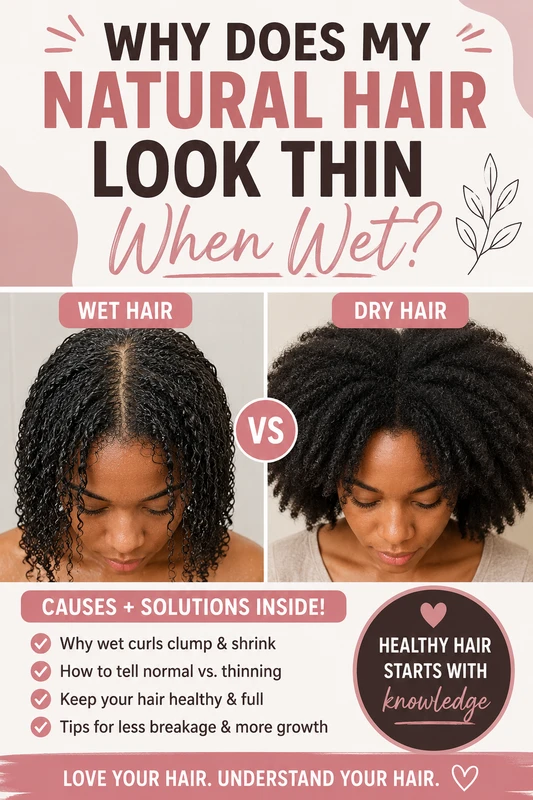
If you have ever stepped out of the shower, looked in the mirror, and wondered, “Why does my natural hair look so thin when it’s wet?”, you are definitely not alone. Natural hair can look dramatically different when wet compared with when it is completely dry, stretched, picked out, or styled.
One minute your dry hair may look thick, fluffy, dense, and full. Then you saturate it with water and suddenly your curls shrink together, your scalp becomes easier to see, and your hair appears much thinner than you expected.
That change can be surprising, especially if you are trying to grow longer, thicker, healthier natural hair.
The good news is that natural hair looking thin when wet does not automatically mean that your hair is thinning. Water changes the way curly, coily, and kinky strands behave. Individual strands group together, curls become more defined, volume decreases, and the scalp may become more visible.
However, there are situations where wet hair can reveal actual changes in density, breakage, shedding, or thinning that are harder to notice when the hair is dry.
In this guide, we will explain why natural hair looks thin when wet, how to tell the difference between normal wet-hair appearance and actual thinning, and what you can do to keep your natural hair looking and feeling healthy.
Why Does Natural Hair Look Thinner When Wet?
The simplest explanation is that water reduces volume.
Natural hair gets much of its fullness from the way curls, coils, and individual strands expand away from one another when dry. Dry natural hair can take up a considerable amount of space even when the actual number of strands has not changed.
Once the hair becomes saturated, water causes those strands to group together.
Instead of thousands of individual strands creating a fluffy shape, wet strands may form larger curl clumps.
The result?
Your hair can suddenly appear significantly thinner.
This is especially noticeable with tightly coiled hair because the difference between dry volume and wet volume can be dramatic.
For example, a person may have a large, dense-looking afro when their hair is dry. After stepping into the shower, that same hair may shrink close to the scalp and form small wet sections.
Nothing necessarily happened to the amount of hair on the person's head.
The visual volume simply changed.
1. Wet Hair Clumps Together
One of the biggest reasons natural hair looks thin when wet is curl clumping.
When water coats your strands, neighboring hairs begin sticking together and forming curl groups.
Imagine having 100 individual pieces of thread spread across a table. They cover a large area.
Now imagine grouping those threads into 10 bundles.
You still have 100 threads, but visually, it looks like there are fewer individual pieces.
Something similar happens with natural hair.
When your curls clump together, there may be larger spaces between those curl groups. Those spaces can expose more of your scalp.
This can create the illusion that your hair has suddenly become thin.
Curl clumping is actually desirable for many natural hairstyles.
People intentionally encourage clumping when creating:
- Wash-and-go styles
- Defined curls
- Finger coils
- Twist-outs
- Braid-outs
- Curl-definition styles
So seeing your scalp between wet curl clumps isn't automatically a sign of a problem.
2. Water Weighs Your Hair Down
Water adds weight to your hair.
When natural hair is dry, curls and coils can stand outward from the scalp, creating height and volume.
When the hair becomes saturated, the additional weight pulls those curls downward.
Your roots may become flatter.
Your curls may stretch.
Your overall hairstyle may collapse closer to your head.
The combination makes your hair appear less dense.
Once your hair dries, some of that volume usually returns as the strands become lighter and expand again.
This is one reason you shouldn't judge your hair's overall thickness based exclusively on how it looks immediately after washing it.
3. Your Natural Hair Shrinks When Wet
Shrinkage plays another major role.
Curly and coily hair can shrink considerably after being exposed to water.
Depending on your curl pattern, hair that appears shoulder-length when stretched may shrink several inches when wet or allowed to dry without stretching.
Shrinkage can make your hair appear:
- Shorter
- Smaller
- Flatter
- Less voluminous
- More compact
When your hair contracts toward your scalp, you may also notice sections of scalp that aren't normally visible when your hair is stretched or fluffed.
Shrinkage itself is generally a normal characteristic of curly and coily hair.
In fact, strong shrinkage can be associated with strands that still have good elasticity.
4. Your Scalp Is Easier to See Through Wet Hair
Have you noticed that someone's scalp is often easier to see when their hair is wet?
That happens with many hair textures.
Wet hair becomes darker, flatter, and more organized into groups. The scalp underneath creates contrast against those wet strands.
With dry natural hair, strands overlap one another from multiple directions.
That overlapping creates visual coverage.
When wet, those same strands become grouped together, revealing small spaces between the curls.
Seeing some scalp while your hair is soaking wet can therefore be completely normal.
The more important question is:
Has the amount of visible scalp changed significantly over time?
If you have always been able to see certain portions of your scalp when your hair is wet, that may simply be your natural density.
If you're suddenly seeing much larger areas than you previously did, it deserves more attention.
Does Seeing Your Scalp When Hair Is Wet Mean You're Going Bald?
Not necessarily.
This is an important distinction.
Visible scalp does not automatically equal hair loss.
People naturally have different hair densities.
Some people have extremely high-density hair with strands packed closely together.
Others have medium or lower-density hair.
Both can have healthy hair.
A person with lower-density natural hair may see considerably more scalp when their hair is wet even though their hair follicles are perfectly healthy.
Your natural density is largely influenced by genetics.
Instead of asking whether you can see your scalp at all, pay attention to changes in your normal pattern.
For example, consider whether:
- Your part has become noticeably wider.
- Your ponytail feels significantly smaller.
- Your edges look less full.
- Your crown appears thinner than before.
- Certain areas show substantially more scalp.
- You are experiencing unusually heavy shedding.
- You are finding excessive broken hairs.
- Your hair feels dramatically less dense than it did several months ago.
Changes like these provide more useful information than simply seeing your scalp during wash day.
Hair Density vs. Hair Thickness
People often use the words density and thickness interchangeably, but they aren't exactly the same thing.
Understanding the difference can help you figure out why your wet natural hair looks thin.
Hair Density
Hair density refers to approximately how many strands are growing within an area of your scalp.
You can generally think of density as:
- Lower density
- Medium density
- Higher density
Someone with high-density hair may have a very full-looking head of hair even if each individual strand is relatively fine.
Strand Thickness
Strand thickness refers to the diameter of each individual strand.
Your strands may be:
- Fine
- Medium
- Coarse
A person can have fine strands but high density.
Another person can have coarse strands but lower density.
This explains why two people with similar curl patterns can have completely different amounts of visible scalp when their hair is wet.
Fine Natural Hair Can Look Especially Thin When Wet
If you have naturally fine strands, the wet-hair transformation may be particularly noticeable.
Fine strands don't individually provide as much visual coverage as thicker strands.
When hundreds of fine hairs become wet and clump together, the overall appearance can become much flatter.
Once dry, those strands separate and create considerably more volume.
Fine hair is not automatically unhealthy hair.
You can have fine natural hair that is:
- Strong
- Long
- Moisturized
- Elastic
- Shiny
- Healthy
The key is understanding your natural hair characteristics rather than comparing your wet hair with someone who naturally has coarse, high-density strands.
Low-Density Natural Hair May Show More Scalp
Some people simply have fewer strands per square inch of scalp.
If this has always been the case, it doesn't necessarily indicate hair loss.
Low-density natural hair often appears surprisingly full when dry because curls expand and overlap.
Water removes much of that visual volume.
Therefore, wash day may reveal your true density more clearly.
This is one reason someone can have a beautiful, full-looking twist-out and then be shocked by how little hair they appear to have once they step into the shower.
The number of strands didn't suddenly change.
Their curls simply stopped creating the same amount of visual coverage.
Can Hair Porosity Affect How Thin Hair Looks When Wet?
Porosity can influence how your hair interacts with water, although it doesn't directly determine your hair density.
Hair porosity describes how easily your strands absorb and retain moisture.
Natural hair is commonly described as having:
- Low porosity
- Medium porosity
- High porosity
Highly porous or damaged strands may absorb water quickly.
Lower-porosity hair may take longer to become fully saturated.
Regardless of porosity, once the hair becomes thoroughly wet, it can lose much of the volume that it had while dry.
The more defined and compact your wet curls become, the thinner your hair may appear.
Why Does My Hair Look Thick Dry but Thin Wet?
This is one of the most common situations among people with natural hair.
Your dry hair gets volume from several things:
Curl Expansion
Dry curls expand outward.
Strand Separation
Thousands of strands separate rather than staying in large wet clumps.
Root Volume
Dry roots often lift away from the scalp.
Shrinkage
Although shrinkage makes hair shorter, it can also create considerable fullness.
Frizz
A little natural frizz can dramatically increase visual volume.
Styling
Picking, fluffing, stretching, twisting, braiding, and separating curls can make hair appear considerably fuller.
Water temporarily removes many of these effects.
Therefore:
Thick-looking dry hair + thinner-looking wet hair can be completely normal.
When Thin-Looking Wet Hair Could Be a Warning Sign
Although wet hair often looks thinner naturally, you shouldn't ignore obvious changes in your hair.
There is a difference between:
“My hair has always looked thin when soaking wet.”
and
“My wet hair looks much thinner than it did six months ago.”
The second situation deserves closer attention.
Here are several things to watch.
1. Your Part Is Getting Wider
Take occasional pictures of your normal part.
If the part gradually becomes wider, you may be experiencing a change in density.
Don't obsessively check it every day because lighting, styling, oil, moisture, and camera angles can make your part look different.
Instead, compare photographs taken several months apart under similar conditions.
2. Your Ponytail Feels Smaller
Your ponytail circumference can provide another clue.
If you have worn ponytails for years and suddenly notice that your ponytail feels dramatically smaller, your overall density may have changed.
However, remember that recent haircuts, layers, breakage, shrinkage, and styling can also affect ponytail size.
Look for a consistent pattern rather than relying on a single wash day.
3. Your Edges Are Becoming Sparse
Your edges can be especially vulnerable because the hair around the hairline is often finer and exposed to frequent manipulation.
Repeated tension from tight hairstyles can place unnecessary stress on the hairline.
Be cautious with hairstyles that constantly pull your edges, including extremely tight:
- Braids
- Ponytails
- Buns
- Cornrows
- Extensions
Protective styling should actually protect your hair.
A hairstyle that causes persistent pulling, pain, or excessive tension isn't very protective.
4. Your Crown Looks Thinner
The crown is another area worth monitoring.
If you suddenly notice increased scalp visibility around your crown, compare it with older pictures if possible.
Some people naturally have visible scalp around the crown because of the direction in which the hair grows.
A sudden change is more important than the appearance itself.
5. You Are Experiencing Excessive Breakage
Sometimes hair looks thinner because of breakage rather than changes at the follicle.
Natural hair can break when the strands become weak or are subjected to excessive mechanical stress.
Common contributors can include:
- Rough detangling
- Excessive heat
- Frequent chemical processing
- Tight hairstyles
- Repeated manipulation
- Poor conditioning habits
- Friction
- Neglecting split or damaged ends
Breakage can gradually reduce fullness.
You may still have plenty of hair growing from your scalp, but if strands continuously break before reaching longer lengths, your ends can become thin and uneven.
Shedding vs. Breakage: Know the Difference
Natural hair normally sheds strands as part of the hair-growth cycle.
Because curly and coily hair doesn't always release shed strands immediately, those hairs can remain trapped inside your curls until wash day.
This can make the amount of hair in your hands during detangling look alarming.
If you wash your hair once a week or less frequently, you may see several days' worth of naturally shed strands at once.
Breakage is different.
A shed hair usually comes from the scalp as a full strand.
Broken hairs may appear as shorter pieces of different lengths.
If you repeatedly notice large amounts of short broken strands, consider examining your detangling, styling, heat, and moisture practices.
Can Detangling Make Natural Hair Look Thinner?
Aggressive detangling can contribute to breakage.
Natural hair should be handled carefully, particularly when tangled.
Instead of ripping a comb through knots, work gradually.
Try dividing your hair into manageable sections.
Apply enough water and/or a product that provides slip, depending on what works for your hair.
Begin detangling near the ends and gradually work upward.
Finger detangling can also help you locate knots before a comb or brush runs into them.
The goal isn't to make wash day take forever.
The goal is to avoid unnecessary mechanical damage.
Can Heat Damage Make Hair Look Thinner When Wet?
Yes.
Repeated exposure to excessive heat can weaken natural hair.
Heat damage may also change the way curls behave when wet.
You might notice that certain sections:
- Don't curl like they used to.
- Remain unusually straight.
- Feel weak.
- Break easily.
- Look stringy when wet.
- Have inconsistent texture.
Occasional heat styling isn't automatically destructive, but temperature, frequency, technique, and the condition of your hair matter.
If you use heat, consider reducing unnecessary passes and using appropriate heat protection.
Can Tight Protective Styles Cause Thinning?
Protective styles are popular because they can reduce daily manipulation.
But they should not create constant tension.
Braids, twists, cornrows, wigs, ponytails, and extensions can become problematic when they repeatedly pull on the same areas.
Your hairstyle shouldn't require you to tolerate significant pain in the name of beauty.
Pay particular attention to your:
- Hairline
- Temples
- Nape
- Crown
Give your scalp and hairline breaks between high-tension styles when needed.
If you notice persistent thinning or loss around areas repeatedly subjected to tension, consider consulting a dermatologist rather than simply covering the area with another hairstyle.
Does Dryness Cause Natural Hair to Become Thin?
Dryness itself doesn't automatically mean that your follicles will stop producing hair.
However, extremely dry, brittle strands can become more vulnerable to breakage.
That breakage can reduce length retention and make your hair look less full over time.
This is why moisture management is such an important part of natural hair care.
Your routine may include:
- Cleansing the scalp and hair as needed.
- Conditioning after cleansing.
- Detangling carefully.
- Applying leave-in or moisturizing products when appropriate.
- Limiting unnecessary manipulation.
- Protecting the hair while sleeping.
Consistency generally matters more than using dozens of different products.
How to Make Natural Hair Look Fuller When Wet
You don't necessarily need to make your wet hair look thick.
Wet hair is wet hair.
However, if your goal is maintaining maximum density and fullness over time, focus on preserving the strands you already have.
Here are several helpful habits.
1. Be Gentle During Wash Day
Hair care doesn't need to feel like a wrestling match.
Divide thick or long natural hair into sections before shampooing and detangling.
Sections can reduce tangling and help you keep better control of your hair.
You might use four, six, or eight sections depending on your length and density.
2. Detangle From the Ends Up
Starting at the roots and dragging a tool through every knot can create unnecessary stress.
Instead:
Ends → middle → roots
Work gradually.
If you hit a knot, stop and address it rather than forcing your tool through it.
3. Keep Your Hair Conditioned
Conditioning can improve manageability and reduce friction during detangling.
Choose products based on how your own hair responds rather than automatically following every social-media trend.
Your natural hair routine should work for your hair.
4. Reduce Excessive Manipulation
Constantly styling, brushing, combing, pulling, separating, and restyling natural hair can contribute to mechanical wear.
Give your hair time to rest.
Low-manipulation styles can be useful when they aren't installed too tightly.
5. Protect Your Hair at Night
Cotton bedding can create friction against the hair as you move while sleeping.
Many people with natural hair prefer satin or silk accessories to reduce friction.
Options include:
- Satin bonnet
- Satin scarf
- Satin pillowcase
- Silk scarf
- Silk pillowcase
The goal is reducing unnecessary rubbing and tangling overnight.
6. Pay Attention to Your Ends
Your ends are the oldest part of your hair.
For someone with long natural hair, those ends may have been exposed to years of washing, styling, weather, friction, and manipulation.
Treat them carefully.
Damaged, splitting, and breaking ends can make longer hair look thinner toward the bottom.
How to Tell If Your Natural Hair Is Actually Getting Thinner
Instead of relying on a single mirror check after washing your hair, monitor your hair over time.
A simple method is taking monthly photographs.
Take pictures of your:
- Front hairline
- Left temple
- Right temple
- Center part
- Crown
- Back of the head
Try to use similar lighting, hairstyle, hair condition, and camera distance.
Comparing standardized pictures every few months is much more useful than trying to remember what your hair looked like last year.
You can also pay attention to how your hair feels.
Has your ponytail become noticeably smaller?
Do your twists seem significantly thinner?
Are you suddenly needing fewer twists to style your entire head?
Does your scalp appear more visible in places that were previously dense?
Those changes can provide useful clues.
Why Comparing Your Natural Hair to Social Media Can Be Misleading
Social media can create unrealistic expectations about natural-hair density.
You may see someone online with extremely thick waist-length hair and wonder why your wet hair doesn't look anything like theirs.
Remember that people naturally have different:
- Densities
- Strand diameters
- Curl patterns
- Hairlines
- Growth patterns
- Shrinkage levels
Styling also dramatically changes how hair appears on camera.
Lighting, extensions, camera angles, curl separation, picking, stretching, and editing can make hair look significantly fuller.
Healthy natural hair doesn't have one specific appearance.
Your goal should be maximizing the health and retention of your own hair, not trying to make your density identical to someone else's.
Why Natural Hair May Look Thinner After Taking Down Braids
You may also notice that your hair looks thinner immediately after removing a long-term protective style.
Part of this can be visual.
You've become accustomed to seeing the volume created by braiding hair or extensions.
Once those extensions are removed, your natural hair may suddenly look much smaller.
Additionally, naturally shed hairs can remain trapped inside braids for weeks.
When you finally remove the hairstyle and detangle, you may see a substantial amount of shed hair at once.
That doesn't automatically mean the hairstyle caused all of those strands to fall out.
However, if you notice broken sections, thinning edges, bald areas, pain, bumps, or obvious changes in density, don't ignore them.
Why Does My Natural Hair Look Thin After Washing?
Hair often looks its least voluminous immediately after washing because it is:
- Saturated with water
- Clumped together
- Shrunk
- Hanging downward
- Flattened at the roots
- Not yet fluffed or styled
Wait until your hair is completely dry before making conclusions about its volume.
Once dry, you can gently separate or fluff your curls if your style allows.
You may be surprised by how much volume returns.
Should I Apply Oil to Make Thin Natural Hair Thicker?
Oil can be useful within a hair-care routine depending on your hair and how you use it, but applying oil doesn't instantly increase the number of follicles on your scalp.
Hair oils may help with lubrication, shine, reducing friction, or sealing in moisture depending on the formula and routine.
But don't confuse the appearance of fuller, shinier hair with an actual increase in follicle density.
For people focused on retaining fuller-looking natural hair, the bigger priorities are usually:
- Scalp care
- Gentle handling
- Moisture management
- Reduced breakage
- Appropriate cleansing
- Avoiding excessive tension
- Protecting existing length
Can You Increase Natural Hair Density?
Your baseline follicle density is heavily influenced by genetics, so there isn't a simple cosmetic trick that creates an entirely new head of follicles.
However, protecting your existing hair can make a huge difference in how full your natural hair appears.
Imagine that your scalp is producing healthy strands, but many of those strands repeatedly break halfway down.
Your hair may look thin even though growth is occurring.
Reducing breakage allows more strands to remain on your head for longer.
That can produce:
- Fuller ends
- Thicker-looking twists
- Bigger twist-outs
- Longer hair
- More overall volume
This is why length retention is such an important part of the natural-hair journey.
Healthy Scalp Habits for Fuller-Looking Natural Hair
Healthy-looking hair begins with caring for your scalp appropriately.
Your scalp doesn't need to be covered with layers of products at all times.
Develop a routine that keeps it clean and comfortable.
Depending on your needs, that can include:
Regular Cleansing
Wash often enough to remove excess oil, sweat, dirt, and product buildup.
Gentle Scalp Massage
Use your fingertips rather than aggressively scratching with your nails.
Avoid Excessive Product Buildup
More product isn't always better.
Avoid Constant Tension
Give your hairline and scalp breaks from tight hairstyles.
Address Persistent Scalp Problems
If you experience ongoing itching, inflammation, scaling, sores, or unexplained hair loss, consider speaking with a qualified healthcare professional or dermatologist.
A Simple Routine for Natural Hair That Looks Thin When Wet
If your hair looks thin wet but returns to its usual fullness after drying, you probably don't need to completely overhaul your routine.
Instead, concentrate on maintaining healthy strands.
Step 1: Cleanse
Clean your scalp and hair according to your needs and product buildup.
Step 2: Condition
Apply conditioner and give extra attention to areas that tangle easily.
Step 3: Detangle
Work in sections and remove knots gently.
Step 4: Moisturize
Apply your preferred leave-in or moisturizing products as appropriate.
Step 5: Style Gently
Choose styles that don't place unnecessary tension on your scalp or edges.
Step 6: Protect at Night
Use satin or silk accessories to reduce overnight friction.
Step 7: Monitor Changes
Take occasional pictures so you can identify real changes in density rather than worrying about normal wet-hair behavior.
Frequently Asked Questions About Natural Hair Looking Thin When Wet
Is It Normal for Natural Hair to Look Thin When Wet?
Yes. It is common for curly, coily, and kinky hair to look considerably thinner when saturated with water. Wet strands clump together and lie closer to the scalp, reducing visual volume.
Why Can I See My Scalp When My Natural Hair Is Wet?
Water causes strands to form curl clumps. The spaces between those clumps can expose the scalp. Your scalp may also become more noticeable because wet hair lies flatter.
Why Does My Hair Look So Much Thicker When It's Dry?
Dry curls separate, expand, lift at the roots, and overlap one another. That creates substantially more visual volume than wet curl clumps.
Does Wet Hair Reveal Your True Density?
Wet hair can make your natural density easier to observe because it reduces the volume created by dry curls. However, wet appearance alone shouldn't be used to diagnose hair thinning.
Why Does My 4C Hair Look Thin When Wet?
Tightly coiled hair can experience a dramatic transformation when saturated. Strands clump, shrink, and become more compact. A large dry afro can therefore appear surprisingly small when completely wet.
Does Shrinkage Mean My Hair Is Thin?
No. Shrinkage and density are different characteristics. Hair can shrink considerably and still have high density.
Can Fine Natural Hair Still Be Healthy?
Absolutely. Fine describes the diameter of individual strands. Fine strands can still be healthy, strong, moisturized, and long.
Should I Worry If I See My Scalp After Washing My Hair?
Not necessarily. Some scalp visibility can be normal, particularly with wet or low-density hair. Pay closer attention to whether the amount of visible scalp is increasing over time.
When Should I Be Concerned About Hair Thinning?
Consider seeking professional guidance if you notice sudden or persistent changes such as bald patches, a rapidly widening part, significant unexplained shedding, scalp symptoms, or progressive thinning.
How to Stop Obsessing Over Wet-Hair Density
Natural-hair journeys can make people hyperaware of every shed strand.
You wash your hair.
You see your scalp.
You find hair in the comb.
Suddenly you start wondering whether you're losing all your hair.
Try looking at the bigger picture.
Ask yourself:
Is my density actually changing over time?
If your hair looked similar when wet last year, your ponytail feels similar, your edges remain full, and your dry hair maintains its normal volume, your wet-hair appearance may simply be part of your natural texture.
Documenting your progress can provide a much clearer picture than constantly checking the mirror.
Focus on Retention, Not Just Growth
Many natural-hair conversations revolve around getting hair to grow faster.
But growing hair is only half of the equation.
You also need to keep the hair that grows.
If your hair grows but continually breaks, it can feel as though you aren't making progress.
Focus on protecting your strands through:
- Gentle detangling
- Regular conditioning
- Low-manipulation styling
- Nighttime protection
- Careful heat use
- Avoiding excessive tension
- Protecting fragile ends
Over time, improved retention can make your hair look noticeably fuller because more strands survive to longer lengths.
Final Thoughts: Why Does My Natural Hair Look Thin When Wet?
So, why does your natural hair look thin when wet?
In many cases, the answer is surprisingly simple:
Water changes the way your curls sit.
Your strands become heavier, clump together, shrink, flatten toward your scalp, and lose much of the volume they have when dry.
That can expose more scalp and make a thick head of natural hair appear dramatically thinner.
For many people, this is completely normal.
The most important thing to watch isn't whether your scalp is visible during wash day. It's whether your hair's density is changing over time.
Pay attention to your hairline, crown, part width, ponytail size, breakage, and overall fullness. Take occasional progress photos and compare your hair under similar conditions.
Most importantly, treat your natural hair gently.
Healthy hair isn't determined by how enormous it looks when wet. Natural hair comes in different densities, strand sizes, curl patterns, and growth patterns.
Build a consistent routine that keeps your scalp comfortable, minimizes unnecessary breakage, protects your ends, and helps you retain the hair you're growing.
Because when it comes to achieving longer, fuller-looking natural hair, protecting the strands already on your head can be just as important as focusing on new growth.