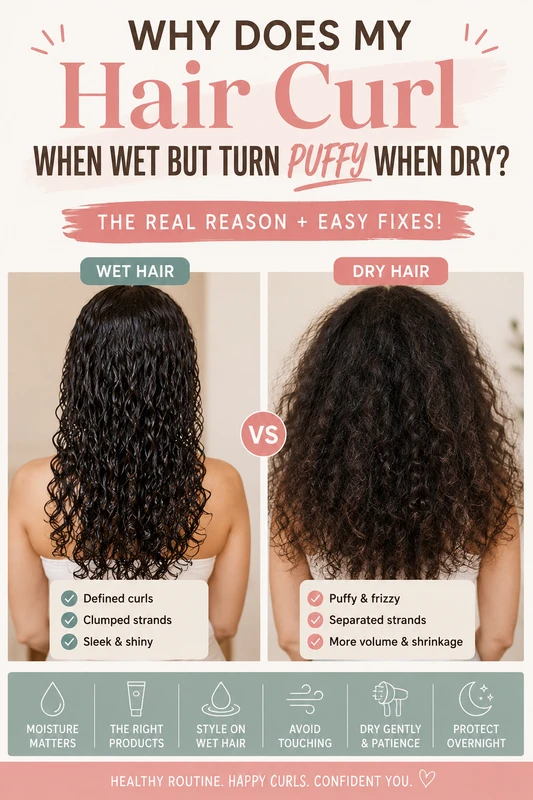
You step out of the shower, look in the mirror, and your hair seems to be doing exactly what you want. Your curls look defined. Your strands are clumped together. Your natural curl pattern is easy to see, and your hair may even look shinier, smoother, and longer.
Then your hair dries.
Suddenly, those defined wet curls seem to disappear. Your hair becomes bigger, puffier, frizzier, or less defined. Instead of the curls you saw when your hair was soaking wet, you are left wondering why your hair looks completely different once it is dry.
If you have ever asked, “Why does my hair curl when wet but turn puffy when dry?”, you are definitely not alone.
This is especially common with natural, curly, coily, and kinky hair textures. In many cases, it is simply the result of how water temporarily changes the behavior of the hair fiber. However, excessive puffiness can also be influenced by moisture levels, porosity, product application, styling technique, humidity, damage, and the way you dry your hair.
The good news is that puffy hair does not necessarily mean unhealthy hair.
Once you understand what happens between the wet and dry stages, you can build a routine that helps your curls stay more defined after your hair dries.
In this complete guide, we will explain why hair curls when wet but gets puffy when dry, how to tell the difference between normal volume and frizz, and what you can do to maintain better curl definition.
Why Does My Hair Curl When Wet but Turn Puffy When Dry?
Hair often looks curlier and more defined when wet because water weighs the strands down and encourages neighboring hairs to group together into curl clumps.
As the water evaporates, several things happen.
Your hair becomes lighter. Your natural shrinkage becomes more noticeable. Individual strands may begin separating from their curl clumps. Raised cuticles, friction, humidity, dryness, or insufficient styling product can make that separation even more obvious.
The result can be hair that looks:
- Puffy
- Frizzy
- Bigger
- Less defined
- Shorter
- Drier
- More separated
- Less shiny
For many people, some of this transformation is completely normal.
The goal should not necessarily be to make dry hair look exactly like soaking-wet hair. Instead, the goal is usually to preserve enough of your wet curl pattern that your dry hair remains moisturized, defined, and manageable.
What Happens to Curly Hair When It Gets Wet?
Water temporarily changes the physical behavior of your hair.
Hair contains keratin proteins, and its shape is influenced partly by chemical bonds within the hair fiber. Some of the weaker bonds involved in the hair's temporary shape are affected by water.
This is why hair can be manipulated more easily when wet.
When curly or coily hair becomes saturated, water also adds weight to the strands. This can stretch the curls and reduce some of the volume you normally see when the hair is dry.
At the same time, wet strands tend to stick together.
Instead of thousands of individual hairs moving independently, multiple strands may group into larger curl clumps.
This is why soaking-wet curls often look extremely defined.
But that appearance is temporary.
As the water evaporates, the hair becomes lighter and begins returning toward its natural dry shape.
1. Water Is Temporarily Weighing Your Hair Down
One of the simplest explanations for why your hair looks so different wet versus dry is water weight.
Wet hair is heavier than dry hair.
That extra weight pulls the curls downward, which can make your hair appear:
- Longer
- Smoother
- More defined
- Less voluminous
- Less frizzy
When the water evaporates, that additional weight disappears.
Your curls can spring upward and outward.
For tightly curled or coily hair, the difference can be dramatic.
Hair that appears shoulder-length while soaking wet may shrink several inches once completely dry.
That does not necessarily mean anything went wrong during your styling routine.
You may simply be seeing your natural curl pattern without the weight of water stretching it.
2. Your Curl Clumps Are Separating as Your Hair Dries
Curl clumping is one of the biggest differences between wet and dry curly hair.
When your hair is soaking wet, several strands can naturally group together into one curl.
Imagine 20 individual strands forming one smooth curl clump.
As the hair dries, some of those strands may separate.
Instead of one large curl, you now have numerous smaller curls and individual strands.
The overall result looks fuller and puffier.
This can happen naturally, but excessive separation may be caused by:
- Touching the hair while it dries
- Not using enough styling product
- Applying products when the hair is too dry
- Excessive towel friction
- Wind
- Sleeping on the hair before it is dry
- Brushing after styling
- Frequently manipulating the curls
If you want maximum definition, preserving those curl clumps during the drying process is extremely important.
3. Your Hair Is Shrinking
Shrinkage plays a major role in the wet-to-dry transformation of natural hair.
When curly and coily hair is wet, the weight of the water stretches the curl pattern.
As it dries, the hair contracts.
The tighter your curl pattern, the more noticeable this can become.
Shrinkage can make your hair appear significantly:
- Shorter
- Thicker
- Fuller
- Puffier
This is not necessarily frizz.
Sometimes what people call “puffiness” is actually their natural curl pattern contracting and creating volume.
Healthy natural hair can shrink considerably.
In fact, the ability of curls to spring back after being stretched can be associated with good elasticity.
So before trying to eliminate all puffiness, determine whether you are actually dealing with frizz or simply natural volume and shrinkage.
4. Your Hair May Need More Moisture
If your curls look beautiful when soaking wet but become extremely rough, dull, and frizzy when dry, your hair may need a better moisture routine.
Water temporarily makes dry hair feel moisturized.
However, simply getting your hair wet does not guarantee that it will remain soft and manageable after the water evaporates.
A good wash-day routine may include:
- Cleansing the scalp and hair appropriately.
- Conditioning thoroughly.
- Detangling gently.
- Applying a leave-in product when appropriate.
- Using a moisturizing styling product.
- Applying a gel, mousse, or other styler for hold if definition is the goal.
Your exact routine will depend on your hair texture, porosity, density, climate, and preferred hairstyle.
The important point is that water alone usually does not provide lasting curl definition.
5. Your Styling Product Does Not Have Enough Hold
Moisture and hold are not exactly the same thing.
This is an important distinction.
A moisturizing cream may leave your hair feeling incredibly soft, but it may not provide enough hold to keep your curl clumps intact as your hair dries.
If maximum curl definition is your goal, you may need a styling product designed to create hold.
Depending on your hair, that could include:
- Curl-defining gel
- Styling gel
- Mousse
- Foam
- Curl custard
- Curl-defining cream
Some people get their best results by combining a moisturizing leave-in or cream with a stronger-hold styler.
Others get better results with fewer products.
The key is experimentation.
If your hair repeatedly looks defined when wet and completely undefined once dry, insufficient hold is one possibility worth investigating.
6. You May Be Applying Products Too Late
Timing can make a major difference in curl definition.
For many curl types, styling products work particularly well when applied to very wet or soaking-wet hair.
Why?
Because your curl clumps have already formed.
You can apply the product over those existing clumps and encourage them to remain together as the hair dries.
If you wait until your hair is half dry before applying your styler, some of those clumps may have already separated.
Try experimenting with this sequence:
Wet hair → leave-in → curl product → hold product → dry without excessive touching.
If sections start drying before you reach them, use a spray bottle to add water before applying your styling products.
7. Your Hair Porosity Could Be Contributing to Puffiness
Hair porosity describes how easily your hair absorbs and retains water.
Porosity can significantly affect how your curls behave as they dry.
High-Porosity Hair
High-porosity hair tends to absorb water relatively quickly but may also lose moisture quickly.
The cuticle may be more raised or damaged.
High porosity can occur naturally, but it can also be associated with:
- Bleaching
- Permanent coloring
- Chemical processing
- Excessive heat
- Mechanical damage
- Environmental weathering
High-porosity hair may look extremely defined while wet but become dry and frizzy relatively quickly.
Low-Porosity Hair
Low-porosity hair generally resists water penetration more than highly porous hair.
Products may sometimes seem to sit on the surface, particularly when too much heavy product is used.
If your hair is low porosity, piling on more oils and butters is not automatically the solution.
You may get better results from lighter layers of product and making sure your hair is thoroughly saturated before styling.
8. Humidity Can Make Dry Hair Expand
Have you ever styled your hair perfectly indoors, walked outside, and watched it get bigger?
Humidity may be responsible.
Hair interacts with moisture in the surrounding air.
In humid conditions, hair fibers can absorb water from the environment. This can alter the temporary bonds that help maintain a styled shape.
For curly hair, the result may be:
- Increased frizz
- More volume
- Loss of definition
- Curl expansion
- Flyaways
- Puffy roots
This explains why a routine that works perfectly in one season may not perform the same way during another.
Your summer routine may need to be different from your winter routine.
A stronger-hold styling product can sometimes help curls maintain their shape in humid weather.
9. You Are Touching Your Hair While It Dries
This sounds simple, but it can make an enormous difference.
You finish styling your curls.
They look perfect.
Then you keep touching them.
You separate a curl.
You fluff the roots.
You move the hair from one side to another.
You run your fingers through a section.
Each movement can disturb the curl clumps that you just created.
The more the strands separate before the style is set, the puffier your finished hairstyle may become.
After applying your styling products, try leaving your hair alone until it is completely—or nearly completely—dry.
Once dry, you can carefully separate or fluff the hair if you want more volume.
10. Your Towel Could Be Creating Frizz
Traditional bath towels can sometimes create unnecessary friction on curly hair.
Aggressively rubbing your hair with a towel can separate curls and disturb the cuticle.
Instead of rubbing your hair dry, consider gently blotting or squeezing excess water.
Many people with curly hair prefer:
- Microfiber towels
- Soft cotton T-shirts
- Gentle air drying
- Diffusing
The important factor is reducing rough friction.
Your drying technique matters almost as much as the products you apply.
11. You May Be Brushing Your Hair After Curl Clumps Form
Brushes can be extremely useful for detangling and styling curly hair.
But timing matters.
Brushing soaking-wet hair with conditioner or styling product can help organize strands and encourage curl formation.
Brushing hair once it has begun drying can have the opposite effect.
You may break apart your curl clumps and create a much fuller, puffier appearance.
If you prefer defined curls, complete most detangling and brush styling while the hair is wet.
Then allow the curls to set.
12. Your Hair May Have Product Buildup
More product does not always mean more moisture.
If your hair feels coated, dull, sticky, waxy, or unusually difficult to wet, you may be experiencing buildup.
Over time, styling products, oils, butters, minerals, and other residues can accumulate on the hair.
This may interfere with the way water and styling products interact with your strands.
If buildup is a problem, an occasional clarifying shampoo may help.
How frequently you clarify depends on your hair, scalp, product use, water quality, and washing schedule.
The goal is not to strip your hair constantly.
The goal is to remove excessive buildup when necessary so that your normal routine can work effectively.
13. Hard Water May Affect How Your Hair Feels
The water coming from your shower can also influence your hair.
Hard water contains relatively high levels of dissolved minerals, commonly including calcium and magnesium.
Over time, mineral deposits may contribute to hair feeling:
- Rough
- Coated
- Dry
- Dull
- Difficult to manage
If your hair seems unusually rough despite changing your products and routine, hard water could be one factor worth considering.
A chelating shampoo is specifically designed to help remove mineral deposits.
However, because these cleansers can be stronger than everyday shampoos, follow the product directions and condition your hair appropriately afterward.
14. Heat or Chemical Damage Can Change Curl Definition
If certain sections curl beautifully when wet but become strangely straight, fuzzy, or shapeless when dry, damage may be involved.
Frequent high-temperature styling can damage the hair fiber.
Chemical treatments can also permanently alter the structure of the hair.
Possible signs of significant damage include:
- Curls that no longer return after washing
- Excessive breakage
- Rough ends
- Split ends
- Uneven curl patterns
- Weak strands
- Increased tangling
- Sections that remain much straighter than the surrounding hair
Damaged hair cannot always be restored to its original condition.
Conditioners and treatments can temporarily improve manageability and appearance, but severely damaged sections may eventually need to be trimmed as healthy hair grows in.
15. Your Ends May Need a Trim
Sometimes the roots and middle sections of your curls look great while the ends remain fuzzy.
Your ends are the oldest part of your hair.
They have experienced more:
- Washing
- Detangling
- Styling
- Friction
- Sun exposure
- Heat
- Environmental stress
Split, weathered, or damaged ends may not clump as effectively as healthier sections.
A trim can sometimes make the entire hairstyle appear more defined.
Is Puffy Hair the Same as Frizzy Hair?
Not necessarily.
This distinction is especially important for natural hair.
Puffy hair may simply have a lot of volume.
Your curls can be healthy, moisturized, and defined while still being large and voluminous.
Frizz, on the other hand, generally describes strands that separate from the main curl pattern and create a fuzzy appearance.
You can have:
- Defined hair with volume
- Frizzy hair with little volume
- Puffy and frizzy hair
- Smooth hair with minimal volume
Do not assume that every bit of volume needs to be eliminated.
For many curly and coily textures, volume is part of the beauty of the natural pattern.
Why Does My Hair Look So Much Longer When Wet?
The answer is primarily water weight and shrinkage.
When your curls are saturated, the weight of the water stretches them downward.
Once dry, your natural curl pattern contracts.
This creates shrinkage.
The tighter your curl pattern, the more dramatic the difference may appear.
Shrinkage does not mean your hair stopped growing.
Your actual strand length is still there.
The hair simply occupies less vertical space when it curls back into its dry pattern.
Why Does My Hair Look Straight When Wet but Curly When Dry?
Some people experience the opposite effect.
Their hair appears relatively straight or wavy while soaking wet and becomes much curlier as it dries.
Again, water weight is often involved.
Water can stretch the curl pattern.
Once the water evaporates, the hair becomes lighter and the curls contract.
This is why judging your curl type solely while your hair is soaking wet can sometimes be misleading.
Your dry pattern tells you more about how your curls naturally behave without the weight of water.
How to Keep Your Hair Curly Instead of Puffy When It Dries
If your goal is more definition, your routine should focus on maintaining moisture, creating curl clumps, providing adequate hold, and reducing unnecessary manipulation.
Here is a simple routine to experiment with.
Step 1: Cleanse Your Hair
Start with clean hair.
Use a shampoo appropriate for your scalp and hair needs.
Focus primarily on cleansing the scalp, while allowing the lather to move through the lengths as you rinse.
If you use lots of heavy styling products, periodically clarify as needed.
Step 2: Condition Thoroughly
Apply conditioner throughout your hair.
Work in sections if your hair is thick.
Conditioner can improve slip and make detangling easier.
Pay particular attention to older, drier ends.
Step 3: Detangle Carefully
Detangle while your hair has plenty of slip.
Depending on your preference, you can use:
- Fingers
- Wide-tooth comb
- Detangling brush
Start near the ends and gradually work upward.
Avoid aggressively ripping through knots.
Reducing breakage helps preserve fuller, healthier-looking curls over time.
Step 4: Keep the Hair Wet
Do not allow the entire head to dry before you start styling.
Work in sections.
If a section begins drying, mist it with water.
For many people, wetter hair produces larger, smoother curl clumps.
Step 5: Apply Your Leave-In
If your routine benefits from a leave-in conditioner, apply a moderate amount.
Distribute it evenly.
More is not necessarily better.
Using excessive leave-in can sometimes weigh down certain curl types or interfere with the performance of other styling products.
Step 6: Apply Your Curl Styler
Next, apply your preferred curl-defining product.
You can use your hands to smooth the product through each section.
Popular application techniques include:
- Praying hands
- Raking
- Shingling
- Scrunching
- Brush styling
Experiment to determine which method creates the best curl clumps for your hair.
Step 7: Add Hold
This can be the missing step for people whose hair looks perfect wet but puffy dry.
Apply a gel, mousse, foam, custard, or other product that provides enough hold for your desired style.
The hold product helps keep strands grouped together as the water evaporates.
Some products form a temporary firm layer around the curls commonly called a cast.
Do not immediately assume that a crunchy cast is bad.
Once the hair is completely dry, gently scrunching the curls can soften the cast while preserving definition.
Step 8: Stop Touching Your Hair
This may be the hardest step.
Once the curls are arranged exactly how you want them, leave them alone.
Do not continuously fluff them while they are drying.
Do not repeatedly run your fingers through them.
Allow the style to set first.
Step 9: Dry Completely
You can air-dry or diffuse.
Air Drying
Air drying minimizes direct heat but can take a long time, especially for dense hair.
Diffusing
A diffuser attachment distributes airflow over a larger area and can speed up drying while helping maintain the curl pattern.
If using a diffuser, use a comfortable heat and airflow setting and avoid concentrating excessive heat on one area for too long.
Step 10: Break the Cast After Drying
If your gel leaves your hair stiff, wait until it is fully dry.
Then gently scrunch your curls.
This can soften the hair while retaining much of the definition created during styling.
You can also gently fluff the roots for additional volume.
The key is waiting until the style is set.
How to Make Wet Curl Definition Last Longer
If you love your wet curl pattern, focus on preserving the clumps rather than trying to preserve the actual wet appearance.
Try these techniques:
Style wetter. Apply products while your curl clumps are still clearly formed.
Use enough hold. A cream alone may not provide sufficient structure.
Work in sections. This allows more even product distribution.
Smooth your products through the hair. Make sure the strands are evenly coated without excessive buildup.
Avoid touching while drying. Manipulation encourages separation.
Protect your hair at night. Friction from bedding can disturb curls.
Refresh selectively. You may not need to completely wet your entire head every morning.
How to Protect Defined Curls Overnight
Your nighttime routine can determine whether your curls last one day or several.
Consider sleeping on a satin or silk pillowcase or using a satin bonnet or scarf.
These smoother surfaces can reduce friction compared with rougher fabrics.
If your hair is long enough, you can also experiment with loosely gathering it toward the top of your head—a method commonly called the pineapple.
Avoid tying the hair excessively tight.
The objective is to preserve the curls without putting unnecessary tension on the hairline.
Should You Put Oil on Puffy Hair?
Oil can be useful in some hair routines, but it is important to understand what oil can and cannot do.
Oil is not the same thing as water.
Applying oil to dehydrated hair does not automatically replace the moisture the hair needs.
Depending on the product and your hair type, oils may help with:
- Lubrication
- Shine
- Reducing friction
- Softening the feel of the hair
- Finishing a style
But if your curls consistently feel extremely dry, simply applying more oil may not solve the underlying issue.
Look at your entire routine, including cleansing, conditioning, water, styling products, drying, and nighttime protection.
Why Is My Hair Puffy at the Roots but Curly at the Ends?
Puffy roots with defined ends are extremely common.
There are several possible explanations.
Your roots may have less styling product because you concentrated primarily on your ends.
The roots may also dry faster or be disturbed more frequently.
Your natural curl pattern can also vary across different areas of your head.
Try applying your styling product closer to the roots without coating your scalp unnecessarily.
You can also work in smaller sections and make sure the root area is adequately wet while styling.
Remember that some root volume can actually make a curly hairstyle look fuller and more dimensional.
You do not necessarily need perfectly flat roots.
Why Is the Top of My Hair Puffy but the Underneath Curly?
Different sections of your head can behave differently.
The top layer of your hair receives more direct exposure to:
- Sunlight
- Wind
- Manipulation
- Hats
- Pillows
- Environmental conditions
It may therefore behave differently from the protected hair underneath.
You may also naturally have multiple curl patterns.
It is extremely common for one person to have tighter curls in one section and looser curls in another.
Give the puffier sections extra attention during conditioning and styling rather than assuming your entire head should respond identically.
Does Puffy Hair Mean High Porosity?
No.
Puffiness alone is not enough to determine hair porosity.
High-porosity hair may be more prone to certain forms of dryness and frizz, but people with low- and medium-porosity hair can experience puffiness too.
Instead of diagnosing porosity based on a single characteristic, observe how your hair responds to water, products, chemical treatments, heat, and drying over time.
Does Puffy Hair Mean Your Hair Is Damaged?
Not necessarily.
Healthy curly hair can be extremely voluminous.
If your hair:
- Springs back normally
- Has a recognizable curl pattern
- Feels reasonably strong
- Is not experiencing excessive breakage
- Responds well to conditioning
- Maintains reasonable elasticity
then puffiness may simply be part of your natural texture.
Damage becomes more likely when puffiness occurs alongside symptoms such as excessive breakage, split ends, severe roughness, significant loss of elasticity, or permanent changes to previously healthy curls.
Common Mistakes That Make Curls Puffy
If your hair becomes much puffier than you would like, examine your routine for these common mistakes:
- Styling hair that is already too dry
- Using no hold product
- Applying too little styler
- Applying far too much product and causing buildup
- Rough towel drying
- Brushing partially dry curls
- Touching curls while they dry
- Sleeping on wet hair
- Failing to clarify when buildup becomes excessive
- Skipping conditioning
- Using excessive heat
- Neglecting damaged ends
- Constantly separating curl clumps
Fixing just one or two of these habits can sometimes produce noticeably better results.
What Products Help Prevent Puffy Curls?
Instead of focusing only on brand names, consider what role each product performs.
A balanced curl routine may include:
Cleanser
Removes sweat, dirt, oils, and product residue.
Conditioner
Improves softness, slip, and manageability.
Leave-In Conditioner
Can provide additional conditioning after washing.
Curl Cream
May provide softness, definition, and styling control.
Gel
Usually provides stronger hold and helps preserve curl clumps.
Mousse or Foam
Can provide lighter hold and volume with less weight than some creams and gels.
You do not necessarily need all six.
Some hair performs better with a simple routine.
The best routine is the one that gives you the results you want without creating unnecessary buildup.
Wet Styling vs Damp Styling
Should you style soaking-wet hair or damp hair?
There is no universal answer.
Soaking-Wet Styling
May create:
- Larger curl clumps
- More definition
- Less initial frizz
- More elongated wet curls
But drying can take longer.
Damp Styling
May create:
- More volume
- Faster drying
- Smaller curl clumps
- Potentially more fullness
Experiment with both.
If your primary complaint is that your hair becomes too puffy, start by trying wetter styling and compare your results.
Definition vs Volume: You May Have to Choose a Balance
One important truth about curly hair is that maximum definition and maximum volume often work against each other.
Large, undisturbed curl clumps create more definition but can make the hair look less voluminous.
Separating and fluffing the curls creates more volume but can reduce definition.
Neither result is wrong.
You simply need to decide what appearance you prefer.
For maximum definition, use stronger hold and minimize separation.
For maximum volume, separate curls and fluff the roots after drying.
For a balance, preserve most of your curl clumps while gently lifting the roots.
A Simple Anti-Puff Wash-Day Routine
If you are overwhelmed by complicated routines, start here:
1. Shampoo your scalp and hair.
2. Apply conditioner and gently detangle.
3. Rinse thoroughly.
4. Keep your hair very wet.
5. Apply leave-in if needed.
6. Apply a curl-defining product.
7. Apply a gel or mousse for hold.
8. Smooth or scrunch your curls into shape.
9. Avoid touching your hair while it dries.
10. Once completely dry, gently soften any cast and fluff only as much as desired.
Try this consistently before adding numerous extra products.
Sometimes a simpler routine makes it easier to identify exactly what your hair needs.
Frequently Asked Questions
Why are my curls beautiful when wet but frizzy when dry?
Water temporarily weighs down the hair and encourages strands to form curl clumps. As the hair dries, those clumps may separate because of shrinkage, friction, humidity, insufficient hold, manipulation, or the natural characteristics of your hair.
How do I make my hair stay the way it looks when wet?
You cannot completely preserve the appearance of soaking-wet hair because water eventually evaporates. However, you can preserve more curl definition by styling very wet hair, using an appropriate hold product, maintaining curl clumps, and minimizing manipulation while drying.
Why does my natural hair get bigger as it dries?
As water evaporates, your hair becomes lighter and your curl pattern contracts. Shrinkage, curl separation, and natural volume can make your hair appear significantly bigger.
Is puffy natural hair unhealthy?
No. Natural hair can be healthy and still be voluminous or puffy. Pay more attention to breakage, elasticity, split ends, roughness, scalp condition, and overall manageability than volume alone.
Should I use gel if my hair gets puffy?
Gel can be helpful if you want stronger curl definition because it can provide hold as your hair dries. However, the ideal product depends on your texture, porosity, density, hairstyle, and personal preference.
Why does my hair get frizzy immediately after drying?
Possible reasons include insufficient hold, humidity, rough drying, touching the hair while drying, buildup, damage, or styling the hair when it is not wet enough.
Can I eliminate frizz completely?
Probably not—and you do not necessarily need to. Curly and coily hair naturally has texture, volume, and individual strands that may not remain perfectly aligned. The goal can be manageable frizz rather than completely eliminating every flyaway.
Does oil stop hair from becoming puffy?
Oil may help lubricate the hair and add shine, but it is not a replacement for water, conditioner, or styling hold. If lack of definition is the problem, a curl styler or hold product may be more useful.
Why does my hair feel soft but still look puffy?
Softness and definition are different characteristics. Your moisturizing products may be working well, but you may need more styling hold if you want your curl clumps to remain intact.
Is it better to air-dry or diffuse curly hair?
Both can work. Air drying requires less equipment, while diffusing can dramatically reduce drying time. Your technique matters: excessive heat, airflow, and manipulation can contribute to frizz.
How Long Should You Give a New Curl Routine?
Do not necessarily judge a routine after one wash day.
Weather, product amounts, drying methods, and application techniques can all change the result.
Try keeping notes for several wash days.
Record:
- Which shampoo you used
- Which conditioner you used
- How wet your hair was during styling
- How much leave-in you applied
- Which styler you used
- Whether you used gel or mousse
- Whether you air-dried or diffused
- How your hair looked on day one
- How it looked on days two and three
You may quickly discover a pattern.
For example, you might notice that your hair stays defined when you apply gel to soaking-wet hair but becomes fluffy when you apply curl cream to damp hair.
That information is far more useful than constantly buying new products without understanding why your results change.
Learn to Work With Your Natural Curl Pattern
One of the most important lessons in natural hair care is understanding what your hair naturally wants to do.
Your wet hair and dry hair will probably never look identical.
And that is completely normal.
Water stretches curls, adds weight, and temporarily groups strands together. Drying removes that weight and allows your natural texture, volume, and shrinkage to return.
Rather than fighting every bit of volume, focus on maintaining healthy hair while controlling the amount of definition you want.
You may eventually discover that a little puffiness actually makes your hairstyle look fuller.
The goal is not necessarily perfectly controlled curls.
The goal is healthy, moisturized, manageable hair that behaves predictably enough for you to style it the way you want.
Final Thoughts: Why Does My Hair Curl When Wet but Turn Puffy When Dry?
If your hair curls when wet but turns puffy when dry, the most likely explanation is a combination of water weight, shrinkage, curl-clump separation, and the natural behavior of your texture.
However, excessive puffiness or frizz may also be influenced by dryness, humidity, hair porosity, buildup, styling technique, insufficient hold, friction, heat damage, or damaged ends.
Start by observing exactly when the puffiness appears.
Does your hair look defined until you touch it?
Try reducing manipulation.
Does curl definition disappear during air drying?
Experiment with a stronger-hold styling product.
Does your hair feel rough even after conditioning?
Investigate buildup, damage, your conditioning routine, and possibly hard water.
Does your hair feel healthy but simply gets much bigger?
You may be seeing normal shrinkage and volume rather than a problem that needs fixing.
The biggest mistake is assuming that your dry hair should look exactly like your soaking-wet hair.
It will not.
But with the right combination of water, conditioning, styling, hold, gentle drying, and nighttime protection, you can help preserve much more of the curl definition you see on wash day.
Your curls do not disappear when your hair dries.
They are simply responding to the loss of water and returning to their natural dry state.
Understanding that difference can make building your curly-hair routine much easier.