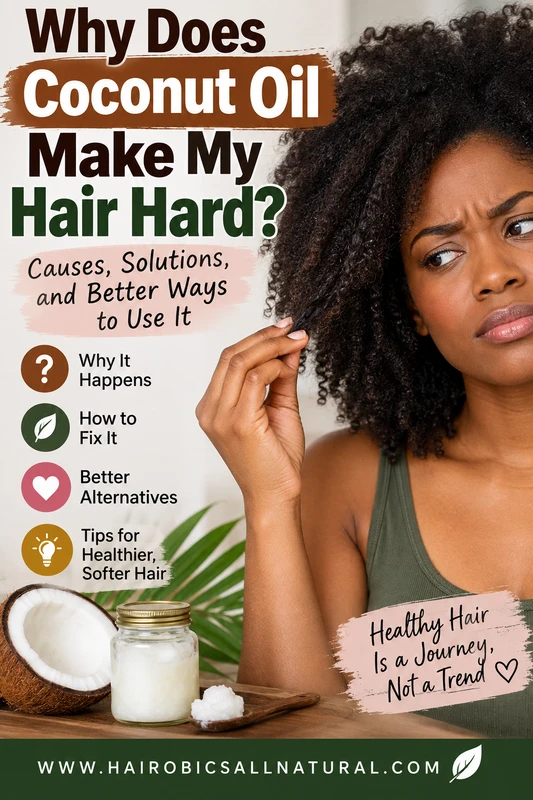
Coconut oil is one of the most popular oils used for natural hair. It is found in shampoos, conditioners, deep treatments, hair masks, scalp products, and countless DIY hair recipes. Many people love coconut oil because it can help reduce moisture loss, improve lubrication, and protect hair from some types of damage.
But coconut oil does not work the same way for everyone.
If you've ever applied coconut oil expecting soft, moisturized hair only to end up with strands that feel hard, stiff, rough, crunchy, dry, or difficult to detangle, you may have wondered:
Why does coconut oil make my hair hard?
You're definitely not imagining the change in texture. Coconut oil can make some people's hair feel noticeably harder or drier, particularly when too much is used, when it is repeatedly layered onto the hair, or when it is used in a routine that doesn't provide enough water and conditioning.
The problem also isn't necessarily that coconut oil is "bad" for your hair. Coconut oil has properties that can make it beneficial for certain hair types and routines. The key is understanding what coconut oil actually does—and what it doesn't do.
In this guide, we'll explain why coconut oil can make natural hair feel hard, how coconut oil interacts with the hair shaft, whether protein sensitivity is really responsible, how porosity can affect your results, and what you can do if coconut oil simply doesn't agree with your hair.
Why Does Coconut Oil Make My Hair Hard?
Coconut oil may make your hair feel hard because it can penetrate the hair shaft, reduce water-related swelling, coat the strands, and create a heavier or more rigid feeling when too much is used.
Several things can contribute to the problem:
- Using too much coconut oil
- Applying oil without enough water or moisture
- Repeatedly layering coconut oil on the hair
- Product buildup
- Using coconut oil too frequently
- Combining it with protein-heavy products
- Leaving excessive amounts on the hair
- Using coconut oil as if it were a moisturizer
- Your individual hair simply responding poorly to it
One of the biggest misunderstandings about coconut oil is that because it makes some people's hair feel soft, it must automatically be a moisturizer.
Oil and moisture aren't the same thing.
Water provides hydration. Oil can help lubricate the hair and slow water loss, but applying more oil to already-dry hair doesn't necessarily make that hair hydrated.
This distinction becomes especially important for natural hair.
What Does Coconut Oil Actually Do to Hair?
Coconut oil is unusual compared with many other plant oils because its fatty-acid composition allows it to interact with hair differently.
Coconut oil contains a high percentage of lauric acid, a fatty acid with characteristics that allow coconut oil to penetrate the hair shaft more effectively than many oils.
Research has also found that coconut oil can help reduce protein loss from hair when used under certain conditions.
This is one reason coconut oil became so popular in natural hair care.
However, that doesn't mean coconut oil adds protein to your hair.
That's an important distinction.
Coconut oil can help reduce protein loss, but coconut oil itself is not a protein treatment.
Still, the way it interacts with the hair can make some strands feel firmer, especially when combined with other factors in your routine.
Does Coconut Oil Contain Protein?
No.
Pure coconut oil does not contain hair protein.
You'll frequently hear people say:
"Coconut oil makes my hair hard because I'm protein sensitive."
The explanation is more complicated than that.
Coconut oil doesn't supply keratin or protein to the hair the way a hydrolyzed-protein treatment might. Instead, coconut oil may help reduce the amount of protein that is lost from the hair during washing and grooming.
For someone whose hair already feels stiff, coarse, coated, or overloaded, the effect of coconut oil may therefore be interpreted as "protein overload."
But the oil itself isn't adding protein.
If you're experiencing hard hair, look at your entire routine, not just coconut oil.
Check your:
- Shampoo
- Conditioner
- Deep conditioner
- Leave-in conditioner
- Styling cream
- Gel
- Edge control
- Hair mask
- Protein treatments
If several products contain hydrolyzed proteins while you're also using coconut oil frequently, your hair may need a different balance of conditioning, hydration, cleansing, and strengthening products.
Why Coconut Oil Can Make Natural Hair Feel Hard
Natural hair is incredibly diverse. Two people can have curls that look similar while their hair reacts completely differently to the same product.
Here are some of the most common reasons coconut oil leaves natural hair feeling hard.
1. You're Using Too Much Coconut Oil
More oil doesn't necessarily mean softer hair.
Coconut oil can become heavy when applied generously. If you repeatedly coat your strands, the hair may begin feeling:
stiff, greasy, coated, waxy, rough, tangled, or hard.
This is especially common when coconut oil is applied every day without regularly cleansing the hair.
You may only need a tiny amount.
For example, instead of scooping a large amount from the jar and covering your entire head, melt a small amount between your palms and lightly smooth it over the sections that need it.
Your hair shouldn't have to look drenched in oil to benefit from it.
2. You're Applying Coconut Oil to Dry Hair
This is one of the biggest mistakes people make with oils.
Imagine your hair is already extremely dry.
You apply coconut oil.
The strands become shiny.
They may even temporarily feel smoother.
But underneath that oil, your hair can still be dehydrated.
Shine is not the same as moisture.
Oil can reduce friction and help slow moisture loss, but it doesn't replace the water your hair needs.
That's why you can have hair that looks shiny while simultaneously feeling dry and brittle.
Instead of starting with oil, try starting with water or a water-based leave-in product.
A simple routine might look like:
Water → leave-in treatment → small amount of oil
The exact routine depends on your hair, but the principle is important:
Hydrate first. Seal or lubricate second.
3. Coconut Oil May Be Building Up on Your Hair
Product buildup can completely change the way natural hair feels.
If you regularly apply coconut oil but don't cleanse your hair thoroughly enough, layers of oil can accumulate on your strands.
Eventually, your hair may feel:
- Heavy
- Dull
- Hard
- Sticky
- Greasy
- Dry underneath
- Difficult to detangle
- Less responsive to conditioner
You may even notice that water seems to sit on top of your hair rather than soaking in easily.
When this happens, applying another layer of moisturizer or oil might make things worse.
Your hair may simply need to be cleansed.
4. You May Need to Clarify Your Hair
If your hair has become hard after weeks or months of heavy oil use, consider whether you need a deeper cleanse.
A clarifying shampoo is designed to remove stubborn buildup from oils, styling products, butters, silicones, minerals, and other residues.
After clarifying, follow with a moisturizing conditioner or deep conditioner because clarifying shampoos can sometimes leave the hair feeling cleaner but less lubricated.
You don't necessarily need to clarify every wash day.
How often you need it depends on:
- How much product you use
- How often you wash
- Whether you use heavy oils or butters
- Your water quality
- Your styling routine
- How quickly buildup develops
Pay attention to your hair rather than following an arbitrary schedule.
5. You're Using Coconut Oil Too Frequently
Even if coconut oil works well occasionally, using it every day may be too much.
Natural hair routines can become complicated because we often hear that we should constantly add something to our hair.
Oil your scalp.
Moisturize your ends.
Refresh your curls.
Apply leave-in.
Seal with oil.
Add styling cream.
Then repeat.
Eventually, you may have multiple layers of products sitting on your strands.
Sometimes the solution isn't another product.
Sometimes your hair needs to be washed.
If coconut oil makes your hair progressively harder every time you use it, reduce the frequency or stop using it temporarily.
6. Your Hair May Simply Not Like Coconut Oil
Not every popular ingredient will work for you.
That's okay.
Coconut oil can be beneficial for hair, but you don't need coconut oil to have healthy natural hair.
If you've experimented with:
- Smaller amounts
- Different application methods
- Applying it before shampooing
- Applying it after moisturizing
- Using it less frequently
…and your hair still feels terrible afterward, you don't need to force coconut oil into your routine.
There are plenty of alternatives.
Does Hair Porosity Affect Coconut Oil?
Hair porosity describes how easily your hair absorbs and retains water.
Porosity is commonly discussed as:
Low porosity, medium porosity, and high porosity.
Although these categories simplify a complicated biological structure, they can still be useful for understanding how products behave on your hair.
Coconut Oil and Low-Porosity Hair
Low-porosity hair often resists water penetration and may be prone to product buildup.
People with low-porosity hair sometimes find that heavy oils and butters sit on the strands instead of creating the soft feeling they're looking for.
If coconut oil leaves your low-porosity hair feeling coated or stiff, try using significantly less—or switch to a lighter-feeling oil.
Your hair may respond better to products that don't leave a heavy coating.
Coconut Oil and High-Porosity Hair
High-porosity hair tends to absorb water easily but may also lose it quickly.
Some people with high-porosity hair enjoy coconut oil because it helps lubricate their strands and can be useful as part of a pre-shampoo routine.
But high porosity doesn't guarantee coconut oil will work for you.
Damaged or highly porous hair still needs a balanced routine that includes conditioning, hydration, gentle handling, and appropriate strengthening when necessary.
Is Coconut Oil Good for Black Hair?
Coconut oil can be useful for Black hair, but there's no universal oil that every person with Black or natural hair needs.
Black hair varies tremendously in:
- Curl pattern
- Strand thickness
- Density
- Porosity
- Damage level
- Scalp condition
- Styling habits
- Chemical-treatment history
Someone with fine, low-porosity coils may have completely different needs from someone with coarse, highly porous hair.
Instead of asking:
"Is coconut oil good for Black hair?"
A more useful question is:
"How does my hair respond to coconut oil?"
If your hair becomes soft, manageable, flexible, and easier to detangle, coconut oil may fit nicely into your routine.
If it becomes hard, tangled, coated, or brittle-feeling every time you use coconut oil, choose something else.
Why Does My Hair Feel Dry After Using Coconut Oil?
This usually happens because the oil isn't providing the hydration your hair needs.
Remember:
Oil isn't water.
If your hair is dehydrated before you apply coconut oil, covering it with oil doesn't automatically correct the dehydration.
Think about a dry sponge.
Covering a completely dry sponge in oil isn't the same as soaking it in water.
Your hair works differently from a sponge, of course, but the example demonstrates an important concept:
Dryness can't always be solved by adding more oil.
Natural hair often needs water-based conditioning products to maintain softness and flexibility.
Can Coconut Oil Cause Hair Breakage?
Coconut oil itself isn't automatically a cause of breakage.
In fact, research suggests coconut oil can help reduce protein loss from hair.
However, if your hair consistently becomes extremely stiff or difficult to manipulate after coconut oil is applied, continuing to comb, brush, twist, or style that hair aggressively could contribute to mechanical breakage.
Hair needs flexibility during manipulation.
If your strands feel unusually rigid:
Stop manipulating them aggressively.
Wash away excess buildup, condition your hair, detangle gently, and reassess your routine.
Signs Coconut Oil May Not Be Working for Your Hair
Your hair doesn't need to pass a complicated test.
Pay attention to what happens after you use the product.
Possible signs that coconut oil isn't fitting your current routine include:
- Hair feels hard after application
- Hair feels crunchy
- Strands become unusually stiff
- Hair becomes difficult to detangle
- Curls lose flexibility
- Hair looks oily but feels dry
- Hair feels coated
- Products stop absorbing as well
- Hair tangles more easily
- You notice increasing buildup
- Your hair feels better when you stop using coconut oil
One bad wash day isn't enough to establish a pattern.
But if the same thing happens repeatedly, listen to your hair.
How to Fix Hair That Feels Hard After Coconut Oil
If you've already used coconut oil and your hair feels hard, don't panic.
In most cases, you simply need to adjust your routine.
Step 1: Stop Adding More Oil
Don't try to fix hard, oily hair by adding another oil.
Adding jojoba oil, olive oil, castor oil, and avocado oil on top of coconut oil can create even more buildup.
Give your hair a reset.
Step 2: Wash Your Hair
Use a shampoo appropriate for your hair and scalp.
Concentrate on cleaning your scalp while allowing the shampoo to move through the length of your hair.
If you've been using heavy oils and butters for weeks, you may need a clarifying shampoo.
Step 3: Condition Thoroughly
After cleansing, apply a moisturizing conditioner.
Work in sections if necessary.
Give special attention to your ends, which are typically the oldest and most vulnerable portion of your hair.
Step 4: Detangle Gently
Don't rip through stiff hair.
Apply conditioner and carefully detangle using your fingers or an appropriate detangling tool.
Start near the ends and gradually work upward.
Step 5: Use a Water-Based Leave-In
Once your hair has been cleansed and conditioned, apply a leave-in treatment designed to help maintain softness and manageability.
Your goal is to restore hydration and slip—not coat your hair in another thick layer of oil.
Step 6: Give Coconut Oil a Break
Try several wash cycles without coconut oil.
Watch how your hair responds.
If it becomes consistently softer and easier to manage, you may have found the culprit.
Should You Stop Using Coconut Oil Completely?
Not necessarily.
Before eliminating it, you can experiment with a different application method.
Coconut oil may work better as a pre-shampoo treatment than as a daily styling oil.
Apply a modest amount before washing your hair, allow it to sit for a period of time, and then shampoo and condition normally.
This allows you to experiment with coconut oil's benefits without leaving a thick layer sitting on your finished hairstyle.
If your hair still feels hard after repeated experiments, stop using it.
There is no requirement that healthy natural hair routines contain coconut oil.
Best Alternatives to Coconut Oil for Natural Hair
If coconut oil doesn't work for you, several oils may provide a different feel.
Jojoba Oil
Jojoba oil is popular because it is lightweight compared with many heavier oils.
It can work well for people who want lubrication and shine without a particularly heavy feeling.
Grapeseed Oil
Grapeseed oil is another relatively lightweight option.
It can be useful for people who dislike thick oils and butters.
Sweet Almond Oil
Sweet almond oil provides slip and shine and can be incorporated into many natural hair routines.
Avocado Oil
Avocado oil is popular for dry and textured hair and can work well as part of a conditioning or sealing routine.
Argan Oil
Argan oil is commonly used in finishing products because a small amount can add shine and reduce a rough feel without requiring a heavy application.
Remember, though:
Switching oils won't fix dehydration.
If your hair needs water, give it water and conditioning—not an endless rotation of oils.
Coconut Oil vs Jojoba Oil for Hard Hair
If coconut oil consistently leaves your hair feeling stiff, jojoba oil may be worth trying.
Coconut oil is known for its ability to penetrate the hair shaft, while jojoba oil tends to be used more for surface lubrication and conditioning.
People who dislike the heavy or rigid feeling they experience with coconut oil may prefer the feel of jojoba oil.
However, individual results vary.
Start with a small amount.
You don't want to replace coconut-oil buildup with jojoba-oil buildup.
Coconut Oil vs Grapeseed Oil
Grapeseed oil tends to feel lighter than coconut oil.
This can make it appealing for:
- Fine natural hair
- Low-density hair
- People who dislike heavy oils
- Lightweight styling routines
- Hair that becomes weighed down easily
If you're trying grapeseed oil for the first time, use only a few drops on moisturized hair and evaluate how your hair feels over the next few days.
Should You Put Coconut Oil on Wet or Dry Hair?
If your goal is to help retain moisture, applying a small amount after water or a water-based leave-in often makes more sense than putting it onto completely dry hair.
For example:
- Start with damp hair.
- Apply your leave-in conditioner.
- Distribute it evenly.
- Apply a very small amount of oil if your hair benefits from it.
- Style as usual.
You don't necessarily need to see or feel oil sitting on your hair.
A light application may be enough.
Can Coconut Oil Make Low-Porosity Hair Hard?
It can make some low-porosity hair feel hard or coated, especially when too much is used.
Low-porosity hair can be particularly susceptible to the feeling of product sitting on the strands.
If this sounds familiar, experiment with:
Less product, lighter products, more water, regular cleansing, and fewer layers.
You may discover that your hair thrives with a much simpler routine.
Can Coconut Oil Make 4C Hair Hard?
Yes, some people with 4C hair report a stiff or hard feeling after using coconut oil.
But this doesn't mean coconut oil is inherently bad for 4C hair.
Curl pattern alone can't determine whether an ingredient will work.
Two people with 4C hair can have different:
- Porosity
- Strand diameter
- Density
- Damage
- Styling routines
- Product preferences
One person's 4C hair may love coconut oil while another person's hair may feel terrible after using it.
Judge the product by your results.
Does Coconut Oil Moisturize 4C Hair?
Coconut oil should not be viewed as a replacement for water-based moisture.
For dry 4C hair, a routine may include:
Water or a water-based product + leave-in conditioner + styling product + optional oil
You don't necessarily need every layer.
Some people find that a good leave-in and styling cream provide enough conditioning without adding pure oil.
The best routine is often the simplest routine that keeps your hair hydrated, manageable, and protected.
Why Does Coconut Oil Make My Hair Tangled?
If coconut oil causes your strands to become stiff or coated, they may not slide past one another as easily.
That can make detangling more difficult.
The problem can become worse when you keep adding oil without cleansing.
If your hair suddenly becomes difficult to detangle:
- Stop adding oil.
- Shampoo your hair.
- Apply a slippery conditioner.
- Divide your hair into sections.
- Detangle gently.
- Rinse thoroughly.
- Apply a water-based leave-in.
You may notice a dramatic improvement once the buildup is removed.
Coconut Oil and Protein Treatments
Be especially careful about stacking multiple strengthening treatments.
For example, your routine might contain:
- Coconut oil
- Protein shampoo
- Protein conditioner
- Protein deep treatment
- Protein leave-in
- Strengthening styling cream
Your hair doesn't necessarily need every product in your routine to be strengthening.
Healthy hair care requires balance.
If your strands are feeling increasingly hard and brittle, inspect ingredient lists for hydrolyzed proteins such as:
- Hydrolyzed wheat protein
- Hydrolyzed keratin
- Hydrolyzed silk
- Hydrolyzed rice protein
- Hydrolyzed soy protein
Try alternating strengthening products with moisturizing products rather than using everything simultaneously.
How Often Should You Use Coconut Oil?
There isn't one schedule that works for everyone.
Some people may use coconut oil weekly.
Others may use it occasionally as a pre-shampoo treatment.
Some may avoid it completely.
Instead of asking how often everyone else uses coconut oil, ask:
How frequently can I use coconut oil before my hair stops feeling good?
Your hair will usually provide clues.
If it feels:
- Soft
- Flexible
- Manageable
- Easy to detangle
your current routine may be working.
If it becomes:
- Hard
- Brittle-feeling
- Greasy
- Coated
- Tangled
- Dull
something probably needs to change.
How to Prevent Coconut Oil Buildup
If you enjoy coconut oil and want to continue using it, moderation is your friend.
Use small amounts.
Avoid reapplying it every day simply because your hair feels dry.
If your hair feels dry, determine whether it actually needs water or conditioning rather than more oil.
Also wash your hair regularly enough to remove accumulated products.
Your wash-day schedule should be based on your scalp, hairstyle, activity level, and product use.
Your Scalp Doesn't Need to Be Drenched in Coconut Oil
Natural hair culture has a long tradition of using oils and greases on the scalp.
But your scalp doesn't necessarily need to be covered in heavy oil.
The scalp naturally produces sebum.
If you're experiencing persistent:
- Itching
- Flaking
- Redness
- Burning
- Sores
- Excessive scaling
don't assume the answer is simply more coconut oil.
Certain scalp conditions can require appropriate medical diagnosis and treatment. Persistent or severe symptoms are a good reason to see a dermatologist or healthcare professional.
A Better Moisture Routine for Natural Hair
If coconut oil has been making your hair hard, simplifying your routine may help.
Wash
Clean your scalp and hair regularly with an appropriate shampoo.
Condition
Apply a moisturizing conditioner to restore slip and improve manageability.
Detangle
Detangle gently while your hair has plenty of slip.
Hydrate
Use water and/or a water-based leave-in treatment.
Seal if Necessary
If your hair benefits from oils, use a small amount of a compatible oil.
Protect
Reduce unnecessary manipulation, protect your ends, and use satin or silk at night.
That's often more effective than constantly adding oil to dry hair.
Don't Confuse Softness With Greasiness
This distinction can completely change your natural hair routine.
Hair can be:
Greasy and dry at the same time.
When this happens, many people assume they need even more oil.
They don't.
Your hair may need cleansing and hydration.
After washing away the excess oil and applying a water-based conditioner, you may find that your strands feel dramatically softer.
What If Every Oil Makes My Hair Feel Hard?
If coconut, castor, olive, avocado, and other oils all seem to make your hair feel worse, consider whether you actually need pure oils in your routine.
You don't have to use them.
Some natural hair responds beautifully to a simple routine built around:
- Shampoo
- Conditioner
- Leave-in treatment
- Styling cream or gel
That's enough for many people.
Your routine doesn't have to look like someone else's routine on social media.
Frequently Asked Questions
Why does coconut oil make my hair stiff?
Coconut oil may leave hair feeling stiff when too much is applied, when buildup develops, when it's layered onto dry hair, or when it simply doesn't work well with your individual hair.
Is coconut oil bad for natural hair?
No. Coconut oil isn't inherently bad for natural hair. Some people get excellent results from it, while others experience stiffness, dryness, buildup, or tangling.
Is coconut oil a protein?
No. Pure coconut oil isn't protein. However, research suggests coconut oil can help reduce protein loss from hair.
Should I use coconut oil if I'm protein sensitive?
If your hair consistently becomes hard after using coconut oil, you can reduce or eliminate it regardless of whether "protein sensitivity" is responsible. Pay attention to your hair's actual response.
Why does coconut oil make my 4C hair hard?
Possible reasons include using too much oil, product buildup, insufficient hydration, combining coconut oil with numerous strengthening products, or simply having hair that doesn't respond well to coconut oil.
Can coconut oil dry out hair?
Coconut oil isn't inherently a drying ingredient, but hair can still feel dry after using it if the strands aren't adequately hydrated or become coated with excess product.
How do I remove coconut oil from my hair?
Wash your hair thoroughly with shampoo. If substantial buildup has developed, a clarifying shampoo may be useful. Follow with a moisturizing conditioner.
What oil should I use instead of coconut oil?
Depending on your hair, you might experiment with jojoba, grapeseed, sweet almond, avocado, or argan oil. Start with small amounts.
Should I put coconut oil on my scalp?
You can use coconut oil on the scalp if it works well for you, but your scalp doesn't need to be saturated in oil. Persistent itching, flaking, sores, or irritation should be evaluated rather than repeatedly covered with oil.
Can I leave coconut oil in my hair overnight?
Some people do, but longer isn't automatically better. If coconut oil makes your hair stiff, leaving large amounts on overnight may not improve your results. A shorter pre-shampoo treatment may work better.
The Bottom Line: Why Does Coconut Oil Make Your Hair Hard?
If coconut oil makes your hair hard, you don't have to keep using it just because it's popular.
Your hair may be reacting to excessive coconut oil, product buildup, insufficient hydration, your combination of products, or simply the way coconut oil interacts with your individual strands.
The biggest lesson is to stop treating oil and moisture as interchangeable.
Water hydrates. Oil helps lubricate and can help reduce moisture loss.
If your hair is dry, start by focusing on hydration and conditioning rather than continuously adding more oil.
Try using less coconut oil, applying it to hydrated hair, using it as a pre-shampoo treatment, clarifying buildup when necessary, or switching to a lighter oil.
And if your hair consistently feels better without coconut oil?
Leave it out.
Healthy natural hair care isn't about using every ingredient that's popular. It's about discovering what keeps your hair soft, flexible, manageable, and protected.
At Hairobics All Natural, we believe a good natural hair routine starts with understanding what your hair actually needs. Whether you're caring for coils, curls, an afro, braids, twists, or locs, paying attention to how your hair responds to ingredients can help you build a simpler and more effective routine.