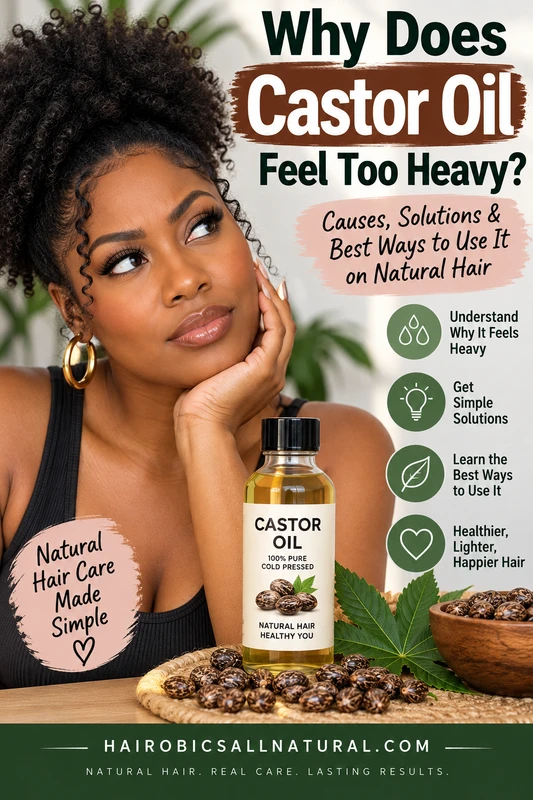
Castor oil is one of the most popular oils used in natural hair care. It is especially popular among people with curly, coily, kinky, and textured hair who want to protect their strands, seal in moisture, reduce dryness, and maintain a healthy scalp.
But there is one complaint that comes up again and again:
Why does castor oil feel so heavy on my hair?
You may apply a small amount of castor oil only to discover that your hair feels greasy, sticky, weighed down, coated, or difficult to style. Your curls may lose definition. Your roots may look flat. Your scalp might feel like it has a thick layer sitting on top of it.
If this sounds familiar, it does not necessarily mean castor oil is bad for your hair. Castor oil is naturally a very thick oil, and how it behaves depends on your hair texture, density, porosity, the amount you use, and what other products are already on your hair.
For some people, castor oil works beautifully. For others, using it straight from the bottle can simply be too much.
The key is understanding why castor oil feels heavy and how to adjust the way you use it.
In this guide, we'll explain what makes castor oil so thick, which hair types are most likely to feel weighed down by it, how much you should use, whether you should apply it to wet or dry hair, and how you can make castor oil feel lighter without completely removing it from your natural hair routine.
What Is Castor Oil?
Castor oil is a vegetable oil produced from the seeds of the castor plant, Ricinus communis. It has been used for generations in beauty and personal-care routines.
In natural hair care, castor oil is commonly used on:
- The scalp
- Hair strands
- Dry ends
- Edges
- Protective styles
- Braids
- Twists
- Locs
- Afros
One of the most noticeable characteristics of castor oil is its consistency.
Unlike lightweight oils that spread quickly across your hands and hair, castor oil is extremely thick and viscous. When you pour it into your palm, it moves much more slowly than oils such as grapeseed, jojoba, or sweet almond oil.
That thickness is one reason people love castor oil.
It can provide a substantial coating over the hair, which may help reduce moisture loss and friction. However, that same characteristic can make it feel far too heavy when too much is applied.
Why Does Castor Oil Feel Too Heavy on My Hair?
There are several possible reasons.
The most obvious is simply that castor oil is naturally heavy.
But your application method and hair characteristics can make the effect much more noticeable.
Let's examine the biggest causes.
1. Castor Oil Is Naturally Thick
You are not imagining it.
Castor oil really is considerably thicker than many oils commonly used for natural hair.
When you apply a lightweight oil, it may spread quickly across a large section of hair. Castor oil tends to remain concentrated wherever it is applied.
This means you usually need much less castor oil than you might expect.
If you normally use a tablespoon of another hair oil and suddenly use the same amount of castor oil, your hair could become extremely oily and weighed down.
With castor oil, a little can go a long way.
2. You May Be Using Too Much Castor Oil
This is one of the most common mistakes.
Someone hears about the benefits of castor oil and assumes using more will produce better results.
That isn't necessarily true.
If your hair is already moisturized and coated with conditioner, leave-in conditioner, cream, gel, or another oil, adding a generous amount of castor oil can create multiple layers of product.
Instead of feeling soft and moisturized, your hair may feel:
- Greasy
- Sticky
- Limp
- Heavy
- Waxy
- Coated
- Difficult to manipulate
Start with only a few drops.
You can always add more.
Removing excess oil is much more difficult than adding another drop.
3. Your Hair May Be Fine
Hair texture and strand thickness are not the same thing.
Someone can have tightly coiled natural hair while still having very fine individual strands.
Fine hair can become weighed down more easily because each strand has less diameter.
Imagine putting the same heavy coat over a thin piece of thread and a thick piece of rope.
The coating will have a much greater effect on the thinner material.
Similarly, fine natural hair may struggle under heavy layers of castor oil.
If your hair becomes flat immediately after applying castor oil, strand thickness could be part of the reason.
Fine-haired naturals may prefer lighter oils such as:
- Grapeseed oil
- Jojoba oil
- Sweet almond oil
- Argan oil
Another option is mixing a very small amount of castor oil with a lighter oil.
4. You Have Low-Porosity Hair
Hair porosity describes how easily your hair absorbs and retains moisture.
Low-porosity hair has tightly arranged cuticle layers that can make it more difficult for water and products to move into the strand.
As a result, products sometimes remain on the surface.
This can be particularly noticeable with thick oils.
If you have low-porosity hair and apply a generous amount of castor oil, you might notice that the oil appears to sit on your hair rather than disappear into your routine.
Your hair may look shiny but still feel dry underneath.
That is an important distinction.
Oil and moisture are not the same thing.
Water provides hydration. Oil can help reduce moisture loss by coating the hair, but adding more oil to dehydrated hair does not necessarily solve the underlying dryness.
For low-porosity hair, applying a lighter layer of product is often easier to manage.
5. You're Applying Castor Oil to Dry Hair
Castor oil does not magically turn dry hair into moisturized hair.
If your strands are already extremely dry and you coat them with thick oil, you may simply end up with dry hair covered in oil.
This can create the strange combination of hair that feels greasy and dry at the same time.
Instead, many people find castor oil easier to use after adding moisture.
For example:
- Lightly dampen your hair with water.
- Apply your preferred leave-in treatment or moisturizer.
- Apply a very small amount of oil to help seal the moisture in.
The oil becomes the finishing layer rather than the primary moisturizer.
6. You're Layering Too Many Heavy Products
Castor oil may not be the only problem.
Look at your entire routine.
Suppose you apply:
Leave-in conditioner → thick hair butter → styling cream → castor oil → gel.
That is a lot of product.
Even very thick, dense natural hair can eventually become overwhelmed.
Product layering can also make it difficult to identify which product is causing the heaviness.
Try simplifying your routine.
For example:
Water → leave-in → small amount of oil
or
Water → moisturizer → styling product
You don't necessarily need five or six products every time you style your hair.
7. You're Applying Castor Oil Too Often
Even if you only use a moderate amount each time, frequent application can eventually lead to buildup.
Imagine applying oil every day for seven days without adequately cleansing your hair.
Each new application can add another layer.
Eventually, your hair may feel increasingly coated.
This is why asking "How often should I use castor oil?" can be just as important as asking how much to use.
Some people may only need it once or twice a week.
Others may use a tiny amount between wash days specifically on their ends or particularly dry areas.
There is no universal schedule.
Pay attention to how your hair responds.
8. Your Hair Already Has Product Buildup
Sometimes castor oil gets blamed when the real problem began before the oil was applied.
If your hair already contains layers of:
- Conditioner
- Leave-in conditioner
- Styling cream
- Butter
- Gel
- Edge control
- Oil
- Pomade
adding castor oil can push your hair over the edge.
You might notice your hair suddenly becomes dull, sticky, greasy, or difficult to style.
A thorough wash may be necessary.
If your normal shampoo isn't removing accumulated products effectively, occasional clarifying may help restore a cleaner surface.
However, clarifying too frequently can leave some hair feeling dry, so adjust based on your hair and the products you use.
Is Castor Oil Too Heavy for Low-Porosity Hair?
It can be.
Low-porosity hair doesn't automatically mean you must avoid castor oil, but thick products may be easier to overapply.
People with low-porosity hair may have better results by using less castor oil and applying it strategically.
Instead of covering your entire head with castor oil, try applying a tiny amount to your ends.
You can also dilute castor oil with a lighter carrier oil.
For example, instead of using straight castor oil, combine a small portion with jojoba or grapeseed oil.
This reduces the overall thickness of the mixture and makes it easier to distribute.
Is Castor Oil Too Heavy for Fine Hair?
Castor oil can definitely feel heavy on fine hair.
Fine strands generally don't require the same amount of heavy product as coarse strands.
If your hair is fine, try using just a few drops.
Rub the oil between your palms until there is a very thin coating on your hands. Then lightly smooth your palms over the areas that need extra sealing.
You shouldn't necessarily see oil sitting on the hair.
If your hair immediately looks wet or greasy from the oil, you may have used more than necessary.
Is Castor Oil Good for Thick or Coarse Natural Hair?
People with thick, coarse, or very dense natural hair may find castor oil easier to incorporate into their routine.
Thicker strands can often tolerate richer products without immediately losing volume.
Castor oil may be particularly useful for sealing moisture into dry ends or helping lubricate strands before certain styles.
However, coarse hair can still experience buildup.
Having thick hair does not mean you need unlimited amounts of oil.
Start small and increase only when your hair actually needs it.
Does Castor Oil Moisturize Hair?
This is one of the biggest misunderstandings in natural hair care.
Oil is not the same thing as water-based moisture.
When natural hair feels dry, the instinct is often to add oil.
Your hair may temporarily look shinier, but shine doesn't necessarily mean hydration.
Water is the primary source of hydration for hair.
Oil primarily coats and lubricates the hair and can help reduce moisture loss.
Think of it this way:
Water hydrates. Oil helps seal.
That's why applying castor oil to already dry hair may not give you the softness you expected.
Try moisturizing first and sealing afterward.
Should You Put Castor Oil on Wet or Dry Hair?
Both methods can work, but they serve different purposes.
Castor Oil on Damp Hair
Applying a small amount of castor oil after moisturizing can help create a protective layer over the strand.
This is particularly useful for dry ends.
A simple routine might look like:
Water → leave-in treatment → small amount of oil
Castor Oil on Dry Hair
Applying castor oil to dry hair may provide lubrication and shine, but it will not add water to dehydrated strands.
If your hair already feels moisturized, using a tiny amount on dry hair may be fine.
If your hair feels brittle or extremely dry, adding moisture first may produce better results.
How Much Castor Oil Should You Use?
Probably less than you think.
There is no perfect measurement because the correct amount depends on:
- Hair length
- Density
- Strand thickness
- Porosity
- Hairstyle
- Current moisture level
However, start small.
For one section of hair, you may only need a couple of drops.
Rub those drops between your hands first.
This distributes the oil across your palms and prevents you from depositing a thick blob onto one area.
If your hair still feels dry after application, add another drop or two.
Build gradually.
How to Make Castor Oil Feel Lighter
If you like castor oil but dislike its thick texture, you don't necessarily have to stop using it.
Try diluting it.
Castor Oil + Jojoba Oil
Jojoba oil has a lighter texture than castor oil and spreads more easily.
Combining the two can create a thinner mixture.
Castor Oil + Grapeseed Oil
Grapeseed oil is popular among people who prefer lightweight hair oils.
This combination can work well when straight castor oil feels too sticky.
Castor Oil + Sweet Almond Oil
Sweet almond oil can also make a castor-oil blend easier to spread through natural hair.
Castor Oil + Avocado Oil
Avocado oil provides another option for creating a more fluid oil blend.
You do not need a complicated formula.
You can simply begin with substantially more lightweight oil than castor oil and adjust according to how your hair feels.
Castor Oil vs Jojoba Oil
If castor oil constantly makes your hair greasy, jojoba oil may be worth trying.
Castor oil is:
- Very thick
- Slow spreading
- Rich
- Easy to overapply
Jojoba oil is generally:
- Lighter
- Easier to distribute
- Less likely to create an immediately heavy feeling
People with fine or low-porosity hair may prefer jojoba oil for regular use while saving castor oil for specific areas such as the ends.
Castor Oil vs Grapeseed Oil
Grapeseed oil is another lightweight alternative.
If your main complaint is:
"Castor oil makes my curls flat."
Grapeseed oil may provide a lighter finishing option.
You can also combine them.
This gives you some of the richness of castor oil without using it at full strength.
Castor Oil vs Coconut Oil
These oils can feel very different on natural hair.
Castor oil is extremely thick and tends to coat the strands.
Coconut oil is lighter in consistency, although some people report that coconut oil makes their hair feel hard or stiff.
Hair responds differently to different oils.
The fact that one oil is popular doesn't guarantee that it will work well for your particular hair.
Experiment carefully and pay attention to results.
Why Does Castor Oil Make My Hair Greasy?
Greasy hair after using castor oil usually means more oil was applied than your hair needed or the oil was layered over existing buildup.
Try reducing the amount dramatically.
Instead of pouring oil directly onto your scalp or hair, place a few drops on your fingertips.
Rub your fingers together.
Then gently apply the oil.
This gives you much greater control.
Why Does Castor Oil Make My Hair Sticky?
Castor oil naturally has a thick, somewhat sticky consistency.
When too much is used, strands may stick together.
This can make detangling and styling more difficult rather than easier.
If this happens regularly, dilute your castor oil with a lighter oil or reduce the amount you apply.
Your hair should feel lubricated—not drenched.
Why Does My Hair Look Flat After Using Castor Oil?
Flat hair is another sign that your routine may be too heavy.
This is especially common with:
- Fine hair
- Low-density hair
- Loose curls
- Low-porosity hair
Heavy oil can reduce volume by coating the strands and pulling them downward.
If volume is important to you, concentrate oil primarily on your ends rather than your roots.
You can also switch to a lightweight oil.
Should You Put Castor Oil Directly on Your Scalp?
You can apply cosmetic castor oil to the scalp if it agrees with your skin, but you don't need to saturate your scalp.
Using an applicator bottle can make it easy to accidentally create thick lines of oil.
Instead, apply a small amount to your fingertips and gently distribute it across the desired areas.
Your scalp shouldn't look like it has been drenched.
If you experience persistent itching, redness, burning, sores, significant flaking, or other scalp symptoms, discontinue products that appear to aggravate the problem and consider talking with a dermatologist.
Does Castor Oil Make Hair Grow Faster?
Castor oil is frequently promoted as a hair-growth oil, but claims that it dramatically speeds up hair growth should be approached carefully.
Hair growth is influenced by numerous factors, including:
- Genetics
- Age
- Nutrition
- Hormones
- Health conditions
- Scalp health
- Hair-care practices
- Breakage
There isn't strong evidence showing that simply applying castor oil makes human hair follicles grow hair dramatically faster.
However, an oil can still be useful in a healthy hair-care routine.
Reducing friction, keeping hair lubricated, protecting fragile ends, and minimizing unnecessary breakage can help you retain more of the hair you grow.
Hair growth and length retention are related, but they are not the same thing.
Castor Oil for Hair Length Retention
This is where the conversation becomes particularly important for natural hair.
Sometimes people believe their hair isn't growing because they aren't seeing additional length.
But hair can be growing at the scalp while breaking at the ends.
Imagine your hair grows a certain amount during several months but nearly the same amount breaks from the ends.
Your visible length barely changes.
Protecting your ends can therefore play an important role in reaching longer hair goals.
A small amount of oil can help lubricate the ends and reduce friction, particularly when combined with gentle handling and proper moisturizing.
How to Use Castor Oil Without Weighing Down Natural Hair
Try this simple approach.
Step 1: Start With Clean Hair
Buildup makes heavy oils even more noticeable.
Cleanse your hair according to the schedule that works for you.
Step 2: Add Water-Based Moisture
Apply water or a water-based leave-in treatment.
Focus particularly on areas that become dry quickly.
Step 3: Divide Your Hair Into Sections
Sections make product distribution easier.
Instead of applying a large amount to the entire head, you can control exactly how much each section receives.
Step 4: Use Only a Few Drops
Place a tiny amount of castor oil in your hand.
Rub your palms together thoroughly.
Step 5: Concentrate on Your Ends
Your ends are the oldest part of your hair and often experience the most wear.
If castor oil is too heavy for your entire head, reserve it for your ends.
Step 6: Style Normally
Complete your twist-out, braid-out, wash-and-go, Afro, or protective style.
Step 7: Evaluate the Results
The next day, ask yourself:
Does my hair feel soft?
Does it feel greasy?
Are my curls flat?
Does my hair feel coated?
Did I actually need more oil?
Your hair's response should determine what you do next.
Castor Oil for Protective Styles
Castor oil is frequently used while wearing:
- Box braids
- Knotless braids
- Cornrows
- Feed-in braids
- Twists
- Crochet styles
But protective styles make overapplication especially easy.
If you repeatedly pour thick oil between your braids, buildup can accumulate around your scalp and roots.
A better approach is to use small amounts and focus on what your scalp and natural hair actually need.
Remember that more oil does not automatically equal healthier hair.
Castor Oil for Locs
People with locs should also be careful with heavy products.
Thick products can become difficult to remove if too much accumulates inside or around the loc.
If you use castor oil on locs, use it sparingly.
You can also mix a small amount with a lighter oil if straight castor oil leaves your locs feeling coated.
Healthy loc care generally benefits from keeping the routine simple and avoiding unnecessary product accumulation.
Castor Oil for Edges
Castor oil is commonly applied around the hairline.
Again, a tiny amount is usually enough.
Avoid aggressively rubbing or brushing fragile edges after applying oil.
Hairline thinning can have many causes, including repeated tension from tight hairstyles.
Oil cannot correct every cause of thinning edges.
If you notice significant or worsening hair loss around your hairline, consider seeing a dermatologist to identify the underlying cause.
Signs You're Using Too Much Castor Oil
Your hair will usually tell you.
Possible signs include:
- Hair feels greasy immediately after styling
- Curls lose their bounce
- Hair looks flat
- Roots appear oily
- Strands stick together
- Hair feels coated
- Your hands become oily every time you touch your hair
- Products seem to sit on top of your strands
- Hair attracts lint easily
- You feel the need to shampoo more frequently
If several of these happen regularly, reduce your amount.
You may be surprised by how little oil your hair actually needs.
How to Remove Too Much Castor Oil From Hair
We've all done it.
You pour too much oil into your hand, apply it, and suddenly your hair looks like it has been dipped in oil.
Don't keep adding products in an attempt to fix it.
If the buildup is mild, you may be able to distribute the excess oil across additional sections of hair.
If your hair is heavily coated, washing may be the simplest solution.
Use your regular shampoo and rinse thoroughly.
If substantial product buildup remains despite normal cleansing, you may need an appropriate clarifying shampoo.
After cleansing, condition your hair and return to a simpler routine.
Can Castor Oil Cause Buildup?
Yes, particularly when it is applied frequently and not adequately cleansed away.
Buildup isn't unique to castor oil.
Many products can accumulate when repeatedly layered onto the hair.
The thicker the product, however, the more noticeable that buildup may become.
This is why a healthy routine should include both adding products and periodically removing them.
Your hair needs a clean foundation.
How Often Should You Use Castor Oil?
There is no single schedule that works for everyone.
You might use castor oil:
- Once a week
- A couple of times between wash days
- Only after washing
- Only on your ends
- Only during protective styles
What matters most is whether your hair actually needs another application.
Before reaching for the bottle, touch your hair.
If it already feels soft, lubricated, and moisturized, you may not need more oil.
Best Hair Types for Castor Oil
Castor oil may be particularly appealing for people with:
Thick hair: Thicker strands may tolerate rich oils better.
Coarse hair: Coarse strands may benefit from richer sealing products.
High-density hair: Large amounts of hair can sometimes distribute heavier products more effectively.
Very dry ends: Small amounts of castor oil can be used as a finishing sealant.
But none of these are absolute rules.
Your individual results matter more than your hair category.
Who Might Prefer a Lighter Oil?
You may prefer a lighter alternative if you have:
- Fine strands
- Low-density hair
- Low-porosity hair
- Loose curls that lose volume easily
- Hair that becomes greasy quickly
Possible lightweight options include:
Jojoba oil – lightweight and easy to distribute.
Grapeseed oil – useful for people who dislike heavy coatings.
Argan oil – commonly used as a lightweight finishing oil.
Sweet almond oil – another versatile option for natural hair.
You can also blend one of these oils with a small amount of castor oil.
The Best Way to Use Castor Oil for Dry Natural Hair
If your natural hair is chronically dry, resist the temptation to continually add more oil.
Instead, focus on the complete routine.
Cleanse
Remove sweat, dirt, and product buildup when needed.
Condition
Use conditioner to improve softness and manageability.
Hydrate
Water and water-based products provide hydration.
Seal
Use a modest amount of oil to help reduce moisture loss.
Protect
Limit excessive manipulation, harsh detangling, and unnecessary friction.
Maintain
Refresh moisture when your hair actually needs it rather than automatically applying oil every day.
This approach addresses dryness more comprehensively than simply coating the hair with increasingly heavy layers of oil.
What If Every Oil Feels Heavy on Your Hair?
If castor oil isn't the only oil that makes your hair feel weighed down, your hair may simply need very little oil.
That's perfectly fine.
Natural hair does not have to be covered in oil to be healthy.
Some people do better with lightweight leave-in products and almost no additional oil.
Others love rich oils and butters.
The goal isn't to follow somebody else's routine.
The goal is to find the smallest combination of products that keeps your hair manageable, moisturized, and protected.
Frequently Asked Questions About Castor Oil Feeling Heavy
Why does castor oil sit on top of my hair?
Your hair may have low porosity, existing product buildup, or simply more oil than it can comfortably accommodate. Reduce the amount and apply it after moisturizing rather than pouring a large amount directly onto dry hair.
Can I dilute castor oil?
Yes. Mixing castor oil with a lighter cosmetic hair oil such as jojoba, grapeseed, sweet almond, or avocado oil can make it easier to distribute.
Is castor oil too heavy for 4C hair?
Not necessarily.
Curl pattern alone doesn't determine how much oil your hair can tolerate. Strand thickness, density, porosity, product layering, and individual preference are also important.
Someone with fine 4C hair may find straight castor oil extremely heavy, while someone with coarse, dense 4C hair may enjoy it.
Can castor oil dry out your hair?
Oil itself does not provide the same hydration as water. If you continually apply oil without adequately hydrating your hair, your strands may still feel dry underneath the coating.
Why is my hair greasy but still dry?
This often happens when oil is applied to dehydrated hair. The surface becomes oily while the strands still lack adequate moisture.
Try adding water or a water-based moisturizing product before applying a small amount of oil.
Should I use castor oil every day?
Daily use isn't necessary for everyone.
If your hair already feels coated or greasy, applying more every day will probably make the problem worse.
Apply based on your hair's needs rather than automatically following a daily schedule.
Is castor oil better for the scalp or hair?
It can be used in small amounts on either, assuming your scalp tolerates it. However, you don't need to saturate your scalp or hair to incorporate castor oil into your routine.
Can I mix castor oil with leave-in conditioner?
You can layer a small amount of oil over a compatible leave-in conditioner. Mixing products together in the bottle is generally unnecessary unless the manufacturer recommends it.
Apply the leave-in first, then lightly seal with oil.
Final Thoughts: Why Does Castor Oil Feel Too Heavy?
If castor oil feels too heavy on your natural hair, there is probably a simple explanation.
Castor oil is naturally one of the thicker oils commonly used in hair-care routines. When it is applied too generously—or layered over multiple other products—it can leave the hair feeling greasy, sticky, flat, or coated.
Fine hair and low-porosity hair may notice this effect particularly quickly, but any hair type can become weighed down by too much product.
The solution may not be eliminating castor oil completely.
Try using less.
Apply it primarily to your ends.
Use it after adding water-based moisture.
Mix a small amount with a lighter oil.
And most importantly, pay attention to how your own hair responds.
Natural hair care doesn't require the heaviest product or the most complicated routine. A successful routine is one that gives your hair the moisture, lubrication, cleansing, and protection it needs without unnecessary buildup.
If straight castor oil consistently leaves your hair feeling heavy, consider switching to a lighter oil or choosing a balanced hair-care product formulated to provide conditioning and softness without requiring you to saturate your strands.
For more natural hair-care tips, moisturizing routines, scalp-care guides, and products created for textured hair, visit Hairobics All Natural at www.hairobicsallnatural.com.