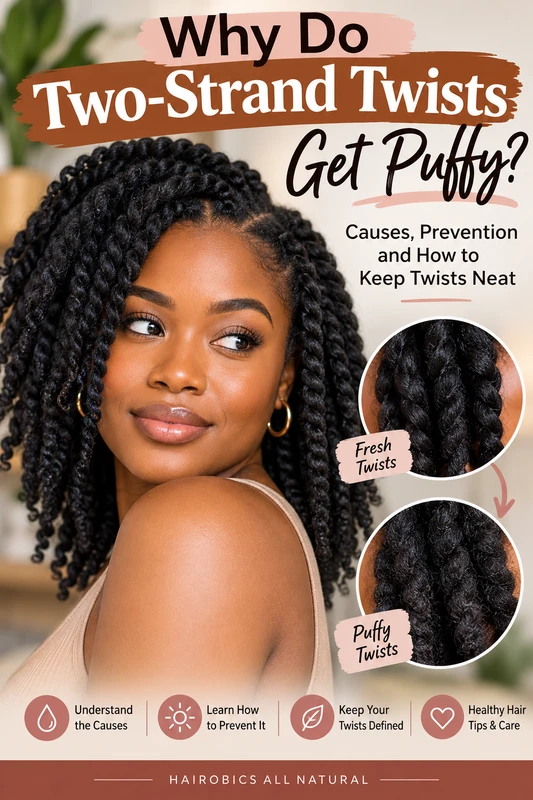
Two-strand twists are one of the most popular protective hairstyles for natural hair. They're versatile, relatively easy to maintain, and work beautifully on different hair textures, lengths, and densities. Whether you're wearing mini twists, medium twists, chunky twists, or two-strand twists over starter locs, this hairstyle can help reduce daily manipulation while giving your natural hair a stylish appearance.
However, one common frustration is discovering that your freshly installed twists start looking puffy, fuzzy, or swollen after only a few days.
You might notice your twists expanding, becoming frizzy around the roots, losing their definition, or looking noticeably bigger than when you first styled them. Sometimes this happens overnight. Other times, your twists gradually become puffy after washing, moisturizing, exercising, or spending time in humid weather.
So, why do two-strand twists get puffy, and how can you prevent them from losing their neat appearance?
The answer usually involves a combination of your hair's natural texture, moisture levels, styling technique, humidity, and daily maintenance habits.
In this comprehensive guide from Hairobics All Natural, we'll explain what causes puffy two-strand twists, how to keep them defined longer, and what you can do when your twists start expanding.
What Does It Mean When Two-Strand Twists Get Puffy?
Puffy two-strand twists occur when the hair strands within each twist begin expanding, separating, or losing their original smooth arrangement.
When you first install two-strand twists, the hair is typically stretched, detangled, moisturized, and twisted into organized sections. This creates a relatively uniform appearance.
As time passes, however, the individual strands naturally respond to moisture, friction, movement, and changes in the environment.
You may notice several changes:
-
Twists become thicker or wider than they were initially.
-
Hair begins sticking out along the length of the twists.
-
Roots appear fluffy instead of neatly separated.
-
Twists lose their original definition.
-
Individual twists shrink and become shorter.
-
The hairstyle develops a soft, fuzzy appearance.
Although these changes can be frustrating, puffiness does not automatically mean your twists are damaged or improperly installed.
For many people with tightly coiled natural hair, puffiness is simply a normal part of how their hair behaves.
Understanding the underlying cause makes it easier to decide whether your twists need additional moisture, better styling techniques, or a different maintenance routine.
1. Your Natural Hair Texture Causes Twists to Expand
One of the biggest reasons two-strand twists become puffy is the natural structure of textured hair.
Type 3 and Type 4 hair often contain curls, coils, and bends that naturally resist remaining stretched.
When you twist these strands together, you're temporarily organizing them into a more controlled pattern. However, the hair still retains its natural tendency to curl and contract.
Over time, the strands begin returning toward their original shape.
Why tightly coiled hair becomes puffy
Type 4 hair, particularly 4B and 4C textures, may experience noticeable expansion because the individual strands have tight bends and coils.
As the hair contracts, it can create additional volume throughout the twist.
This is especially noticeable when twists are installed on stretched hair.
For example, if you blow-dry your hair before twisting, your twists may initially look longer and smoother. Once your hair absorbs moisture from the atmosphere, it may begin shrinking.
The result is shorter, thicker, puffier twists.
This is not necessarily a sign that your hairstyle is failing.
In fact, it often demonstrates your hair's natural elasticity and curl pattern.
How to manage texture-related puffiness
Choose styling techniques that work with your natural curl pattern rather than trying to eliminate every sign of texture.
Use a moisturizing leave-in conditioner, apply an appropriate styling product, and maintain consistent tension while twisting without pulling excessively.
Remember that a little puffiness is normal, particularly for tightly coiled hair.
2. Humidity Makes Two-Strand Twists Puffy
Humidity is another major reason two-strand twists lose definition.
Natural hair can absorb water vapor from the surrounding environment. When humidity increases, hair fibers take up moisture and their hydrogen-bond arrangements change.
This can cause stretched hair to contract and previously smooth sections to become less defined.
If you've ever stepped outside with freshly installed twists and noticed them becoming puffy a few hours later, humidity may be responsible.
Signs humidity is affecting your twists
Your twists may look neat indoors but become noticeably larger outside.
You might also experience increased frizz around the roots, additional shrinkage, and loose hairs sticking out along each twist.
Humid conditions can be especially challenging when your hair has been blow-dried or stretched before styling.
How to protect twists from humidity
Apply a lightweight styling product designed to provide hold and frizz control.
Avoid overloading your twists with heavy creams or oils, which may create buildup without preventing humidity-related changes.
A satin-lined hat or scarf can reduce friction while you're traveling, although it won't completely block atmospheric moisture.
Most importantly, allow your twists to dry thoroughly after installation.
Twists that are still damp may change shape as they dry, particularly in humid conditions.
3. Your Twists Were Installed on Hair That Was Too Wet
Installing two-strand twists on wet hair can produce beautiful curl definition, but it may also contribute to puffiness if the twists aren't allowed to dry completely.
Wet hair is more flexible and can be shaped into twists easily.
However, as the hair dries, it shrinks toward its natural curl pattern.
This can make twists appear thicker, shorter, and more textured.
Wet twists versus dry twists

Twisting wet hair
Often produces strong curl definition and more shrinkage. The twists may look fuller after drying.

Twisting stretched or mostly dry hair
Often produces longer-looking twists with less initial shrinkage, although humidity can still cause expansion.
Neither method is automatically better.
The ideal choice depends on whether you prefer defined, compact twists or a more elongated hairstyle.
How to reduce puffiness from wet styling
If you're twisting damp hair, use a moderate amount of styling product and allow the hairstyle to dry completely before manipulating it.
Avoid immediately separating, stretching, or repeatedly touching your twists.
If you prefer a longer, smoother appearance, consider gently stretching your hair before installation using low-tension methods.
Always use heat protection if you choose to blow-dry your hair.
4. You Didn't Use Enough Styling Hold
Moisturizing your hair and defining your twists are related but different styling goals.
A moisturizing product helps improve softness and manageability, while a styling product provides the hold needed to maintain the shape of your twists.
If you only apply a lightweight moisturizer, your twists may initially look neat but begin expanding as the strands move apart.
This is especially common with larger twists or highly textured hair.
Products that help maintain twist definition
A good two-strand twist routine may include a water-based leave-in conditioner followed by a styling cream, mousse, or gel.
The right combination depends on your hair's texture, density, porosity, and preferred finish.
For fine hair, lightweight mousse may provide enough hold without weighing down the strands.
For coarse or densely textured hair, a twist cream or moderate-hold gel may offer longer-lasting definition.
Avoid excessive product layering
More product doesn't necessarily produce better results.
Applying several thick creams, butters, and oils can leave your hair feeling coated.
Excessive product accumulation may also make twists appear dull or attract lint.
Start with a small amount of product and distribute it evenly throughout each section.
If your twists repeatedly feel sticky or coated, review your product routine before adding anything else.
5. Your Two-Strand Twists Are Too Loose
The technique used to install your twists directly influences how long they maintain their shape.
If the two strands are loosely wrapped around each other, the hair may separate more easily.
This creates additional space between strands and allows the twists to expand.
Loose twisting can be particularly noticeable near the roots, where new growth and natural movement make the hairstyle look fluffier.
How to twist natural hair correctly
Start with clean, detangled, properly moisturized hair.
Divide each section into two relatively equal strands.
Wrap the strands around one another with consistent, gentle tension, working from the roots toward the ends.
Avoid switching the direction of your twisting motion halfway through.
When you reach the ends, use your fingers to coil them if your curl pattern allows.
The goal is a secure, uniform twist—not an excessively tight hairstyle.
Important: Tight twisting can cause discomfort, breakage, and traction-related hair loss. Never sacrifice scalp comfort to achieve a neater appearance.
6. Your Twists Are Too Large
The size of your twists can influence how quickly they become puffy.
Chunky two-strand twists contain more hair per section, which naturally creates additional volume.
As the individual strands expand, the entire twist can become noticeably thicker.
Smaller twists often have a more compact appearance and may maintain their definition longer.
However, mini twists aren't immune to frizz or puffiness.
Mini twists versus chunky twists
|
Twist size |
Typical appearance |
Maintenance considerations |
|---|---|---|
|
Mini twists |
Small, detailed, often more defined |
Longer installation time |
|
Medium twists |
Balanced volume and definition |
Versatile for everyday styling |
|
Chunky twists |
Fuller, larger sections |
Puffiness can be more noticeable |
If your twists consistently become much larger than you prefer, experiment with smaller sections.
You don't necessarily need extremely tiny twists.
Sometimes switching from chunky twists to medium-sized twists is enough to create a more controlled appearance.
7. Your Hair Is Dry and Needs Moisture
Dry hair can contribute to frizz, roughness, and poor twist definition.
When hair lacks sufficient conditioning, the strands may feel less flexible and become more difficult to keep organized.
Dryness can also increase tangling and friction between neighboring hairs.
However, it's important to distinguish between hair that needs conditioning and twists that naturally expand because of humidity or shrinkage.
Adding water repeatedly won't solve every type of puffiness.
Signs your twists may be dry
Your hair may feel rough, brittle, stiff, or difficult to manipulate.
You may also notice more tangling at the ends or breakage when handling your twists.
How to moisturize puffy twists
Use a lightweight, water-based moisturizer or leave-in conditioner when your hair needs it.
Apply the product sparingly and distribute it along the length of your twists.
Focus on maintaining flexibility rather than saturating the hairstyle.
If your hair benefits from an oil, a small amount may help lubricate the strands and reduce friction.
Remember that oil alone does not replace a water-based moisturizing routine.
For additional guidance, explore the difference between moisturizing and sealing natural hair.
8. Sleeping Without Protection Creates Frizz
Nighttime friction is one of the most common reasons two-strand twists become fuzzy.
When you sleep directly on cotton pillowcases, your twists repeatedly rub against the fabric.
This movement can loosen individual hairs and disturb the surface of the twists.
After several nights, the hairstyle may look noticeably puffier.
How to protect twists overnight
Wear a satin or silk bonnet that comfortably accommodates the length of your twists.
Alternatively, use a satin scarf or pillowcase.
For longer twists, loosely gather the hair before putting on your bonnet.
Avoid tight nighttime hairstyles that pull against your scalp or edges.
A simple nighttime routine can help reduce unnecessary friction and preserve your twist definition.
9. Washing Your Twists Causes Them to Swell
If your two-strand twists become puffy immediately after washing, you're not alone.
Water causes hair fibers to swell temporarily. Washing also allows strands to contract toward their natural curl pattern.
As a result, your twists may look fuller and shorter after cleansing.
Shampooing can also loosen the arrangement of hairs within each twist, particularly if you scrub the lengths aggressively.
How to wash twists without excessive frizz
Dilute shampoo only when appropriate for the product's directions and your cleansing needs.
Apply shampoo primarily to your scalp, gently massaging with your fingertips.
Allow the lather to move through your twists as you rinse.
Avoid rubbing the twists together or aggressively scrubbing the lengths.
After washing, gently squeeze out excess water using a microfiber towel or soft T-shirt.
Make sure your twists and scalp dry thoroughly.
If you're wearing two-strand twists as part of your loc journey, proper drying is especially important because prolonged dampness can create an environment that encourages unwanted odor and microbial growth.
10. Frequent Touching Makes Twists Lose Definition
Touching your twists throughout the day may seem harmless, but repeated manipulation can gradually disturb their structure.
Running your fingers through your hair, pulling twists apart, or constantly rearranging your hairstyle increases friction.
This can cause individual strands to escape from the twist pattern.
The result is a softer, fuzzier appearance.
How to reduce manipulation
Style your twists in the morning and avoid repeatedly adjusting them throughout the day.
When refreshing your hairstyle, focus on the areas that genuinely need attention.
You don't need to retwist every section whenever you notice a little frizz.
Sometimes the best maintenance technique is simply leaving your hair alone.
11. New Growth Makes the Roots Look Puffy
If your twists have been installed for several weeks, puffiness around the roots may be a sign of normal hair growth.
As new hair emerges from your scalp, it hasn't yet been incorporated into the existing twists.
This can create a fluffy appearance around the base of each section.
The longer you wear your twists, the more noticeable this effect may become.
Should you retwist puffy roots?
You can gently refresh selected twists when needed.
However, frequent root retwisting isn't always necessary.
Excessive twisting and tension around the same sections can contribute to breakage.
If your roots are simply growing out, consider embracing the softer appearance until your next planned maintenance session.
Healthy hair and scalp comfort should always come before perfectly defined roots.
12. Your Hair Has Different Textures Throughout Your Head
Many people have multiple curl patterns on the same head of hair.
For example, the crown may contain tightly coiled strands, while the back has looser curls.
These differences can affect how your twists behave.
Some sections may remain compact for days, while others expand shortly after installation.
How to manage mixed hair textures
Adjust your styling technique to the needs of each section.
Looser textures may benefit from additional styling hold or smaller twists.
Tighter textures may need careful detangling and consistent moisture management.
You may also need to vary the amount of product used across different areas.
Instead of forcing every section to behave identically, focus on achieving a balanced overall appearance.
13. How to Fix Puffy Two-Strand Twists Without Starting Over
If your twists are already puffy, you don't necessarily need to take down your entire hairstyle.
A targeted refresh can improve definition while minimizing unnecessary manipulation.
Step 1: Identify the problem areas
Examine your twists to determine whether the puffiness is concentrated at the roots, ends, or throughout the entire hairstyle.
If only a few twists have become loose, focus on those sections.
Step 2: Apply a small amount of moisture
If your hair feels dry, lightly mist the affected sections with a water-based moisturizer.
Avoid soaking the entire hairstyle, especially if moisture tends to cause significant shrinkage.
Step 3: Add styling hold
Apply a small amount of mousse, twisting cream, or lightweight gel to the puffy sections.
Smooth the product gently along each twist.
Avoid repeatedly layering new products over old buildup.
Step 4: Retwist loose sections
Carefully unravel only the twists that need refreshing.
Separate the strands gently, remove any tangles, and twist them again using consistent tension.
Avoid pulling tightly at the roots.
Step 5: Allow the twists to set
Let your refreshed twists dry completely.
If you use a dryer, choose an appropriate low-heat setting and follow the styling product's instructions.
Avoid touching the twists until they're dry.
This approach can restore a neater appearance without requiring a complete hairstyle reinstall.
14. How to Keep Two-Strand Twists From Getting Puffy Overnight
Preventing overnight puffiness requires more than simply putting on a bonnet.
Your nighttime routine should reduce friction, preserve the twist pattern, and avoid excessive tension.
For short twists, a comfortable satin bonnet may be enough.
For shoulder-length or longer twists, loosely gathering the hair into sections can help prevent unnecessary tangling.
If your twists are particularly thick, choose a bonnet with enough room to accommodate them without crushing the hairstyle.
Make sure your hair is dry before covering it for the night.
Repeatedly sleeping with damp twists can prolong drying and leave your hairstyle less defined.
In the morning, gently separate twists that have become flattened instead of pulling them aggressively.
If necessary, smooth a tiny amount of styling product over frizzy sections.
15. Do Puffy Two-Strand Twists Mean Your Hair Is Growing?
Not necessarily.
Puffiness and hair growth are different processes.
When twists become fluffy near the roots after several weeks, new hair growth may contribute to the appearance.
However, twists can also become puffy within hours because of humidity, shrinkage, or loose styling.
Therefore, puffiness alone isn't a reliable way to measure hair growth.
If you want to track your progress, compare photographs taken under similar conditions or periodically measure selected stretched sections.
Focus on length retention, reduced breakage, and scalp comfort rather than assuming that every change in twist size represents new growth.
16. Are Puffy Two-Strand Twists Bad for Your Hair?
In most cases, no.
Puffiness is primarily a cosmetic change rather than evidence of damage.
Natural hair expands and contracts in response to environmental conditions, moisture, and styling.
A soft, fluffy twist can still contain healthy hair.
However, you should pay attention to accompanying symptoms.
Excessive tangling, significant breakage, scalp discomfort, or painful tension may indicate a problem that needs attention.
If your twists begin matting together and you don't intend to start locs, consider removing and reinstalling the hairstyle before detangling becomes difficult.
For those intentionally starting locs with two-strand twists, some swelling, budding, and frizz can be expected as the hair begins locking.
You can learn more about this process in our guide to different types of locs and their maintenance needs.
17. How Long Should Two-Strand Twists Stay Neat?
The amount of time your twists remain defined depends on your hair texture, installation method, lifestyle, and maintenance habits.
Some people notice puffiness within the first few days, while others maintain a relatively smooth appearance for one or two weeks or longer.
Smaller twists may remain organized longer, although individual results vary.
If you exercise frequently, swim, or live in a humid environment, your twists may become frizzy sooner.
Rather than focusing on keeping every twist perfectly smooth, evaluate whether the hairstyle remains comfortable, clean, and easy to maintain.
Loose two-strand twists are often worn for approximately one to three weeks, depending on the individual's hair and care routine. This isn't a fixed rule, and washing or earlier removal may be necessary.
If your twists are tangling, collecting buildup, or causing discomfort, don't keep them installed simply to reach a particular number of weeks.
18. Best Hair Care Routine for Two-Strand Twists
A consistent routine can help you preserve definition while maintaining healthy-feeling hair.
Simple weekly twist maintenance schedule
|
Wash and style day |
Cleanse, condition, detangle, moisturize, twist, and dry completely. |
|
Days 2–3 |
Protect at night and avoid unnecessary manipulation. |
|
Days 4–5 |
Check moisture levels; lightly refresh dry sections if needed. |
|
Days 6–7 |
Assess scalp cleanliness, buildup, and loose twists. Refresh or wash as appropriate. |
The goal is to maintain clean, manageable twists without constantly adding products.
If your hair feels soft and comfortable, you may not need to moisturize again immediately.
If your scalp becomes itchy, flaky, or coated, prioritize appropriate cleansing rather than applying more oil.
19. How Hairobics All Natural Can Help Maintain Your Twists
Maintaining two-strand twists begins with choosing products that complement your hair's moisture needs without leaving excessive residue.
At Hairobics All Natural, we understand the importance of caring for natural hair, braids, twists, and locs with a consistent routine.

Raaw Roots Moisturizer Spray
If your twists feel dry between wash days, the Raaw Roots Moisturizer Spray can be incorporated into your moisture routine. Apply lightly as needed, avoiding oversaturation when you're trying to preserve definition.
Remember that moisturizing sprays support hair hydration but aren't necessarily substitutes for styling products designed to provide hold.
If your twists are expanding because of humidity or loose installation, you may still need a styling mousse or twisting product.
For additional tips on choosing oils that complement protective hairstyles, read our article on the best oils for braids and twists.
20. Common Mistakes That Make Two-Strand Twists Puffy Faster
Even a well-installed hairstyle can lose definition when certain habits are repeated.
One mistake is applying too much water every day. Although water is important for hair hydration, repeatedly saturating twists can encourage shrinkage and disrupt their shape.
Another is using excessive amounts of styling cream. Too much product can create buildup, making the hair feel coated without providing additional hold.
Sleeping without protection can also increase friction and cause hairs to escape from the twist pattern.
Installing twists without thoroughly detangling the hair may contribute to uneven sections, tangling, and poor definition.
Finally, constantly retwisting the roots can create unnecessary tension.
If you want your twists to last longer, focus on gentle handling, balanced moisture, and a consistent nighttime routine.
You can also review our step-by-step guide to detangling natural hair without breakage before your next installation.
Frequently Asked Questions About Puffy Two-Strand Twists
Why do my two-strand twists get puffy after one day?
Twists can become puffy after one day because of humidity, shrinkage, loose installation, or insufficient styling hold. This is particularly common when twisting stretched natural hair that begins returning to its original curl pattern.
Why do my twists get puffy after washing?
Water temporarily swells the hair fiber and allows curls to contract. Washing can also loosen individual strands, making the twists appear thicker and less defined.
How do I stop my 4C twists from puffing up?
Use a styling product with suitable hold, twist with consistent gentle tension, let the hairstyle dry completely, and protect it overnight. Some puffiness is natural for tightly coiled hair.
For more advice on moisture and maintenance, explore our complete 4C hair care routine for beginners.
Should I retwist my hair when it gets puffy?
You can refresh selected twists, but you don't need to retwist your entire hairstyle whenever frizz appears. Excessive retwisting may cause unnecessary tension and breakage.
Does mousse help puffy two-strand twists?
Yes, an appropriate styling mousse can help smooth flyaways and improve definition. Apply a modest amount and allow it to dry completely. Results depend on your hair and the product's level of hold.
Is it better to twist natural hair wet or dry?
Wet twisting often creates stronger curl definition with more shrinkage. Twisting stretched or mostly dry hair can produce a longer appearance with less initial shrinkage. Neither technique is universally better.
Can two-strand twists turn into locs?
Yes. Two-strand twists are commonly used as a starter-loc method. Over time, the hair may begin matting and locking together. Puffiness and frizz can be normal parts of that process.
Why are my twist roots puffy but the ends are neat?
Puffy roots may result from new growth, natural texture, loose installation, or moisture exposure. If the ends remain defined, you may only need to refresh the root area gently.
Does oil stop two-strand twists from getting puffy?
Oil may help reduce friction and improve the appearance of dry strands, but it doesn't provide the same styling hold as mousse or gel. It also cannot completely prevent humidity-related shrinkage.
Can I keep two-strand twists in for a month?
Some people wear twists for a month, but loose natural-hair twists may begin tangling or matting, especially near the roots. Consider your hair texture, cleansing needs, and whether you intend to form locs before extending the wear time.
Final Thoughts: Embrace Your Natural Texture While Keeping Twists Defined
Two-strand twists get puffy for several reasons, including humidity, shrinkage, moisture exposure, loose styling, product choices, and nighttime friction.
Although you can reduce excessive puffiness with better styling techniques and maintenance, some expansion is a completely normal characteristic of natural hair.
The key is finding the right balance between moisture, definition, and gentle handling.
Start with clean, detangled hair, use appropriate styling products, avoid excessive tension, and protect your twists while sleeping.
Most importantly, remember that healthy natural hair doesn't have to look perfectly smooth to be beautiful.
Whether you prefer neat mini twists, fuller chunky twists, or soft, fluffy two-strand twists, a consistent care routine can help you enjoy your hairstyle while minimizing unnecessary breakage.
For more natural hair maintenance tips and protective-style care, explore Hairobics All Natural.
Additional Tips for Keeping Twists Soft Without Losing Definition
If your two-strand twists frequently become puffy after moisturizing, the solution isn't necessarily to stop moisturizing. Instead, adjust how much product you apply and how often you refresh your hairstyle.
For a more detailed approach, read our guide on how to keep natural hair moisturized. It explains how moisture retention, hair porosity, and protective styling work together.
Also, if you've been applying oil to your twists every day but your hair still feels dry, our article on why oil doesn't moisturize dry hair can help you understand the difference between hydration and sealing.