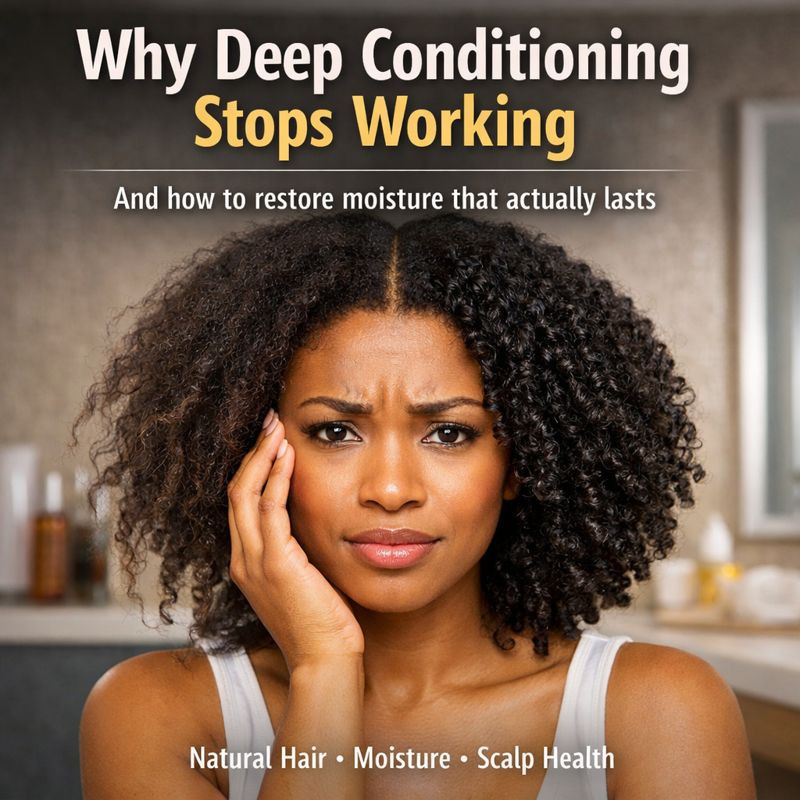
If you’ve ever said, “I deep condition every week, but my hair still feels dry,” you’re not alone — and you’re not doing anything wrong.
Deep conditioning does stop working for many people over time. Not because deep conditioners are bad, but because your hair, scalp, and routine change, while your products often stay the same.
In this guide, we’ll break down:
-
Why deep conditioning suddenly feels useless
-
The science behind conditioner fatigue
-
How scalp health secretly controls moisture
-
The biggest mistakes that block results
-
Exactly how to reset your hair so deep conditioning works again
Let’s get into it.
What Deep Conditioning Is Supposed to Do
A deep conditioner is designed to:
-
Replenish moisture inside the hair shaft
-
Improve elasticity
-
Smooth the cuticle
-
Reduce breakage
-
Restore softness after washing
When it works properly, your hair should feel:
-
Softer after it dries (not just when wet)
-
More flexible
-
Easier to detangle
-
Less prone to snapping
So if your hair feels dry, stiff, or brittle 24–48 hours later, something is blocking the process.
The #1 Reason Deep Conditioning Stops Working: Moisture Can’t Get In
Here’s the truth most people miss:
Deep conditioners don’t hydrate hair — they help hair hold hydration.
If moisture can’t enter the hair shaft in the first place, no deep conditioner will fix that.
Common barriers that block moisture:
-
Product buildup
-
Hard water minerals
-
Protein overload
-
Closed or damaged cuticles
-
Inflamed or clogged scalp
Once the hair shaft is blocked, conditioners sit on top instead of penetrating.
That’s when you notice:
-
Product just “coating” the hair
-
Hair feeling soft while wet but dry when dry
-
No long-term improvement
Product Buildup: The Silent Deep Conditioning Killer
One of the biggest reasons deep conditioning stops working is invisible buildup.
Buildup doesn’t always look dirty
Your hair can look clean but still be coated with:
-
Oils
-
Butters
-
Silicones
-
Heavy creams
-
Mineral residue from water
This creates a water-resistant layer around the strand.
When that happens:
-
Water slides off instead of soaking in
-
Conditioners can’t penetrate
-
Hair feels dry no matter what you use
Signs buildup is blocking moisture:
-
Hair takes forever to get wet
-
Water beads up on strands
-
Deep conditioner sits on top
-
Hair feels stiff or waxy
Fix:
Use a clarifying or chelating shampoo every 3–4 weeks to reset your hair.
Protein Overload: When “Strengthening” Backfires
Protein is essential — until it’s not.
Many deep conditioners contain:
-
Hydrolyzed keratin
-
Silk protein
-
Wheat protein
-
Rice protein
Too much protein makes hair:
-
Hard
-
Brittle
-
Straw-like
-
Prone to snapping
Why protein overload stops deep conditioning
Protein fills gaps in the hair shaft. But once those gaps are full, extra protein stiffens the strand, making it resistant to moisture.
Your deep conditioner might actually be making dryness worse.
Signs of protein overload:
-
Hair feels hard even when wet
-
Hair snaps instead of stretching
-
Deep conditioning gives no softness
-
Hair feels worse after treatments
Fix:
Take a 2–4 week break from protein and switch to moisture-only conditioners.
Your Scalp Is Blocking Moisture (Yes, Really)
Most people deep condition their hair and ignore their scalp — but that’s a huge mistake.
A clogged or inflamed scalp:
-
Disrupts sebum distribution
-
Alters moisture balance
-
Prevents healthy hair formation
When scalp health is off:
-
Hair grows in dry
-
Hair won’t retain moisture
-
Deep conditioning becomes temporary
Common scalp issues that sabotage moisture:
-
Excess oil + dryness at the same time
-
Product buildup on the scalp
-
Poor circulation
-
Infrequent cleansing
Deep conditioning the hair without fixing the scalp is like watering leaves with dead roots.
Heat Damage & Cuticle Damage Change How Hair Absorbs Conditioner
Hair absorbs moisture through the cuticle layer.
When cuticles are:
-
Lifted
-
Cracked
-
Permanently damaged
Moisture escapes faster than it enters.
Heat-damaged hair:
-
Feels soft initially
-
Dries out quickly
-
Requires constant re-conditioning
Deep conditioning stops working because the hair can’t retain moisture anymore.
Fix:
-
Reduce heat frequency
-
Trim damaged ends
-
Focus on sealing moisture after conditioning
You’re Using the Wrong Deep Conditioner for Your Hair’s Current State
Your hair doesn’t need the same thing year-round.
Hair needs change based on:
-
Season
-
Styling habits
-
Age
-
Hormones
-
Water quality
-
Stress levels
If you’re still using the same deep conditioner you used two years ago, it may no longer match your hair’s needs.
Example:
-
Dry winter air → needs humectants + sealants
-
Summer humidity → needs lightweight hydration
-
Protective styles → needs elasticity + slip
When your conditioner doesn’t match your hair’s environment, results stall.
Over-Conditioning Is a Real Thing
More is not always better.
Deep conditioning:
-
Too often
-
Too long
-
Without cleansing properly
can actually weaken hair.
Over-conditioned hair:
-
Feels mushy
-
Loses structure
-
Breaks easily when stretched
This makes people think they need more conditioner — when they actually need balance.
Fix:
Deep condition once a week (or every 7–10 days) unless your hair is severely damaged.
Why Your Hair Feels Dry Right After Deep Conditioning
This frustrates a lot of people.
If your hair feels dry immediately after deep conditioning, it usually means:
-
No water was absorbed
-
Conditioner lacked slip or humectants
-
Hair wasn’t properly cleansed
-
Cuticle wasn’t opened
Pro tip:
Deep conditioners work best on soaking wet hair, not towel-dried hair.
Water is the vehicle. Conditioner is the assistant.
How to Make Deep Conditioning Work Again (Step-by-Step Reset)
Step 1: Clarify
Remove buildup so moisture can enter.
Step 2: Use Warm Water
Warm water gently opens the cuticle.
Step 3: Apply Conditioner on Wet Hair
Don’t squeeze the water out first.
Step 4: Add Heat (Optional but Powerful)
A warm towel or hooded dryer improves penetration.
Step 5: Rinse With Cool Water
This helps smooth the cuticle.
Step 6: Seal Moisture Immediately
Use a lightweight oil or leave-in to lock hydration in.
Why Natural Hair Is More Prone to Deep Conditioning Fatigue
Curly and coily hair:
-
Has fewer cuticle layers
-
Loses moisture faster
-
Is more sensitive to buildup
That’s why deep conditioning routines need periodic resets, not just repetition.
What worked at 6 months natural may not work at 6 years natural.
The Biggest Myth About Deep Conditioning
Myth: “If my hair is dry, I need a stronger deep conditioner.”
Truth:
Dryness is usually a system problem, not a product problem.
Until you fix:
-
Buildup
-
Scalp health
-
Balance
-
Moisture retention
No conditioner will perform miracles.
Final Thoughts: Deep Conditioning Isn’t Broken — Your Routine Is
If deep conditioning has stopped working, it’s not because your hair is “bad” or “difficult.”
It’s because:
-
Hair changes
-
Needs evolve
-
Old routines stop serving new conditions
The solution isn’t piling on more products — it’s resetting the foundation.
Once moisture can actually enter and stay inside the strand, deep conditioning works again — sometimes better than ever.