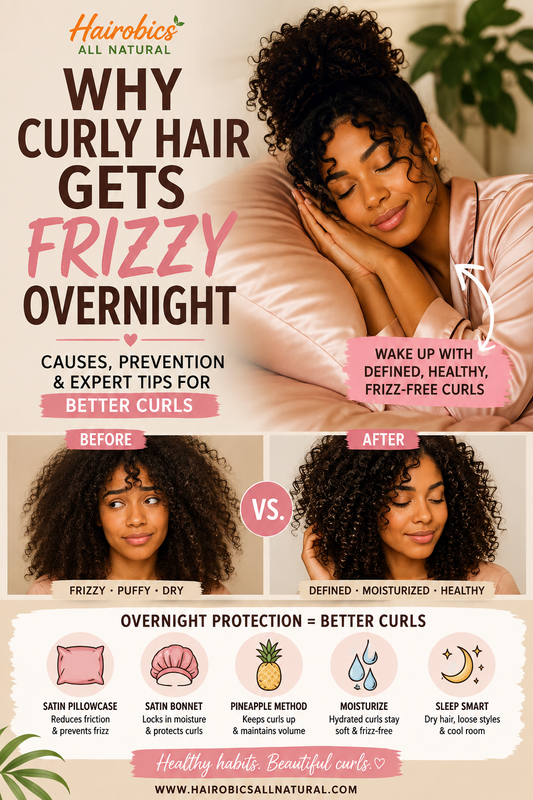
Have you ever gone to bed with perfectly defined curls only to wake up with a head full of frizz? You're not alone. Overnight frizz is one of the biggest frustrations for people with curly hair. Whether you have loose waves, springy ringlets, or tight coils, your curls can change dramatically while you sleep.
The good news is that overnight frizz isn't random. It's caused by several predictable factors—including friction, moisture loss, hair porosity, sleeping position, and even your bedroom environment.
Understanding why curly hair becomes frizzy overnight allows you to build a nighttime routine that preserves curl definition, reduces breakage, and saves you time every morning.
In this complete guide, you'll learn:
- Why curly hair gets frizzy overnight
- What happens while you sleep
- The biggest mistakes people make before bed
- How to protect curls overnight
- The best products for preventing frizz
- Morning fixes for already-frizzy curls
Why Curly Hair Is Naturally More Prone to Frizz
Curly hair is naturally drier than straight hair.
Unlike straight hair, natural oils produced by the scalp struggle to travel around bends and coils. The result is hair that's often thirsty for moisture.
Dry hair equals rough cuticles.
Rough cuticles create friction.
Friction creates frizz.
This is why people with curls experience more overnight frizz than those with straight hair.
What Happens While You Sleep?
Many people assume hair simply rests overnight.
Actually, your curls experience hours of movement.
During sleep you may:
- Roll over dozens of times
- Rub hair against your pillow
- Sweat
- Lose moisture
- Compress curls beneath your head
- Stretch some curls while flattening others
Every movement slightly changes curl formation.
After six to eight hours, all those tiny movements add up.
Cause #1: Pillow Friction
The biggest reason curly hair gets frizzy overnight is friction.
Cotton pillowcases grip the hair fibers.
Instead of allowing curls to glide smoothly, cotton grabs them.
This causes:
- Raised cuticles
- Tangles
- Broken curl clumps
- Flyaways
- Split ends
- Static
Imagine rubbing a balloon against fabric.
Hair experiences something similar throughout the night.
Cause #2: Moisture Loss
Hair loses moisture every day.
It also loses moisture overnight.
If your curls weren't fully moisturized before bed, they'll often feel:
- Dry
- Puffy
- Rough
- Undefined
Low humidity inside homes—especially during winter—can make moisture loss even worse.
Cause #3: Sleeping on Loose Hair
Loose curls flatten underneath your head.
Some curls stretch.
Others compress.
Some twist into knots.
The result is uneven curl patterns.
That's why one side often looks better than the other in the morning.
Cause #4: Hair Porosity
High-porosity curls absorb moisture quickly.
Unfortunately, they also lose it quickly.
This means overnight drying happens faster.
Signs include:
- Constant frizz
- Hair that dries rapidly
- Ends that always feel rough
- Difficulty maintaining definition
Cause #5: Damaged Cuticles
Hair that's been damaged by:
- Heat
- Bleach
- Coloring
- Chemical treatments
- Excessive brushing
has raised cuticles.
Raised cuticles catch on everything—including pillowcases.
This increases overnight frizz dramatically.
Cause #6: Dry Bedroom Air
Air conditioning and heaters remove moisture from the air.
Lower humidity means your curls lose water faster.
Many people notice:
- Winter frizz
- Dry ends
- Puffy curls
- Increased breakage
A dry room can undo a great wash day.
Cause #7: Sweat
Sweating during sleep changes moisture balance.
When sweat evaporates, salt remains on the hair.
Salt can:
- Dry the hair
- Create roughness
- Cause tangling
- Reduce shine
People who sleep hot often wake up with more frizz.
Cause #8: Product Buildup
Too much product can create overnight problems.
Heavy buildup:
- Prevents moisture absorption
- Makes curls stiff
- Creates flakes
- Encourages tangling
Hair should feel moisturized—not coated.
Cause #9: Going to Bed with Wet Hair
Wet hair is weaker than dry hair.
Sleeping on soaking wet curls causes:
- Flattened curl patterns
- Frizz
- Stretching
- Breakage
- Tangles
It's one of the fastest ways to ruin curl definition.
Cause #10: Cotton Bedding
It's not only the pillow.
Cotton sheets and blankets also create friction.
Long curly hair rubbing against bedding can become tangled by morning.
Signs Your Overnight Routine Needs Improvement
You probably need a new bedtime routine if you notice:
- Frizz every morning
- Flat roots
- Puffy ends
- Broken curl clumps
- Knots
- Split ends
- Excessive shedding
- Dry hair after waking
How to Prevent Overnight Frizz
1. Use a Satin Pillowcase
Satin allows curls to glide.
Benefits include:
- Less friction
- Better curl definition
- Fewer tangles
- Less breakage
- More moisture retention
It's one of the easiest improvements you can make.
2. Sleep with a Satin Bonnet
A bonnet protects curls from movement.
It keeps:
- Moisture inside
- Curl clumps together
- Hair off rough fabrics
Choose one that's roomy enough to avoid crushing curls.
3. Pineapple Your Hair
The pineapple method gathers curls loosely on top of your head.
This protects:
- Curl shape
- Volume
- Definition
Use a soft satin scrunchie rather than a tight elastic.
4. Moisturize Before Bed
If your hair feels dry before sleeping, lightly refresh it.
A small amount of:
- Leave-in conditioner
- Curl cream
- Lightweight oil
can help reduce moisture loss overnight.
Avoid overloading your curls.
5. Dry Hair Before Sleeping
Hair should be mostly dry before bed.
Aim for at least 90–100% dry.
If needed, diffuse gently.
6. Detangle Only When Necessary
Avoid dry brushing curly hair.
Instead:
- Finger-detangle
- Use wide-tooth combs
- Detangle with conditioner
This preserves curl clumps.
7. Trim Split Ends
Damaged ends frizz faster.
Regular trims help curls look smoother.
8. Avoid Heavy Cotton Towels
Microfiber towels reduce cuticle disruption.
They also absorb water without roughing up curls.
9. Keep Hair Hydrated
Healthy curls require consistent moisture.
Deep condition weekly.
Use hydrating products regularly.
10. Protect Long Hair
Long curls benefit from:
- Loose braids
- Pineapple styles
- Bonnets
- Silk scarves
Protection reduces overnight tangles.
Morning Routine for Frizzy Curls
Don't panic if you wake up with frizz.
Try this routine:
Step 1
Lightly mist hair with water.
Step 2
Apply a tiny amount of leave-in conditioner.
Step 3
Scrunch curls upward.
Step 4
Smooth flyaways with a lightweight oil.
Step 5
Allow curls to air dry.
Avoid brushing.
Ingredients That Help Fight Frizz
Look for products containing:
- Aloe vera
- Shea butter
- Coconut oil
- Argan oil
- Jojoba oil
- Avocado oil
- Castor oil
- Glycerin (depending on humidity)
- Marshmallow root
- Flaxseed
These ingredients help maintain softness and curl definition.
Ingredients That Can Increase Frizz
Some ingredients may dry out curls when used excessively.
These include:
- Harsh sulfates
- Drying alcohols
- Excessive salt sprays
- Heavy waxes
- Strong detergents
Choose gentle cleansing products whenever possible.
Best Overnight Hairstyles
Excellent options include:
- Pineapple
- Loose braid
- Loose twists
- Satin bonnet
- Silk scarf
- High puff (loosely secured)
Avoid hairstyles that create unnecessary tension.
Common Overnight Curl Mistakes
Many people unknowingly create frizz by:
- Sleeping on cotton
- Using tight ponytails
- Going to bed with wet hair
- Skipping nighttime moisture
- Sleeping with loose curls
- Using rough towels
- Overusing products
- Brushing dry curls
Does Hair Type Matter?
Yes.
Type 2 Waves
Can flatten overnight.
Type 3 Curls
Often lose definition from friction.
Type 4 Coils
Usually experience dryness more than flattening.
Each curl type benefits from nighttime protection.
Seasonal Changes
Winter
- Dry air
- Heater use
- Increased static
Expect more frizz.
Summer
Humidity can cause:
- Puffiness
- Curl expansion
- Flyaways
Protective styling becomes even more important.
Does Age Affect Overnight Frizz?
As we age:
- Hair produces less oil
- Moisture retention decreases
- Hair becomes more fragile
Older curls often require richer conditioning products.
Can Healthy Hair Still Get Frizzy?
Absolutely.
Even healthy curls experience:
- Friction
- Humidity
- Compression
- Movement
The goal isn't eliminating every strand of frizz—it's minimizing unnecessary damage while maintaining healthy, hydrated curls.
Sample Nighttime Routine
- Wash and condition as needed.
- Apply a leave-in conditioner.
- Seal moisture with a lightweight oil if your hair needs it.
- Ensure hair is fully dry.
- Gather curls into a loose pineapple.
- Put on a satin bonnet.
- Sleep on a satin pillowcase.
- Refresh lightly in the morning if needed.
Consistency with this routine can significantly reduce overnight frizz.
Frequently Asked Questions
Why does my curly hair look perfect at night but frizzy in the morning?
Hours of friction against bedding, moisture loss, and movement while sleeping can disrupt curl clumps and lift the hair cuticle, leading to frizz by morning.
Is sleeping with wet curly hair bad?
Yes. Wet hair is more vulnerable to stretching and breakage. Sleeping with wet curls can flatten your curl pattern and increase tangles and frizz.
Are satin pillowcases really worth it?
For many people with curly hair, yes. Satin reduces friction, helping preserve curl definition, minimize tangles, and retain moisture better than cotton.
Should I refresh my curls every morning?
Not necessarily. If your nighttime routine protects your curls well, a light mist of water or a small amount of leave-in conditioner may be all you need.
Why is only one side of my hair frizzy?
Many people consistently sleep on one side, exposing that section to more friction and compression throughout the night.
Final Thoughts
Curly hair gets frizzy overnight because it experiences friction, moisture loss, movement, and compression while you sleep. Since curly hair is naturally drier than straight hair, these factors have an even greater impact on curl definition.
The good news is that small changes—such as switching to a satin pillowcase, wearing a bonnet, using the pineapple method, and keeping your curls properly moisturized—can dramatically improve how your hair looks when you wake up. By protecting your curls overnight and adopting a consistent nighttime routine, you'll spend less time refreshing your hair each morning and more time enjoying healthy, defined, and vibrant curls.