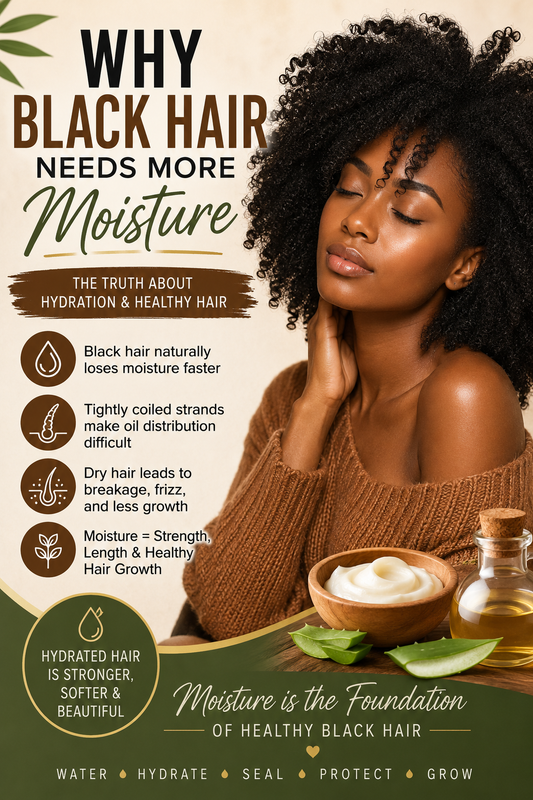
If you've ever wondered why your hair seems dry shortly after moisturizing it, you're not alone. One of the biggest challenges people with Black hair face is maintaining moisture throughout the week. Unlike straighter hair types, Black hair naturally loses moisture faster, making hydration one of the most important parts of any healthy hair care routine.
The good news is that dry hair isn't something you simply have to accept. Once you understand why Black hair behaves differently, you can create a routine that keeps your hair soft, strong, and growing.
In this guide, you'll learn:
- Why Black hair gets dry faster
- The science behind moisture retention
- Common mistakes that cause dryness
- The best moisturizing ingredients
- Daily, weekly, and monthly moisture routines
- How to keep locs, braids, twists, curls, and 4C hair hydrated
- Natural ways to lock moisture into your hair
Understanding Black Hair Structure
Black hair has one of the most unique structures of all hair types.
Instead of growing in a straight line, the hair shaft bends and coils repeatedly.
These beautiful curls create volume and texture, but they also make it much harder for natural oils to travel from the scalp to the ends.
Sebum, the scalp's natural moisturizer, easily coats straight hair.
With tightly coiled hair, that oil must travel around hundreds of twists and bends.
Most of it never reaches the ends.
This leaves the oldest part of the hair extremely dry.
The Science Behind Dry Hair
Hair itself isn't alive.
Once it grows from the scalp, it can't produce moisture on its own.
Instead, it depends on:
- Water
- Natural scalp oils
- Moisturizing products
- Humidity in the environment
Because Black hair naturally has fewer opportunities for oil distribution, it depends much more on outside moisture sources.
Without regular hydration, hair begins to lose flexibility.
Dry hair becomes:
- Brittle
- Rough
- Tangled
- Fragile
- More likely to snap
Why Curly Hair Loses Moisture Faster
Every curl creates tiny raised areas along the cuticle.
These raised cuticles allow moisture to escape more easily.
Think of shingles on a roof.
When they're flat, water stays out.
When they're lifted, water escapes.
Hair works similarly.
Damaged or raised cuticles allow moisture to leave the hair shaft quickly.
Why the Ends Are Always the Driest
Hair ends are the oldest part of your hair.
Some ends may be several years old.
They've experienced:
- Sun exposure
- Heat styling
- Friction
- Washing
- Combing
- Protective styles
- Weather
Over time, the protective cuticle becomes thinner.
That's why your ends often feel:
- Crunchy
- Dry
- Rough
- Thin
Regular moisturizing helps preserve them longer.
Moisture vs Oil: Understanding the Difference
Many people believe oil moisturizes hair.
It doesn't.
Water provides moisture.
Oil seals that moisture inside.
Think of it this way:
Water hydrates.
Oil protects.
Using oil on dry hair simply seals in dryness.
Always apply oils after adding moisture.
Signs Your Hair Needs More Moisture
Your hair may need hydration if you notice:
- Excessive breakage
- Hair snapping during detangling
- Rough texture
- Frizz
- Dull appearance
- Stiff curls
- Single-strand knots
- Split ends
- Difficulty styling
These are often early signs of moisture loss.
Common Causes of Dry Black Hair
Washing With Harsh Shampoo
Strong sulfates remove dirt—but they also remove beneficial oils.
Choose moisturizing cleansers whenever possible.
Heat Styling
Flat irons and blow dryers evaporate water inside the hair shaft.
Frequent heat leads to chronic dryness.
Chemical Treatments
Relaxers
Bleach
Hair color
Texturizers
These treatments weaken the cuticle, allowing moisture to escape faster.
Weather
Winter air has very low humidity.
Summer sun can dry hair quickly.
Wind also increases moisture loss.
Cotton Pillowcases
Cotton absorbs moisture overnight.
Many people wake up with noticeably drier hair because of pillow friction.
Sleeping with satin or silk helps preserve moisture.
Why Water Is the Best Moisturizer
Water penetrates the hair shaft better than oils.
Proper hydration begins with water.
That's why many leave-in conditioners list water as the first ingredient.
Whenever moisturizing:
Start with water.
Then apply a conditioner.
Finally seal with an oil or butter.
Ingredients That Help Black Hair Stay Moisturized
Excellent moisturizing ingredients include:
Aloe Vera
Helps attract moisture while soothing the scalp.
Glycerin
Draws water into the hair.
Excellent during moderate humidity.
Honey
A natural humectant that attracts moisture.
Marshmallow Root
Provides excellent slip and hydration.
Slippery Elm
Helps soften hair while reducing tangles.
Panthenol (Vitamin B5)
Improves softness and flexibility.
Coconut Water
Contains minerals that help hydrate hair naturally.
Flaxseed Gel
Provides lightweight moisture and curl definition.
Oils That Help Lock In Moisture
After hydrating your hair, seal it with lightweight oils such as:
- Jojoba Oil
- Avocado Oil
- Sweet Almond Oil
- Argan Oil
- Grapeseed Oil
- Jamaican Black Castor Oil (best used sparingly due to its thickness)
Remember:
Oil doesn't replace water.
It keeps water from escaping.
The LOC Method
One popular moisturizing technique is:
L = Liquid
O = Oil
C = Cream
This works well for many people with medium to high-porosity hair.
The LCO Method
Others prefer:
Liquid
Cream
Oil
This works especially well when creams provide most of the hydration before sealing.
How Often Should Black Hair Be Moisturized?
Every head is different.
General guidelines:
Daily
Refresh lightly if needed.
Every 2–3 Days
Apply leave-in conditioner.
Weekly
Deep condition.
Monthly
Clarify product buildup before deep conditioning.
Deep Conditioning Matters
Deep conditioners contain ingredients that penetrate the hair shaft longer than regular conditioners.
Benefits include:
- Increased softness
- Better elasticity
- Reduced breakage
- Improved shine
- Stronger curls
Leave deep conditioners on for 20–40 minutes.
Moisture for 4C Hair
4C hair has the tightest curl pattern.
Because oil has the longest journey down the hair shaft, 4C hair often benefits from:
- Regular hydration
- Gentle detangling
- Protective styling
- Low manipulation
- Rich leave-in conditioners
Consistency matters more than expensive products.
Moisturizing Locs
Locs need hydration too.
Avoid heavy creams that cause buildup.
Instead use:
- Water-based sprays
- Aloe vera
- Lightweight botanical moisturizers
- Light oils
Hydrated locs remain flexible and strong.
Keeping Braids Moisturized
Many people forget about their natural hair while wearing braids.
Your scalp and hair still need moisture.
Use:
- Water-based braid sprays
- Lightweight scalp oils
- Gentle scalp massages
Keeping braids moisturized reduces itching and breakage.
Best Protective Styles for Moisture Retention
Protective styles reduce daily manipulation.
Popular options include:
- Twists
- Braids
- Buns
- Wigs
- Flat twists
- Cornrows
- Locs
Protective styles work best when hair is moisturized before installation.
Diet Also Affects Hair Hydration
Healthy hair begins inside the body.
Focus on:
- Water intake
- Fruits
- Vegetables
- Healthy fats
- Protein
- Omega-3 fatty acids
Hydrated bodies generally support healthier scalps.
Avoid These Moisture Mistakes
Many people accidentally dry out their hair by:
- Using oils instead of water
- Overwashing
- Using excessive heat
- Ignoring deep conditioning
- Sleeping without satin protection
- Using alcohol-heavy styling products
- Skipping trims
- Detangling dry hair
Small improvements make a huge difference over time.
Sample Moisture Routine
Monday
Mist hair with water.
Apply leave-in conditioner.
Seal lightly with oil.
Wednesday
Refresh curls with water-based spray.
Massage scalp gently.
Friday
Light moisturizer.
Protective nighttime style.
Sunday
Wash hair.
Deep condition.
Apply leave-in.
Seal moisture.
Style.
Repeat weekly.
Frequently Asked Questions
Why does Black hair dry so fast?
Its tightly coiled structure prevents natural scalp oils from easily traveling down the hair shaft, so moisture escapes more quickly.
Is oil enough to moisturize Black hair?
No. Water hydrates the hair, while oils help seal that moisture in.
How often should I deep condition?
Most people benefit from deep conditioning once a week, though very dry or damaged hair may benefit from more frequent treatments.
Should I moisturize my hair every day?
Not always. Many people do well moisturizing every 2–3 days, while others only need weekly hydration. Adjust based on your hair's porosity, texture, and environment.
Why do my ends stay dry?
The ends are the oldest part of your hair and have experienced the most wear and tear. They naturally lose moisture faster than newer growth.
Final Thoughts
Black hair is beautifully unique, but its natural curl pattern also means it requires intentional moisture care. Because scalp oils have a harder time reaching every strand, hydration should always be at the center of your routine. Using water-based products, deep conditioning regularly, sealing moisture with lightweight oils, minimizing heat, and protecting your hair at night can make a noticeable difference in softness, strength, and length retention.
Healthy hair doesn't come from chasing dozens of products—it comes from consistent care. Build a moisture-focused routine that fits your hair type and lifestyle, and over time you'll likely see less breakage, better manageability, and healthier-looking curls, coils, braids, or locs.