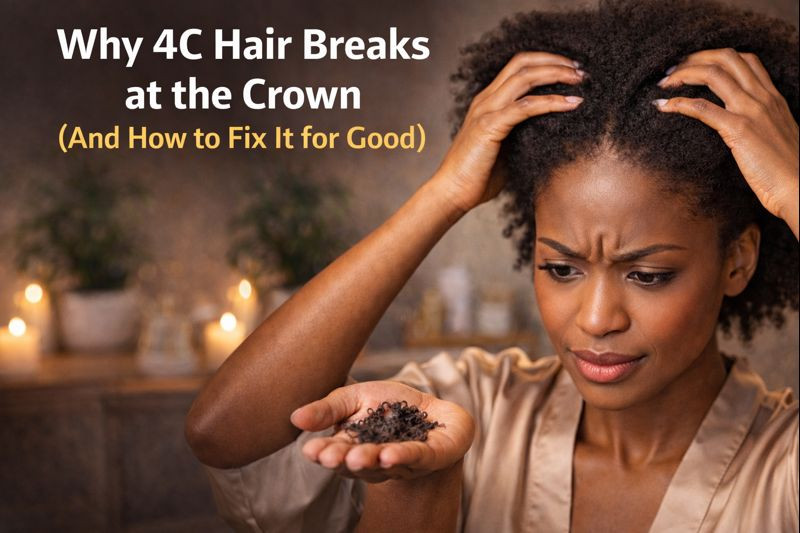
If your 4C hair seems to thrive everywhere except the crown, you’re not imagining things. The crown is one of the most common breakage zones for tightly coiled hair, and it’s often the slowest area to retain length.
The frustrating part? Many people moisturize, oil, and protect their hair—yet the crown still breaks.
In this comprehensive guide, we’ll break down exactly why 4C hair breaks at the crown, the hidden habits that make it worse, and how to restore strength, thickness, and length to this delicate area.
Why the Crown Is the Weakest Area of 4C Hair
The crown (top center of the head) is structurally different from the rest of your scalp. Several factors make it more vulnerable to dryness, friction, and breakage—especially for 4C hair.
Key reasons the crown struggles:
-
It receives less natural oil (sebum)
-
It’s exposed to constant friction
-
It often has tighter curl patterns
-
It’s frequently over-manipulated without notice
Understanding these differences is the first step toward fixing crown breakage.
1. The Crown Is the Driest Area of 4C Hair
4C hair already struggles with moisture retention due to its tight coils. At the crown, the problem is magnified.
Why the crown stays dry:
-
Sebum has a harder time traveling upward and outward
-
Tight coils slow oil distribution
-
Many people focus moisture on ends, not scalp zones
Dry hair lacks elasticity, and dry 4C strands snap easily under tension—especially at the crown.
? Dryness is the #1 silent cause of crown breakage.
2. Constant Friction Damages the Crown
The crown experiences more friction than any other part of your head.
Common friction sources:
-
Sleeping on cotton pillowcases
-
Car headrests
-
Couch cushions
-
Hoodie hoods
-
Hats and caps
-
Helmet liners
Repeated friction lifts the cuticle, leading to:
-
Weak strands
-
Split ends
-
Thinning at the crown
Over time, hair breaks faster than it can grow.
3. Tension From Styles Targets the Crown
Many protective styles unknowingly put extra tension right at the crown.
Styles that stress the crown:
-
High buns and top knots
-
Pineapple styles
-
Tight ponytails
-
Braids pulled upward
-
Slicked-back styles
For 4C hair, repeated tension causes:
-
Micro-breakage
-
Weak follicle anchoring
-
Thinning and uneven growth
Even “protective” styles can be damaging when worn too tightly or too often.
4. The Crown Is Often Over-Manipulated
You may not realize it, but the crown is one of the most frequently touched areas.
People often:
-
Scratch the crown when stressed
-
Rub it absentmindedly
-
Pull hair while styling edges
-
Reposition buns and ponytails
Over-manipulation weakens fragile strands, especially when hair is dry.
5. Tight Curl Pattern = Higher Breakage Risk
Many people with 4C hair have multiple curl patterns, and the crown often has:
-
Tighter coils
-
More shrinkage
-
Less elasticity
Tighter curls bend sharply at multiple points along the strand, creating weak stress points. Without enough moisture and slip, these strands snap easily.
6. Product Buildup Can Suffocate the Crown
Because the crown is harder to see, it’s often:
-
Under-cleansed
-
Over-oiled
-
Layered with heavy products
Buildup can:
-
Block moisture from entering
-
Cause scalp inflammation
-
Weaken follicles
-
Slow growth
A compromised scalp leads to fragile hair growth from the start.
7. Heat and Blow-Drying Damage the Crown First
When heat is used, the crown often takes the most damage.
Why?
-
People pass heat tools over the crown repeatedly
-
It’s harder to see heat damage there
-
Hot air from blow dryers concentrates at the top
Heat weakens keratin bonds, making hair prone to breakage—even months later.
8. Stress and Hormones Affect the Crown More Than You Think
Stress-related hair loss and shedding often show up at the crown first.
High cortisol levels can:
-
Reduce blood flow to follicles
-
Shorten the growth phase
-
Increase shedding
Because the crown already has weaker circulation than the nape or sides, stress hits it harder.
9. Lack of Scalp Stimulation at the Crown
Many routines focus on ends and edges but ignore the crown scalp.
Without stimulation:
-
Blood flow slows
-
Nutrients don’t reach follicles efficiently
-
Growth weakens over time
A neglected scalp produces weaker strands.
Signs Your 4C Hair Is Breaking at the Crown
You may be experiencing crown breakage if you notice:
-
Short, uneven hairs at the top
-
A thinner-looking crown
-
Slow or no length retention
-
Dryness that returns quickly
-
Hair snapping during detangling
Catching these signs early makes recovery much easier.
How to Stop 4C Hair Breakage at the Crown
Now let’s talk solutions—because crown breakage is fixable with consistency and the right approach.
1. Moisturize the Crown Separately
Don’t rely on “overall” moisturizing.
Best practices:
-
Apply water-based moisture directly to the crown
-
Seal lightly with oil or butter
-
Refresh every 2–3 days
? Treat the crown like its own zone.
2. Massage the Crown Regularly
Scalp massage improves circulation and strengthens new growth.
Do this:
-
Massage the crown 3–5 times per week
-
Use gentle circular motions
-
Focus on relaxation, not pressure
This encourages thicker, stronger strands over time.
3. Reduce Tension-Based Styles
Rotate styles and lower tension at the top.
Try:
-
Low buns
-
Loose twists
-
Flat twists instead of tight braids
-
Side parts instead of constant center parts
Give the crown frequent breaks from stress.
4. Protect the Crown at Night
Nighttime friction does serious damage.
Protect with:
-
Satin or silk bonnet
-
Satin-lined hoodies and hats
-
Satin pillowcases
This alone can drastically reduce breakage.
5. Cleanse the Crown Thoroughly
Focus shampoo and scalp care on the crown—not just edges.
Tips:
-
Massage shampoo into the crown
-
Avoid heavy buildup
-
Clarify monthly if needed
A healthy scalp grows stronger hair.
6. Use Lightweight, Penetrating Oils
Heavy products can weigh crown hair down.
Better options:
-
Jojoba oil
-
Grapeseed oil
-
Castor oil (used sparingly)
-
Herbal-infused oils
Apply directly to the scalp, not just the hair.
7. Detangle With Extra Care
The crown tangles faster due to tight coils.
Detangle when:
-
Hair is damp
-
Fully moisturized
-
Sectioned carefully
Always work slowly to avoid snapping fragile strands.
How Long Does It Take to Repair Crown Breakage?
With consistency:
-
Reduced breakage: 3–4 weeks
-
Improved moisture balance: 4–6 weeks
-
Visible length retention: 8–12 weeks
-
Fuller crown appearance: 3–6 months
Patience + consistency = results.
Common Mistakes That Keep Crown Hair Breaking
Avoid these:
❌ Ignoring the crown during wash day
❌ Over-oiling without moisture
❌ Wearing tight styles too often
❌ Skipping nighttime protection
❌ Using heat without protection
Fixing crown breakage requires intentional care, not more products.
Final Thoughts: Your Crown Isn’t Broken—Your Routine Is
If your 4C hair breaks at the crown, it’s not because your hair is “difficult” or “damaged beyond repair.” It’s because the crown needs specialized care, less tension, more moisture, and better protection.
Once you treat the crown as its own priority zone, you’ll notice:
-
Less breakage
-
Better thickness
-
Improved length retention
-
Healthier overall growth
? Healthy 4C hair grows everywhere—including the crown—when it’s properly supported.