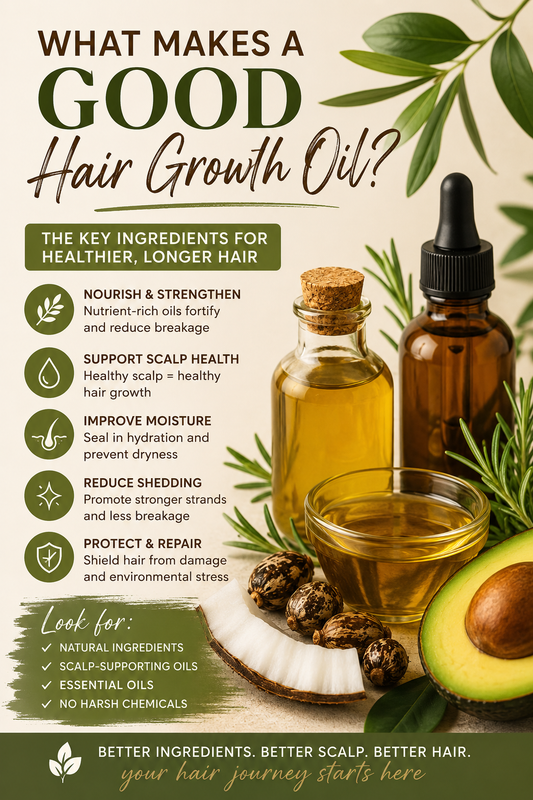
Walk into any beauty supply store or search online for hair care products, and you'll find hundreds of oils claiming to grow hair faster, stop hair loss, strengthen edges, and transform thinning hair into thick, healthy strands. While some hair growth oils can support healthier hair, not all oils are created equal.
Many people spend years trying different products without seeing the results they want because they don't understand what actually makes a hair growth oil effective. The truth is that hair growth isn't just about putting oil on your scalp. A quality hair growth oil works by supporting scalp health, reducing breakage, protecting follicles, and creating an environment where hair can thrive.
If you have natural hair, curly hair, locs, braids, or are struggling with thinning edges, choosing the right oil can make a significant difference in your hair care journey.
In this guide, we'll break down exactly what makes a good hair growth oil, which ingredients matter most, what to avoid, and how to use oils correctly for maximum results.
Understanding Hair Growth
Before discussing oils, it's important to understand how hair grows.
Hair grows from follicles located beneath the scalp. Each follicle goes through a cycle consisting of three main phases:
Anagen Phase
The growth phase.
This phase can last between 2 and 7 years depending on genetics and overall health. The longer hair stays in this phase, the longer it can grow.
Catagen Phase
The transition phase.
Hair growth slows and follicles begin shrinking.
Telogen Phase
The resting phase.
Hair eventually sheds, allowing a new strand to begin growing.
Healthy follicles are essential for maintaining a healthy growth cycle. This is where a quality hair growth oil can help.
What Does Hair Growth Oil Actually Do?
One of the biggest misconceptions is that oils directly grow hair.
No oil can magically force hair to grow faster than your body's natural growth rate.
However, a good hair growth oil can:
- Improve scalp health
- Reduce breakage
- Minimize dryness
- Soothe irritation
- Strengthen strands
- Support healthy follicles
- Improve moisture retention
- Protect hair from damage
The result is better length retention and healthier-looking hair.
The Most Important Quality of a Hair Growth Oil
Scalp Support
Healthy hair starts with a healthy scalp.
A scalp that is:
- Dry
- Inflamed
- Itchy
- Flaky
- Clogged with buildup
cannot perform at its best.
Good hair growth oils help create an environment where follicles can function properly.
Signs your scalp needs support include:
- Excessive itching
- Dry patches
- Dandruff
- Tenderness
- Slow growth
- Increased shedding
Oils rich in nutrients and antioxidants help nourish the scalp and maintain balance.
Carrier Oils Matter
The foundation of any quality hair growth oil is the carrier oil.
Carrier oils make up the majority of most formulations and provide nourishment to both the scalp and hair shaft.
Jamaican Black Castor Oil
One of the most popular oils for natural hair.
Benefits include:
- Helps seal moisture
- Supports thicker-looking hair
- Reduces breakage
- Strengthens strands
- Excellent for edges
Many people with Type 4 hair use Jamaican Black Castor Oil as part of their growth regimen.
Jojoba Oil
Jojoba oil closely resembles the scalp's natural sebum.
Benefits include:
- Lightweight feel
- Non-greasy moisture
- Helps balance scalp oils
- Supports scalp health
This makes it ideal for individuals who dislike heavy oils.
Coconut Oil
Coconut oil is one of the few oils proven to penetrate the hair shaft.
Benefits include:
- Reduces protein loss
- Strengthens hair
- Minimizes breakage
- Helps retain moisture
Avocado Oil
Rich in:
- Vitamin E
- Fatty acids
- Antioxidants
Benefits include:
- Softens hair
- Improves elasticity
- Reduces dryness
- Supports healthier strands
Olive Oil
Used for centuries in hair care.
Benefits include:
- Deep conditioning
- Increased softness
- Moisture retention
- Protection against dryness
Essential Oils That Support Hair Growth
Essential oils are often added to hair growth formulas because they may support scalp health.
Rosemary Oil
Rosemary oil has become one of the most talked-about ingredients for hair growth.
Benefits include:
- Supports scalp circulation
- Encourages healthy follicles
- Helps reduce shedding
- Promotes thicker-looking hair
Many people compare rosemary oil to some of the most popular hair growth treatments available today.
Peppermint Oil
Peppermint oil creates a cooling sensation on the scalp.
Benefits include:
- Invigorates the scalp
- Supports circulation
- Refreshes follicles
- Helps maintain scalp cleanliness
Tea Tree Oil
Tea tree oil is known for scalp-cleansing properties.
Benefits include:
- Helps reduce buildup
- Supports healthy scalp conditions
- Helps with flakes
- Refreshes irritated scalps
Lavender Oil
Benefits include:
- Calms the scalp
- Soothes irritation
- Supports overall scalp wellness
Cedarwood Oil
Often included in premium growth formulas.
Benefits include:
- Supports scalp balance
- Encourages healthy hair appearance
- Works well with rosemary and peppermint
Nutrient-Rich Ingredients to Look For
The best hair growth oils often include ingredients packed with nutrients.
Look for oils containing:
Vitamin E
Helps protect hair from oxidative stress.
Omega Fatty Acids
Support scalp hydration and strand flexibility.
Antioxidants
Help defend follicles from environmental stressors.
Plant Extracts
Can support scalp wellness and healthy hair maintenance.
What Makes an Oil Effective for Black Hair?
Black hair often faces unique challenges.
These include:
- Dryness
- Breakage
- Shrinkage
- Fragile ends
- Edge thinning
A quality oil should:
Help Seal Moisture
Type 4 hair tends to lose moisture quickly.
Good oils help lock hydration into the hair shaft.
Reduce Breakage
Length retention is often the biggest challenge.
Strong strands retain length more effectively.
Support Protective Styles
Braids, twists, wigs, and locs place stress on hair.
Oils help maintain moisture and flexibility.
Nourish the Scalp
Healthy follicles support healthy growth.
Ingredients to Avoid
Not every oil product deserves a place in your routine.
Watch out for:
Mineral Oil
May create a heavy coating without providing nourishment.
Excessive Synthetic Fragrance
Can irritate sensitive scalps.
Alcohol-Based Formulas
Can contribute to dryness.
Cheap Fillers
Some products contain minimal beneficial ingredients and rely heavily on fillers.
Always read ingredient labels carefully.
Signs of a High-Quality Hair Growth Oil
A good hair growth oil should:
✓ Contain nutrient-rich oils
✓ Include scalp-supporting ingredients
✓ Be free from unnecessary fillers
✓ Absorb reasonably well
✓ Support moisture retention
✓ Reduce breakage
✓ Improve scalp comfort
✓ Be suitable for regular use
How to Use Hair Growth Oil Correctly
Even the best oil won't help if used incorrectly.
Step 1: Apply to Clean Scalp
A clean scalp absorbs products more effectively.
Heavy buildup can block ingredients from reaching the scalp.
Step 2: Massage Gently
Massage for 3-5 minutes.
Benefits include:
- Improved circulation
- Better product distribution
- Relaxation
Step 3: Focus on Problem Areas
Pay extra attention to:
- Edges
- Crown
- Nape
- Thinning spots
Step 4: Be Consistent
Consistency matters more than quantity.
Using a quality oil several times weekly often works better than applying large amounts occasionally.
Common Hair Growth Oil Mistakes
Using Too Much
More oil does not equal more growth.
Excessive oil can:
- Attract dirt
- Cause buildup
- Weigh hair down
Ignoring Moisture
Oil is not a moisturizer.
Oil helps seal moisture.
Hydration must come first.
Expecting Overnight Results
Hair growth takes time.
Most people need several months of consistency before noticing significant changes.
Skipping Scalp Care
Healthy growth starts beneath the surface.
Scalp care is just as important as hair care.
Hair Growth Oil for Edges
Edges are often the first area to show signs of stress.
Common causes include:
- Tight hairstyles
- Excessive styling
- Dryness
- Tension
A quality growth oil can help:
- Reduce breakage
- Improve moisture
- Support healthier-looking edges
Remember that gentle styling habits are equally important.
Hair Growth Oil for Locs
Locs require consistent scalp maintenance.
Benefits of oils for loc wearers include:
- Reduced dryness
- Improved scalp comfort
- Better moisture retention
- Healthier appearance
Avoid overusing heavy products that may cause buildup.
Hair Growth Oil for Braids
Braids can protect hair but may also contribute to dryness.
Applying oil to the scalp while wearing braids can:
- Reduce itching
- Improve moisture
- Support healthy follicles
Lightweight oils often work best.
Can Hair Growth Oils Help Thinning Hair?
Hair growth oils may help support healthier-looking hair by:
- Improving scalp conditions
- Reducing breakage
- Supporting follicles
However, thinning caused by medical conditions may require professional evaluation.
Building the Perfect Hair Growth Routine
Hair growth oils work best when combined with:
Healthy Nutrition
Focus on:
- Protein
- Fruits
- Vegetables
- Water
Scalp Care
Keep the scalp clean and balanced.
Protective Styling
Reduce manipulation and breakage.
Deep Conditioning
Maintain moisture and elasticity.
Consistency
Healthy hair habits produce long-term results.
Why Natural Oils Continue to Dominate Hair Care
Natural oils remain popular because they:
- Support scalp health
- Improve moisture retention
- Reduce breakage
- Enhance softness
- Work well with natural hair textures
For many people, they form the foundation of a healthy hair regimen.
Final Thoughts
A good hair growth oil isn't necessarily the most expensive oil or the trendiest product on social media. The best hair growth oils are formulated with ingredients that support scalp health, strengthen strands, reduce breakage, and help retain moisture.
Look for nutrient-rich carrier oils such as Jamaican Black Castor Oil, Jojoba Oil, Coconut Oil, and Avocado Oil. Pair them with powerful essential oils like Rosemary, Peppermint, Tea Tree, Lavender, and Cedarwood for additional scalp support.
Remember that hair growth is a journey. No oil can instantly create long hair overnight, but a high-quality oil used consistently can help create the conditions needed for healthier, stronger, longer hair over time.
If your goal is longer natural hair, healthier edges, stronger locs, or improved scalp health, choosing the right hair growth oil may be one of the smartest investments you make in your hair care routine.