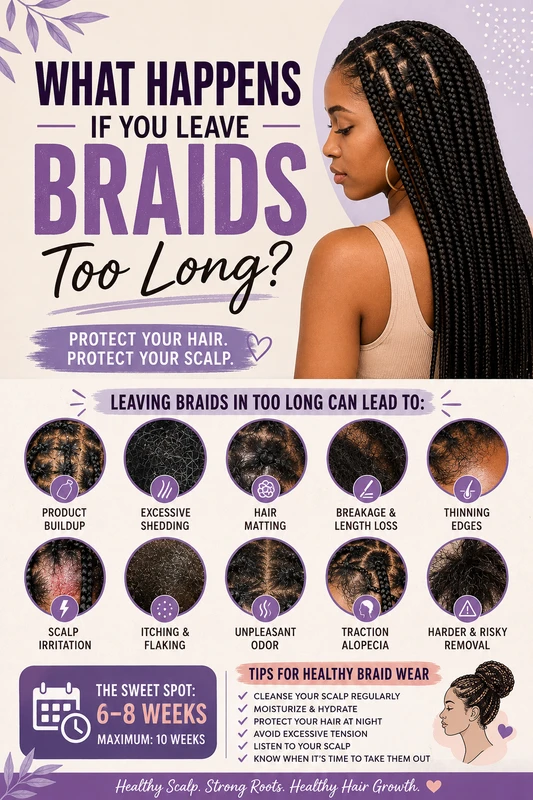
Braids are one of the most popular protective styles for natural hair. Whether you wear box braids, knotless braids, cornrows, crochet braids, or tribal braids, they offer convenience, versatility, and a break from daily styling. Many people choose braids to help retain length, reduce manipulation, and simplify their hair care routine.
However, one common question continues to come up among women with natural hair:
What happens if you leave braids in too long?
While braids can protect your hair, keeping them installed for too many weeks can lead to several problems that may actually work against your hair growth goals. Excessive buildup, matting, breakage, thinning edges, scalp irritation, and even hair loss can occur when braids are worn beyond their recommended timeframe.
In this comprehensive guide, you'll learn:
- How long braids should stay in
- Signs it's time to remove your braids
- The dangers of leaving braids too long
- How braids affect hair growth
- Best practices for maintaining healthy braided hair
- How to protect your scalp while wearing braids
By the end, you'll know exactly when it's time to take your braids out and how to maximize hair growth while wearing protective styles.
Why People Leave Braids In Too Long
Many people start with good intentions but end up keeping braids longer than planned.
Common reasons include:
- Trying to save money
- Busy schedules
- Not wanting to spend hours removing them
- Wanting to stretch the style as long as possible
- Believing longer wear equals more growth
Unfortunately, hair health doesn't always benefit from extended braid wear.
The reality is that protective styles only remain protective when they are maintained properly.
Once braids become old, frizzy, and overloaded with shed hair and buildup, they can become damaging rather than protective.
How Long Should Braids Stay In?
The ideal length depends on the braid style.
Knotless Braids
Recommended:
6–8 weeks
Maximum:
10 weeks with excellent maintenance
Box Braids
Recommended:
6–8 weeks
Maximum:
8–10 weeks
Cornrows
Recommended:
2–6 weeks
Crochet Braids
Recommended:
4–8 weeks
Feed-In Braids
Recommended:
2–4 weeks
Micro Braids
Recommended:
8–12 weeks
Most hairstylists agree that 8 weeks is the sweet spot for most braid styles.
After that point, the risks begin increasing significantly.
What Happens to Your Hair While Wearing Braids?
Even though your hair is tucked away, it never stops changing.
Hair continues to:
- Grow
- Shed
- Produce oil
- Collect dirt
- Experience friction
- Require moisture
Your scalp also remains active throughout the life of the style.
Each day your hair naturally sheds approximately 50–100 strands.
Normally these hairs fall away.
Inside braids, however, shed hairs become trapped.
Over weeks and months, these shed hairs accumulate inside the braid structure.
This is one reason extremely old braids become difficult to remove.
Problem #1: Massive Product Buildup
One of the first issues that develops is buildup.
Over time your scalp accumulates:
- Oils
- Sweat
- Dust
- Dead skin cells
- Hair products
Many people continue applying:
- Oils
- Moisturizers
- Edge controls
- Mousse
- Leave-in conditioners
Without proper cleansing, these products pile up.
This buildup can:
- Clog follicles
- Cause itching
- Trigger irritation
- Create unpleasant odors
- Attract dirt
Eventually the scalp becomes unhealthy.
A healthy scalp is essential for healthy hair growth.
Problem #2: Excessive Shedding Becomes Trapped
Hair shedding is completely normal.
However, braids trap shed hairs.
After 8–12 weeks, thousands of shed strands may remain inside the style.
When you finally remove the braids, you may panic at the amount of hair coming out.
Sometimes this is normal accumulated shedding.
However, excessive trapped shedding can also cause:
- Tangles
- Matting
- Knotting
- Breakage during removal
The longer braids remain installed, the greater the risk.
Problem #3: Hair Matting
Matting is one of the biggest dangers of leaving braids too long.
Hair naturally wraps around neighboring strands.
As shed hair accumulates, it can form dense tangles near the roots.
Severe matting may:
- Require hours to remove
- Cause significant breakage
- Lead to cutting sections of hair
In extreme cases, hair can become locked together.
This risk increases dramatically after 10–12 weeks.
Problem #4: Breakage at the Demarcation Line
A demarcation line develops where new growth meets the braided section.
Over time this area becomes vulnerable.
The braid may swing, pull, and create tension on the same spot repeatedly.
Eventually weakness develops.
This can cause:
- Mid-shaft breakage
- Split strands
- Length loss
Many people think their hair isn't growing.
In reality, it grows but breaks off before they see results.
Problem #5: Thinning Edges
Your edges are the most delicate hairs on your head.
Leaving braids in too long often places prolonged stress on:
- Temples
- Hairline
- Nape
Continuous tension can damage follicles.
Warning signs include:
- Soreness
- Redness
- Small bumps
- Thinning edges
- Receding hairline
If ignored, traction alopecia can develop.
Traction alopecia occurs when repeated tension damages follicles over time.
Problem #6: Scalp Inflammation
An inflamed scalp is never ideal.
Old braids can contribute to:
- Itching
- Tenderness
- Flaking
- Redness
- Burning sensations
Inflammation may slow healthy growth and create an environment where follicles struggle to thrive.
Common causes include:
- Product buildup
- Lack of cleansing
- Excess tension
- Bacterial growth
Problem #7: Unpleasant Odor
Many people notice an odor developing after several weeks.
Contributors include:
- Sweat
- Sebum
- Product residue
- Environmental pollutants
Even if hair appears clean on the surface, buildup deep within the braid can trap odors.
Regular cleansing helps, but eventually old braids become difficult to fully refresh.
Problem #8: Increased Risk of Breakage During Removal
Removing old braids is much harder than removing fresh ones.
After several months:
- Shed hairs become intertwined
- Knots form
- Hair dries out
This increases the likelihood of:
- Snapping
- Tangling
- Excess shedding
- Length loss
Many people lose months of growth retention during braid removal.
Problem #9: Dryness and Moisture Loss
A common misconception is that braids automatically keep hair moisturized.
They do not.
Hair still requires hydration.
Over time moisture levels decline.
Signs include:
- Brittle strands
- Rough texture
- Increased breakage
- Dull appearance
Dry hair is fragile hair.
Without consistent moisturizing, braid wear can become damaging.
Problem #10: Follicle Stress
Healthy follicles support healthy growth.
Excessively old braids can stress follicles through:
- Constant tension
- Buildup
- Inflammation
When follicles become stressed, growth may appear slower and hair quality may decline.
Signs You've Left Braids In Too Long
Watch for these warning signs:
Excessive Frizz
Large amounts of frizz indicate the style has aged significantly.
Heavy New Growth
Several inches of new growth create imbalance and increased tangling.
Persistent Itching
Chronic itching often signals buildup.
Strong Odor
An unpleasant smell usually means cleansing is overdue.
Matting at the Roots
This is one of the clearest signs removal should happen immediately.
Thinning Edges
Any noticeable thinning deserves attention.
Difficulty Accessing the Scalp
If cleansing becomes impossible, removal is often necessary.
Can Leaving Braids Too Long Cause Hair Loss?
Yes.
In some situations, prolonged braid wear contributes to hair loss.
Possible causes include:
Traction Alopecia
Repeated tension damages follicles.
Breakage
Hair snaps from weakness and dryness.
Matting
Tangled hair breaks during removal.
Scalp Inflammation
Chronic irritation may negatively affect hair health.
The good news is that early intervention often allows recovery.
Do Braids Help Hair Grow?
Braids do not directly increase growth rate.
Hair growth occurs at the follicle level.
What braids can do is:
- Reduce manipulation
- Minimize breakage
- Improve length retention
When maintained correctly, braids help you keep more of the hair you grow.
That's why many people experience longer hair after wearing protective styles consistently.
How to Maintain Braids Properly
Proper maintenance extends the life of your style while protecting hair health.
Cleanse Regularly
Wash every 2–3 weeks.
Focus on:
- Scalp health
- Removing buildup
- Preventing odor
Moisturize
Use lightweight moisturizers.
Focus on:
- New growth
- Scalp
- Exposed hair
Protect at Night
Sleep with:
- Satin bonnet
- Satin scarf
- Satin pillowcase
Avoid Excessive Pulling
Limit:
- Tight ponytails
- High buns
- Constant manipulation
Refresh Carefully
Avoid repeatedly redoing edges every few days.
This creates additional tension.
What to Do When It's Time to Remove Braids
Removal is just as important as installation.
Step 1: Detangle Before Washing
Separate sections gently.
Step 2: Remove Slowly
Avoid rushing.
Step 3: Detangle Thoroughly
Use patience.
Expect accumulated shed hair.
Step 4: Cleanse the Scalp
Remove:
- Dirt
- Product buildup
- Dead skin
Step 5: Deep Condition
Restore moisture.
Step 6: Give Hair a Break
Allow your scalp and strands time to recover before installing another style.
How Long Should You Wait Before Reinstalling Braids?
Many experts recommend waiting at least 1–2 weeks.
This allows you to:
- Hydrate hair
- Strengthen strands
- Assess scalp health
- Repair damage
Repeated back-to-back braiding without breaks may increase stress on follicles.
Best Hair Care Routine While Wearing Braids
Weekly Routine:
1. Moisturize Scalp
Apply a lightweight moisturizing spray.
2. Massage the Scalp
Gentle massages encourage circulation.
3. Cleanse When Needed
Avoid excessive buildup.
4. Protect at Night
Always use satin protection.
5. Monitor Edges
Watch for signs of tension.
Consistency makes a significant difference.
Common Myths About Leaving Braids In Longer
Myth #1: Longer Wear Means More Growth
False.
Hair grows regardless of braid duration.
Retention is what matters.
Myth #2: Braids Don't Need Washing
False.
Your scalp still needs cleansing.
Myth #3: Old Braids Are Safer Than Reinstalling
False.
Old braids often create more damage than timely removal.
Myth #4: More New Growth Means Better Results
Not necessarily.
Excessive new growth can increase tangling and breakage risk.
The Best Time to Remove Braids
For most people:
Ideal Window
6–8 weeks
Acceptable Maximum
10 weeks
High-Risk Zone
12+ weeks
The longer you exceed the recommended timeframe, the greater the likelihood of damage.
Conclusion
Braids are one of the best protective styles available for natural hair, but only when worn responsibly.
Leaving braids in too long can lead to:
- Product buildup
- Scalp irritation
- Excess shedding
- Matting
- Breakage
- Thinning edges
- Hair loss
Most experts recommend removing braids within 6–8 weeks, with 10 weeks being the upper limit for many styles.
Remember, protective styles are meant to protect your hair—not become a source of damage.
If your braids are excessively frizzy, itchy, tangled, or showing significant new growth, it may be time to take them down.
By maintaining a healthy scalp, moisturizing consistently, and removing braids on time, you can maximize length retention, protect your edges, and keep your natural hair thriving year-round.
Healthy hair growth isn't about wearing braids forever—it's about knowing when it's time to let them go.