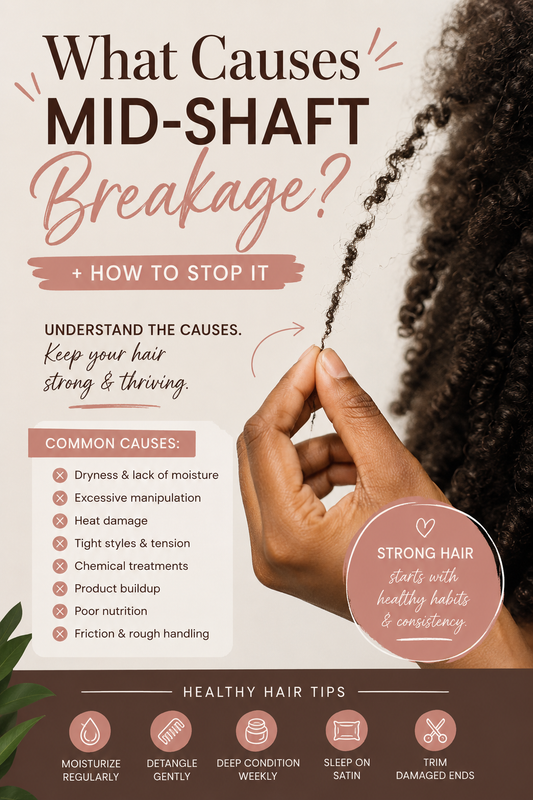
Have you ever noticed short pieces of hair all over your sink, shoulders, or bathroom floor—even though your roots seem healthy and your ends don't appear split? If so, you may be dealing with mid-shaft breakage.
Mid-shaft breakage occurs when hair snaps somewhere between the root and the ends rather than shedding naturally from the follicle. This type of breakage is especially common among people with natural hair, curly hair, coily hair, locs, braids, and chemically treated hair.
For many people, mid-shaft breakage can be frustrating because it prevents length retention. Your hair may actually be growing from the scalp, but the strands continue breaking before you can see progress.
The good news is that mid-shaft breakage is usually preventable once you identify the root cause.
In this comprehensive guide, we'll explore:
- What mid-shaft breakage is
- How to identify it
- The most common causes
- Why Black hair is particularly vulnerable
- How locs, braids, and protective styles contribute
- The best ways to repair and prevent breakage
- A proven routine for stronger hair
Let's dive in.
What Is Mid-Shaft Breakage?
Mid-shaft breakage happens when a hair strand breaks somewhere in the middle instead of falling naturally from the follicle.
Healthy shed hairs typically have a white bulb at one end. Broken hairs usually do not.
Signs include:
- Hair strands of different lengths
- Short broken hairs throughout your head
- Thinning areas
- Reduced length retention
- Increased shedding appearance
- Frizzy sections
- Weak spots in locs
Many people mistake breakage for slow growth.
In reality, their hair is growing normally but breaking faster than it grows.
Why Mid-Shaft Breakage Is So Common in Natural Hair
Natural hair has unique characteristics that make it more vulnerable.
The bends, twists, and coils in curly and coily hair create weak points along the strand.
Each curve can become a stress point where breakage develops.
Natural hair also:
- Loses moisture more quickly
- Experiences more friction
- Is prone to tangling
- Requires careful handling
This doesn't mean natural hair is weak.
It simply means proper care is essential.
The Structure of a Hair Strand
To understand breakage, it's helpful to understand hair anatomy.
Hair consists of three primary layers:
Cuticle
The outer protective layer.
Think of it as shingles on a roof.
Healthy cuticles lie flat.
Damaged cuticles lift and expose the strand.
Cortex
The middle layer.
Contains:
- Protein
- Elasticity
- Strength
- Pigment
Most breakage occurs when damage reaches the cortex.
Medulla
The innermost layer.
Not all hair contains a medulla.
When the cuticle and cortex become compromised, the strand eventually snaps.
Cause #1: Dryness and Lack of Moisture
One of the leading causes of mid-shaft breakage is dryness.
Dry hair becomes brittle.
Brittle hair loses flexibility.
Without flexibility, strands snap when manipulated.
Common causes of dryness include:
- Infrequent moisturizing
- Harsh shampoos
- Overexposure to sun
- Indoor heating
- Hard water
- Product buildup
Hair should bend before it breaks.
Dry hair breaks immediately.
How to Fix It
- Use moisturizing products regularly
- Deep condition weekly
- Seal moisture into strands
- Drink plenty of water
- Avoid overly drying products
Cause #2: Protein Damage
Hair is primarily made of protein.
When protein structures weaken, strands become fragile.
Protein damage can result from:
- Chemical treatments
- Heat damage
- Excessive manipulation
- UV exposure
Signs include:
- Mushy hair
- Stretchy strands
- Weak texture
- Constant snapping
Solution
Restore protein balance with:
- Protein treatments
- Strengthening conditioners
- Protein-rich hair products
Balance is key.
Too much protein can also cause breakage.
Cause #3: Excessive Manipulation
The more you touch your hair, the more stress you place on the strands.
Frequent manipulation includes:
- Constant styling
- Daily brushing
- Excessive combing
- Tight ponytails
- Repeated retwisting
Every manipulation creates friction.
Over time, friction weakens the shaft.
The result is breakage.
Cause #4: Heat Damage
Heat can permanently weaken hair.
Common sources include:
- Flat irons
- Curling irons
- Blow dryers
- Hot combs
Repeated heat exposure removes moisture.
It also weakens protein bonds.
Signs include:
- Hair breaking in random areas
- Loss of curl pattern
- Increased dryness
- Split strands
Heat damage often begins in the middle of the strand before becoming visible elsewhere.
Cause #5: Tight Protective Styles
Protective styles can help retain length.
But styles that are too tight can do the opposite.
Examples include:
- Tight braids
- Tight loc styles
- Tight ponytails
- Tight sew-ins
Constant tension weakens strands.
Weak strands eventually snap.
Pay special attention to:
- Hairline areas
- Crown regions
- Nape sections
These areas often show breakage first.
Cause #6: Product Buildup
Many people overlook buildup.
When oils, butters, gels, and sprays accumulate:
- Moisture can't penetrate
- Hair becomes stiff
- Strands lose flexibility
This leads to hidden dryness.
Eventually, breakage develops.
Signs include:
- Hair feels coated
- Moisturizers stop working
- Dull appearance
Clarifying occasionally can help restore balance.
Cause #7: Chemical Treatments
Chemical processing changes the structure of hair.
Examples include:
- Relaxers
- Permanent color
- Bleach
- Texturizers
These treatments weaken protein bonds.
Overlapping applications are especially damaging.
Hair often begins breaking at the most processed sections.
For many people, that's the middle of the strand.
Cause #8: Rough Detangling
Improper detangling is a major contributor to breakage.
Common mistakes include:
- Detangling dry hair
- Rushing
- Using fine-tooth combs
- Pulling through knots
Every snag weakens the shaft.
Repeated damage creates weak points.
Those weak points eventually break.
Cause #9: Friction
Daily friction can damage hair.
Sources include:
- Cotton pillowcases
- Hats
- Hoodies
- Scarves
- Car headrests
Over time, friction wears down the cuticle.
The cortex becomes exposed.
Breakage follows.
Cause #10: Weak Spots in Locs
Loc wearers frequently experience mid-shaft breakage.
Common reasons include:
Product Buildup
Heavy residue weakens locs.
Uneven Weight Distribution
Heavy ends place stress on thinner sections.
Retwisting Too Frequently
Over-manipulation can weaken roots and shafts.
Dryness
Dry locs become brittle.
Weak points eventually develop and snap.
How Braids Can Cause Mid-Shaft Breakage
Braids are protective when installed correctly.
Problems occur when:
- Hair is braided too tightly
- Extensions are too heavy
- Styles stay in too long
- Hair isn't moisturized
The weight of extensions places stress on strands.
This often causes breakage exactly where tension is highest.
Nutritional Causes of Mid-Shaft Breakage
Hair health starts internally.
Deficiencies can weaken strands.
Common concerns include:
Protein Deficiency
Hair needs amino acids.
Iron Deficiency
Low iron can affect growth and strength.
Vitamin D Deficiency
Linked to hair thinning.
Zinc Deficiency
Impacts follicle health.
Poor Hydration
Dehydration reduces elasticity.
Healthy hair begins with a healthy body.
Signs You Have Mid-Shaft Breakage
Watch for:
- Hair snapping during styling
- Short hairs everywhere
- Uneven length
- Thin spots
- Frizz along strands
- Weak loc sections
- Hair that never seems to get longer
These are classic warning signs.
How to Stop Mid-Shaft Breakage
1. Moisturize Consistently
Moisture improves elasticity.
Hydrated hair bends instead of breaking.
A quality moisturizer can help keep strands soft and flexible.
2. Reduce Manipulation
Less handling equals less stress.
Protective styles should truly be protective.
3. Deep Condition Weekly
Deep conditioning restores moisture.
It also improves elasticity and softness.
4. Trim Damaged Areas
Weak sections continue splitting.
Removing severe damage prevents further breakage.
5. Sleep on Satin
Reduce friction overnight.
Use:
- Satin bonnets
- Satin scarves
- Satin pillowcases
6. Strengthen Weak Hair
Use strengthening treatments periodically.
Balanced protein supports stronger strands.
Best Routine for Preventing Mid-Shaft Breakage
Daily
- Moisturize hair
- Protect hair at night
- Avoid excessive touching
Weekly
- Cleanse scalp
- Deep condition
- Check for tangles
Monthly
- Clarify if needed
- Evaluate breakage
- Trim damaged areas
Consistency matters more than perfection.
The Role of Hair Oils
Hair oils do not magically grow hair.
However, they can help:
- Reduce moisture loss
- Improve flexibility
- Minimize friction
- Support scalp health
When combined with proper moisture, oils can be valuable tools for reducing breakage.
Why Your Hair Isn't Retaining Length
Many people blame slow growth.
Usually, the issue is retention.
Hair grows approximately half an inch per month on average.
That's around six inches annually.
If you never see progress, breakage may be canceling out your growth.
Stopping breakage often reveals how much growth was already happening.
Recovery Timeline
Month 1
- Less shedding
- Improved moisture
Month 2–3
- Reduced breakage
- Improved softness
Month 4–6
- Better length retention
- Stronger strands
Month 6–12
- Noticeable growth
- Fuller appearance
Patience is essential.
Hair recovery takes time.
Final Thoughts
Mid-shaft breakage is one of the biggest obstacles to healthy hair growth and length retention. Whether you wear natural hair, locs, braids, twists, or curls, breakage can prevent you from seeing the results you're working hard to achieve.
The most common causes include dryness, excessive manipulation, heat damage, tight styles, chemical processing, product buildup, friction, and nutritional deficiencies.
Fortunately, most forms of breakage can be prevented through proper moisture, gentle handling, consistent scalp care, and a balanced hair routine.
If your hair seems stuck at the same length year after year, don't assume it isn't growing. In many cases, your hair is growing just fine—it simply isn't surviving long enough to show the progress.
Focus on strengthening the strand, protecting moisture, and reducing stress on the hair shaft. Over time, healthier habits lead to stronger hair, better retention, and the longer, fuller hair you deserve.