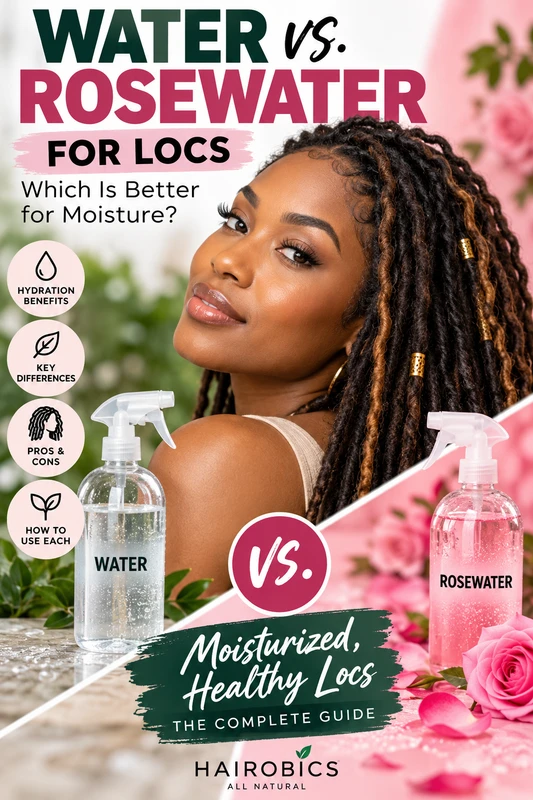
Keeping locs properly moisturized sounds simple until you start looking at all the different products and techniques recommended for loc care.
Some people mist their locs with plain water every morning. Others swear by rosewater. Some mix rosewater with oils, aloe vera, glycerin, or other ingredients. And others prefer a ready-made moisturizing spray designed specifically for locs.
This raises an important question:
Is water or rosewater better for locs?
The simple answer is that both water and rosewater can be useful for locs, but they aren't necessarily interchangeable.
Plain water provides straightforward hydration without adding extra ingredients to your hair. Rosewater is primarily water too, but depending on how it is produced and formulated, it can offer a pleasant scent and additional botanical components.
However, neither option automatically guarantees that your locs will stay moisturized all day.
The bigger issue is understanding what your locs actually need.
If your locs repeatedly feel dry, rough, stiff, or brittle, simply spraying them with more liquid may not solve the underlying problem. Your cleansing routine, environment, product buildup, hair porosity, frequency of moisturizing, and products you use can all affect how your locs retain moisture.
In this complete guide, we'll compare water vs. rosewater for locs, explain the advantages and disadvantages of each, discuss how often you should mist your locs, and show you how to build a simple moisture routine that keeps your locs soft, flexible, and healthy-looking.
Why Do Locs Need Moisture?
Locs may look extremely strong, but they are still made from individual strands of hair.
Those strands can become dry.
As locs mature, individual hairs intertwine and compact together. Although this structure gives locs their characteristic appearance and strength, the hair still experiences environmental exposure, shampooing, friction, heat, styling, and normal wear.
Dry locs may eventually feel:
- Rough
- Hard
- Stiff
- Crunchy
- Brittle
- Dull
- Less flexible
When dryness becomes severe, the individual strands making up the loc may become more vulnerable to breakage.
That is why moisture should be a regular part of your loc-care routine.
If dryness is already a problem for you, read our complete guide on Why Your Locs Are Dry and How to Fix It.
The goal isn't to keep your locs soaking wet.
Instead, you want to maintain enough hydration that the hair remains flexible and comfortable without constantly saturating the inside of your locs.
That distinction is important.
Moisturized locs and wet locs are not the same thing.
Is Water Good for Locs?
Yes.
Water is one of the most basic sources of hydration for hair.
In fact, when someone says their hair needs "moisture," water is an important part of what they're talking about.
A light water mist can temporarily help dry locs feel softer and more flexible.
Water also has several advantages.
It's inexpensive, readily available, lightweight, and doesn't contain oils, waxes, butters, creams, or styling ingredients that can potentially accumulate inside locs.
This simplicity makes water particularly attractive to people trying to maintain a minimal loc-care routine.
Benefits of Using Water on Locs
Plain water can be helpful because it:
- Provides direct hydration
- Is lightweight
- Doesn't weigh locs down
- Doesn't contain heavy butters or waxes
- Can help temporarily soften dry hair
- Is inexpensive
- Can easily be placed in a misting bottle
- Works well as the first step before applying certain lightweight moisturizing products
For people who are extremely sensitive to product buildup, water can be an excellent foundation for a simplified routine.
Can You Spray Your Locs With Water Every Day?
You can lightly mist locs with water as needed, but that doesn't mean everyone needs to saturate their locs every single day.
Pay attention to your hair.
If your locs feel soft and flexible, you may not need additional moisture that day.
If they feel noticeably dry, a light mist may help.
The key word is light.
You don't necessarily need to soak mature locs from root to tip every morning.
This becomes particularly important with thick locs.
Dense locs can hold water internally for much longer than loose hair. If you repeatedly soak thick locs without allowing them to dry thoroughly, the interior can remain damp.
Hairobics explains this issue in greater detail in Why Do Locs Take So Long to Dry?.
Think mist, not drench when refreshing your locs between wash days.
The Problem With Using Only Water
Water can hydrate hair, but there is a limitation:
Water evaporates.
You may mist your locs in the morning and notice that they immediately feel softer.
Several hours later, however, they may feel dry again.
That doesn't necessarily mean water is bad for your locs.
It means your moisture routine may need something more than repeatedly wetting your hair.
Factors such as dry weather, indoor heating, air conditioning, hair porosity, frequent shampooing, sun exposure, and your individual hair characteristics can affect how quickly your locs feel dry again.
This is one reason some people prefer rosewater or a lightweight moisturizing spray rather than relying exclusively on plain water.
What Is Rosewater?
Rosewater is a fragrant liquid associated with roses and is commonly produced through processes involving rose petals and water, including distillation.
It has been used for generations in beauty and personal-care routines.
Today, rosewater can be found in:
- Facial products
- Hair products
- Scalp sprays
- Body products
- Fragrances
- DIY hair mixtures
Because it is predominantly water-based, rosewater can provide many of the same immediate hydration benefits you experience when misting your hair with plain water.
The difference is that rosewater may also contain naturally derived aromatic compounds from roses.
For many people, the biggest noticeable difference is simply the experience: rosewater provides hydration while leaving behind a light floral aroma.
Is Rosewater Good for Locs?
Rosewater can be incorporated into a loc-care routine.
Because it is water-based, it can work well as a lightweight mist for refreshing locs without applying a thick cream, butter, or wax.
This is particularly appealing for locs because heavy products can sometimes become trapped between the intertwined strands.
Rosewater may be a good option for people who want something that feels more luxurious than plain water while still maintaining a relatively simple routine.
However, don't assume that something labeled "rosewater" is automatically ideal for your hair.
Read the ingredient list.
Products sold as rosewater sprays can contain additional ingredients, including fragrance, preservatives, humectants, oils, or other botanical ingredients.
The formula matters.
Water vs. Rosewater for Locs: What's the Difference?
At their core, water and rosewater can both help provide hydration.
But there are several practical differences.
Plain Water
Water is the simplest option.
It provides hydration without fragrance or additional botanical ingredients.
Advantages:
- Extremely inexpensive
- Easy to find
- No fragrance
- Minimal ingredients
- Lightweight
- Very low risk of product buildup from the water itself
Disadvantages:
- Evaporates relatively quickly
- May not keep very dry locs feeling moisturized for long
- Doesn't provide the sensory benefits of rosewater
- May require another product as part of a complete moisture routine
Rosewater
Rosewater provides water-based hydration with rose-derived components and typically a natural floral scent.
Advantages:
- Lightweight
- Refreshing
- Pleasant aroma for many people
- Easy to mist onto locs
- Can replace plain water in some refreshing routines
Disadvantages:
- More expensive than tap or filtered water
- Quality varies significantly between products
- Some formulas contain additional ingredients
- Fragrance may not be appropriate for everyone
- Still may not provide enough lasting moisture by itself
Which Is Better: Water or Rosewater for Locs?
Neither is automatically better for everyone.
If your goal is simply to add lightweight hydration with the fewest possible ingredients, plain water is difficult to beat.
If you enjoy the aroma and experience of rosewater, rosewater can be a pleasant alternative.
But here's the important part:
If your locs are chronically dry, switching from water to rosewater alone may not completely solve the problem.
You need to look at your entire loc routine.
Ask yourself:
Are you shampooing with something that leaves your hair excessively stripped?
Are you using heavy products that are coating your locs?
Are you moisturizing often enough?
Are you spending significant time in extremely dry environments?
Are you using excessive heat?
Are your locs colored?
Are you applying lots of gel during retwists?
These factors can matter more than whether the liquid in your spray bottle is plain water or rosewater.
Rosewater vs. Regular Water for Dry Locs
For mildly dry locs, either can work well as a refreshing mist.
For chronically dry locs, neither may be enough on its own.
This is where a properly formulated water-based loc moisturizer can become useful.
A moisturizing spray can combine water with other conditioning and moisturizing ingredients so you aren't relying solely on water that quickly evaporates.
Hairobics All Natural's Raaw Roots Locs & Braids Moisturizer Spray is formulated with purified water along with botanical oils, glycerin, rose oil, rosemary oil, lavender oil, jojoba oil and herbal ingredients. It's designed to moisturize and condition locs, braids, natural hair and the scalp.
That makes it another option for people who want a convenient loc moisturizer instead of mixing their own water-and-oil combinations.
What About Rosewater and Glycerin for Locs?
Glycerin is a humectant commonly found in hair and skin products.
Humectants interact with water, which is why glycerin appears in many moisturizing formulas.
But DIY mixtures require some caution.
More glycerin isn't automatically better.
How your hair responds can vary based on your hair, the amount used, the rest of the formula, and environmental conditions.
Rather than continuously adding random amounts of glycerin to a spray bottle, many people find it easier to use a professionally formulated moisturizing spray containing glycerin in combination with other ingredients.
The Raaw Roots Locs & Braids Moisturizer Spray, for example, already contains vegetable glycerin as part of its formulation.
Should You Mix Rosewater and Oil for Locs?
You can use water-based moisture and oils in the same loc routine, but remember one important principle:
Oil and water perform different jobs.
Oil isn't a substitute for water.
If your locs are dehydrated, covering them in more and more oil doesn't necessarily provide the hydration they need.
This is one reason some people end up with locs that simultaneously feel greasy and dry.
They keep adding oil because their hair feels dry.
The locs become coated.
Yet the underlying dryness remains.
If you've experienced this problem, simplifying your routine may help.
Start with lightweight water-based moisture and use oils conservatively rather than saturating your locs every day.
Can Too Much Product Make Locs Feel Dry?
Absolutely.
Sometimes people assume that dryness always means they need more product.
But buildup can actually make loc maintenance more difficult.
Heavy waxes, creams, gels, butters, oils, and styling products can accumulate between the compacted strands inside mature locs.
Eventually, your locs may feel:
- Coated
- Heavy
- Sticky
- Dull
- Stiff
- Hard
- Difficult to moisturize
If that sounds familiar, read How to Prevent Loc Buildup.
A good loc routine doesn't require coating your hair with products every day.
Often, less is more.
Water, Rosewater and Stiff Locs
If your locs feel stiff, adding moisture may help—but don't automatically assume lack of water is the only cause.
Stiffness can also be associated with product buildup, mineral deposits from hard water, heavy oils, styling products, or an overly aggressive cleansing routine.
That means continually spraying stiff locs without addressing the underlying cause may only provide temporary relief.
Our guide Why Do My Locs Feel Stiff? explains the common causes in more detail.
Healthy mature locs will naturally feel compact, but they shouldn't constantly feel like rigid ropes.
How Often Should You Moisturize Locs?
There isn't one perfect schedule.
Some people need a light moisture refresh every day or two.
Others can go several days before their locs begin feeling dry.
Your ideal schedule depends on:
- Hair porosity
- Loc thickness
- Loc maturity
- Climate
- Indoor environment
- Activity level
- Shampoo routine
- Hair coloring
- Product use
- Scalp condition
Instead of blindly following someone else's schedule, learn how your own locs respond.
You can find a more detailed routine in our guide to How to Moisturize Locs Properly.
A Simple Water-Based Loc Moisture Routine
You don't need 15 products to maintain moisturized locs.
A simple routine can be extremely effective.
Step 1: Check Your Locs
Before applying anything, touch your hair.
Do your locs actually feel dry?
If they're already soft and flexible, don't add moisture simply because your calendar says it's time.
Step 2: Lightly Mist
If your locs feel dry, lightly mist them with water, rosewater, or a water-based moisturizing spray.
Your locs should feel refreshed—not soaked.
Step 3: Distribute the Moisture
Use clean hands to gently press the moisture along your locs.
Pay particular attention to areas that consistently become dry.
Step 4: Allow Your Locs to Dry
Don't immediately cover damp locs with a bonnet, hat, scarf, or other covering that significantly reduces airflow.
Give moisture an opportunity to evaporate.
Step 5: Monitor Your Hair
Several hours later, check your locs again.
Do they feel soft?
Are they flexible?
Do they feel coated?
Did they become dry again almost immediately?
Your hair's response helps you determine whether your current routine is working.
Don't Confuse Moisturizing With Soaking
This is especially important for people with thick mature locs.
A light mist and fully saturating your hair are two completely different things.
Thick locs can absorb water internally.
The outside may feel dry while the center remains damp.
If you have thick locs, our How to Dry Thick Locs guide explains why thorough drying matters.
This is also why you shouldn't continuously soak your locs multiple times per day in an attempt to fight dryness.
If your hair requires that much water just to remain comfortable, investigate why it is becoming dry so quickly.
Does Washing Affect Loc Moisture?
Definitely.
Shampooing is essential for keeping your scalp and locs clean, but your cleansing technique can influence how your hair feels afterward.
Using extremely hot water, very harsh cleansers, or washing far more frequently than your hair and scalp require may contribute to dryness.
On the other hand, avoiding shampoo for extremely long periods isn't the answer either.
Sweat, scalp oils, styling products, lint, dead skin, and environmental debris can accumulate.
For many people with established locs, washing approximately every 7–14 days can be a practical starting point, although your individual schedule may differ.
Read Can You Wash Locs Too Often? for a deeper explanation of how to find the right cleansing frequency.
Water vs. Rosewater for Starter Locs
Starter locs deserve special consideration.
New locs haven't developed the tightly intertwined internal structure of mature locs.
Excessive manipulation and repeated saturation can encourage some starter methods to loosen or unravel.
That doesn't mean starter locs should never come into contact with water.
Your scalp still needs appropriate cleansing and care.
However, you may need to be gentler about how you mist, wash, and manipulate newer locs.
When refreshing starter locs, use a fine mist rather than blasting the hair with a heavy stream of water.
And when wash day arrives, use gentle techniques.
Our How to Wash Locs Without Unraveling guide provides a complete washing routine for newer locs.
Common Mistakes When Using Water or Rosewater on Locs
1. Soaking Your Locs Every Morning
More water doesn't necessarily mean healthier locs.
Use enough to refresh the hair rather than keeping mature locs continually wet.
2. Sleeping With Wet Locs
Try to let your locs dry before going to bed.
Thick locs can hold moisture internally longer than you might realize.
3. Adding Too Much Oil
Your hair shouldn't need to be saturated in oil after every mist.
Heavy oil use can eventually leave locs coated.
4. Ignoring Product Buildup
If your locs no longer seem to absorb moisture properly, investigate whether buildup may be interfering with your routine.
5. Assuming Rosewater Is a Miracle Treatment
Rosewater can be a pleasant lightweight addition to your routine, but it isn't a cure for every loc problem.
6. Using Heavy Creams to Fight Dryness
Thick creams and butters can be difficult to remove completely from mature locs.
Water-based products are often easier to incorporate into a simple loc routine.
7. Moisturizing Without Cleansing
Adding more moisture spray on top of weeks of sweat, oil and styling products isn't the same as washing your hair.
Locs still need regular cleansing.
Water vs. Rosewater for Locs: Final Verdict
So, which one wins?
Water is the best choice if you want the simplest, least expensive and most basic source of hydration.
Rosewater is a good choice if you want lightweight water-based hydration with the additional experience and fragrance associated with roses.
But neither one automatically solves chronic loc dryness.
Your entire routine matters.
Clean your locs regularly.
Avoid excessive buildup.
Use heavy products sparingly.
Moisturize according to what your hair actually needs.
Allow wet locs to dry thoroughly.
And pay attention to changes in texture, flexibility and softness.
If plain water or rosewater isn't giving your locs enough lasting moisture, consider using a lightweight water-based moisturizing formula rather than continuously saturating your hair.
Hairobics All Natural's Raaw Roots Locs & Braids Moisturizer Spray combines purified water with botanical oils, glycerin, rose oil and herbal ingredients in a spray designed specifically for locs, braids and natural hair.
A few light sprays can make it easier to incorporate moisture into your routine without relying on thick creams, waxes, or butters.
Frequently Asked Questions
Is rosewater better than water for locs?
Not necessarily. Both can provide water-based hydration. Plain water is simpler and cheaper, while rosewater offers a floral aroma and rose-derived components. Which works better depends on your preferences and how your hair responds.
Can I spray water on my locs every day?
A light water mist can be used as needed, but you don't have to wet your locs every day if they already feel moisturized. Avoid repeatedly soaking thick locs without allowing them to dry thoroughly.
Can I use rosewater on my locs every day?
Some people use a light rosewater mist regularly. However, pay attention to how your locs respond and check the complete ingredient list of the rosewater product you're using.
Does rosewater moisturize dry locs?
Because rosewater is predominantly water-based, it can provide temporary hydration. Very dry locs may require a broader moisturizing routine rather than relying exclusively on rosewater.
Should I mix oil with water for my locs?
You don't have to. Water and oils serve different purposes, and excessive oil can leave locs coated. If you use oil, apply it conservatively.
What is the best spray for dry locs?
Look for a lightweight, water-based formula that provides moisture without relying on thick waxes, creams, or butters that can become difficult to remove from locs.
Why are my locs dry even though I spray them with water?
Your water may simply be evaporating quickly, or other factors could be involved, including product buildup, your cleansing routine, environment, hair porosity, heat exposure, or chemical/color treatments.
Is rosewater good for starter locs?
Rosewater can be used lightly on starter locs, but avoid unnecessarily soaking new locs. Starter locs are more susceptible to loosening and unraveling than mature locs.
Should I use distilled water in my loc spray bottle?
Distilled water can be useful for DIY mixtures because it doesn't contain the minerals found in some tap water. However, homemade mixtures containing additional ingredients can have preservation and contamination concerns, so avoid keeping DIY mixtures indefinitely.
Can I use just water on my locs?
Yes. Some people maintain very simple routines using water as their primary hydration source. If your locs remain soft, flexible and comfortable, there is no requirement to use rosewater.
The Bottom Line
When comparing water vs. rosewater for locs, don't make the decision more complicated than it needs to be.
Both can have a place in a healthy loc-care routine.
Plain water offers simple hydration.
Rosewater offers water-based hydration with a pleasant botanical experience.
A formulated moisturizing spray can provide water along with additional moisturizing and conditioning ingredients.
The best option is ultimately the one that leaves your locs feeling soft, flexible, clean, lightweight and manageable without creating unnecessary buildup.
Pay attention to your hair rather than trends.
Your locs will tell you what they need.
And remember: healthy locs don't come from one miracle ingredient. They come from consistent cleansing, appropriate moisture, minimal buildup, thorough drying, gentle handling, and a routine you can maintain over the long term.