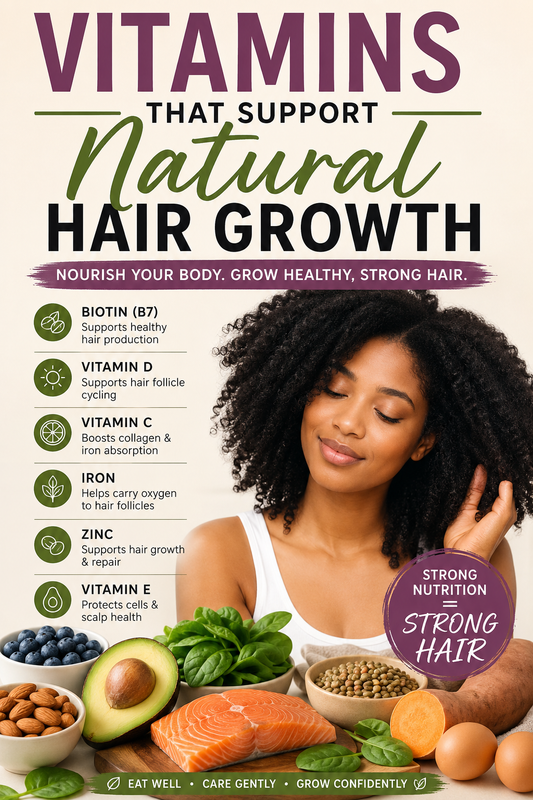
Natural hair growth is influenced by much more than the products you apply to your scalp. While a consistent hair-care routine can help reduce breakage, improve moisture retention, and keep your scalp in good condition, nutrition also plays an important role in maintaining healthy hair.
Your hair follicles are living structures that depend on nutrients supplied through the bloodstream. Vitamins, minerals, protein, essential fatty acids, and adequate calories all contribute to normal hair formation and maintenance.
For people with Black hair, natural hair, curly hair, coily hair, locs, braids, twists, or other textured hairstyles, retaining healthy growth can be especially challenging because tightly curled strands may be more vulnerable to dryness and breakage.
That is why supporting your hair from both the inside and outside can be an important part of a complete natural hair routine.
But which vitamins actually support hair growth? Is biotin really necessary? Can vitamin D affect your hair? What about iron, zinc, vitamin C, or vitamin E?
This complete guide explores the best vitamins and nutrients for natural hair growth, how they support the hair-growth process, which foods contain them, signs you may not be getting enough, and what you should know before taking hair supplements.
Table of Contents
- How Nutrition Affects Natural Hair Growth
- Understanding the Natural Hair Growth Cycle
- Vitamin A for Healthy Hair
- B Vitamins and Natural Hair Growth
- Biotin for Natural Hair
- Vitamin B12 and Hair Health
- Folate and Healthy Hair
- Vitamin C for Natural Hair
- Vitamin D and Hair Follicles
- Vitamin E for Natural Hair
- Iron and Healthy Hair Growth
- Zinc and Hair Health
- Protein and Natural Hair
- Omega-3 Fatty Acids
- Magnesium and Hair Health
- Selenium and Natural Hair
- Best Foods for Hair-Supporting Nutrients
- Should You Take Hair Vitamins?
- Can Too Many Vitamins Cause Hair Problems?
- Vitamins vs. Hair Products
- Natural Hair Growth Routine
- Frequently Asked Questions
- Final Thoughts
How Nutrition Affects Natural Hair Growth
Hair may look like a simple strand once it emerges from your scalp, but hair production is a biologically demanding process.
Each strand originates inside a follicle beneath the surface of the skin. Cells within the follicle divide and eventually form the hair shaft.
To maintain this process, the body needs adequate nutrition.
Nutrients involved in normal hair health include:
- Protein
- Iron
- Zinc
- Vitamin A
- Vitamin C
- Vitamin D
- Vitamin E
- B vitamins
- Essential fatty acids
- Selenium and other trace minerals
This does not mean taking large amounts of vitamins will automatically make your hair grow faster.
If you already consume adequate amounts of a nutrient, taking significantly more does not necessarily increase your growth rate. In some cases, excessive supplementation can actually be harmful.
Nutrition is especially important when a deficiency exists. Correcting an actual deficiency may help restore normal biological processes, including those involved in healthy hair.
Understanding the Natural Hair Growth Cycle
Before discussing individual vitamins, it helps to understand how hair grows.
Hair goes through several phases.
Anagen Phase
The anagen phase is the active growth phase.
During this period, cells within the follicle are actively producing hair. Scalp hairs can remain in this stage for years.
How long an individual hair stays in anagen is influenced significantly by genetics and biology.
Catagen Phase
The catagen phase is a short transitional period.
Hair growth slows, and the follicle begins transitioning away from active growth.
Telogen Phase
The telogen phase is often described as the resting phase.
The strand eventually sheds as the follicle prepares for another growth cycle.
Some shedding is therefore completely normal.
Nutrition cannot eliminate the natural hair cycle, but adequate nutrition helps give your body the materials it needs to support normal follicle function.
1. Vitamin A for Healthy Hair
Vitamin A is an essential nutrient involved in numerous processes throughout the body, including normal cell growth and immune function.
Because hair follicles contain rapidly dividing cells, adequate nutrition is important.
Vitamin A also contributes to normal skin health, making it relevant to overall scalp health.
Foods Containing Vitamin A
Foods that provide vitamin A or vitamin A precursors include:
- Sweet potatoes
- Carrots
- Spinach
- Kale
- Collard greens
- Pumpkin
- Eggs
- Dairy products
- Liver
Orange vegetables are particularly well known for beta-carotene, which the body can convert into vitamin A.
More Isn't Better
Vitamin A demonstrates one of the biggest problems with the "more vitamins = more hair" philosophy.
Excessive vitamin A intake, particularly through supplements, can cause health problems and may contribute to hair loss.
The goal should be adequate nutrition rather than megadosing.
2. B Vitamins and Natural Hair Growth
The B-vitamin family includes several nutrients involved in normal cellular metabolism.
The group includes:
- B1 (thiamine)
- B2 (riboflavin)
- B3 (niacin)
- B5 (pantothenic acid)
- B6
- B7 (biotin)
- B9 (folate)
- B12
You will frequently see B vitamins included in supplements marketed for natural hair.
However, having B vitamins in a product doesn't automatically mean the supplement will accelerate hair growth.
Their importance is primarily related to maintaining adequate nutritional status.
A balanced diet usually provides multiple B vitamins through foods such as:
- Eggs
- Fish
- Poultry
- Meat
- Beans
- Lentils
- Whole grains
- Leafy vegetables
- Nuts
- Seeds
3. Biotin for Natural Hair
Few vitamins have become as closely associated with hair as biotin.
Biotin is vitamin B7.
It plays a role in normal metabolism, helping enzymes process fats, carbohydrates, and amino acids.
Because biotin deficiency can affect hair, skin, and nails, biotin eventually became heavily marketed as a "hair growth vitamin."
But there is an important distinction.
Does Biotin Make Natural Hair Grow Faster?
Biotin is important to normal health, but that doesn't mean taking extra biotin automatically produces faster or longer hair.
True biotin deficiency is relatively uncommon.
If someone is deficient, correcting the deficiency can be important. If someone already receives adequate biotin, however, extremely high-dose supplementation isn't necessarily going to transform their growth rate.
Foods Containing Biotin
Natural sources include:
- Eggs
- Salmon
- Nuts
- Seeds
- Sweet potatoes
- Avocados
- Legumes
- Meat
For many people, eating a balanced diet is enough to obtain biotin.
Important Note About Biotin Supplements
High-dose biotin can interfere with certain laboratory tests and potentially produce misleading results.
Tell your healthcare provider about supplements you're taking, particularly before blood testing.
4. Vitamin B12 and Hair Health
Vitamin B12 contributes to normal red blood cell formation, DNA synthesis, and nervous-system function.
Because hair follicles depend on normal cellular processes and adequate nutrient delivery, B12 is part of the larger nutritional picture surrounding healthy hair.
Vitamin B12 occurs naturally primarily in animal-derived foods.
Sources include:
- Beef
- Fish
- Shellfish
- Chicken
- Eggs
- Milk
- Yogurt
- Fortified foods
People following certain vegetarian or vegan diets may need to pay closer attention to B12 intake because plant foods generally aren't reliable natural sources.
A medical professional can determine whether testing or supplementation is appropriate.
5. Folate and Healthy Hair
Folate is vitamin B9.
It is essential for DNA synthesis and normal cell division.
Natural dietary sources include:
- Spinach
- Collard greens
- Asparagus
- Brussels sprouts
- Beans
- Peas
- Avocados
- Oranges
- Fortified grains
Folate supplements are commonly sold as folic acid or other supplemental forms.
As with other nutrients, supplementation should be based on nutritional needs rather than the assumption that increasingly large doses will create increasingly fast hair growth.
6. Vitamin C for Natural Hair
Vitamin C deserves more attention in discussions about healthy natural hair.
It performs several important functions.
Vitamin C Supports Collagen Formation
Vitamin C is required for normal collagen synthesis.
Collagen is an important structural protein throughout the body.
Vitamin C Helps With Iron Absorption
This is particularly relevant to hair nutrition.
Vitamin C can increase the absorption of non-heme iron—the type of iron found primarily in plant foods.
Someone eating lentils, beans, spinach, or other plant sources of iron can pair those foods with vitamin C-rich foods.
For example:
Spinach + bell peppers
or
Beans + tomatoes
or
Fortified cereal + strawberries
Vitamin C-Rich Foods
Excellent sources include:
- Oranges
- Grapefruit
- Strawberries
- Kiwi
- Bell peppers
- Broccoli
- Tomatoes
- Brussels sprouts
Instead of thinking about one "miracle vitamin," think about how nutrients work together.
7. Vitamin D and Hair Follicles
Vitamin D has become an increasingly discussed nutrient in conversations about hair.
Vitamin D has numerous biological functions, and research has examined associations between vitamin D status and certain forms of hair loss.
However, that does not mean everyone experiencing slow hair growth should immediately start taking large doses of vitamin D.
The appropriate approach is determining whether a deficiency actually exists.
Sources of Vitamin D
Vitamin D can come from:
- Sunlight exposure
- Fatty fish
- Egg yolks
- Fortified milk
- Fortified plant milks
- Certain fortified foods
- Supplements when appropriate
Several factors can influence vitamin D status, including diet, sun exposure, age, skin pigmentation, geography, and health conditions.
A blood test can be used to evaluate vitamin D status when medically appropriate.
8. Vitamin E for Natural Hair
Vitamin E functions as an antioxidant and contributes to normal cellular protection.
It is frequently included in hair oils, scalp products, conditioners, and supplements.
Dietary sources include:
- Almonds
- Sunflower seeds
- Avocados
- Spinach
- Peanuts
- Vegetable oils
- Hazelnuts
Rather than depending entirely on vitamin E capsules, regularly eating nuts, seeds, vegetables, and other nutrient-dense foods can contribute vitamin E as part of a balanced diet.
9. Iron and Healthy Hair Growth
Iron is technically a mineral rather than a vitamin, but it deserves a major place in any discussion about nutrition and hair.
Iron is required to produce hemoglobin, the protein in red blood cells responsible for carrying oxygen.
Iron deficiency is one nutritional issue that can be associated with hair shedding in some people.
Iron-Rich Foods
Sources include:
- Beef
- Poultry
- Seafood
- Lentils
- Beans
- Spinach
- Fortified cereals
- Tofu
- Pumpkin seeds
Iron from animal foods generally has higher bioavailability than non-heme iron from plant foods.
As mentioned earlier, vitamin C can improve the absorption of plant-based iron.
Should You Take an Iron Supplement for Hair Growth?
Do not automatically start taking high-dose iron simply because your hair seems to be growing slowly.
Too much iron can be harmful.
If you are experiencing unusual or persistent hair shedding, a healthcare professional can determine whether testing for iron status or other potential causes is appropriate.
10. Zinc and Hair Health
Zinc is another essential mineral involved in numerous processes, including immune function, protein synthesis, DNA synthesis, and wound healing.
It also contributes to normal cell growth.
Foods containing zinc include:
- Oysters
- Beef
- Crab
- Chicken
- Beans
- Pumpkin seeds
- Fortified cereals
- Nuts
- Dairy products
Both inadequate and excessive nutrient intake can create problems.
This is another reason a "more is better" approach to supplements isn't ideal.
11. Protein: One of the Most Important Hair Nutrients
People often focus on vitamins while overlooking one of the most basic nutritional components of hair:
Protein.
Hair is composed primarily of a protein called keratin.
Your body obtains amino acids from dietary protein and uses them for numerous functions.
Good protein sources include:
- Eggs
- Chicken
- Turkey
- Fish
- Beef
- Greek yogurt
- Cottage cheese
- Beans
- Lentils
- Tofu
- Tempeh
- Nuts
- Seeds
You do not need an extreme high-protein diet simply because you want longer hair.
However, chronically inadequate protein or overall calorie intake can affect the body in many ways.
12. Omega-3 Fatty Acids and Natural Hair
Omega-3 fatty acids aren't vitamins, but they are essential fats.
They are important components of cell membranes and contribute to numerous biological functions.
Sources include:
- Salmon
- Sardines
- Mackerel
- Herring
- Chia seeds
- Flaxseeds
- Walnuts
Including healthy fats in your diet can be part of an overall nutrient-rich eating pattern that supports skin, scalp, and general health.
13. Magnesium and Hair Health
Magnesium participates in hundreds of biochemical reactions throughout the body.
It supports functions involving:
- Energy production
- Protein synthesis
- Muscle and nerve function
- Normal cellular processes
Magnesium-rich foods include:
- Pumpkin seeds
- Chia seeds
- Almonds
- Spinach
- Black beans
- Whole grains
- Avocados
There isn't strong evidence that simply taking extra magnesium will make adequately nourished people grow hair faster.
Its value comes from being one component of overall good nutrition.
14. Selenium and Natural Hair
Selenium is a trace mineral involved in antioxidant defense and thyroid hormone metabolism.
The body only needs relatively small amounts.
Food sources include:
- Seafood
- Meat
- Poultry
- Eggs
- Dairy products
- Certain nuts and grains
Selenium is another nutrient where excessive intake can become problematic.
In fact, too much selenium may contribute to hair and nail problems.
This makes high-dose supplementation without a medical reason particularly unnecessary.
The Best Foods for Natural Hair Growth
Rather than building your entire hair-growth strategy around supplements, focus first on a nutrient-dense diet.
Some excellent foods to incorporate regularly include:
Eggs
Eggs provide:
- Protein
- Biotin
- B vitamins
- Other important nutrients
They are an easy addition to breakfast, salads, or meals.
Salmon
Salmon provides:
- High-quality protein
- Omega-3 fatty acids
- B vitamins
- Vitamin D
Sweet Potatoes
Sweet potatoes contain beta-carotene, which the body can convert to vitamin A.
Spinach
Spinach contains several nutrients, including:
- Folate
- Vitamin C
- Beta-carotene
- Iron
- Magnesium
Lentils
Lentils are especially useful for plant-based diets because they provide:
- Protein
- Iron
- Folate
- Fiber
Avocados
Avocados provide:
- Vitamin E
- Healthy fats
- Folate
- Other micronutrients
Berries
Strawberries and other berries provide vitamin C and various plant compounds.
Nuts and Seeds
Options include:
- Almonds
- Walnuts
- Pumpkin seeds
- Sunflower seeds
- Chia seeds
- Flaxseeds
They can provide combinations of healthy fats, vitamin E, zinc, magnesium, protein, and other nutrients.
A Sample Day of Eating for Healthy Natural Hair
There is no special "natural hair diet," but a nutrient-dense day could look something like this.
Breakfast
Eggs with spinach and avocado, plus berries.
Lunch
Grilled chicken or tofu with quinoa, mixed vegetables, and leafy greens.
Snack
Greek yogurt with walnuts and strawberries.
Dinner
Salmon with sweet potatoes and broccoli.
Plant-Based Alternative
Replace animal proteins with foods such as:
- Lentils
- Chickpeas
- Beans
- Tofu
- Tempeh
- Quinoa
- Nuts
- Seeds
The objective is variety.
Your body needs more than one vitamin to function properly.
Should You Take Hair Vitamins?
Walk through almost any supplement aisle and you'll find bottles promising:
- Longer hair
- Stronger hair
- Faster growth
- Thicker hair
- Healthier hair
Some contain biotin.
Others combine dozens of vitamins, minerals, herbs, and botanical ingredients.
So do you actually need one?
Maybe—but not automatically.
Supplements can be useful when there is a nutritional deficiency or when dietary intake is insufficient.
However, they should not be viewed as guaranteed hair-growth accelerators.
If you eat a varied, nutritionally adequate diet, adding enormous doses of vitamins may provide little additional benefit.
If you're considering supplements because you're experiencing significant shedding or hair loss, it may be more useful to investigate the underlying reason.
Can Too Many Vitamins Cause Hair Problems?
Yes.
This point is extremely important.
People sometimes assume vitamins are harmless because they're sold without a prescription.
But supplements contain biologically active compounds.
Extremely high intake of certain nutrients can create health problems.
Excessive amounts of nutrients such as vitamin A or selenium, for example, can potentially contribute to hair loss.
High-dose supplements may also interact with medications or interfere with medical testing.
That is why the safest goal is:
Correct deficiencies—not megadose nutrients in an attempt to force hair growth.
Hair Vitamins vs. Natural Hair Products
Nutrition and topical hair care serve different purposes.
A vitamin cannot replace conditioner.
A moisturizer cannot correct an iron deficiency.
Think of healthy natural hair as requiring two complementary strategies.
Internal Support
This includes:
- Balanced nutrition
- Adequate protein
- Adequate vitamins and minerals
- Hydration
- Sufficient calories
- Overall health
External Hair Care
This includes:
- Gentle cleansing
- Conditioning
- Moisturizing
- Detangling carefully
- Protecting the ends
- Maintaining the scalp
- Limiting excessive heat
- Avoiding unnecessarily tight styles
- Reducing mechanical breakage
You need to protect the hair that your follicles produce.
Hair Growth vs. Length Retention
This distinction is particularly important for natural hair.
Sometimes people believe their natural hair isn't growing when the real problem is length retention.
Your scalp may be producing new hair normally, but the ends could be breaking at approximately the same rate.
Imagine growing six inches of hair while losing several inches from repeated breakage.
It might look as though your hair barely grew.
This is why vitamins alone cannot solve every length problem.
If breakage is the primary issue, you also need to address the way you handle your hair.
Why Natural Hair Can Struggle With Length Retention
Curly and coily strands have bends and curves throughout the hair shaft.
Natural scalp oils may have more difficulty traveling down these strands than they do on straighter hair.
As a result, the ends can become particularly dry.
The ends are also the oldest portion of your hair.
Over time, they experience:
- Washing
- Detangling
- Styling
- Friction
- Weather exposure
- Heat
- Manipulation
That makes protecting your ends extremely important when trying to grow longer natural hair.
A Natural Hair Routine to Support Length Retention
Nutrition gives your body the building blocks it needs internally.
A consistent routine helps protect your strands externally.
Step 1: Keep Your Scalp Clean
Product buildup, sweat, excess oil, and debris can accumulate on the scalp.
Wash according to your scalp, hairstyle, activity level, and product usage.
You don't need to avoid shampoo simply because you're trying to grow your hair.
Scalp cleanliness is part of healthy hair care.
Step 2: Condition Regularly
Conditioning helps improve manageability and reduce friction between strands.
This can make detangling easier.
Focus particularly on your lengths and ends.
Step 3: Detangle Carefully
Aggressive detangling can destroy length retention.
Work in sections.
Start near the ends and gradually work upward.
Use your fingers or an appropriate detangling tool.
Avoid ripping through knots.
Step 4: Maintain Moisture
Natural hair often benefits from consistent moisture management.
Depending on your hair, this might involve:
- Water-based leave-in products
- Creams
- Moisturizers
- Light oils
- Butters
Your ideal combination depends on your texture, porosity, density, hairstyle, climate, and preferences.
Step 5: Protect Your Ends
Your ends determine how much length you ultimately retain.
Try styles that reduce excessive daily manipulation.
Examples can include:
- Two-strand twists
- Braids
- Buns
- Flat twists
- Loc styles
- Other low-manipulation hairstyles
Protective styles should still be installed and maintained carefully.
Step 6: Avoid Excessive Tension
A hairstyle should not need to hurt to look good.
Repeated tension can place unnecessary stress on the hair and scalp.
Be especially cautious around delicate areas such as your edges.
Step 7: Protect Hair While Sleeping
Nighttime friction can contribute to dryness, tangling, and breakage.
Consider using:
- Satin bonnet
- Satin scarf
- Satin pillowcase
Long natural hair, braids, twists, and locs can also be loosely gathered to prevent excessive tangling while sleeping.
Can Vitamins Make Black Hair Grow Faster?
There isn't a special vitamin that makes Black hair grow dramatically faster simply because of hair texture.
Hair-growth rate is influenced heavily by genetics and biology.
What nutrients can do is help support normal healthy hair production when your body has adequate nutritional status.
For someone who has a nutrient deficiency, correcting that deficiency may make an important difference.
For someone who already receives everything their body needs, taking more isn't guaranteed to increase growth speed.
For many people with natural hair, the biggest opportunity isn't dramatically accelerating follicle growth.
It is keeping more of the hair that already grows.
That means combining good nutrition with better length retention.
Do Hair Gummies Work?
Hair gummies are essentially supplements in gummy form.
They often contain ingredients such as:
- Biotin
- Vitamin C
- Vitamin D
- Vitamin E
- Zinc
- Folate
- B12
Whether they provide a meaningful benefit depends on several factors, including your current diet and whether you are deficient in any included nutrients.
A gummy isn't automatically superior to obtaining nutrients through food.
And more milligrams or micrograms on the label doesn't necessarily mean better results.
How Long Does It Take for Hair Vitamins to Work?
Hair changes take time.
Hair follicles operate through biological growth cycles, so you should not expect a dramatic transformation within a few days.
If a nutritional deficiency is affecting your hair, correcting it may require weeks or months before visible changes become apparent.
Remember that the hair you see at your ends was produced months—or even years—ago.
Healthy hair growth is a long-term process.
Signs Your Diet May Need More Attention
Hair alone cannot diagnose a nutritional deficiency.
However, if you're experiencing significant changes such as unusual shedding, thinning, or other symptoms, it may be worth speaking with a healthcare professional.
Potential nutritional issues cannot reliably be identified simply by looking at your hair.
Blood tests and medical evaluation may be needed.
Avoid diagnosing yourself based on social-media videos or supplement advertisements.
Can Drinking More Water Make Hair Grow?
Hydration is essential for normal body function.
However, drinking gallons of extra water isn't a shortcut to dramatically faster hair growth.
Drink enough fluid to meet your body's needs.
Hydration should be part of overall wellness rather than treated as a miracle hair-growth treatment.
Is Biotin or Collagen Better for Hair?
These products work differently.
Biotin is a B vitamin.
Collagen is a protein containing amino acids.
Neither should be viewed as a guaranteed hair-growth solution for everyone.
Protein needs can generally be met through a varied diet, and most people can obtain biotin through food.
Supplementation may be appropriate in certain circumstances, but marketing claims should not replace evidence or individualized medical advice.
Best Vitamins for Natural Hair Growth: Quick Summary
When thinking about nutrition for healthy natural hair, some of the most relevant nutrients include:
Vitamin A
Supports normal cell and skin functions.
Food sources: sweet potatoes, carrots, spinach, kale.
B Vitamins
Contribute to numerous metabolic and cellular processes.
Food sources: eggs, meat, fish, legumes, whole grains and leafy greens.
Biotin
Important for normal metabolism.
Food sources: eggs, salmon, nuts, seeds and legumes.
Vitamin C
Supports collagen formation and helps the body absorb non-heme iron.
Food sources: oranges, strawberries, bell peppers, kiwi and broccoli.
Vitamin D
Important for numerous biological processes and has been studied in relation to hair-follicle biology and hair-loss conditions.
Sources: sunlight, fatty fish and fortified foods.
Vitamin E
An antioxidant nutrient.
Food sources: almonds, sunflower seeds, spinach and avocado.
Iron
Essential for hemoglobin and oxygen transport.
Food sources: meat, seafood, beans, lentils and fortified cereals.
Zinc
Important for protein synthesis, DNA synthesis and normal cell function.
Food sources: oysters, beef, poultry, beans and pumpkin seeds.
Protein
Provides amino acids needed throughout the body, including for keratin production.
Food sources: eggs, meat, fish, dairy, beans, lentils and tofu.
Omega-3 Fatty Acids
Essential fats that support normal cellular functions.
Food sources: salmon, sardines, chia seeds, flaxseeds and walnuts.
Frequently Asked Questions About Vitamins and Natural Hair Growth
What Is the Best Vitamin for Natural Hair Growth?
There isn't one universally "best" hair-growth vitamin.
Hair health depends on adequate intake of many nutrients, including protein, iron, zinc, vitamins A, C, D and E, B vitamins, and essential fats.
If a deficiency exists, the most important nutrient may be whichever one you're lacking.
Does Biotin Grow Natural Hair?
Biotin is necessary for normal biological functions, and deficiency can affect hair.
However, taking large amounts of biotin when you aren't deficient has not been proven to make everyone's natural hair grow dramatically faster.
Does Vitamin D Help Hair Grow?
Vitamin D plays important roles throughout the body and has been studied in relation to several hair-loss conditions.
If you're concerned that you're deficient, a healthcare professional can determine whether testing is appropriate.
Avoid taking very high doses without professional guidance.
Does Vitamin C Help Hair Growth?
Vitamin C supports normal collagen synthesis and improves absorption of non-heme iron.
It is therefore a useful component of a nutritionally balanced diet that supports healthy hair.
Is Iron Good for Natural Hair Growth?
Iron is essential to the body, and iron deficiency may be associated with hair shedding in some people.
But you should not take high-dose iron solely because you want longer hair.
Testing can determine whether you actually need additional iron.
What Foods Make Natural Hair Grow?
No food can override your genetic growth rate.
However, nutrient-dense foods can support normal hair health.
Good options include:
- Eggs
- Salmon
- Spinach
- Sweet potatoes
- Avocados
- Beans
- Lentils
- Berries
- Nuts
- Seeds
- Lean meats
- Whole grains
Aim for dietary variety rather than depending on a single "hair-growth food."
What Can I Take to Grow My Hair Faster?
Before reaching for supplements, evaluate the basics:
Are you eating enough protein?
Are you eating fruits and vegetables?
Are you consuming iron-rich foods?
Are you getting healthy fats?
Are you protecting your ends?
Are you experiencing significant shedding rather than simply slow length retention?
If you're experiencing unexplained or persistent hair loss, a healthcare professional can help determine whether nutritional deficiencies, medications, hormonal factors, scalp conditions, genetics, or other issues may be involved.
Can I Take Multiple Hair Vitamins Together?
Be careful.
Different supplements may contain overlapping ingredients.
For example, a multivitamin, hair gummy, separate vitamin D capsule, and additional biotin supplement could result in unnecessarily high intake of certain nutrients.
Read supplement labels carefully and discuss your regimen with a qualified healthcare professional when appropriate.
Can Protective Styles Help My Hair Grow?
Protective styles don't make follicles produce hair faster.
Their potential benefit is reducing manipulation and helping you retain length.
Braids, twists, wigs, and similar styles can still cause problems when they are too tight, too heavy, installed improperly, or neglected for excessive periods.
Why Is My Natural Hair Growing but Not Getting Longer?
Breakage may be the reason.
If your hair grows at the roots while breaking from the ends, your overall length may appear unchanged.
Look for:
- Split ends
- Excessive tangling
- Broken short strands
- Dry ends
- Single-strand knots
- Breakage during detangling
Improving moisture management, reducing manipulation, protecting your ends, and handling your hair gently can improve length retention.
Build Your Natural Hair Growth Strategy From the Inside Out
The most effective approach to natural hair growth isn't searching endlessly for one miracle vitamin.
It is creating an environment in which your body can produce healthy hair while your hair-care routine protects the strands you already have.
Start with your foundation:
Eat enough protein.
Eat fruits and vegetables.
Include healthy fats.
Consume iron- and zinc-containing foods.
Maintain adequate vitamin and mineral intake.
Then protect the hair externally:
Clean your scalp.
Condition regularly.
Moisturize as needed.
Detangle gently.
Reduce excessive manipulation.
Protect your ends.
Avoid excessive tension.
Protect your hair at night.
Those habits may not sound as exciting as a bottle promising inches of growth, but they address the fundamentals of maintaining healthy natural hair.
Final Thoughts: Vitamins That Support Natural Hair Growth
Vitamins and minerals play an important role in normal hair health, but they should be understood as part of a much larger picture.
Vitamin A, B vitamins, biotin, vitamin C, vitamin D, vitamin E, iron, zinc, protein, essential fatty acids, and other nutrients all contribute to normal biological processes that support healthy hair.
The key word is balance.
More vitamins don't automatically mean more hair.
If your body already receives enough of a particular nutrient, taking extremely large amounts is unlikely to turn your natural hair into a rapid-growing machine. Some excessive nutrient intakes can even cause problems.
For most people, the best starting point is a balanced diet containing protein-rich foods, fruits, vegetables, whole grains, legumes, nuts, seeds, and healthy fats.
Then combine that internal nutrition with a natural hair routine designed around moisture, gentle handling, scalp care, low manipulation, and length retention.
Natural hair doesn't simply need to grow.
It needs to survive long enough for you to see that growth.
By nourishing your body while protecting your strands, you give yourself a much stronger foundation for achieving healthier, stronger, longer-looking natural hair.