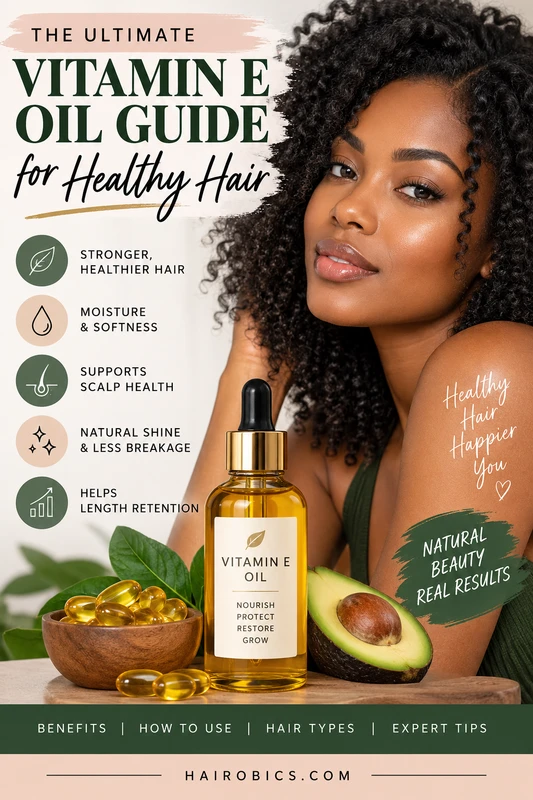
Vitamin E oil has become a popular ingredient in natural hair routines, scalp oils, deep conditioners, and moisturizing treatments. Whether you have natural hair, curly hair, relaxed hair, braids, twists, or locs, vitamin E can be incorporated into a healthy hair-care routine to help condition dry strands, support the scalp, improve softness, and protect hair from environmental stress.
For Black hair in particular, maintaining moisture and reducing unnecessary breakage are often major priorities. Because tightly curled and coily strands can make it more difficult for natural scalp oils to travel down the hair shaft, the ends of the hair may become dry more easily. Oils can help by lubricating the strands and slowing moisture loss.
Vitamin E is especially interesting because it isn't simply an oil. Vitamin E is a fat-soluble nutrient and antioxidant. It occurs naturally in various plant oils, nuts, seeds, and foods and is also added to many cosmetic products.
But does vitamin E oil actually help hair grow? Can you put it directly on your scalp? How often should you use it? And is vitamin E oil suitable for locs, braids, curly hair, and low-porosity hair?
This complete vitamin E oil guide covers what you need to know.
What Is Vitamin E Oil?
Vitamin E refers to a family of fat-soluble compounds with antioxidant activity. Alpha-tocopherol is the form of vitamin E that is most commonly discussed in human nutrition.
When you see "vitamin E oil" on a hair or skin product, however, the formulation can vary significantly.
Some products contain concentrated vitamin E mixed with a carrier oil. Others use vitamin E as one ingredient in a larger blend containing oils such as jojoba, coconut, sunflower, avocado, argan, or sweet almond oil.
Vitamin E may also appear on ingredient labels under names such as tocopherol or tocopheryl acetate.
This distinction is important because a bottle labeled vitamin E oil may not consist entirely of vitamin E.
Always read the ingredient list before using a new product.
Why Is Vitamin E Popular for Hair?
Vitamin E has become popular in hair care primarily because of its antioxidant properties and its ability to complement moisturizing and conditioning formulas.
Hair is constantly exposed to environmental factors.
These may include:
- Sun exposure
- Heat styling
- Dry air
- Pollution
- Frequent manipulation
- Chemical treatments
- Friction from clothing and bedding
- Product buildup
- Repeated washing and styling
No single oil can eliminate all of these sources of stress. A well-designed hair routine, however, can reduce unnecessary damage and help hair remain softer and more manageable.
Vitamin E-containing oils are commonly used as part of that routine.
Vitamin E Oil Benefits for Hair
Vitamin E oil has several potential advantages when used appropriately. It is important to distinguish between supporting healthy hair and claiming that an ingredient can cure hair loss or dramatically accelerate hair growth.
Here are some of the primary reasons people use vitamin E oil for their hair.
1. Helps Condition Dry Hair
Dryness is one of the most common concerns among people with natural and curly hair.
Coily hair can be particularly susceptible to dryness because sebum from the scalp has a more difficult journey along bends and curls than it does on straighter strands.
Vitamin E is frequently included in oil blends and conditioners intended to improve the feel of dry hair.
Oil does not hydrate hair in the same way that water does. Instead, applying an appropriate oil after a water-based moisturizer can help reduce moisture loss and improve lubrication.
This can leave hair feeling softer and smoother.
2. Helps Improve Hair Softness
Soft hair tends to be easier to manipulate.
When hair becomes extremely dry, strands may rub against each other more aggressively. That friction can contribute to tangles, knots, and breakage during styling.
A small amount of oil can lubricate the strands.
Vitamin E-containing oil blends may therefore be useful as a finishing step after moisturizing.
3. Supports a Healthy Scalp Environment
Healthy-looking hair begins with good scalp care.
Vitamin E's antioxidant properties are one reason it is commonly included in scalp-care products.
However, more oil isn't automatically better for the scalp.
The scalp still needs regular cleansing. Applying layer after layer of heavy oil without washing can lead to buildup.
Think of scalp oil as one component of scalp care rather than a replacement for shampooing.
4. May Reduce the Appearance of Dull Hair
Dry hair frequently looks dull because its surface doesn't reflect light as evenly.
A small amount of oil spread across the strands can increase shine temporarily.
Vitamin E oil can be particularly useful on the ends, which are usually the oldest and most weathered portion of long hair.
Start with very little.
Too much can make hair look greasy rather than shiny.
5. Helps Lubricate Hair During Styling
Hair breakage isn't always caused by a major underlying problem.
Sometimes it is mechanical.
Combing, brushing, separating, twisting, braiding, detangling, and styling all create friction.
Proper lubrication can help reduce some of that friction.
A lightweight product containing vitamin E may help provide slip, although a conditioner or dedicated detangler will usually be more effective for major detangling sessions.
6. Can Help Protect Fragile Ends
Your ends are the oldest part of your hair.
If you have been growing your hair for several years, the ends may have experienced hundreds of wash days, styling sessions, nights of sleeping, and encounters with clothing.
That's why ends frequently become dry before the rest of the hair.
After applying a water-based leave-in conditioner or moisturizer, a small amount of oil on the ends can help keep them lubricated.
7. Works Well in Oil Blends
Pure or highly concentrated vitamin E products can be extremely thick.
For many hair types, combining vitamin E with a lighter carrier oil makes application easier.
Popular combinations include vitamin E with:
- Jojoba oil
- Avocado oil
- Sweet almond oil
- Grapeseed oil
- Argan oil
- Coconut oil
- Olive oil
- Sunflower oil
The best combination depends on your hair texture, porosity, hairstyle, and personal preference.
Does Vitamin E Oil Help Hair Grow?
This is probably the biggest question people have about vitamin E oil.
Vitamin E is an essential nutrient, and adequate nutrition is important for normal hair health. But applying vitamin E oil to your scalp should not be viewed as a guaranteed hair-growth treatment.
There has been limited research examining vitamin E supplementation and hair loss, but this does not mean topical vitamin E oil has been proven to make everyone's hair grow faster.
Hair growth is influenced by many factors, including:
- Genetics
- Age
- Nutrition
- Hormones
- Scalp health
- Hair-care practices
- Certain medications
- Medical conditions
For people trying to retain longer natural hair, reducing breakage can sometimes be just as important as focusing on the rate of growth.
Your hair may be growing from your scalp while simultaneously breaking at the ends.
If the two happen at similar rates, it can appear that your hair "isn't growing."
A moisture-focused routine that reduces unnecessary breakage can improve length retention.
Vitamin E oil may play a supporting role in that type of routine.
Vitamin E Oil for Black Hair
Vitamin E oil can fit especially well into Black hair-care routines because moisture retention, lubrication, and protection are often important considerations for highly textured hair.
Afro-textured hair can range enormously in density, strand thickness, curl pattern, and porosity. There is no single oil that works perfectly for everyone.
Some people prefer lightweight oils.
Others love heavier oils and butters.
Vitamin E is often best used as part of a blend rather than applying a thick concentrated product all over the hair.
Try using a small amount on freshly moisturized hair and pay attention to how your strands respond.
Your hair should feel soft and flexible—not coated and greasy.
Vitamin E Oil for Natural Hair
Natural hair routines frequently involve some combination of water, leave-in conditioner, cream, and oil.
Vitamin E oil can serve as the oil portion of that routine.
For example:
- Start with clean or refreshed hair.
- Add water or a water-based leave-in product.
- Apply your preferred moisturizer or cream if needed.
- Finish with a small amount of vitamin E-containing oil.
- Concentrate on dry areas and ends.
The exact order isn't mandatory.
Some people prefer LOC—liquid, oil, cream.
Others prefer LCO—liquid, cream, oil.
Experiment to determine which leaves your hair moisturized for the longest without excessive buildup.
Vitamin E Oil for 4C Hair
4C hair is known for tight coils and significant shrinkage.
It can also be particularly vulnerable to dryness when moisture routines are inconsistent.
Vitamin E-containing oils may be helpful for sealing moisture into 4C hair after hydration.
Divide the hair into sections before applying products.
This helps ensure that you're moisturizing the entire head rather than simply coating the outside layer.
Pay particular attention to:
- Ends
- Crown
- Hairline
- Areas prone to tangling
- Sections that consistently feel dry
Using more product isn't necessarily the solution.
Even thick 4C hair can become weighed down by excessive oil.
Vitamin E Oil for Curly Hair
Curly hair can benefit from oil, but application technique matters.
People with looser curls may find concentrated vitamin E too heavy.
Instead of saturating your curls, place one or two drops of a lightweight vitamin E oil blend between your palms, rub your hands together, and gently smooth them over dry curls.
This can help add shine and reduce a rough feeling without destroying curl definition.
Oil can also be applied after styling products have dried.
Use a tiny amount when separating curls to reduce friction and unwanted frizz.
Vitamin E Oil for Low-Porosity Hair
Low-porosity hair can sometimes become coated easily by heavy products.
If your hair is low porosity, use vitamin E sparingly.
Consider choosing a formula that combines vitamin E with a lighter carrier oil rather than a thick product.
Apply it after water-based hydration and avoid continuously adding more oil between wash days.
Signs that you may be using too much include:
- Hair feels coated
- Hair feels greasy but still dry
- Products sit on the hair
- Curls become limp
- Hair attracts excessive lint
- Hair takes longer to absorb water during washing
If this happens, clarify your hair when appropriate and reduce the amount of oil in your routine.
Vitamin E Oil for High-Porosity Hair
High-porosity hair tends to absorb moisture quickly but may also lose it quickly.
This can happen naturally or as a result of accumulated damage from coloring, heat, chemical processing, or mechanical stress.
People with high-porosity hair may enjoy richer oil blends.
After applying a leave-in conditioner or moisturizer, smooth a small amount of oil over the strands.
Pay extra attention to the ends.
Remember that oil cannot permanently repair severely damaged hair.
Split ends eventually need trimming.
Vitamin E Oil for Braids
Vitamin E can also be used while wearing braids.
The goal isn't to soak the braids in oil.
Instead, focus on keeping the scalp comfortable and caring for your natural hair underneath the style.
A simple braid-care routine may include:
- Clean the scalp as needed.
- Apply a lightweight water-based moisturizing spray.
- Use a small amount of scalp oil if your scalp tolerates it.
- Protect braids at night with satin or silk.
- Avoid excessive tension.
- Remove the style before severe matting develops.
Avoid pouring heavy vitamin E oil directly over the entire braided style.
Too much oil can attract lint and contribute to buildup.
Vitamin E Oil for Locs
People with locs should be particularly cautious about thick oils.
Locs can trap product more easily than loose hair.
A lightweight vitamin E oil blend can be applied sparingly to the scalp or exterior of the locs, but you generally don't need to saturate them.
A simple loc routine could look like this:
Cleanse → hydrate → lightly oil → allow locs to dry completely.
Proper drying is especially important for mature locs.
Avoid constantly layering oils on top of old products.
Vitamin E Oil for Men's Hair
Vitamin E isn't only for long natural hair.
Men with waves, short curls, afros, braids, twists, and locs can also incorporate vitamin E-containing products into their routines.
For short hair, only a very small amount is usually necessary.
After moisturizing, place a drop or two of oil into your hands and distribute it lightly.
Men who wear waves should be especially careful with heavy oil application because too much product can leave the hair greasy and contribute to buildup underneath durags.
Vitamin E Oil for Children's Hair
Children's hair doesn't require a complicated collection of products.
Gentle cleansing, conditioning, detangling, moisturizing, and low-tension styling are usually the foundation of a good routine.
Parents interested in using vitamin E oil should select a gentle product appropriate for children and patch-test new products.
Avoid applying large amounts directly to a child's scalp.
If a child experiences persistent scalp irritation, sores, unusual hair loss, or severe flaking, consult a pediatrician or dermatologist rather than attempting to treat the problem solely with oils.
How to Use Vitamin E Oil on Hair
There are several ways to incorporate vitamin E into your routine.
Method 1: Use It After Moisturizing
This is one of the easiest methods.
Apply a water-based leave-in conditioner to your hair.
Then apply a very small amount of vitamin E-containing oil.
Focus primarily on your ends.
This method is designed to improve lubrication and help slow moisture loss.
Method 2: Add It to Your Deep-Conditioning Routine
Some people like adding a small amount of oil to their deep conditioner.
You don't need much.
Apply your conditioner according to its instructions, allow it to sit for the recommended amount of time, and rinse thoroughly.
Method 3: Use It for a Scalp Massage
Apply a small amount of a suitable oil blend to your fingertips.
Gently massage your scalp using the pads of your fingers.
You don't need to scratch your scalp or press aggressively.
A scalp massage should feel comfortable.
Five minutes is plenty for many people.
Method 4: Apply It to Your Ends
If your ends dry out faster than the rest of your hair, target them specifically.
Mist your hair lightly with water or apply a moisturizing product first.
Follow with a tiny amount of oil.
Method 5: Use It When Taking Down Protective Styles
Taking down braids or twists can create considerable manipulation.
A small amount of oil on your fingers can reduce friction while you carefully unravel the style.
Work slowly.
Never rip through knots.
Should You Put Vitamin E Oil on Wet or Dry Hair?
You can use vitamin E oil on either wet or dry hair, but the purpose is different.
Applying oil to damp, moisturized hair is generally more useful when your goal is moisture retention.
Remember:
Oil is not water.
If your hair is extremely dry, adding more and more oil may simply create oily dry hair.
Hydrate first.
Then use oil to help maintain softness.
On dry hair, a tiny amount can be used for shine, lubrication, or styling.
How Often Should You Use Vitamin E Oil?
There is no universal schedule.
Some people may use an oil blend two or three times per week, while others only need it after wash day.
Your routine depends on:
- Hair texture
- Porosity
- Hair density
- Climate
- Hairstyle
- Shampoo frequency
- Amount of product used
- Individual scalp response
Instead of automatically oiling every day, pay attention to your hair.
If it still feels soft and lubricated, you may not need additional oil.
Can You Use Vitamin E Oil Every Day?
You can, but daily use isn't necessary for everyone.
Applying oil every day may lead to buildup, especially if you're using a thick formula.
If you find yourself applying large quantities of oil every morning because your hair feels dry again by afternoon, the underlying issue may be your moisturizing routine rather than a lack of oil.
Evaluate your shampoo, conditioner, leave-in product, styling routine, nighttime protection, and frequency of manipulation.
How Much Vitamin E Oil Should You Use?
Less than you might think.
Start with a few drops.
You can always add more.
For short hair, one or two drops may be enough.
For thick, long natural hair, divide the hair into sections and use a small amount on each section.
Your hair should not be dripping with oil.
Vitamin E Oil and Scalp Massage
Scalp massage is a popular component of natural hair-growth routines.
Massage can be relaxing and provides a structured opportunity to pay attention to your scalp.
Use the pads of your fingers rather than your fingernails.
Move your fingertips gently in small circles.
You can massage your scalp with or without oil.
If using vitamin E oil, apply a small amount rather than saturating the scalp.
Can Vitamin E Oil Fix Split Ends?
No oil can permanently fuse split ends back together.
Products may temporarily make damaged ends look smoother, but a true split remains physically damaged.
Trimming is the most reliable way to remove split ends.
Vitamin E oil can still be useful for lubricating your ends and potentially reducing some friction that contributes to future damage.
Prevention is easier than trying to reverse severe damage.
Vitamin E Oil vs. Castor Oil
Both oils are popular in Black hair care, but they feel very different.
Castor oil is generally thick and heavy.
Vitamin E products vary because vitamin E is often mixed into another carrier oil.
If your hair likes rich oils, you may enjoy castor oil.
If your hair becomes weighed down easily, a lightweight vitamin E blend may be preferable.
You can also combine small amounts.
Vitamin E Oil vs. Coconut Oil
Coconut oil is one of the most researched plant oils used on hair and can penetrate the hair fiber to some extent.
Some people love coconut oil.
Others report that it leaves their hair feeling stiff or dry.
Vitamin E oil is more often used as a conditioning or antioxidant component of cosmetic oil blends.
There is no reason everyone needs to choose the same oil.
Use whichever formulation produces the best results for your hair.
Vitamin E Oil vs. Jojoba Oil
Jojoba is technically a liquid wax rather than a conventional triglyceride oil.
It is lightweight and commonly found in scalp and hair products.
Because concentrated vitamin E can be thick, jojoba makes an appealing carrier for a vitamin E blend.
This combination may be particularly attractive to people who dislike heavy oils.
Vitamin E Oil vs. Avocado Oil
Avocado oil is another popular option for natural hair.
It contains fatty acids and naturally occurring vitamin E.
It tends to feel richer than some lightweight oils but usually spreads easily through hair.
Combining avocado oil with vitamin E can create a nourishing oil blend for dry natural hair.
Vitamin E Oil vs. Argan Oil
Argan oil is famous for its lightweight feel and shine-enhancing properties.
It is commonly used as a finishing oil.
If you have curly or fine hair that becomes greasy quickly, an argan-based formula containing vitamin E may be preferable to a thick oil.
Can Vitamin E Oil Cause Buildup?
Yes.
Any oil can contribute to buildup when used excessively.
This is particularly relevant for people with:
- Low-porosity hair
- Fine strands
- Locs
- Braids
- Heavy styling-product routines
Buildup can leave hair feeling strangely dry even though it looks oily.
Regular cleansing is important.
If your normal shampoo isn't removing accumulated product effectively, an occasional clarifying shampoo may help.
Common Vitamin E Oil Mistakes
Vitamin E oil can be simple to use, but several common mistakes can reduce its effectiveness.
Mistake #1: Applying Oil Instead of Moisture
Dry hair needs hydration.
Oil isn't a substitute for water.
Apply a water-based product first when moisture is the goal.
Mistake #2: Using Too Much
More oil doesn't equal healthier hair.
Excessive application can make hair heavy, greasy, and difficult to cleanse.
Mistake #3: Never Washing the Scalp
Some people continuously oil their scalp because they believe shampoo will cause dryness.
But scalp hygiene matters.
Wash often enough to remove sweat, dead skin, excess sebum, and accumulated products.
Mistake #4: Expecting Instant Hair Growth
Healthy hair growth is a long-term process.
Be skeptical of claims that any oil can produce dramatic growth in a few days.
Mistake #5: Ignoring Breakage
You can focus intensely on scalp treatments while losing length from your ends.
If length is your goal, pay attention to retention.
Mistake #6: Using Oil on an Irritated Scalp
If your scalp is inflamed, painful, unusually itchy, or covered in sores, adding more oil may not solve the problem.
Seek professional medical advice for persistent or severe symptoms.
How to Build a Vitamin E Hair Routine
A good routine doesn't need to be complicated.
Wash Day
Cleanse your scalp and hair thoroughly.
Follow with conditioner.
Detangle gently.
Use a deep conditioner when your hair needs additional conditioning.
After Washing
Apply a water-based leave-in conditioner.
Follow with your preferred styling cream if necessary.
Apply a small amount of vitamin E-containing oil, concentrating on the ends.
During the Week
Refresh only when needed.
Don't automatically add oil every day.
If your hair feels dry, lightly hydrate it first.
At Night
Protect your hair from unnecessary friction.
Use a satin bonnet, scarf, or pillowcase.
Long hair can be placed into loose twists, braids, or another low-manipulation nighttime style.
This simple step can sometimes do more for length retention than continually adding new products.
Vitamin E Oil for Hair Breakage
Breakage can make it seem as though your hair isn't growing.
Common causes include:
- Excessive heat
- Tight hairstyles
- Rough detangling
- Chemical damage
- Dryness
- Over-manipulation
- Split ends
- Friction
- Poor conditioning practices
Vitamin E oil may help improve lubrication and softness, but it won't correct every cause of breakage.
Look at your complete routine.
For example, applying expensive oils won't compensate for repeatedly flat-ironing your hair at excessive temperatures.
Vitamin E Oil for Hairline and Edges
Edges deserve gentle treatment.
The hair around the temples and hairline is often finer and can be vulnerable to repeated tension.
If you're trying to maintain healthy edges, focus on:
- Avoiding tight braids
- Avoiding excessive wig adhesive
- Reducing tension from ponytails
- Moisturizing regularly
- Minimizing aggressive brushing
- Protecting your hair at night
A tiny amount of vitamin E oil can be used to condition the area, but oil cannot overcome ongoing mechanical tension.
Persistent or worsening hairline loss should be evaluated by a dermatologist.
Vitamin E Oil for Protective Styles
Protective styles should actually protect your hair.
Braids, twists, wigs, crochet styles, and similar hairstyles can reduce daily manipulation, but they can also cause problems when installed too tightly or left in too long.
While wearing a protective style:
Keep the scalp clean.
Hydrate your natural hair when needed.
Use oils sparingly.
Protect the style at night.
Monitor your hairline for tension.
Don't ignore itching, pain, bumps, or sores.
A lightweight vitamin E oil blend can complement this routine.
Vitamin E Oil and Heat-Styled Hair
Oil should not automatically be considered a heat protectant.
If you're blow-drying, flat-ironing, or curling your hair, use a product specifically formulated and labeled for heat protection.
You can apply a small amount of finishing oil afterward if desired.
Avoid applying heavy oil immediately before very high-temperature styling unless the product is specifically designed for that purpose.
What to Look for When Buying Vitamin E Oil for Hair
Read the ingredient list.
Determine whether you're buying concentrated vitamin E or an oil blend.
Look for formulas that suit your hair's needs.
For example, someone with fine curls may prefer a lightweight formula containing jojoba or argan oil.
Someone with very dry, thick 4C hair may prefer a richer combination containing avocado, olive, or castor oil.
Packaging matters too.
Store oils according to the manufacturer's directions and avoid keeping them in excessive heat or direct sunlight.
Is Natural Vitamin E Better?
You'll encounter several forms of vitamin E in supplements and cosmetics.
For hair-care purposes, the entire formulation is often more important than focusing on a single ingredient.
A beautifully formulated oil blend that spreads easily and works with your hair may be more useful than a highly concentrated vitamin E product that is too thick to apply comfortably.
Don't assume that "stronger" automatically means "better."
Can You Mix Vitamin E Oil With Other Oils?
Yes.
Vitamin E is commonly used in oil blends.
A simple hair oil might combine a carrier oil with a smaller amount of vitamin E.
Popular combinations include:
Vitamin E + jojoba oil: lightweight scalp and hair application.
Vitamin E + avocado oil: richer conditioning for dry hair.
Vitamin E + argan oil: lightweight shine and finishing.
Vitamin E + sweet almond oil: easy-to-spread multipurpose hair oil.
Vitamin E + castor oil: thick blend suited to people who prefer heavier oils.
Avoid turning your routine into a mixture of dozens of ingredients simply because each one is popular online.
A simple formula is often easier to evaluate.
How Long Does It Take to See Results?
That depends on what you mean by results.
If your goal is shine or lubrication, you may notice the cosmetic effect immediately.
If your goal is improved length retention, evaluate your routine over several months rather than several days.
Hair growth is gradual.
Take monthly photos under similar lighting and positioning if you want to monitor your progress accurately.
Who Should Avoid Vitamin E Oil?
Vitamin E-containing products aren't ideal for everyone.
Stop using a product if you notice irritation, redness, burning, swelling, or worsening scalp problems.
Patch-testing a new topical product before widespread use is a sensible precaution, especially if you have sensitive skin.
People with persistent scalp disorders or unexplained hair loss should speak with a dermatologist rather than relying exclusively on oils.
Frequently Asked Questions About Vitamin E Oil for Hair
Is vitamin E oil good for natural hair?
Vitamin E-containing oil products can be useful for conditioning, lubrication, shine, and helping reduce moisture loss when incorporated into an appropriate natural hair routine.
Can vitamin E oil grow 4C hair?
Vitamin E oil should not be considered a guaranteed hair-growth treatment. However, keeping 4C hair moisturized, lubricated, and protected from unnecessary breakage can improve length retention.
Can I put vitamin E oil directly on my scalp?
Many people can tolerate appropriately formulated vitamin E products on the scalp, but concentrated vitamin E may be thick or irritating for some individuals. Start with a small amount and discontinue use if irritation develops.
Can vitamin E oil be left in overnight?
A small amount of a hair-safe vitamin E oil product can generally be left on the hair as a leave-in oil if the formulation is intended for that purpose. You do not need to saturate your hair before bed.
Does vitamin E oil make hair thicker?
Oil can make strands appear shinier and more conditioned, but it doesn't permanently change the genetic diameter of individual hair follicles.
Does vitamin E oil stop hair loss?
Vitamin E oil is not a universal treatment for hair loss. Hair loss has many potential causes, and unexplained, severe, sudden, or persistent hair loss should be evaluated by a healthcare professional.
Can I mix vitamin E oil with leave-in conditioner?
You can layer an oil over your leave-in conditioner. Mixing products directly together can sometimes alter their performance, so layering them separately is usually easier.
Is vitamin E oil good for dry scalp?
A small amount may help condition dry-feeling skin, but not every flaky scalp is simply "dry." Dandruff and other scalp conditions may require different treatment.
Is vitamin E oil good for locs?
It can be used sparingly, preferably in a lightweight formulation. Avoid saturating locs with thick oils because excessive product can contribute to buildup.
Is vitamin E oil good for braids?
Yes, a lightweight vitamin E-containing oil can be incorporated into a braid-care routine, particularly for the scalp. Keep application light and continue cleansing your scalp while wearing braids.
Should I apply vitamin E oil before or after leave-in conditioner?
If your goal is moisture retention, apply your water-based leave-in first and the oil afterward.
How often should I oil my scalp?
There isn't one correct schedule. Some scalps tolerate occasional oiling well, while others do better with little or no added oil. Base your routine on your scalp rather than an arbitrary daily schedule.
Vitamin E Oil and a Healthy Hair-Growth Routine
The most effective hair-growth routine isn't based on a single miracle ingredient.
It's built around consistency.
For natural and Black hair, that often means:
Clean scalp + adequate moisture + gentle detangling + low manipulation + protected ends + sensible styling + good nutrition + patience.
Vitamin E oil can fit comfortably into that formula.
Use it to complement the fundamentals rather than replace them.
If your primary goal is longer hair, also remember the importance of length retention.
Hair that grows half an inch but breaks half an inch hasn't produced visible length.
Reducing unnecessary breakage can therefore make a major difference over time.
Final Thoughts: Is Vitamin E Oil Worth Using for Hair?
Vitamin E oil can be a valuable addition to a natural hair-care routine, particularly for people looking for additional conditioning, lubrication, shine, and support for moisture retention.
It can be used on natural hair, curly hair, 4C hair, braids, twists, locs, relaxed hair, and men's hair—as long as you choose an appropriate formulation and avoid excessive application.
The biggest mistake is expecting vitamin E oil to do everything.
It isn't a substitute for water-based moisture.
It isn't a replacement for shampoo.
It isn't a guaranteed cure for hair loss.
And it can't repair severely damaged or split hair permanently.
Instead, think of vitamin E oil as one useful tool within a complete healthy-hair routine.
Start with clean hair and scalp. Hydrate your strands. Condition regularly. Minimize unnecessary tension and heat. Protect your hair while sleeping. Then use a small amount of vitamin E oil where your hair needs additional lubrication or moisture retention.
Consistency matters more than constantly changing products.
When you combine smart hair-care practices with patience, you're giving your hair the best opportunity to remain strong, soft, manageable, and healthy as it grows.