Curly hair is one of the most beautiful and diverse hair textures in the world. From soft waves to tight coils, curly hair comes in many forms, each with its own unique characteristics, needs, and care routines.
Understanding your curly hair type is the first step to achieving stronger, healthier, and faster-growing hair.
Many people struggle with dryness, breakage, frizz, or slow growth simply because they’re using products and routines that don’t match their hair type.
In this ultimate guide, we’ll break down:
-
The curly hair typing system
-
The differences between wavy, curly, and coily hair
-
How to identify your exact curl pattern
-
The best hair care routine for each hair type
-
How to grow curly hair longer and healthier
-
Common mistakes people make with curly hair
By the end of this guide, you'll understand exactly how to care for your curls.
What Are Curly Hair Types?
Curly hair types are categorized using a system developed by hairstylist Andre Walker, Oprah Winfrey’s longtime stylist.
This system divides hair into four main categories:
| Hair Type | Description |
|---|---|
| Type 1 | Straight Hair |
| Type 2 | Wavy Hair |
| Type 3 | Curly Hair |
| Type 4 | Coily / Kinky Hair |
Each category is then divided into A, B, and C subtypes.
This results in 9 different curl patterns.
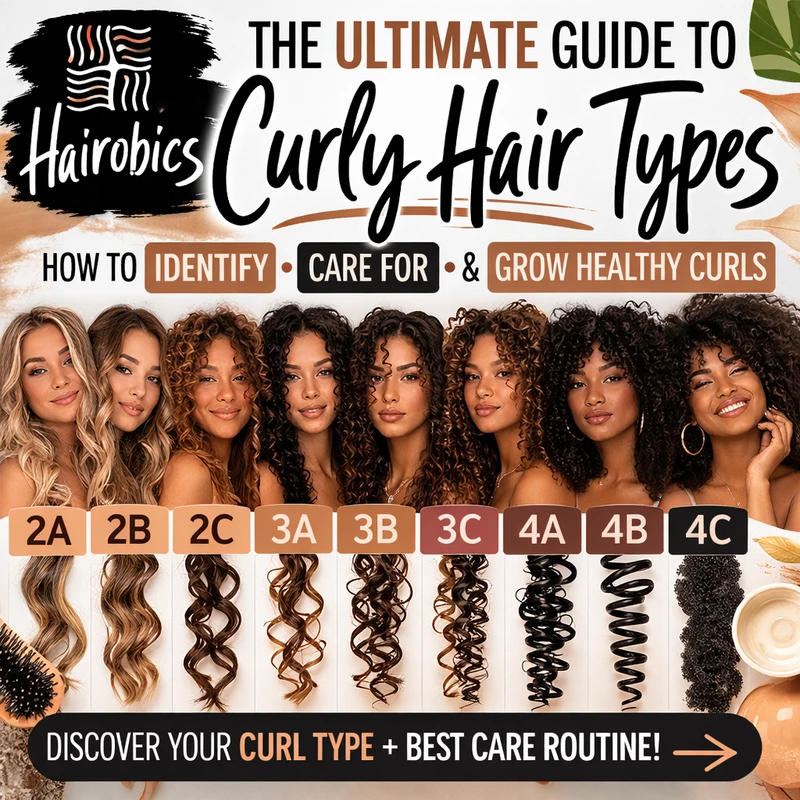
The Curly Hair Type Chart
Here’s a simple breakdown.
Type 2 – Wavy Hair
| Hair Type | Pattern |
|---|---|
| 2A | Loose waves |
| 2B | Defined waves |
| 2C | Strong waves / loose curls |
Type 3 – Curly Hair
| Hair Type | Pattern |
|---|---|
| 3A | Loose spiral curls |
| 3B | Bouncy ringlets |
| 3C | Tight corkscrew curls |
Type 4 – Coily Hair
| Hair Type | Pattern |
|---|---|
| 4A | Defined coils |
| 4B | Z-shaped coils |
| 4C | Tightest curl pattern |
Understanding where your hair falls on this chart helps determine the right routine and products.
Type 2 Hair (Wavy Hair)
Wavy hair sits between straight and curly hair.
It usually has a gentle S-shaped pattern and can range from barely wavy to almost curly.
Type 2A Hair
Type 2A hair has very loose waves.
Characteristics:
-
Fine texture
-
Minimal frizz
-
Waves mostly at the ends
Best care tips:
-
Use lightweight products
-
Avoid heavy oils
-
Scrunch hair while drying
Type 2B Hair
Type 2B hair has more defined waves.
Characteristics:
-
Waves start mid-shaft
-
Slight frizz
-
Medium density
Best routine:
-
Use moisturizing leave-ins
-
Avoid heavy creams
-
Air dry whenever possible
Type 2C Hair
Type 2C hair sits between wavy and curly hair.
Characteristics:
-
Strong wave pattern
-
More volume
-
Frizz-prone
Best products:
-
Curl creams
-
Lightweight oils
-
Hydrating sprays
Type 3 Hair (Curly Hair)
Type 3 hair features well-defined curls that form spirals or ringlets.
This hair type usually has more volume but also more dryness.
Type 3A Hair
Type 3A curls are large, loose spirals.
Characteristics:
-
Big curls
-
Lots of shine
-
Can be weighed down easily
Best care routine:
-
Use lightweight curl creams
-
Avoid heavy oils
-
Diffuse for volume
Type 3B Hair
Type 3B curls are springy ringlets.
Characteristics:
-
High volume
-
Medium density
-
More prone to dryness
Best routine:
-
Hydrating shampoos
-
Leave-in conditioners
-
Curl defining creams
Type 3C Hair
Type 3C curls are tight corkscrew curls.
Characteristics:
-
Dense curls
-
Shrinkage
-
Needs moisture
Best routine:
-
Deep conditioning weekly
-
Use thicker creams
-
Seal moisture with oil
Type 4 Hair (Coily Hair)
Type 4 hair is often called coily or kinky hair.
It has the tightest curl patterns and is common in natural Black hair.
This hair type tends to be the most fragile and moisture-dependent.
Type 4A Hair
Type 4A hair has tight S-shaped coils.
Characteristics:
-
Soft coils
-
Visible curl pattern
-
Medium shrinkage
Best routine:
-
Moisturizing shampoos
-
Creamy leave-ins
-
Twist outs and braid outs
Type 4B Hair
Type 4B hair has a zig-zag pattern instead of spirals.
Characteristics:
-
Less defined curls
-
High shrinkage
-
Dense hair
Best routine:
-
Heavy moisture creams
-
Protective styling
-
Low manipulation
Type 4C Hair
Type 4C hair is the tightest curl pattern.
Characteristics:
-
Maximum shrinkage
-
Very delicate strands
-
Requires consistent moisture
Best routine:
-
Frequent deep conditioning
-
Protective styles
-
Oil sealing
Curl Pattern vs Hair Texture
Your curl pattern is not the only factor that determines how your hair behaves.
You must also consider:
Hair Texture
This refers to strand thickness.
Types include:
-
Fine hair
-
Medium hair
-
Coarse hair
Hair Density
Density refers to how many strands are on your scalp.
Categories include:
-
Low density
-
Medium density
-
High density
Hair Porosity
Porosity determines how well your hair absorbs moisture.
Types include:
Low Porosity
Medium Porosity
High Porosity
Understanding porosity is critical for curly hair care.
Why Curly Hair Is More Prone to Dryness
Curly hair is naturally drier than straight hair.
Here’s why.
The scalp produces natural oil called sebum.
In straight hair, oil easily travels down the hair shaft.
But in curly hair, the bends and twists prevent oil from spreading evenly.
This causes:
-
Dryness
-
Frizz
-
Breakage
The Best Curly Hair Care Routine
Here’s a simple routine that works for most curly hair types.
Step 1: Gentle Cleansing
Use sulfate-free shampoos.
Harsh shampoos strip natural oils from curly hair.
Washing 1–2 times per week works best.
Step 2: Deep Conditioning
Deep conditioning restores moisture.
Use deep conditioners weekly for:
-
hydration
-
elasticity
-
strength
Step 3: Leave-In Conditioner
Leave-ins help curls stay soft and defined.
Benefits:
-
moisture retention
-
frizz reduction
-
curl definition
Step 4: Seal Moisture With Oils
Oils help lock in hydration.
Popular oils include:
-
Castor oil
-
Coconut oil
-
Argan oil
-
Jojoba oil
Step 5: Protective Styling
Protective styles reduce breakage.
Examples include:
-
Braids
-
Twists
-
Buns
-
Locs
How to Grow Curly Hair Faster
Hair growth depends on hair health, scalp health, and moisture balance.
Here are proven strategies.
Maintain a Healthy Scalp
Hair grows from follicles in the scalp.
Stimulate the scalp with:
-
massage
-
oils
-
scalp treatments
Avoid Excessive Heat
Heat tools damage curl structure.
Limit:
-
flat irons
-
curling irons
-
blow dryers
Reduce Breakage
Most curly hair struggles with retention, not growth.
Prevent breakage by:
-
moisturizing regularly
-
trimming split ends
-
wearing protective styles
The Biggest Curly Hair Mistakes
Many people damage their curls without realizing it.
Overwashing
Washing too frequently removes natural oils.
Using the Wrong Products
Heavy products can weigh down waves.
Light products may not moisturize coils enough.
Brushing Dry Hair
Brushing curly hair dry causes frizz and breakage.
Always detangle with conditioner.
Skipping Deep Conditioning
Curly hair thrives on deep moisture.
The Best Hairstyles for Curly Hair
Here are popular curly styles.
-
Twist outs
-
Braid outs
-
Wash and go
-
Pineapple updo
-
Protective braids
-
Locs
These styles protect hair and enhance curl definition.
Curly Hair Myths
Many myths exist about curly hair.
Myth: Curly Hair Doesn’t Grow
Curly hair grows at the same rate as straight hair.
Shrinkage simply hides length.
Myth: Oil Moisturizes Hair
Oil seals moisture but does not provide hydration.
Water and conditioners provide moisture.
Myth: Curly Hair Should Be Washed Less
Curly hair still needs cleansing to maintain scalp health.
How to Identify Your Curl Type
Follow these steps.
-
Wash your hair.
-
Let it air dry.
-
Avoid products.
-
Observe your natural pattern.
Compare your curls to the curl chart above.
The Future of Curly Hair Care
The natural hair movement has transformed the beauty industry.
More people are embracing:
-
curls
-
coils
-
natural textures
Brands are also developing products specifically designed for curly hair.
Final Thoughts
Curly hair is incredibly diverse and beautiful.
Understanding your curl pattern helps you:
-
choose the right products
-
develop the best routine
-
grow healthier hair
Whether you have soft waves, defined curls, or tight coils, the key to thriving curls is moisture, gentle care, and patience.
Once you learn what your curls need, they will reward you with incredible volume, beauty, and strength.