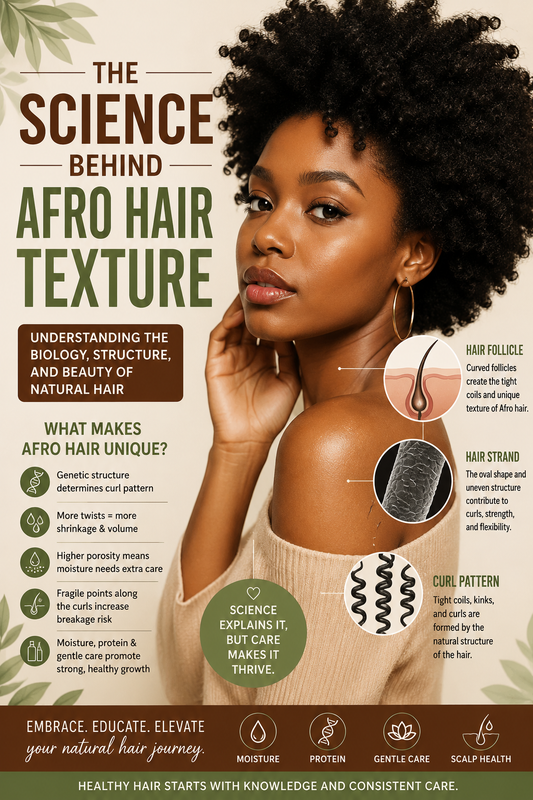
Afro hair is one of the most unique hair types in the world. Its tightly coiled curls, incredible volume, and versatility make it unlike any other hair texture. Yet despite its beauty, Afro-textured hair is often misunderstood. Many myths suggest that Afro hair grows slowly, is naturally unhealthy, or is difficult to manage. In reality, the science tells a very different story.
Afro hair grows at nearly the same rate as other hair types. Its unique appearance comes from the shape of the hair follicle, the structure of the hair strand, and the way curls naturally form. Understanding these biological differences can help you better care for your hair, reduce breakage, and maximize healthy hair growth.
In this complete guide, we'll explore the science behind Afro hair texture, explain why it behaves differently than straight hair, and provide practical tips for maintaining strong, healthy natural hair.
What Is Afro Hair?
Afro hair refers to hair with tightly coiled, spiral-shaped strands that naturally grow upward and outward rather than hanging straight.
Characteristics include:
- Tight coils
- High shrinkage
- Incredible volume
- Dense appearance
- Fine individual strands
- Natural dryness
- High versatility
Afro hair is commonly categorized as Type 4 hair.
This includes:
- 4A
- 4B
- 4C
Each subtype has different curl patterns but shares similar biological characteristics.
The Hair Follicle Determines Hair Texture
The biggest reason Afro hair looks different starts beneath the scalp.
Hair grows from follicles embedded in the skin.
The shape of each follicle determines the final shape of each hair strand.
Straight Hair
Straight hair grows from nearly round follicles.
The strand exits the scalp in a straight direction.
Wavy Hair
Oval follicles produce gentle waves.
Curly Hair
More elliptical follicles create curls.
Afro Hair
Afro hair grows from highly curved, asymmetrical follicles.
This curved follicle forces the growing strand to bend repeatedly as it emerges from the scalp.
The result is:
- Tight coils
- Zig-zag patterns
- Corkscrew curls
- High density
This is entirely genetic.
The Cross-Section of Afro Hair
Hair isn't perfectly round.
If you sliced a hair strand under a microscope:
Straight hair appears almost circular.
Afro hair often appears flattened or oval.
This uneven structure contributes to:
- Curl formation
- Flexibility
- Higher fragility
The more irregular the cross-section, the curlier the hair becomes.
Keratin Creates Hair Strength
Hair consists primarily of keratin.
Keratin is a protein produced by specialized cells in the follicle.
It gives hair:
- Strength
- Elasticity
- Structure
- Flexibility
In Afro hair, keratin bonds develop unevenly around the strand.
This uneven distribution causes curls to twist continuously.
Why Afro Hair Shrinks
One of the most fascinating characteristics of Afro hair is shrinkage.
Hair may appear only six inches long despite stretching to twelve inches or more.
Shrinkage occurs because every curl loops back toward itself repeatedly.
This is actually a sign of healthy elasticity.
Hair with little elasticity often indicates damage.
Why Afro Hair Appears to Grow Slowly
One of the biggest myths is:
"Black hair doesn't grow."
False.
Hair growth occurs beneath the scalp.
Most healthy hair grows about:
0.4–0.6 inches per month
Regardless of ethnicity.
Afro hair appears to grow slower because:
- Curls hide length
- Shrinkage masks growth
- Breakage removes retained length
Growth and length retention are different.
Hair Growth Cycle
Every strand follows the same biological cycle.
Anagen (Growth)
Lasts 2–7 years.
Hair actively grows.
Catagen (Transition)
Growth slows.
The follicle shrinks.
Telogen (Resting)
Hair rests before shedding.
Exogen
Old hairs naturally shed.
New hairs replace them.
Afro hair follows the same cycle as every other hair type.
Why Afro Hair Is More Fragile
Although Afro hair is incredibly resilient, it is structurally more delicate.
Each bend in the curl creates a potential weak point.
Imagine bending a wire repeatedly.
Eventually it weakens.
Hair behaves similarly.
Every curl experiences:
- Twisting
- Compression
- Stretching
This increases breakage risk.
Natural Oils Have a Longer Journey
Sebaceous glands produce sebum.
Sebum naturally moisturizes hair.
Straight hair allows oils to slide easily from root to ends.
Afro hair presents a much longer path.
Natural oils struggle to navigate numerous twists and coils.
As a result:
- Ends become dry
- Hair feels rough
- Moisture escapes faster
This explains why moisturizing is so important.
Understanding Hair Porosity
Porosity measures how easily hair absorbs moisture.
Low Porosity
Moisture struggles to enter.
Products sit on top.
Medium Porosity
Ideal balance.
Hair absorbs and retains moisture well.
High Porosity
Moisture enters quickly but escapes just as fast.
Often caused by:
- Coloring
- Heat
- Relaxers
- Environmental damage
Knowing your porosity helps build an effective routine.
Why Afro Hair Loves Moisture
Moisture supports:
- Elasticity
- Curl definition
- Flexibility
- Strength
Dry hair becomes brittle.
Hydrated hair bends instead of snapping.
Consistent hydration reduces breakage significantly.
Protein Balance Matters
Hair is mostly protein.
Too little protein causes:
- Weak curls
- Mushy texture
- Excess stretching
Too much protein causes:
- Stiffness
- Brittleness
- Snapping
The healthiest routine balances protein and moisture.
The Cuticle Layer
Each hair strand contains overlapping cuticle scales.
Healthy cuticles lie flat.
This helps hair:
- Reflect light
- Retain moisture
- Resist breakage
Damaged cuticles lift.
This increases:
- Frizz
- Dryness
- Tangling
Gentle handling protects the cuticle.
Density vs Thickness
Many people confuse density with strand thickness.
Density refers to how many follicles grow on the scalp.
Strand thickness measures the diameter of individual hairs.
Someone may have:
- Fine strands
- Extremely dense hair
Or:
- Thick strands
- Low density
Understanding both helps choose products.
Elasticity and Healthy Hair
Elasticity measures how much hair stretches before breaking.
Healthy Afro hair stretches slightly and returns to shape.
Poor elasticity often results from:
- Heat damage
- Chemical damage
- Protein imbalance
Improving elasticity helps prevent breakage.
Why Protective Styles Work
Braids, twists, wigs, and buns protect hair by reducing daily manipulation.
Less manipulation means:
- Less friction
- Fewer tangles
- Reduced breakage
- Better length retention
Protective styling doesn't increase growth.
It preserves the growth already happening.
Heat Changes Hair Structure
Heat temporarily breaks hydrogen bonds inside hair.
Flat irons reshape hair until moisture restores curls.
Extreme temperatures permanently damage protein bonds.
Repeated heat causes:
- Curl loss
- Weakness
- Split ends
Heat protectants reduce damage.
Chemical Treatments Affect Hair
Relaxers permanently alter hair by breaking internal protein bonds.
This weakens hair.
Bleaching removes pigment while damaging structural proteins.
Repeated chemical processing increases:
- Breakage
- Dryness
- Porosity
Proper conditioning becomes essential afterward.
Why Afro Hair Tangles Easily
Coils naturally wrap around neighboring strands.
Single-strand knots develop when loose hairs curl around themselves.
Reducing tangles involves:
- Moisturized hair
- Detangling in sections
- Wide-tooth combs
- Finger detangling
The Importance of Scalp Health
Healthy hair starts with a healthy scalp.
Scalp care includes:
- Regular cleansing
- Gentle exfoliation
- Massage
- Moisture balance
A clean scalp allows follicles to function optimally.
Nutrition Supports Hair Growth
Hair is built from nutrients supplied by your body.
Important nutrients include:
- Protein
- Iron
- Zinc
- Vitamin D
- Vitamin A
- Biotin
- Omega-3 fats
- Vitamin C
Balanced nutrition supports healthy hair production.
Stress Can Affect Hair
High stress may contribute to increased shedding through conditions such as telogen effluvium.
Managing stress through sleep, exercise, relaxation, and proper self-care supports overall hair health.
Daily Habits That Protect Afro Hair
Healthy Afro hair benefits from consistent care rather than frequent product changes.
Good habits include:
- Moisturizing regularly
- Sleeping on satin or silk
- Gentle detangling
- Limiting excessive heat
- Avoiding overly tight styles
- Trimming damaged ends
- Protecting hair from harsh weather
- Keeping the scalp clean
Common Myths About Afro Hair
Myth: Afro hair doesn't grow.
Fact: It grows similarly to other hair types but retains length differently.
Myth: Oils moisturize hair.
Fact: Oils help seal in moisture but do not replace water-based hydration.
Myth: Hair must be washed every day.
Fact: Overwashing can strip natural oils. Wash according to your scalp's needs.
Myth: Protective styles make hair grow faster.
Fact: They help reduce breakage and improve length retention.
Building a Healthy Afro Hair Routine
A science-based routine includes:
Cleanse
Use a gentle sulfate-free shampoo or cleanser.
Condition
Restore moisture after every wash.
Deep Condition
Treat hair weekly or biweekly based on its needs.
Moisturize
Apply water-based moisturizers, then seal if desired.
Protect
Use satin bonnets, scarves, or pillowcases to reduce friction.
Minimize Manipulation
Keep styling gentle to reduce unnecessary breakage.
Frequently Asked Questions
Does Afro hair grow slower?
No. Growth rates are generally similar across hair types. The difference lies in shrinkage and length retention.
Why is Afro hair dry?
Natural scalp oils have difficulty traveling down tightly coiled strands, leaving the ends more prone to dryness.
Can shrinkage be reduced?
Yes. Stretching methods like twists, braids, banding, or roller sets can temporarily reduce shrinkage without changing the natural curl pattern.
Is Afro hair stronger than straight hair?
Afro hair has excellent flexibility but is more susceptible to breakage because each curl creates structural stress points.
Does trimming make hair grow faster?
No. Trimming does not affect growth at the follicle, but it helps remove split ends that can travel up the hair shaft and lead to breakage.
Final Thoughts
The science behind Afro hair texture reveals just how remarkable natural Black hair truly is. Its unique follicle shape, coiled structure, and specialized protein arrangement create the beautiful curls, coils, and volume that define Afro-textured hair. While these characteristics also make the hair more prone to dryness and breakage, they do not limit its ability to grow long, healthy, and strong.
The key to thriving natural hair is understanding its biology. Focus on maintaining moisture, minimizing breakage, protecting the hair shaft, nourishing your body, and caring for your scalp. By working with your hair's natural structure instead of against it, you can improve length retention, enhance curl definition, and enjoy healthier hair over time.
Whether your hair is 4A, 4B, or 4C, embracing the science behind Afro hair empowers you to make informed choices that support lasting hair health. With patience, consistency, and the right routine, Afro hair can flourish in all its natural beauty.