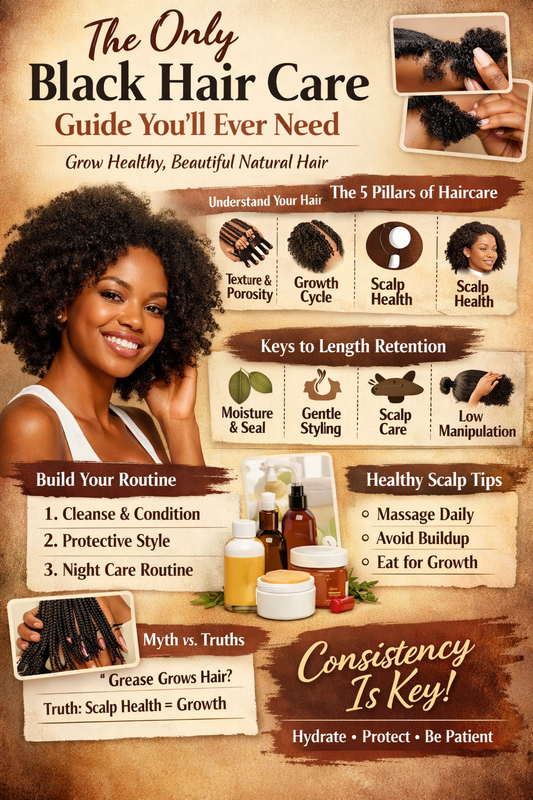
A Complete Science-Backed Guide to Growing, Protecting, and Maintaining Healthy Natural Hair
If you’ve ever felt overwhelmed trying to care for your natural hair, you’re not alone.
Between oils, creams, porosity tests, protective styles, heat damage, scalp health, growth myths, and endless social media advice — it’s easy to feel confused.
This is your complete, science-backed, culturally-rooted, no-fluff Black hair care guide — built specifically for textured hair (Type 3–4 curls, coils, and kinks).
By the end of this guide, you will understand:
-
How Black hair actually grows
-
Why breakage happens
-
How to build a growth routine
-
How to retain length
-
How to choose products
-
How to protect your edges
-
How to moisturize properly
-
How to prevent thinning
-
How to create a long-term healthy hair strategy
Let’s get into it.
Understanding Black Hair: The Foundation
Before you can grow or maintain healthy hair, you must understand what makes Black hair different.
1. The Shape of the Hair Strand
Black hair grows in an elliptical, flattened shape rather than a round one. This structural difference causes:
-
Tighter curl patterns
-
Natural bends along the strand
-
Weak points at each curve
-
Increased dryness
-
Higher breakage risk
Each bend is a potential stress point.
This is why textured hair requires gentler handling and consistent moisture.
2. The Growth Cycle of Black Hair
Hair grows in cycles:
-
Anagen (growth phase) – 2–7 years
-
Catagen (transition phase) – 2–3 weeks
-
Telogen (resting phase) – 3–4 months
Most people grow hair at about ½ inch per month.
If your hair “isn’t growing,” it usually is — you’re just losing length through breakage.
Growth is scalp-based.
Length retention is routine-based.
The Real Secret to Long Black Hair: Length Retention
Let’s clear up the biggest myth:
Hair growth oils don’t make hair grow faster.
They support scalp health. That’s different.
Length retention is about:
-
Moisture balance
-
Low manipulation
-
Reduced friction
-
Protective styling
-
Scalp care
-
Trim consistency
If your ends constantly break, your length stays the same.
The 5 Pillars of Healthy Black Hair
1. Scalp Health
Healthy hair begins with a healthy scalp.
Signs of a healthy scalp:
-
No itching
-
No flaking
-
No redness
-
No soreness
-
Balanced oil production
What damages the scalp?
-
Product buildup
-
Heavy oils clogging follicles
-
Tight hairstyles
-
Inflammation
-
Stress
-
Poor diet
How to Improve Scalp Health
-
Cleanse regularly (every 7–10 days)
-
Avoid petroleum-heavy products
-
Massage scalp 3–5 minutes daily
-
Use lightweight botanical oils
-
Reduce tension styles
2. Moisture vs. Oil (They Are Not the Same)
Water moisturizes.
Oil seals.
Most people apply oil to dry hair and call it moisturizing.
That’s sealing dryness in.
The correct moisture method:
-
Start with water (or water-based leave-in)
-
Add cream or conditioner
-
Seal lightly with oil if needed
This is known as the LOC or LCO method.
If your hair feels dry daily, your problem isn’t oil — it’s water balance.
3. Protein Balance
Black hair needs protein — but not too much.
Signs you need protein:
-
Excessive shedding
-
Mushy wet hair
-
Limp curls
-
Elastic strands
Signs of protein overload:
-
Hard hair
-
Brittle feel
-
Snapping strands
Balance protein treatments once every 4–6 weeks unless your hair is chemically processed.
4. Protective Styling Done Correctly
Protective styles can grow your hair — or destroy it.
Bad protective styling:
-
Too tight
-
Too heavy
-
Left in too long
-
No scalp care
-
No moisture maintenance
Good protective styling:
-
Low tension
-
Moisturized underneath
-
Cleansed scalp
-
Installed on healthy hair
-
Removed gently
Ideal protective style time: 2–6 weeks max.
5. Low Manipulation
Every time you comb, brush, or restyle, you weaken strands.
To grow hair:
-
Detangle only when wet & conditioned
-
Use wide-tooth comb or fingers
-
Avoid daily brushing
-
Sleep in satin or silk
-
Reduce heat styling
Porosity: The Most Overlooked Hair Factor
Porosity determines how your hair absorbs moisture.
Low Porosity Hair
-
Water beads up
-
Takes long to dry
-
Product sits on top
Needs:
-
Warm water
-
Lightweight products
-
Occasional clarifying
High Porosity Hair
-
Dries quickly
-
Absorbs moisture fast
-
Frizzes easily
Needs:
-
Protein support
-
Cream-based moisturizers
-
Sealing oils
-
Cold water rinse
Knowing your porosity changes everything.
Building a Simple Weekly Routine
Here’s a proven structure:
Wash Day (1x per week)
-
Pre-poo (optional)
-
Cleanse scalp thoroughly
-
Deep condition (20–30 min)
-
Apply leave-in
-
Seal lightly
-
Style (twists, braids, bun, wash & go)
Midweek (Optional)
-
Light mist with water
-
Reapply leave-in
-
Massage scalp
Night Routine
-
Pineapple or loose twists
-
Satin bonnet or pillowcase
Consistency beats complexity.
Why Black Hair Breaks So Easily
Breakage causes:
-
Dryness
-
Friction
-
Tight styles
-
Heat damage
-
Over-manipulation
-
Weak ends
-
Skipping trims
-
Poor diet
-
Chronic stress
Most breakage happens at the ends — not the roots.
Trim every 10–12 weeks.
Nutrition for Hair Growth
Hair is protein (keratin).
If you lack nutrients, growth slows.
Essential nutrients:
-
Protein
-
Iron
-
Zinc
-
Vitamin D
-
Biotin (if deficient)
-
Omega-3 fatty acids
-
Water
Hydration alone improves hair elasticity.
Edge Care & Hairline Protection
Edges are fragile.
Common causes of thinning:
-
Tight braids
-
Slick ponytails
-
Lace front tension
-
Excess edge control
-
Inflammation
To regrow edges:
-
Stop tension
-
Massage daily
-
Keep area moisturized
-
Avoid brushing aggressively
Traction alopecia is reversible early — permanent late.
Heat Styling Without Damage
Heat damage permanently alters curl pattern.
If using heat:
-
Always apply heat protectant
-
Stay below 400°F
-
Limit to 1–2 times per month
-
Deep condition after
Air-drying is safest.
How to Know If Your Hair Is Actually Growing
Measure stretched hair monthly.
Take photos every 60 days.
Track:
-
Shedding
-
Breakage
-
Density
-
Thickness
-
Shine
-
Scalp comfort
Growth = retention + consistency.
The Minimalist Black Hair Routine (If You’re Overwhelmed)
If all of this feels like too much, here’s the simplified version:
-
Clean scalp weekly
-
Deep condition weekly
-
Moisturize with water
-
Protect at night
-
Reduce manipulation
-
Eat well
-
Trim quarterly
That’s it.
Myths About Black Hair (Debunked)
Myth: Black hair doesn’t grow.
Truth: It grows at the same rate; it just breaks more.
Myth: Grease makes hair grow.
Truth: It seals. It doesn’t stimulate growth.
Myth: Protective styles always help.
Truth: Only when installed properly.
Myth: You need 20 products.
Truth: You need consistency.
Long-Term Hair Health Strategy
If your goal is waist-length, thick, healthy hair:
Year 1: Focus on scalp health & breakage reduction
Year 2: Focus on retention & routine
Year 3: Maintain density & thickness
Hair growth is not a 30-day challenge.
It’s a lifestyle.
The Only Routine That Truly Works
Clean scalp
Hydrated strands
Low tension
Low manipulation
Balanced nutrition
Patience
Everything else is optional.
Final Thoughts
Black hair is powerful, versatile, and beautiful.
It requires:
-
Knowledge
-
Gentle handling
-
Moisture balance
-
Scalp care
-
Consistency
You don’t need trends.
You need fundamentals.
If you master:
Scalp health + Moisture + Retention
You will grow your hair.
This isn’t about miracle oils.
It’s about discipline.
Healthy Black hair is not complicated.
It’s consistent.