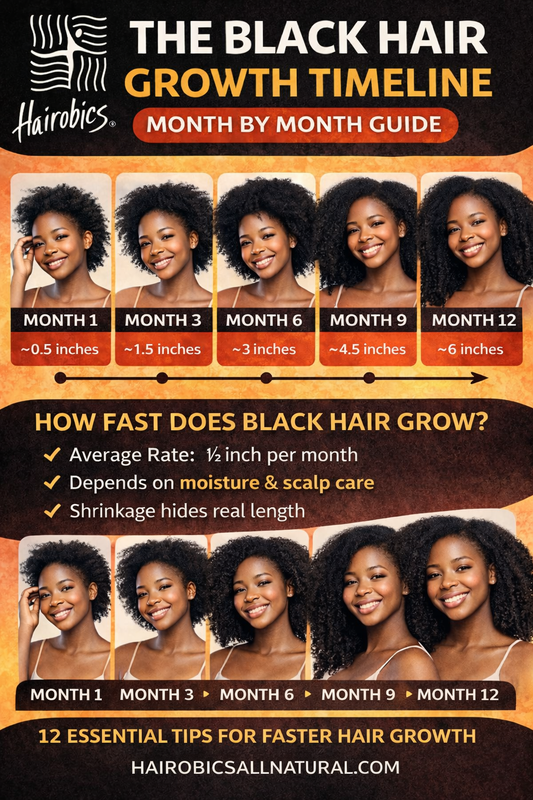
Understanding how Black hair grows can completely change the way you approach your hair care routine. Many people believe hair either grows fast or it doesn’t—but the reality is far more complex. Hair growth follows a biological cycle influenced by genetics, health, protective styling, moisture balance, and scalp care.
For people with natural, curly, coily, or kinky hair textures (especially Type 3 and Type 4 hair), growth can appear slower because of shrinkage and breakage. But when the hair and scalp are properly cared for, Black hair can grow long, thick, and healthy.
In this complete guide, we’ll break down what actually happens month-by-month during the Black hair growth process, what changes you should expect, and how to maximize every stage of the hair growth cycle.
Understanding the Black Hair Growth Cycle
Before diving into the timeline, it’s important to understand how hair actually grows.
Hair grows through four main phases:
1. Anagen Phase (Growth Phase)
This is when hair actively grows from the follicle.
For most people with Black hair:
-
Lasts 2–7 years
-
Hair grows about 0.5 inches per month
-
Determines your maximum hair length
The longer your anagen phase lasts, the longer your hair can grow.
2. Catagen Phase (Transition Phase)
This short phase lasts about 2–3 weeks.
During this time:
-
Hair stops growing
-
The follicle shrinks
-
The strand prepares to shed
3. Telogen Phase (Resting Phase)
This phase lasts 3–4 months.
Hair remains in the follicle but does not grow.
4. Exogen Phase (Shedding Phase)
This is when hair naturally sheds.
People lose 50–100 hairs per day, which is completely normal.
Average Hair Growth Rate for Black Hair
Hair growth rates are similar across ethnic groups, but texture and shrinkage make growth less visible.
Typical growth rate:
-
0.4 – 0.6 inches per month
-
4 – 6 inches per year
However, retention (keeping the hair that grows) is the biggest challenge for curly and coily hair types.
The Black Hair Growth Timeline (Month-by-Month)
Below is what most people experience when growing their hair naturally.
Month 1: Scalp Reset Phase
The first month focuses primarily on the scalp.
What happens:
• The scalp adjusts to your routine
• Follicles begin producing new strands
• Dryness and flaking may improve
During this stage you may notice:
-
Less itching
-
Improved scalp hydration
-
Early baby hairs along the hairline
Growth:
About 0.5 inches of new hair.
However, because of shrinkage, you might only see ¼ inch or less.
Month 2: Early Growth Begins
By the second month, hair growth becomes more noticeable.
Changes you may see:
• Slight increase in density
• Softer roots
• Curl pattern becoming more defined
This is when consistent scalp care begins paying off.
Healthy habits during this stage:
-
Gentle scalp massages
-
Moisturizing the scalp
-
Avoiding tight hairstyles
Growth total so far:
About 1 inch
Month 3: The Texture Adjustment Stage
This stage surprises many people.
You may notice:
-
Your hair feels thicker
-
Roots grow faster than ends
-
More shrinkage appears
This is because new healthy hair is replacing older damaged strands.
Common experiences:
• Frizz increases slightly
• Curl pattern becomes stronger
• Moisture becomes more important
Total growth:
1.5 inches
Month 4: Retention Becomes Critical
This is where many people lose progress.
Hair may begin breaking if not properly protected.
Common problems:
• Dry ends
• Tangles
• Breakage during detangling
Best practices during month four:
-
Deep condition weekly
-
Detangle with conditioner
-
Use protective styles
Growth total:
2 inches
Month 5: Visible Length Changes
Now the growth becomes noticeable.
Signs of progress:
• Ponytail thickness increases
• Hair stretches longer when wet
• Ends appear fuller
Shrinkage may still hide some of the length.
This is also when many people notice:
Edges and hairline filling in.
Total growth:
2.5 inches
Month 6: The Half-Year Milestone
At six months, many people experience a major transformation.
Average growth:
3 inches
This is when hair often transitions from:
-
TWA (teeny weeny afro)
-
To a full rounded afro
You may notice:
• Increased volume
• Less scalp visibility
• Better curl definition
At this stage, moisture balance becomes extremely important.
Month 7: Strength Phase
Hair strands are now stronger.
Changes include:
• Improved elasticity
• Reduced shedding
• Better styling versatility
Hair can now hold styles longer such as:
-
Twist outs
-
Braid outs
-
Wash and go styles
Total growth:
3.5 inches
Month 8: The Breakage Danger Zone
Many people unknowingly damage their hair during this stage.
Why?
Because they begin styling more aggressively.
Common mistakes:
• Over manipulation
• Heat damage
• Tight protective styles
To maintain growth:
-
Keep ends moisturized
-
Avoid daily styling
-
Trim damaged ends
Growth total:
4 inches
Month 9: Length Retention Breakthrough
Hair now reaches a stage where growth becomes obvious.
You may notice:
• More weight to your hair
• Easier stretching during styling
• Fuller ponytails
Shrinkage may still hide 40–75% of your real length.
Total growth:
4.5 inches
Month 10: Growth Momentum
The hair follicles are now operating consistently.
Hair becomes:
• Thicker
• Stronger
• More resilient
This is when many people notice their hair suddenly growing faster.
But in reality:
The hair is simply retaining more length.
Growth total:
5 inches
Month 11: Density Increase
Hair density becomes more noticeable.
Common signs:
• Hair feels heavier
• Part lines appear smaller
• Styles look fuller
If you have been following a consistent routine, this stage can produce dramatic results.
Growth total:
5.5 inches
Month 12: The One-Year Transformation
After one full year, healthy Black hair typically grows:
5–6 inches
This amount can completely change your hairstyle options.
Possible changes:
• Short afro → medium afro
• Shoulder length when stretched
• Fuller braids and twists
Hair also becomes easier to manage because the strands are stronger.
Why Black Hair Growth Sometimes Looks Slow
Even when hair grows normally, several factors can hide the length.
1. Shrinkage
Shrinkage can hide 50–80% of hair length.
For example:
-
6 inches of hair may appear only 2 inches long.
Shrinkage is actually a sign of healthy elasticity.
2. Breakage
Hair that breaks at the ends prevents visible length retention.
Causes include:
• Dry hair
• Heat damage
• Rough detangling
• Tight hairstyles
3. Lack of Moisture
Curly hair struggles to distribute natural oils.
This makes Black hair more prone to dryness.
The Real Secret to Faster Black Hair Growth
Hair growth speed cannot be drastically changed, but retention can.
The biggest factors are:
Healthy Scalp
Hair grows from the scalp.
Healthy follicles produce stronger strands.
Moisture Balance
Hydrated hair breaks less.
Protective Styling
Styles like braids, twists, and buns protect the ends.
Gentle Detangling
Minimizes mechanical damage.
The Best Routine for Long Black Hair
A simple routine works best.
Weekly Routine
Wash hair: 1–2 times per week
Deep condition: once per week
Moisturize hair: every 2–3 days
Scalp massage: 3–4 times per week
Foods That Support Hair Growth
Hair growth depends heavily on nutrition.
Key nutrients include:
Protein
Hair is made from keratin protein.
Sources:
-
Eggs
-
Fish
-
Beans
Iron
Iron deficiency can slow hair growth.
Sources:
-
Spinach
-
Lentils
-
Red meat
Omega-3 Fatty Acids
These support scalp health.
Sources:
-
Salmon
-
Walnuts
-
Flax seeds
Biotin
Supports keratin production.
Sources:
-
Avocados
-
Nuts
-
Whole grains
Protective Styles That Help Hair Grow
Some of the best protective styles include:
• Box braids
• Knotless braids
• Twists
• Cornrows
• Low buns
• Wigs
These styles protect the hair ends and reduce breakage.
Signs Your Hair Is Growing Healthy
Healthy hair growth usually shows these signs:
• Consistent new growth
• Strong strands
• Minimal breakage
• Defined curl pattern
You may also notice less hair shedding during wash days.
Common Hair Growth Myths
Myth: Oil Makes Hair Grow Faster
Oil does not directly grow hair.
However, it protects the scalp and reduces dryness, which can improve retention.
Myth: Cutting Hair Makes It Grow Faster
Trimming hair does not speed growth.
But trimming removes split ends, preventing breakage.
Myth: Protective Styles Guarantee Growth
Protective styles only work if:
• They are not too tight
• The hair stays moisturized
• They are not left in too long
How Long It Takes to Grow Long Black Hair
Here are typical timelines.
Short afro → shoulder length
2–3 years
Shoulder length → bra strap length
2–3 more years
Bra strap → waist length
3–4 years
Consistency matters more than products.
The Truth About Hair Growth Products
Many products claim to grow hair quickly.
But hair growth products mainly work by:
• Improving scalp health
• Strengthening strands
• Preventing breakage
This helps you retain the hair that naturally grows each month.
The Long-Term Black Hair Growth Timeline
Here is a simplified overview.
| Time | Average Growth |
|---|---|
| 3 months | 1.5 inches |
| 6 months | 3 inches |
| 1 year | 6 inches |
| 2 years | 12 inches |
| 3 years | 18 inches |
With strong retention habits, many people can grow hair past waist length.
Final Thoughts
Black hair growth is a journey that requires patience, consistency, and the right care routine.
Even though hair grows only about half an inch per month, protecting your strands from breakage can dramatically improve visible length over time.
By focusing on scalp health, moisture, gentle styling, and proper nutrition, you can maximize every stage of the hair growth cycle.
Within a year, the results can be dramatic.
And with continued care, your hair can grow longer and healthier than you ever expected.