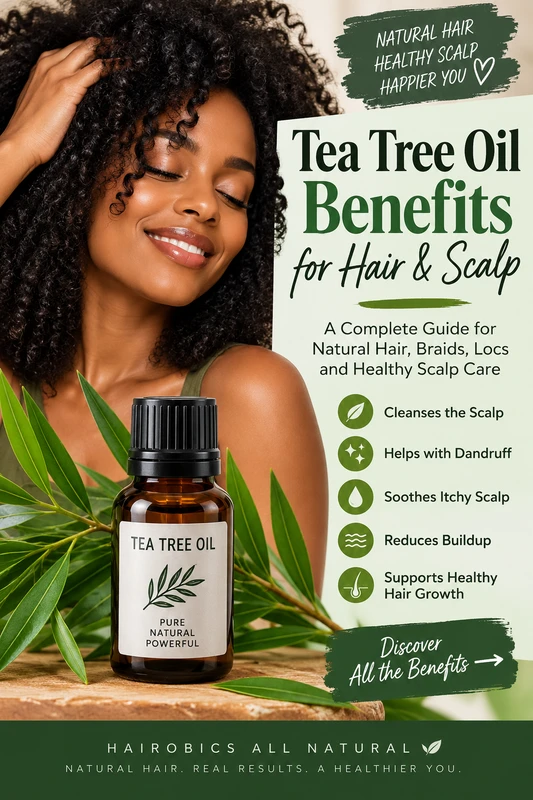
Tea tree oil has become one of the most popular essential oils in natural hair care—and for good reason. Known for its fresh, distinctive scent and cleansing properties, tea tree oil is commonly added to shampoos, scalp oils, conditioners, sprays, and other products designed to keep the scalp feeling clean and refreshed.
For people with natural hair, curly hair, locs, braids, twists, or other protective styles, maintaining a healthy scalp can sometimes be challenging. Product buildup, sweat, excess oil, flakes, and infrequent washing can leave the scalp feeling uncomfortable. Tea tree oil can be a useful addition to a balanced hair-care routine when it is properly diluted and used appropriately.
But what exactly does tea tree oil do for your hair? Can tea tree oil help with dandruff? Is it good for an itchy scalp? Can you put tea tree oil directly on your scalp? And does tea tree oil actually make your hair grow?
This complete guide explores the benefits of tea tree oil for hair and scalp, how to use it safely, and why it has become such a popular ingredient in natural hair care.
What Is Tea Tree Oil?
Tea tree oil is an essential oil obtained from the leaves of Melaleuca alternifolia, a plant native to Australia. It has a long history of topical use and is now commonly found in personal-care products ranging from cleansers and shampoos to scalp treatments.
Tea tree essential oil is highly concentrated.
That distinction is important because pure essential oil should generally not be treated like an ordinary carrier oil such as coconut, jojoba, olive, or avocado oil. Applying undiluted tea tree oil directly to the skin or scalp can cause irritation in some people.
Instead, tea tree oil is typically diluted in a carrier oil or incorporated at an appropriate concentration into a formulated hair product.
When properly formulated, it can provide several potential benefits for scalp care.
12 Tea Tree Oil Benefits for Hair and Scalp
1. Tea Tree Oil Helps Cleanse the Scalp
One of the biggest reasons tea tree oil appears in hair products is its cleansing ability.
Your scalp naturally produces sebum, an oily substance that helps protect the skin and hair. Sebum itself isn't bad. Problems can arise, however, when excess oil combines with sweat, dead skin, environmental debris, and styling-product residue.
This mixture can make your scalp feel greasy or dirty.
People who regularly use:
- Hair gels
- Edge control
- Pomades
- Heavy creams
- Butters
- Scalp oils
- Styling sprays
- Leave-in products
may experience buildup over time.
Tea tree oil is commonly incorporated into cleansing products intended to leave the scalp feeling cleaner and fresher.
This makes tea tree oil particularly interesting for people who use multiple styling products throughout the week.
It does not replace shampoo, however. A proper cleansing routine remains one of the most important steps for maintaining a healthy scalp.
2. Tea Tree Oil May Help With Dandruff and Flaking
Dandruff is one of the most common reasons people become interested in tea tree oil.
Dandruff can cause visible flakes, itching, and irritation. Several factors can contribute to a flaky scalp, so not every case of flaking has the same cause.
Tea tree oil has antimicrobial properties and has been studied in connection with dandruff management.
In one well-known clinical study, participants used shampoo containing 5% tea tree oil for four weeks. The tea tree oil group experienced significantly greater improvement in dandruff severity than the placebo group.
That does not mean that applying pure tea tree essential oil directly to your scalp will eliminate dandruff.
In fact, undiluted essential oil could potentially irritate the scalp and make discomfort worse.
Instead, people interested in tea tree oil for dandruff should consider properly formulated or appropriately diluted products.
Persistent, severe, painful, crusting, or unexplained scalp problems should be evaluated by a dermatologist or another qualified healthcare professional.
3. Tea Tree Oil Can Help an Itchy Scalp Feel Refreshed
Few things are more frustrating than an itchy scalp.
Scalp itching may be associated with dryness, sweat, buildup, dandruff, sensitivity to products, or certain skin conditions.
For people wearing braids, twists, cornrows, wigs, or locs, itching can become particularly noticeable because thoroughly cleansing the scalp may require more planning than when the hair is loose.
Tea tree oil is frequently included in scalp-care products because of the refreshing sensation it provides.
However, itching should not automatically be treated with more oil.
If your scalp is itching because it needs cleansing, continuously adding oils may contribute to additional buildup.
Start by considering the underlying cause.
If you haven't washed your scalp recently and you've been sweating or using several products, cleansing may be more useful than applying another layer of oil.
4. Tea Tree Oil Has Antimicrobial Properties
One of the most extensively discussed characteristics of tea tree oil is its antimicrobial activity.
Tea tree oil contains numerous chemical compounds, including terpinen-4-ol, which is associated with much of its antimicrobial activity.
This is one reason tea tree oil is commonly used in products designed for scalp cleansing and freshness.
The scalp is skin.
Like the skin on the rest of your body, it has its own complex environment of microorganisms. The objective of scalp care isn't to sterilize the scalp. Instead, good scalp care focuses on maintaining cleanliness and supporting a comfortable scalp environment.
Regular shampooing, avoiding excessive product buildup, keeping styling tools clean, and maintaining protective styles properly are all important.
Tea tree oil can complement those habits.
5. Tea Tree Oil May Help Control Excess Scalp Oil
Some people struggle with dry scalps.
Others have the opposite problem.
Their scalp becomes oily quickly, even when their hair strands remain dry.
This can be particularly confusing for people with curly or coily hair because scalp oil does not always travel easily down highly textured strands.
You can therefore have an oily scalp and dry ends at the same time.
Tea tree oil-containing cleansing products may help remove excess oil and buildup from the scalp.
However, aggressively stripping your scalp isn't the goal.
Over-cleansing can leave the scalp uncomfortable, while under-cleansing can allow oil and product residue to accumulate.
The ideal routine is balanced.
Cleanse often enough to keep your scalp comfortable while moisturizing your hair according to its individual needs.
6. Tea Tree Oil Can Be Useful for Protective Styles
Braids, twists, crochet styles, wigs, and other protective hairstyles can reduce daily manipulation, but they don't eliminate the need for scalp care.
In fact, scalp maintenance becomes especially important when a protective style remains installed for several weeks.
During that period, your scalp continues producing:
- Sebum
- Sweat
- Dead skin cells
You may also apply oils, sprays, mousse, edge control, and other products.
Over time, these substances can accumulate.
A diluted tea tree scalp product can provide a refreshing addition to a protective-style routine.
Tea tree oil is particularly popular among people wearing braids because it can provide a clean, invigorating scalp sensation without requiring heavy amounts of product.
However, don't allow tea tree oil to become a substitute for washing your scalp.
Protective styles still need proper cleansing.
7. Tea Tree Oil Can Be Beneficial for Loc Care
Tea tree oil is also popular within the loc community.
People with locs often try to minimize heavy buildup because thick creams, waxes, and butters can become trapped inside locs if they aren't thoroughly removed.
Tea tree oil can be incorporated into lightweight scalp-care routines.
For example, a properly diluted tea tree scalp oil may be used sparingly between wash days.
Tea tree oil is also frequently found in clarifying shampoos.
The key word is sparingly.
Applying large amounts of oil to locs every day can create more buildup than it solves.
A simple loc routine usually works best:
Cleanse the scalp thoroughly, hydrate when needed, use lightweight products, and avoid excessive layering.
8. Tea Tree Oil May Support a Healthy Environment for Hair Growth
Does tea tree oil grow hair?
This question deserves a careful answer.
Tea tree oil should not be presented as a miracle treatment that automatically causes faster hair growth. Human hair growth is influenced by many factors, including genetics, age, hormones, nutrition, overall health, scalp health, hair-care habits, and certain medical conditions.
However, maintaining a healthy scalp is an important part of maintaining healthy hair.
Tea tree oil may support scalp cleanliness by helping address oil, buildup, and dandruff-related concerns.
Think of it this way:
Tea tree oil may help support the scalp environment in which your hair grows rather than acting as a guaranteed hair-growth accelerator.
That distinction matters.
If your goal is longer hair, scalp care should be combined with practices that help retain the hair you already grow.
Those include minimizing breakage, avoiding overly tight hairstyles, keeping hair adequately moisturized, detangling gently, limiting excessive heat, and trimming damaged ends when necessary.
Hair growth and length retention work together.
9. Tea Tree Oil Can Help Refresh a Sweaty Scalp
Exercise is great for your overall health, but regular workouts can complicate a hair routine.
Sweat can accumulate around the scalp, especially beneath:
- Braids
- Wigs
- Hats
- Headbands
- Locs
- Protective styles
You don't necessarily need to shampoo your hair after every workout, depending on your scalp, hairstyle, activity level, and how heavily you sweat.
But allowing sweat and product residue to accumulate indefinitely isn't ideal either.
Tea tree-containing scalp products may provide a refreshing feeling between washes.
If your scalp becomes heavily sweaty, however, washing or rinsing may be more effective than continually applying additional products.
Listen to your scalp.
10. Tea Tree Oil Works Well in Clarifying Routines
Clarifying is designed to remove stubborn buildup that ordinary cleansing may leave behind.
People who frequently use:
- Heavy oils
- Silicone-containing styling products
- Gels
- Pomades
- Butters
- Edge control
- Dry shampoo
- Wax
may occasionally benefit from deeper cleansing.
Tea tree oil is frequently paired with clarifying ingredients because it complements the fresh, deep-clean feeling people want from a clarifying wash.
Curly and natural hair shouldn't necessarily be aggressively clarified every week.
Clarifying frequency depends on how much product you use, your scalp condition, your water quality, and your normal wash schedule.
After clarifying, follow with conditioning because deeply cleansed hair may need additional softness and moisture.
11. Tea Tree Oil Can Help Reduce Unpleasant Scalp Odor
Your scalp can develop an unpleasant smell when sweat, sebum, microorganisms, and styling products accumulate.
This is especially common when hair remains covered for long periods or when protective styles aren't being cleansed frequently enough.
Tea tree oil's distinctive fresh scent may help hair products smell refreshing, while its cleansing and antimicrobial properties make it popular in scalp-focused formulations.
But covering scalp odor with fragrance isn't the solution.
If your scalp smells dirty shortly after washing, reconsider your cleansing routine and the products you're applying.
Persistent or unusual scalp odor accompanied by irritation, sores, drainage, significant flaking, or other symptoms should be professionally evaluated.
12. Tea Tree Oil Works With Many Hair Types
Tea tree oil isn't exclusively for one hair texture.
It can be incorporated into routines for:
- Type 3 curly hair
- Type 4 coily hair
- Natural hair
- Relaxed hair
- Locs
- Braids
- Twists
- Men's hair
- Children's hair, with extra caution regarding essential oils and age-appropriate products
What changes is how you use it.
Someone with an oily scalp may prefer a tea tree shampoo, while someone with a dry scalp may prefer a gentle scalp product containing a low concentration of tea tree oil.
There is no universal hair routine.
Tea Tree Oil Benefits for Black Hair
Tea tree oil can be particularly useful in Black hair-care routines because many popular hairstyles are worn for extended periods.
Braids, locs, cornrows, wigs, twists, sew-ins, and crochet styles can make daily styling easier, but the scalp underneath still requires attention.
A healthy Black hair routine should consider both the hair strands and scalp.
Tea tree oil may complement that routine by helping keep the scalp feeling clean and refreshed.
However, textured hair often requires careful moisture management.
Don't confuse scalp oil with hair moisture.
Water provides hydration. Oils primarily help lubricate and reduce moisture loss rather than adding water to dry hair.
If your curls or coils feel brittle, adding more tea tree oil isn't necessarily the solution.
Hydration, conditioning, gentle handling, and appropriate moisturizing products are equally important.
Tea Tree Oil for Natural Hair
Natural hair can accumulate product surprisingly quickly.
A typical routine might include leave-in conditioner, curl cream, gel, oil, edge control, and a refresher spray.
Layer those products repeatedly without thorough cleansing and buildup becomes increasingly likely.
A tea tree shampoo or scalp cleanser can be useful when your scalp starts feeling coated or greasy.
After cleansing, focus on replenishing moisture.
A balanced natural-hair routine might look like:
Cleanse → Condition → Moisturize → Style → Protect
Tea tree oil belongs primarily in the scalp-care and cleansing portion of that routine rather than being viewed as a complete hair-care solution by itself.
Tea Tree Oil for Braids
Tea tree oil is especially popular for braided hairstyles.
Braids can remain installed for several weeks, meaning the scalp has plenty of time to accumulate sweat and buildup.
A lightweight scalp product containing tea tree oil can be applied between braid sections when needed.
Use only a small amount.
Your scalp should not look soaked in oil.
You should also continue cleansing your scalp while wearing braids. Depending on your lifestyle and scalp needs, that may involve carefully shampooing between braid sections and thoroughly rinsing afterward.
Make sure braids dry completely after washing.
Constantly applying heavy oils to an unwashed scalp can trap debris and contribute to buildup.
Tea Tree Oil for Locs
Locs require their own maintenance strategy.
Because locs can retain product, lightweight formulations are often preferable to thick waxes and creams.
Tea tree oil may be incorporated into shampoos or lightweight scalp oils used for loc maintenance.
When washing locs, concentrate shampoo on the scalp first.
Massage gently with your fingertips rather than aggressively scratching with your nails.
Allow the cleanser and water to move through your locs and rinse extremely well.
Product left inside locs can contribute to buildup.
Tea tree oil should complement good loc hygiene—not replace it.
Tea Tree Oil for Men's Hair
Men can benefit from tea tree oil as well.
Men who regularly use pomade, wave grease, styling cream, or hair fibers may develop product buildup on the scalp.
Tea tree shampoo can help provide a deeper-clean feeling.
Men with locs, waves, braids, curls, or short natural hairstyles can incorporate tea tree oil into their routine depending on their scalp needs.
The same safety rule applies:
Do not assume more tea tree oil means better results.
Essential oils are concentrated.
How to Use Tea Tree Oil for Hair
There are several ways to incorporate tea tree oil into your routine.
Tea Tree Oil Shampoo
This is one of the easiest options.
Choose a shampoo already formulated with tea tree oil and follow the manufacturer's directions.
Concentrate shampoo primarily on your scalp.
Massage gently with your fingertips and rinse thoroughly.
Tea Tree Scalp Oil
You can also choose a commercially formulated scalp oil containing tea tree oil.
Apply small amounts directly to the scalp rather than saturating your entire head.
If you're making a DIY mixture, tea tree essential oil must be properly diluted in a carrier oil. Because essential-oil concentration matters, follow reputable dilution guidance rather than estimating by pouring directly from the bottle.
Tea Tree Oil Scalp Massage
A gentle scalp massage can feel relaxing and help distribute a properly formulated scalp product.
Use the pads of your fingers.
Avoid scratching your scalp with your nails.
Massage gently for several minutes.
Aggressive rubbing isn't necessary and may irritate sensitive skin.
Best Carrier Oils to Pair With Tea Tree Oil
Because tea tree essential oil is concentrated, it is commonly combined with carrier oils.
Popular choices include:
Jojoba Oil
Jojoba oil is lightweight and frequently used in scalp products.
Coconut Oil
Coconut oil is popular in natural hair care and can help reduce protein loss from hair under certain conditions.
Olive Oil
Olive oil is heavier and provides lubrication and softness for many hair types.
Avocado Oil
Avocado oil is commonly incorporated into moisturizing hair formulations.
Grapeseed Oil
Grapeseed oil is relatively lightweight and may appeal to people who dislike heavier scalp oils.
Your best choice depends on your scalp, hair texture, hairstyle, and product preferences.
Can You Put Tea Tree Oil Directly on Your Scalp?
Applying undiluted tea tree essential oil directly to your scalp is generally not recommended.
Essential oils are concentrated substances.
Direct application can cause:
- Redness
- Burning
- Irritation
- Dryness
- Itching
- Allergic reactions
Dilute tea tree oil appropriately or choose a professionally formulated product that already contains it.
Patch testing a new topical product is also sensible, particularly if you have sensitive skin.
Stop using a product if it causes significant burning, swelling, rash, or irritation.
How Often Should You Use Tea Tree Oil on Your Hair?
There isn't one perfect schedule.
How frequently you should use a tea tree product depends on:
- Your scalp condition
- Product concentration
- Hair type
- Wash frequency
- Protective style
- Amount of buildup
- Product directions
A tea tree shampoo might be used on wash day, while a properly formulated lightweight scalp product may be used between washes according to its directions.
Daily use isn't automatically better.
If your scalp feels increasingly dry or irritated, reduce your usage and reassess the products you're using.
Tea Tree Oil for Dry Scalp vs Dandruff
Dry scalp and dandruff are often confused.
They aren't necessarily the same problem.
A dry scalp may feel tight and produce small dry flakes.
Dandruff commonly involves larger flakes and can be associated with an oily or irritated scalp.
Tea tree oil may be more useful in dandruff-focused cleansing products because of its antimicrobial properties.
If your scalp is simply very dry, excessive tea tree oil or overly aggressive cleansing could potentially make it feel worse.
Correctly identifying the problem is important.
Does Tea Tree Oil Unclog Hair Follicles?
You'll often see claims online that tea tree oil "unclogs hair follicles."
This phrase oversimplifies what is happening.
Hair follicles can become surrounded by sebum, dead skin, and product buildup. Proper cleansing helps remove material from the scalp surface.
Tea tree oil-containing cleansers may assist with removing excess oil and buildup.
But tea tree oil isn't a magical follicle-opening treatment.
Regular scalp cleansing remains the foundation.
Does Tea Tree Oil Make Hair Grow Faster?
There isn't strong evidence that simply applying tea tree oil makes human hair grow dramatically faster.
Hair typically grows according to its biological cycle.
Instead of focusing only on growth speed, concentrate on length retention.
If your hair grows but continually breaks at the ends, it may appear as though it isn't growing.
To retain more length:
- Keep hair moisturized
- Avoid excessive heat
- Detangle gently
- Avoid overly tight hairstyles
- Protect hair while sleeping
- Reduce unnecessary manipulation
- Keep the scalp clean
- Address breakage early
Tea tree oil may contribute to the scalp-care portion of this strategy.
Tea Tree Oil vs Peppermint Oil
Tea tree oil and peppermint oil are both popular essential oils in hair care, but they aren't identical.
Tea tree oil is best known for its cleansing and antimicrobial properties.
Peppermint oil is particularly known for its cooling sensation and menthol content.
Some scalp formulations combine the two.
Because both are potent essential oils, appropriate formulation and dilution are important.
Tea Tree Oil vs Rosemary Oil
Rosemary oil has become extremely popular in conversations about hair growth.
Tea tree oil is more commonly associated with scalp cleansing, dandruff, and buildup.
This means they can serve different purposes within the same overall hair routine.
Someone primarily concerned with scalp buildup may be more interested in tea tree oil, while someone researching botanical ingredients associated with hair growth may encounter rosemary oil more frequently.
Neither should be considered a guaranteed cure for hair loss.
Sudden, unexplained, patchy, or severe hair loss should be evaluated by a qualified medical professional.
Mistakes to Avoid When Using Tea Tree Oil
Tea tree oil can be useful, but incorrect use can create unnecessary problems.
Using pure tea tree oil directly on your scalp: Concentrated essential oils can irritate the skin.
Using too much: More isn't better.
Applying oil instead of washing your scalp: If your scalp is dirty, adding another oil may increase buildup.
Ignoring irritation: Burning isn't proof that a product is "working."
Using tea tree oil as a cure for every scalp problem: Different scalp conditions require different approaches.
Expecting overnight hair growth: Healthy hair growth is a long-term process.
Overloading protective styles with oil: Braids and locs don't need to be drenched daily.
Building a Healthy Scalp Routine
Tea tree oil works best as one part of a complete scalp-care strategy.
Start with consistent cleansing.
Wash often enough to remove sweat, oil, dead skin, and styling-product residue.
Next, monitor your scalp.
If you regularly experience flakes, itching, excessive oil, dryness, sores, or unusual irritation, don't simply cover the symptoms with oils.
Pay attention to what your scalp is telling you.
Keep your styling tools and accessories clean as well.
Wash bonnets, scarves, pillowcases, brushes, combs, and other items that regularly touch your hair.
And don't forget your hairstyle.
Extremely tight braids, ponytails, loc retwists, or extensions can place unnecessary tension on your scalp and hairline.
Healthy hair care requires more than ingredients.
It requires healthy habits.
Frequently Asked Questions About Tea Tree Oil for Hair
Is tea tree oil good for Black hair?
Tea tree oil can be incorporated into Black hair-care routines, particularly for scalp cleansing and freshness. It may be especially convenient for people wearing braids, locs, twists, wigs, or other long-lasting hairstyles.
Is tea tree oil good for natural hair?
Yes, when used appropriately. Tea tree oil is commonly included in scalp cleansers and shampoos for natural hair.
Can tea tree oil help dandruff?
Research suggests tea tree oil-containing shampoo may help improve dandruff symptoms for some people. Results vary, and persistent scalp conditions may require professional treatment.
Can tea tree oil stop an itchy scalp?
It may help in some situations, particularly when itching is associated with dandruff or buildup. However, itching has many potential causes, so tea tree oil isn't appropriate for every situation.
Can I leave tea tree oil in my hair overnight?
A properly formulated leave-on scalp product containing tea tree oil may be designed for extended wear. Pure tea tree essential oil should not simply be poured onto your scalp and left overnight.
Always follow the instructions for the specific product you're using.
Can tea tree oil grow edges?
There isn't strong evidence that tea tree oil alone regrows thinning edges.
If your edges are thinning because of tight hairstyles or repeated tension, reducing that tension is extremely important.
Persistent edge loss should be evaluated professionally.
Is tea tree oil good for braids?
Tea tree oil can be useful in a braid-care routine, particularly in lightweight scalp products. But your scalp still needs regular cleansing while wearing braids.
Is tea tree oil good for locs?
It can be. Tea tree oil is commonly found in shampoos and scalp products marketed for loc maintenance. Lightweight products and thorough cleansing are particularly important for avoiding loc buildup.
Should I use tea tree oil every day?
Not necessarily. Follow the directions of your specific product and monitor how your scalp responds.
Does tea tree oil moisturize hair?
Tea tree essential oil itself shouldn't be thought of primarily as a hair moisturizer.
If your hair is dry, focus on hydration and conditioning. Tea tree oil is generally more useful as a scalp-focused ingredient.
Final Thoughts: Is Tea Tree Oil Good for Your Hair?
Tea tree oil can be a valuable ingredient in a healthy hair and scalp routine.
Its biggest potential benefits revolve around the scalp.
Tea tree oil is known for its antimicrobial and cleansing properties and may be helpful in products intended to address dandruff, excess oil, buildup, and scalp freshness.
It can also fit well into routines for natural hair, curly hair, braids, locs, twists, protective styles, and men's hair.
However, tea tree oil isn't a miracle hair-growth treatment.
Healthy hair starts with the basics: keep your scalp clean, moisturize your hair appropriately, minimize breakage, avoid excessive tension, protect your hair at night, and choose products that work well with your individual hair and scalp.
When using tea tree essential oil, remember that it is highly concentrated. Avoid casually applying undiluted essential oil directly to your scalp. Proper dilution or professionally formulated products are safer choices.
Used thoughtfully, tea tree oil can become a useful addition to a balanced natural hair-care routine—especially when your goal is maintaining a cleaner, fresher, healthier-feeling scalp and stronger overall hair-care habits.