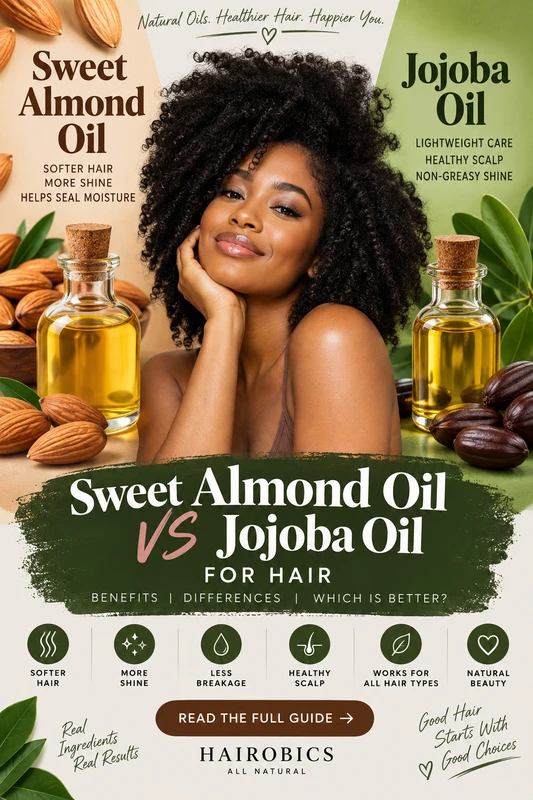
When it comes to natural hair care, choosing the right oil can make a noticeable difference in how your hair feels, looks, and responds to your routine. Two oils that frequently appear in natural hair products are sweet almond oil and jojoba oil.
Both can help soften hair, reduce dryness, improve shine, and support a healthier-feeling scalp. But they aren't identical. Sweet almond oil tends to work especially well when softness, slip, and sealing moisture into dry hair are the priorities. Jojoba oil is particularly popular for scalp care and lightweight conditioning because its wax esters have similarities to components found in human sebum.
So which one should you use?
The answer depends on your hair, scalp, styling habits, porosity, and what you're trying to accomplish.
In this guide, we'll compare sweet almond oil vs jojoba oil for hair, including their benefits, differences, how to use them, and which may be better for natural hair, dry hair, braids, locs, and scalp care.
Sweet Almond Oil vs Jojoba Oil: Quick Comparison
Sweet almond oil is a plant oil derived from almonds. It contains fatty acids and vitamin E and has a smooth, relatively lightweight texture. It can be useful for adding softness, reducing friction, and helping seal moisture into the hair.
Jojoba oil is technically a liquid wax rather than a traditional triglyceride oil. Its chemical structure makes it relatively stable and gives it a lightweight feel that works particularly well for many scalp and hair-care routines.
Here is the simplest way to think about the difference:
Sweet almond oil: Excellent for softness, lubrication, shine, and sealing.
Jojoba oil: Excellent for lightweight conditioning, scalp application, shine, and reducing the heavy feeling some oils leave behind.
Neither oil actually hydrates hair by itself. Water provides hydration. Oils are generally better thought of as ingredients that can lubricate the hair and help reduce moisture loss.
That distinction is particularly important for naturally dry or textured hair.
What Is Sweet Almond Oil?
Sweet almond oil is produced from the kernels of sweet almonds. It is widely used in cosmetic products for the skin, scalp, and hair.
It contains a high proportion of oleic and linoleic fatty acids as well as smaller amounts of other fatty acids and vitamin E compounds.
Because it spreads easily across the hair, sweet almond oil can provide lubrication without necessarily feeling as heavy as oils such as castor oil.
For natural hair, that can be especially useful.
Curly and coily strands frequently need products that improve slip and reduce friction between individual hairs. Excessive friction can contribute to tangling and mechanical breakage during styling and detangling.
Sweet almond oil can be incorporated into a routine after a water-based moisturizer or leave-in conditioner to help the hair remain soft and manageable.
Benefits of Sweet Almond Oil for Hair
1. Helps Hair Feel Softer
One of the biggest advantages of sweet almond oil is its ability to make dry hair feel softer and smoother.
Natural hair can sometimes feel rough even after moisturizing. Applying a small amount of oil after your leave-in can help lubricate the surface of the strands.
This can create a softer feel without requiring large amounts of product.
2. Helps Reduce Friction
Hair strands constantly rub against each other, clothing, pillowcases, hats, and styling tools.
This friction can contribute to tangles and breakage.
Lubricating the hair with an appropriate oil can reduce some of that friction. Sweet almond oil's texture makes it particularly convenient for spreading through the ends and lengths of the hair.
3. Adds Shine
If your natural hair looks dull, sweet almond oil can add a subtle sheen.
Curly and coily hair doesn't always reflect light in the same way straight hair does, so healthy natural hair can sometimes appear less shiny.
A small amount of sweet almond oil can enhance shine without requiring heavy styling products.
4. Helps Seal in Moisture
Sweet almond oil doesn't replace water or a moisturizing product.
Instead, try applying it after a water-based leave-in or moisturizer.
For example:
Water or water-based product → leave-in conditioner → sweet almond oil.
The oil can help slow water loss while providing additional lubrication.
5. Can Improve Detangling
Good slip can make detangling significantly easier.
Sweet almond oil can be used alongside a conditioner or detangling product to reduce friction while separating knots.
Always detangle gently, preferably working from the ends toward the roots.
6. Works Well on Dry Ends
The ends are the oldest portion of your hair.
They've experienced months—or even years—of washing, manipulation, styling, weather exposure, and friction.
That's why ends frequently become dry before the rest of the hair.
Applying a small amount of sweet almond oil to moisturized ends can help keep them feeling softer.
What Is Jojoba Oil?
Jojoba oil comes from the seeds of the Simmondsia chinensis plant.
Despite its name, jojoba oil isn't technically an oil in the same sense as almond, coconut, avocado, or olive oil.
It's primarily composed of liquid wax esters.
That characteristic is one reason jojoba has become popular in cosmetic formulations.
Jojoba's wax esters have similarities to some of the lipids present in human sebum, although this doesn't mean jojoba oil is identical to your scalp's natural oil.
Its texture is relatively lightweight, which makes it attractive for people who don't like heavy oils sitting on their scalp or hair.
Benefits of Jojoba Oil for Hair
1. Lightweight Scalp Application
If heavier oils make your scalp feel greasy, jojoba oil may be worth trying.
You generally don't need much.
A few drops spread across the fingertips can often cover a surprisingly large area of the scalp.
2. Helps Lubricate Dry Hair
Jojoba oil can coat and lubricate the hair shaft, helping strands feel smoother.
This can be especially useful when dealing with dryness around the ends.
3. Adds Shine Without Excessive Heaviness
People with fine or low-density hair sometimes avoid oils because they flatten their hairstyles.
Jojoba's relatively light texture may be easier to use in small quantities without making the hair look excessively oily.
4. Useful for Scalp Massage
Jojoba oil makes a convenient carrier for scalp massage because it spreads easily.
Place a few drops on your fingertips and gently massage the scalp using the pads of your fingers rather than scratching with your nails.
Scalp massage can feel relaxing and can be incorporated into a regular hair-care routine.
However, don't assume that using more oil will automatically make your hair grow faster.
5. Useful for Protective Styles
Jojoba oil can work well with:
- Box braids
- Knotless braids
- Cornrows
- Twists
- Locs
- Feed-in braids
- Crochet styles
Because it is lightweight, you can apply a small amount to accessible areas of the scalp without heavily coating the style.
Sweet Almond Oil vs Jojoba Oil for Natural Hair
For natural hair, both oils can be useful, but they shine in slightly different situations.
If your primary problem is hair that feels dry, rough, or difficult to detangle, sweet almond oil may give you the softness and lubrication you're looking for.
If your primary concern is finding a lightweight oil for your scalp or avoiding buildup, jojoba oil may be more appealing.
Your routine also matters.
Someone with thick, high-density 4C hair may comfortably use more sweet almond oil than someone with fine, low-density curls.
There is no universal amount that everyone needs.
Start small.
You can always add more oil, but removing excessive oil usually requires washing your hair again.
Which Oil Is Better for Dry Natural Hair?
For extremely dry natural hair, sweet almond oil has some practical advantages.
Its emollient properties can help dry strands feel smoother and softer.
However, there's an important mistake to avoid:
Don't rely on oil alone to moisturize extremely dry hair.
If your hair is dehydrated, repeatedly applying oil may eventually leave you with hair that feels both greasy and dry.
Instead, start with water or a water-based moisturizing product.
A simple routine could look like this:
- Lightly dampen your hair.
- Apply a moisturizing leave-in.
- Distribute the product through your hair.
- Apply a small amount of sweet almond oil.
- Concentrate on your ends.
- Style your hair with minimal tension.
Jojoba oil can also be used this way, particularly if sweet almond oil feels too rich for your hair.
Which Oil Is Better for the Scalp?
Jojoba oil is often an excellent choice when the goal is lightweight scalp lubrication.
You don't need to saturate your scalp.
Place a few drops on your fingertips and gently massage them across the areas that feel dry.
It's also important to recognize that not every itchy or flaky scalp needs more oil.
Persistent itching, redness, scaling, sores, tenderness, or severe flaking can have causes that aren't corrected simply by adding oil. In those situations, consider talking with a dermatologist or healthcare professional.
Continually coating an irritated scalp with additional oil without understanding the underlying cause may not solve the problem.
Sweet Almond Oil vs Jojoba Oil for Hair Growth
This is one of the most important questions people ask:
Does sweet almond oil or jojoba oil grow hair faster?
Neither should be treated as a proven miracle hair-growth treatment.
Hair grows from follicles underneath the scalp. Genetics, age, nutrition, hormonal factors, certain health conditions, medications, scalp health, and hair-care practices can all influence what you ultimately see in terms of growth and length.
Where oils can potentially help is length retention.
Imagine your hair grows steadily at the scalp, but your ends break almost as quickly.
You may feel like your hair isn't growing.
Reducing excessive manipulation, keeping hair appropriately conditioned, protecting your ends, and reducing breakage can help you retain more of the hair you grow.
Sweet almond and jojoba oils can play supporting roles by improving lubrication and helping reduce friction.
That's different from claiming they make follicles produce hair dramatically faster.
Sweet Almond Oil vs Jojoba Oil for Low-Porosity Hair
Low-porosity hair can be prone to product buildup when too many heavy products are layered onto it.
If that sounds familiar, jojoba oil may be the easier starting point.
Use only a few drops.
Apply your water-based moisturizer first, followed by a very light layer of jojoba oil.
Sweet almond oil can still work for low-porosity hair, but quantity matters.
If your hair feels coated, sticky, limp, or greasy, you may be applying too much product.
Remember:
More product does not automatically equal more moisture.
Sweet Almond Oil vs Jojoba Oil for High-Porosity Hair
High-porosity hair often absorbs products quickly but can also lose moisture relatively quickly.
Sweet almond oil may work particularly well in this situation because of its emollient qualities.
After moisturizing your hair, concentrate a small amount on your ends and any areas that become dry quickly.
Jojoba oil can still be used, especially if you prefer lighter products.
Some people even use the two together.
Can You Mix Sweet Almond Oil and Jojoba Oil?
Yes.
There is no rule saying you must choose only one.
A simple mixture might combine roughly equal amounts of sweet almond and jojoba oil.
The sweet almond oil contributes softness and lubrication, while jojoba keeps the mixture relatively lightweight.
You can adjust the ratio based on your hair.
If your hair is extremely dry, try a little more sweet almond oil.
If your hair gets weighed down easily, increase the proportion of jojoba.
Store your mixture in a clean, properly closed bottle away from excessive heat and direct sunlight.
Sweet Almond Oil vs Jojoba Oil for 4C Hair
Both can fit well into a 4C hair-care routine.
4C hair often experiences significant shrinkage, and the tight bends and curves of the strands can make natural sebum less likely to travel easily from the scalp down the entire length of the hair.
This can leave the ends feeling particularly dry.
Sweet almond oil can help provide softness and lubrication after moisturizing.
Jojoba can provide lighter conditioning when you don't want a heavier coating.
Try using sweet almond oil primarily on your hair and jojoba primarily around your scalp.
That isn't a mandatory rule—it is simply one practical way to take advantage of their different textures.
Which Is Better for Breakage?
Neither oil can repair severely damaged hair permanently.
Once a strand is significantly split or broken, an oil cannot biologically rebuild it.
However, reducing friction and improving lubrication can help protect strands from some mechanical damage.
Sweet almond oil may be especially useful before manipulating dry, tangled hair.
Instead of aggressively combing through dry strands, apply your normal moisturizing or detangling product and add a small amount of oil for additional slip.
Work in sections.
Start at the ends.
Slowly move upward.
This approach can make detangling much gentler.
Which Oil Is Better for Hair Ends?
Your ends deserve special attention because they're the oldest and often most fragile part of your hair.
For very dry ends, sweet almond oil is an excellent option.
Apply a small amount after moisturizing.
Jojoba oil can be better when your ends need lubrication but become greasy easily.
You can also alternate.
For example, use sweet almond oil after wash day and a tiny amount of jojoba oil for touch-ups between washes.
Jojoba Oil vs Sweet Almond Oil for Braids
Protective styles don't eliminate the need for hair care.
When wearing braids for several weeks, your scalp and exposed hair can still experience dryness.
Jojoba oil is particularly convenient for braids because it's relatively lightweight.
Apply sparingly between braid sections.
For the hair itself, use a water-based braid spray or moisturizer first.
Remember that oil doesn't replace hydration.
If the scalp becomes severely itchy or flaky while wearing braids, don't automatically keep adding oil. Product buildup, irritation, tension, or an underlying scalp condition could be contributing.
Jojoba Oil vs Sweet Almond Oil for Locs
Locs generally benefit from products that don't leave excessive residue.
For that reason, jojoba oil may be attractive for people who prefer lightweight loc maintenance.
Apply small amounts to the scalp rather than saturating the locs.
Sweet almond oil can also be used, especially when mature locs feel dry, but moderation is important.
Heavy, repeated product application can lead to buildup.
A light mist of water or a water-based moisturizing spray followed by a small amount of oil may work better than repeatedly coating dry locs with oil.
Which Oil Is Better for Fine Hair?
Jojoba oil generally has the advantage when you're trying to keep your routine lightweight.
Fine strands can become weighed down easily.
Start with one or two drops rubbed between your palms.
Then lightly smooth your hands over your hair.
Avoid pouring oil directly onto fine hair.
If you use sweet almond oil, start with a similarly small amount.
The goal isn't to make your hair visibly oily.
Which Oil Is Better for Thick Hair?
Thick, coarse, or high-density natural hair may tolerate richer oil application more easily.
Sweet almond oil can provide additional lubrication and softness, particularly on thick ends.
But hair density doesn't automatically determine how much oil you need.
Porosity, strand thickness, hairstyle, climate, and the products underneath the oil all matter.
Experiment gradually.
Can You Use Sweet Almond Oil or Jojoba Oil Every Day?
You can use either as needed, but daily application isn't automatically necessary or better.
Applying oil every day can cause buildup for some people.
If your hair constantly feels dry despite daily oiling, the problem may be that you're adding oil without enough water-based moisture.
Instead of immediately adding another layer of oil, evaluate your routine.
Ask yourself:
Is my hair actually hydrated?
Am I using too much product?
When did I last shampoo?
Do my ends need trimming?
Am I sleeping with satin or silk protection?
Am I manipulating my hair excessively?
Is my protective style too tight?
Sometimes changing the overall routine makes a larger difference than adding another product.
How to Use Sweet Almond Oil on Natural Hair
One of the easiest methods is using it after moisturizing.
After wash day, divide your hair into manageable sections.
Apply your preferred leave-in conditioner or moisturizer.
Then place a few drops of sweet almond oil into your palms.
Rub your hands together and gently smooth the oil through each section, paying particular attention to the ends.
Then style.
Twists, braids, buns, and other low-manipulation styles can help protect moisturized hair.
How to Use Jojoba Oil on Your Scalp
Start with a clean scalp.
Apply a few drops of jojoba oil to your fingertips or carefully place small amounts along sections of your scalp.
Massage gently using the pads of your fingers.
Avoid scratching with your nails.
You don't need to soak your scalp.
If your scalp looks extremely shiny or oil is running down your forehead, you've probably used more than necessary.
How to Use These Oils During Wash Day
Both oils can be incorporated into wash day.
You could apply a small amount before shampooing if you enjoy pre-shampoo treatments.
Then shampoo your scalp and hair thoroughly.
Follow with conditioner.
After rinsing, apply your leave-in moisturizer.
Finish with a small amount of sweet almond or jojoba oil if your hair responds well to sealing.
Pay attention to how your hair feels over the next several days.
Your own results are more useful than blindly following a complicated routine.
Sweet Almond Oil vs Jojoba Oil for Twist-Outs
For twist-outs, you usually want softness and definition without excessive greasiness.
Sweet almond oil can be excellent when your hair tends to feel dry after unraveling twists.
After applying your leave-in and styling cream, smooth a very small amount through the section before twisting.
Jojoba oil may work better if your twist-outs lose volume because heavier products weigh them down.
You can also rub one or two drops of jojoba oil onto your fingertips before separating twists.
This provides lubrication while you manipulate the curls.
Which Oil Is Better in Winter?
Cold weather, indoor heating, wind, and low humidity can leave hair feeling particularly dry.
During winter, some people prefer slightly richer routines.
Sweet almond oil can be useful for sealing moisturized ends and reducing the rough feeling associated with dry winter hair.
Jojoba can still work well for the scalp and for people whose hair becomes weighed down easily.
Protecting your hair physically matters too.
Satin-lined hats, protective hairstyles, regular conditioning, and nighttime protection can all complement your oil routine.
Which Oil Is Better in Summer?
Hot and humid weather often changes what your hair needs.
Heavy product layering can feel uncomfortable in summer, especially when you're sweating frequently.
Jojoba oil may be particularly convenient because you can use a very small amount.
Sweet almond oil is still useful, but you may find yourself needing less than during colder months.
Adjust your routine according to your hair instead of using exactly the same amount year-round.
Common Mistakes When Using Hair Oils
Using Oil Instead of Moisturizer
This is probably the biggest mistake.
If your hair is thirsty, covering it with additional oil isn't the same as providing water.
Use water or a water-based moisturizing product first.
Applying Too Much
Natural hair doesn't need to drip with oil to be healthy.
Excessive oil can leave the hair greasy, attract debris, contribute to buildup, and make wash day more difficult.
Ignoring Your Ends
People often concentrate oil around their scalp because that's where hair grows.
But your ends may need more protection because they're older and more vulnerable to mechanical wear.
Oiling a Dirty Scalp Repeatedly
Layering oil onto weeks of sweat, dead skin, and styling-product residue isn't a substitute for cleansing.
Maintain a wash schedule appropriate for your scalp, lifestyle, and hairstyle.
Expecting Instant Hair Growth
Hair growth takes time.
Healthy hair habits are usually more valuable than chasing miracle ingredients.
Focus on maintaining your scalp, reducing unnecessary breakage, protecting your ends, eating adequately, and handling your hair gently.
Sweet Almond Oil vs Jojoba Oil: Which Is Better for Men?
Both can work well for Black men's hair.
For short waves, jojoba oil can provide lightweight shine and lubrication without requiring a heavy layer of oil.
For longer curls, twists, or an afro, sweet almond oil may provide additional softness.
Men with locs may prefer jojoba because of its lightweight consistency.
Again, the best choice depends more on the person's hair than gender.
Sweet Almond Oil vs Jojoba Oil for Kids' Hair
A simple routine is generally preferable for children's hair.
Either oil may be used sparingly on the hair if tolerated, but patch testing a new product is sensible, especially for sensitive skin.
Avoid unnecessary essential oils or heavily fragranced mixtures on children.
And remember that sweet almond oil comes from almonds. Anyone with known nut allergies or concerns about allergic reactions should speak with an appropriate healthcare professional before using almond-derived products.
Can Sweet Almond Oil or Jojoba Oil Cause Buildup?
Any hair product can contribute to buildup when used excessively.
Jojoba is lightweight, but that doesn't mean you can apply unlimited amounts without eventually needing to cleanse your hair.
Sweet almond oil can also accumulate when repeatedly layered with butters, creams, gels, and pomades.
Signs that it may be time to cleanse include hair that feels coated, unusually heavy, greasy, dull, sticky, or resistant to your normal moisturizing routine.
A good shampoo can reset the hair so your conditioner and styling products can work more effectively.
Can You Use Jojoba and Sweet Almond Oil With Leave-In Conditioner?
Absolutely.
In fact, this is often more effective than applying oil to completely dry hair.
Try this order:
Step 1: Start with clean or lightly damp hair.
Step 2: Apply a water-based leave-in treatment.
Step 3: Distribute it thoroughly.
Step 4: Apply a small amount of sweet almond or jojoba oil.
Step 5: Concentrate on dry areas and ends.
Step 6: Style your hair.
This approach gives the hair hydration first and oil second.
How Much Oil Should You Use?
Less than you may think.
For short hair, a few drops may be enough.
For longer, thicker natural hair, you'll probably need more, but it's still best to work gradually.
Section your hair and distribute small amounts.
Your hair shouldn't necessarily look or feel saturated.
The ideal amount leaves your hair soft, flexible, and manageable rather than excessively greasy.
Sweet Almond Oil vs Jojoba Oil: Which Is Better for You?
The better oil depends on what your hair needs.
Choose sweet almond oil when you want:
- More softness
- Additional slip
- Help lubricating dry ends
- A useful sealing oil
- An oil for thick or very dry natural hair
Choose jojoba oil when you want:
- A lightweight oil
- A scalp-friendly application
- Less heaviness
- An oil suitable for braids or locs
- Something that works well for fine or easily weighed-down hair
And remember—you don't necessarily have to choose.
Many people can successfully incorporate both oils into the same routine.
Sweet Almond Oil vs Jojoba Oil for Hair Growth and Length Retention
If growing longer natural hair is your goal, don't focus exclusively on finding the "best hair-growth oil."
Pay attention to length retention.
Your hair may already be growing, but repeated breakage can prevent you from seeing significant increases in length.
A healthy length-retention routine may include:
- Regular cleansing
- Consistent conditioning
- Gentle detangling
- Keeping hair appropriately moisturized
- Protecting the ends
- Avoiding excessive heat
- Avoiding chronically tight hairstyles
- Sleeping with satin or silk protection
- Limiting unnecessary manipulation
- Trimming damaged ends when needed
Sweet almond and jojoba oils can complement these habits by providing lubrication and softness.
But the oil is only one part of the routine.
Frequently Asked Questions
Is jojoba oil better than sweet almond oil?
Neither is universally better. Jojoba is particularly useful when you want something lightweight or scalp-friendly, while sweet almond oil can be excellent when softness, slip, and sealing dry hair are priorities.
Which oil is better for 4C hair?
Both can work for 4C hair. Sweet almond oil may be preferable for very dry strands and ends, while jojoba may be better when you want lightweight scalp application.
Which is better for low-porosity hair?
Jojoba may be easier to use because it's relatively lightweight. However, low-porosity hair can use sweet almond oil successfully when applied sparingly.
Which is better for high-porosity hair?
Sweet almond oil can be a useful choice for high-porosity hair because it provides good lubrication and helps moisturized hair feel softer. Jojoba remains a good lightweight alternative.
Can I mix jojoba and sweet almond oil?
Yes. They can be combined or used separately in different parts of your routine.
Does sweet almond oil grow hair?
Sweet almond oil shouldn't be considered a proven treatment for accelerating hair growth. Its greater practical benefit is helping lubricate and condition the hair, which may support length retention by reducing unnecessary mechanical damage.
Does jojoba oil grow hair?
Jojoba oil isn't a proven miracle hair-growth treatment either. It can be incorporated into a healthy scalp and hair-care routine, but don't expect it alone to dramatically change your natural growth rate.
Can I put sweet almond oil directly on my scalp?
You can, provided your scalp tolerates it, but you don't need large amounts. Anyone with an almond or nut allergy should be cautious and seek appropriate medical guidance before using almond-derived products.
Can I leave jojoba oil in my hair overnight?
For most people who tolerate it, jojoba can be used as a leave-in oil in small quantities. There usually isn't a need to saturate your hair before bed.
Should I apply oil to wet or dry hair?
If your goal is moisture retention, applying a small amount of oil after water or a water-based moisturizer generally makes more sense than repeatedly putting oil onto very dry hair.
Final Thoughts: Sweet Almond Oil or Jojoba Oil?
The sweet almond oil vs jojoba oil debate doesn't need a single winner.
Both can have a place in a healthy natural hair routine.
Sweet almond oil is an excellent option when your priorities are softness, lubrication, shine, easier detangling, and protecting dry ends.
Jojoba oil stands out when you want lightweight conditioning, scalp application, shine, or an oil that doesn't feel excessively heavy.
For many people with natural hair, one of the best strategies is actually using them differently.
Apply a water-based leave-in treatment to hydrate your hair, use a small amount of sweet almond oil on particularly dry strands and ends, and use jojoba sparingly when your scalp needs lightweight lubrication.
Most importantly, pay attention to what your own hair is telling you.
If your hair feels soft, flexible, moisturized, and manageable, your routine is probably moving in the right direction. If it constantly feels greasy but still dry, adding more oil probably isn't the answer.
Healthy natural hair doesn't depend on discovering one magical ingredient.
It's built through consistent cleansing, conditioning, moisturizing, gentle handling, protecting your ends, and choosing products that complement your individual hair.