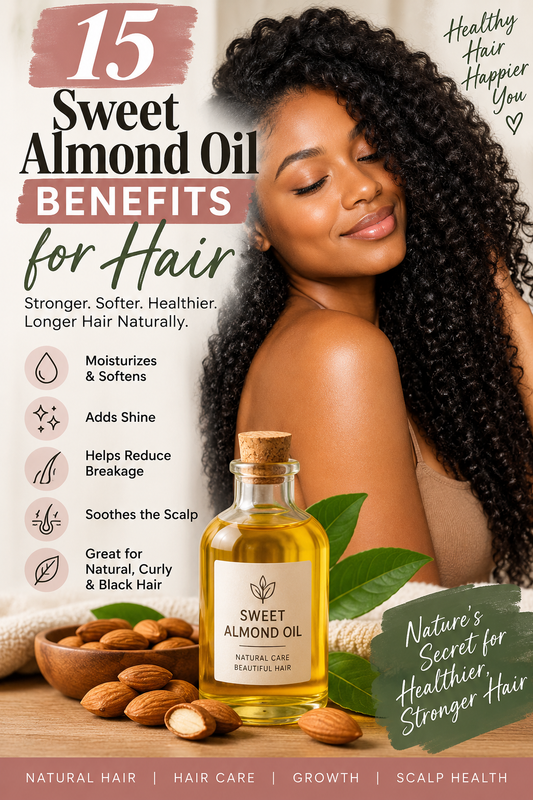
Sweet almond oil has become a popular ingredient in natural hair care—and for good reason. Lightweight, versatile, and naturally rich in fatty acids, sweet almond oil can be used to help soften dry hair, improve shine, reduce friction, support moisture retention, and keep the scalp feeling comfortable.
For people with Black hair, natural hair, curly hair, coils, braids, twists, or locs, maintaining moisture is often one of the biggest parts of a healthy hair routine. Because curls and coils can make it more difficult for natural scalp oils to travel down the entire hair shaft, the ends of the hair may become dry and vulnerable to breakage.
That is where oils such as sweet almond oil can be useful.
Unlike extremely heavy oils that may leave some hair types feeling coated or greasy, sweet almond oil has a relatively lightweight feel. It can be applied by itself, combined with other oils, added to conditioners, or used as the sealing step of a moisturizing routine.
But what does sweet almond oil actually do for your hair?
This complete guide explores the benefits of sweet almond oil for hair, how to use it, whether it can help with hair growth, how often you should apply it, and how it compares with other popular natural oils.
What Is Sweet Almond Oil?
Sweet almond oil is an oil extracted from the seeds of the sweet almond tree, Prunus dulcis.
Almonds are widely known as a nutritious food, but their oil is also commonly found in cosmetics, skin-care products, conditioners, shampoos, scalp oils, and natural hair treatments.
Sweet almond oil should not be confused with bitter almond oil.
The sweet variety is the form commonly used in cosmetic and personal-care products.
Sweet almond oil naturally contains several components that make it attractive for hair care, including:
- Oleic acid
- Linoleic acid
- Palmitic acid
- Vitamin E compounds
- Other naturally occurring plant compounds
Its fatty-acid composition contributes to its emollient properties, meaning it can help lubricate and soften the surface of the hair.
This can be especially valuable for hair that frequently feels rough, dry, tangled, or difficult to manage.
15 Sweet Almond Oil Benefits for Hair
1. Helps Soften Dry Hair
One of the most noticeable benefits of sweet almond oil is its ability to make dry hair feel softer.
Natural hair can lose moisture because of environmental conditions, frequent washing, heat styling, chemical treatments, and everyday manipulation.
Curly and coily hair may be particularly prone to dryness because the shape of the strands makes it harder for sebum from the scalp to coat the full length of the hair.
Sweet almond oil acts as an emollient.
When applied lightly to the hair, it lubricates the strand's surface and can create a smoother, softer feel.
For very dry natural hair, try applying a water-based moisturizer or leave-in conditioner first and following with a small amount of sweet almond oil.
The oil helps complement your moisturizing routine.
2. Helps Seal In Moisture
One misconception about hair oils is that they hydrate hair by themselves.
Oil and water aren't the same thing.
Water provides hydration, while oils are often most useful for reducing moisture loss and conditioning the hair after hydration has been added.
For example, you might:
- Mist your hair lightly with water.
- Apply a leave-in conditioner.
- Smooth a small amount of sweet almond oil over your strands.
- Concentrate particularly on dry ends.
This approach can be especially helpful for natural hair that seems to become dry shortly after moisturizing.
Remember: if your hair is already extremely dry, adding more oil without introducing water or a moisturizing product may simply coat dry strands.
3. May Reduce Hair Breakage
Growing longer hair isn't only about how quickly your follicles produce new hair.
Length retention matters too.
Your hair can be growing normally at the scalp while breaking at the ends almost as quickly as new length appears.
This creates the impression that your hair "isn't growing."
Sweet almond oil can help by lubricating the strands and reducing some of the friction associated with handling, styling, and detangling.
Less friction can mean less mechanical stress.
This is particularly useful around fragile areas such as:
- Hair ends
- Hairline
- Nape
- Crown
- Areas frequently manipulated during styling
Sweet almond oil cannot repair severely damaged hair permanently, but incorporating lubricating products into a gentle routine can make fragile strands easier to manage.
4. Makes Hair Feel Smoother
If your hair feels rough when you run your fingers down the strands, sweet almond oil may help improve its feel.
A tiny amount smoothed over the hair can create a more polished surface.
This can be particularly helpful after:
- Blow-drying
- Twist-outs
- Braid-outs
- Roller sets
- Wash-and-go styles
- Removing protective styles
Avoid applying too much.
With oils, more isn't always better.
Start with a few drops, distribute them between your palms, and gently smooth them over the hair.
5. Adds Natural-Looking Shine
Healthy shine can sometimes be harder to see on tightly coiled hair.
Straight hair reflects light relatively uniformly, while curls and coils reflect light in multiple directions.
That doesn't mean coily hair is unhealthy.
Adding a lightweight oil can create additional surface shine without requiring heavy styling products.
Sweet almond oil is particularly useful when you want a soft sheen rather than an extremely oily appearance.
Try rubbing two or three drops between your palms and lightly smoothing them over your finished hairstyle.
Sweet Almond Oil Benefits for Black Hair
Sweet almond oil can be especially useful in a Black hair-care routine because many popular natural hairstyles require careful moisture management.
6. Works Well With Natural Hair
Whether you have loose curls, tight coils, an Afro, twists, braids, or a wash-and-go, sweet almond oil is incredibly versatile.
It can be incorporated into nearly every stage of a natural hair routine.
For example:
Wash day: Add a small amount to a pre-shampoo treatment.
After washing: Apply it after your leave-in conditioner.
Twist-outs: Use a tiny amount while separating twists.
Protective styles: Apply sparingly to exposed natural hair or the scalp as needed.
Nighttime: Smooth a little onto dry ends before covering your hair with satin.
Because sweet almond oil is relatively lightweight compared with some heavier oils, people who dislike the feeling of thick oil may prefer it.
7. Helps Protect Fragile Ends
Your ends are the oldest part of your hair.
If your hair is shoulder length or longer, those ends may have been exposed to years of washing, detangling, styling, clothing friction, environmental exposure, and manipulation.
That makes them particularly vulnerable.
Apply sweet almond oil to your ends after moisturizing.
You don't need to saturate them.
A light coating is usually enough.
Pair this with other length-retention practices, including:
- Gentle detangling
- Regular conditioning
- Minimal excessive heat
- Satin or silk nighttime protection
- Protective styling
- Trimming damaged ends when necessary
Oil works best as one part of an overall healthy hair routine.
8. Can Make Detangling Easier
Detangling dry curls can lead to unnecessary breakage.
Hair strands can catch on one another, forming knots and tangles.
Sweet almond oil provides slip.
That extra lubrication may make it easier for strands to slide past each other.
However, don't rely on oil alone for severe tangles.
For easier detangling, try:
- Divide hair into sections.
- Mist each section with water if appropriate for your style.
- Apply a conditioner or detangling product.
- Add a small amount of sweet almond oil for additional slip.
- Finger-detangle large knots.
- Follow with a wide-tooth comb or detangling brush if desired.
- Work from the ends toward the roots.
Never force a comb through a knot.
Does Sweet Almond Oil Help Hair Growth?
This is one of the most frequently asked questions about almond oil.
Sweet almond oil is often marketed as a hair-growth oil, but it's important to distinguish between directly stimulating follicles and supporting conditions that help you retain healthier-looking hair.
There isn't strong clinical evidence showing that applying sweet almond oil by itself dramatically increases the biological speed of human hair growth.
However, that doesn't make it useless for someone trying to grow longer hair.
Sweet almond oil may support a length-retention routine by:
- Reducing friction
- Softening strands
- Improving manageability
- Protecting dry ends
- Supporting moisture retention
- Helping reduce breakage caused by manipulation
Think about it this way.
If your hair grows approximately half an inch during a month but continually breaks at the ends, you may see very little increase in overall length.
Reducing breakage allows you to retain more of the hair you're already growing.
So rather than thinking of sweet almond oil as a miracle growth treatment, consider it a useful hair-conditioning and length-retention oil.
Sweet Almond Oil Benefits for the Scalp
9. Helps Condition a Dry-Feeling Scalp
Some people enjoy applying small amounts of sweet almond oil directly to their scalp.
Its lightweight texture makes it convenient for scalp massage.
If your scalp feels dry, a few drops may help it feel more conditioned.
However, persistent flaking, severe itching, sores, redness, inflammation, or sudden hair loss shouldn't simply be covered with oil.
Those symptoms can have multiple causes and may require evaluation by a dermatologist or another qualified healthcare professional.
10. Excellent for Scalp Massage
Sweet almond oil makes an excellent carrier oil for scalp massage because it spreads easily.
You don't need to drench your scalp.
Place a few drops on your fingertips and gently massage your scalp using the pads of your fingers.
Massage for approximately three to five minutes.
Avoid scratching with your fingernails.
Scalp massage can feel relaxing, while the oil helps reduce friction between your fingertips and skin.
Sweet Almond Oil for Curly Hair
11. Helps Reduce Frizz
Frizz is completely normal for curly hair, but sometimes you may want a smoother finish.
A small amount of sweet almond oil can help smooth flyaways and reduce the appearance of frizz.
After styling:
Rub one or two drops between your palms.
Lightly glide your hands over the outer surface of your curls.
Don't rake a large amount through freshly styled curls, since this can disrupt definition.
12. Helps Maintain Curl Softness
Curly hair can look beautifully defined immediately after wash day but gradually become drier over the next several days.
Sweet almond oil can be incorporated into your curl-refresh routine.
For example:
Day 1: Wash, condition, moisturize, style.
Day 2: Leave your curls alone unless they need refreshing.
Day 3: Lightly mist dry areas and apply a small amount of leave-in.
Day 4: Smooth one or two drops of sweet almond oil over dry ends.
Adjust the schedule according to your hair.
Some curls require moisture every day, while others can go several days without additional products.
Sweet Almond Oil for Protective Styles
13. Can Be Used With Braids
Braids protect much of your hair from daily manipulation, but your scalp and natural hair still require attention.
Sweet almond oil can be applied sparingly while wearing:
- Box braids
- Knotless braids
- Cornrows
- Feed-in braids
- Crochet styles
- Twists
Apply only a small amount.
Excessive oil can combine with sweat, lint, dead skin, and styling products, leading to buildup.
Keep your scalp clean according to your needs rather than continuously layering oil over it.
14. Can Be Used on Locs
People with locs often want moisture without products that create heavy residue.
Sweet almond oil's lightweight texture can make it an option for some loc routines.
A simple approach is:
Hydrate first → oil lightly second.
Mist locs with a water-based moisturizing spray and follow with a small amount of sweet almond oil.
Concentrate on dry areas instead of saturating the entire loc.
Remember that oil alone isn't a substitute for hydration.
15. Helps Reduce Friction During Styling
Manipulation is a major contributor to mechanical damage.
Think about everything your hair experiences:
- Combing
- Brushing
- Finger styling
- Braiding
- Twisting
- Detangling
- Ponytails
- Buns
- Clothing friction
- Pillow friction
Lubricating hair before certain styling activities can reduce resistance between strands.
Sweet almond oil's smooth texture makes it useful for this purpose.
Sweet Almond Oil for Low-Porosity Hair
Low-porosity hair has tightly arranged cuticle layers and may resist absorbing water and products.
People with low-porosity hair frequently complain that products sit on top of their strands.
If that's you, sweet almond oil may be preferable to very heavy oils.
But portion size matters.
Start with one or two drops per section, not a palmful.
If your hair feels greasy, limp, waxy, or coated after using the oil, reduce the amount or frequency.
You may also find that applying it to damp hair works better than applying it to completely dry hair.
Sweet Almond Oil for High-Porosity Hair
High-porosity hair tends to absorb moisture readily but can also lose it quickly.
Porosity may be naturally higher or increase due to damage from:
- Bleaching
- Coloring
- Relaxers
- Excessive heat
- Mechanical wear
Sweet almond oil may help high-porosity hair feel smoother and reduce moisture loss when layered over a moisturizing product.
Some high-porosity hair may require richer products than sweet almond oil alone.
You can combine it with creams, butters, or heavier oils depending on what your strands prefer.
Sweet Almond Oil vs Castor Oil
Both oils are popular in Black hair care, but they feel very different.
Sweet Almond Oil
Sweet almond oil is generally:
- Lightweight
- Easy to spread
- Good for shine
- Useful for sealing
- Suitable for scalp massage
- Less sticky
- Convenient for frequent use
Castor Oil
Castor oil is generally:
- Much thicker
- More viscous
- Heavier on fine hair
- Popular for sealing
- Often used on edges and scalp
- Better suited to people who prefer rich oils
You don't necessarily need to choose one.
They can also be blended.
Combining castor oil with a lighter carrier oil such as sweet almond oil can make the mixture easier to distribute.
Sweet Almond Oil vs Coconut Oil
Coconut oil is unique among popular hair oils because some of its fatty acids can penetrate the hair shaft, and research has shown benefits related to reducing protein loss under certain conditions.
Sweet almond oil is generally used more as an emollient and surface-conditioning oil.
Choose coconut oil if your hair responds well to it.
Choose sweet almond oil if you prefer something lighter and primarily want softness, lubrication, and shine.
Some people find coconut oil makes their hair feel stiff or dry.
Hair responses vary, so experimentation matters.
Sweet Almond Oil vs Jojoba Oil
Jojoba oil is technically a liquid wax rather than a conventional triglyceride oil.
Both jojoba and sweet almond oil are popular lightweight options.
Jojoba may be especially attractive for scalp applications, while sweet almond oil is excellent for smoothing and conditioning the hair.
Both can work beautifully in the same routine.
Sweet Almond Oil vs Olive Oil
Olive oil is usually heavier than sweet almond oil.
If you have thick, coarse, extremely dry hair, you might appreciate olive oil's richer feel.
If you have fine strands, low-density hair, or hair that becomes greasy easily, sweet almond oil may be easier to manage.
The "best" oil isn't universal.
It's the oil that works with your particular hair.
How to Use Sweet Almond Oil for Hair
There are several ways to incorporate almond oil into your routine.
Method 1: Seal Moisturized Hair
This is one of the simplest methods.
After washing:
- Divide damp hair into sections.
- Apply your favorite leave-in conditioner.
- Add a small amount of sweet almond oil.
- Smooth it down the strands.
- Concentrate on the ends.
- Style normally.
Method 2: Pre-Shampoo Treatment
Apply sweet almond oil before shampooing.
Divide your dry hair into sections and apply a modest amount throughout the lengths.
Leave it on for around 15–30 minutes before washing.
You don't need to soak your hair in oil.
Then shampoo and condition normally.
Method 3: Add It to Deep Conditioner
Want to make your conditioning routine feel richer?
Place the amount of conditioner you're going to use in your hand or a separate bowl and mix in a few drops of sweet almond oil.
Apply the mixture to your hair.
Avoid pouring oil directly into the entire conditioner container because altering a formulated cosmetic product can affect how it performs.
Method 4: Scalp Massage
Place several drops of oil on your fingertips.
Gently massage your scalp for three to five minutes.
Use circular movements without scratching.
Method 5: Protect Your Ends
After moisturizing your hair, apply one or two drops to the ends of each section.
This technique works especially well before:
- Twisting
- Braiding
- Bunning
- Wearing a protective style
- Going to bed
Method 6: Separate Twist-Outs
Sweet almond oil can also help reduce friction when taking down a twist-out or braid-out.
Rub a tiny amount onto your fingertips before unraveling each twist.
This can provide additional slip and shine.
DIY Sweet Almond Oil Hair Blend
If you enjoy simple oil blends, try combining sweet almond oil with another compatible carrier oil.
Simple Hair Oil Blend
Combine:
- 2 tablespoons sweet almond oil
- 1 tablespoon jojoba oil
- 1 tablespoon coconut or olive oil
Mix and store in a clean, suitable container.
Apply sparingly.
You can adjust the proportions according to your hair's thickness and preference.
Can You Use Sweet Almond Oil Every Day?
Technically, some people can use small amounts daily.
But most people don't need to.
Applying oil every day can eventually lead to buildup, especially if you're applying generous amounts.
Instead, pay attention to your hair.
If it still feels:
- Soft
- Flexible
- Moisturized
- Smooth
you probably don't need additional oil.
If it feels dry, first determine whether it needs water/moisture, rather than automatically adding more oil.
For many people, applying sweet almond oil around one to three times per week is plenty.
Your ideal frequency depends on your:
- Hair texture
- Porosity
- Density
- Strand thickness
- Hairstyle
- Climate
- Wash frequency
Can You Leave Sweet Almond Oil in Your Hair Overnight?
Yes, sweet almond oil can be used as a leave-in oil when your skin and scalp tolerate it.
However, leaving a huge amount of oil on your hair overnight isn't necessary.
If you want an overnight treatment, use a modest amount.
Protect your pillow with a satin bonnet, scarf, or other appropriate covering.
Shampoo afterward if your hair feels excessively oily.
Does Sweet Almond Oil Make Hair Thicker?
Sweet almond oil won't magically increase the number of follicles on your scalp.
However, hair that is better conditioned and experiencing less breakage may appear fuller over time because you're retaining more strands and length.
The oil can also temporarily make individual strands look smoother and shinier.
If you're experiencing unexplained thinning, bald patches, rapid shedding, or a receding hairline, don't depend on cosmetic oils alone.
Consider speaking with a dermatologist.
Sweet Almond Oil for Edges
Your edges are among the most fragile hairs on your head.
They are frequently exposed to:
- Brushing
- Gel
- Tight ponytails
- Braids
- Wigs
- Edge control
- Headbands
- Scarves
Sweet almond oil can help condition the area, but it can't compensate for chronic tension.
If your hairstyle constantly pulls on your hairline, oil isn't enough.
Protecting your edges requires reducing excessive tension and manipulation.
Possible Side Effects of Sweet Almond Oil
Natural doesn't automatically mean risk-free.
Some people may experience sensitivity or allergic reactions to almond-derived ingredients.
People with known almond or tree-nut allergies should consult an appropriate healthcare professional before using almond-based cosmetic products.
If you're trying a new oil, patch testing can also be sensible.
Stop using it if you develop symptoms such as significant redness, swelling, burning, hives, or persistent irritation.
How to Choose Sweet Almond Oil for Hair
When shopping for almond oil, read the label carefully.
Look for a product that clearly identifies the ingredient as sweet almond oil, often listed as:
Prunus Amygdalus Dulcis (Sweet Almond) Oil
Cold-pressed and minimally processed oils are popular among people who prefer less-refined hair-care ingredients, although refinement doesn't automatically make an oil unsuitable for cosmetic use.
Also examine:
- Ingredient list
- Expiration or best-by information when provided
- Storage instructions
- Added fragrances
- Added essential oils
Store your oil according to the manufacturer's instructions, away from excessive heat and direct sunlight.
Who Should Try Sweet Almond Oil?
Sweet almond oil may be worth trying if your hair is:
- Dry
- Curly
- Coily
- Natural
- Frizz-prone
- Difficult to detangle
- Prone to breakage
- Dull-looking
- Frequently worn in protective styles
It's also a good option if you dislike extremely heavy oils.
Who Might Not Like Sweet Almond Oil?
Not every ingredient works for everyone.
Sweet almond oil may not be ideal if:
- You have an almond allergy
- Your hair becomes greasy easily
- You prefer oil-free styling
- Your scalp reacts poorly to oils
- You already have significant product buildup
If your hair feels weighed down, simply use less or discontinue it.
Sweet Almond Oil and a Healthy Hair Routine
The greatest mistake people make with hair-growth oils is expecting one ingredient to do everything.
Healthy hair usually requires multiple habits working together.
For better length retention, focus on:
Regular Cleansing
Clean your scalp often enough to remove sweat, oil, dead skin, and product buildup.
Conditioning
Use conditioner after shampooing to improve softness, manageability, and detangling.
Deep Conditioning
If your hair benefits from deep conditioning, incorporate it when needed.
Gentle Detangling
Detangle carefully and avoid ripping through knots.
Moisture
Use water-based moisturizing products when your hair needs hydration.
Sealing
Follow with an oil such as sweet almond oil when appropriate.
Nighttime Protection
Sleep with satin or silk protection to reduce friction.
Low-Tension Styling
Avoid hairstyles that constantly pull on your scalp and hairline.
Heat Protection
Limit excessive heat and use an appropriate heat protectant when heat styling.
Protect Your Ends
Pay particular attention to the oldest and most fragile part of your hair.
Sweet almond oil can fit beautifully into this larger routine.
Frequently Asked Questions About Sweet Almond Oil for Hair
Is sweet almond oil good for Black hair?
Yes. Sweet almond oil can be a useful conditioning oil for Black hair because it helps lubricate strands, add softness and shine, and support moisture retention. Its relatively lightweight feel can work well for many curly and coily textures.
Can sweet almond oil grow hair?
There isn't strong evidence that sweet almond oil directly makes follicles produce hair dramatically faster. However, its conditioning and lubricating properties can support length retention by helping reduce friction and breakage.
Can I put sweet almond oil directly on my scalp?
Many people do. Apply a small amount and massage gently. If your scalp becomes irritated, excessively oily, or develops persistent symptoms, discontinue use.
Is sweet almond oil good for dry hair?
Yes. It works particularly well when applied after a water-based moisturizer or leave-in conditioner.
Is sweet almond oil good for natural hair?
Yes. It can be incorporated into wash-and-go routines, twists, braid-outs, protective styles, loc care, and everyday natural hair maintenance.
Is sweet almond oil heavy?
Compared with oils such as castor oil, sweet almond oil generally feels relatively lightweight.
Should I apply almond oil to wet or dry hair?
Either is possible, but applying a small amount to damp or freshly moisturized hair can be particularly useful when your goal is moisture retention.
Can almond oil stop hair breakage?
No oil can guarantee that breakage will stop completely. Sweet almond oil can help lubricate strands and reduce friction, which may decrease some forms of mechanical breakage.
Can you use sweet almond oil on braids?
Yes. Use it sparingly on the scalp and exposed natural hair. Avoid continuously layering large amounts because buildup can develop.
Can you use almond oil on locs?
Yes. A light application can add softness and shine without the heaviness associated with some thicker products. Hydrate your locs first when moisture is the goal.
How often should I use sweet almond oil?
For many people, one to three applications per week is enough, but there's no universal schedule. Let your hair's condition guide you.
Does sweet almond oil help dry ends?
It can help soften and lubricate dry ends, especially when applied after a moisturizing product.
Can I mix sweet almond oil with other oils?
Yes. It can be blended with oils such as jojoba, olive, coconut, or castor oil.
Sweet Almond Oil Benefits: Final Thoughts
Sweet almond oil deserves its place among the most versatile oils for natural hair care.
Its greatest strength isn't that it is a miracle hair-growth treatment.
It's that it can perform several useful jobs at once.
Sweet almond oil can help soften dry hair, improve shine, reduce friction, make detangling easier, condition the scalp, protect fragile ends, support moisture retention, and improve overall manageability.
Those benefits can be especially valuable for Black hair, curly hair, coily hair, protective styles, and locs.
If your ultimate goal is longer, healthier-looking hair, remember that length retention matters just as much as growth.
Your hair is constantly exposed to manipulation, environmental stress, styling, washing, friction, and normal wear. A lightweight conditioning oil such as sweet almond oil can help make strands easier to handle and reduce some of that everyday stress.
For the best results, don't simply pour oil onto dry hair and expect instant transformation.
Instead, build sweet almond oil into a complete routine:
Cleanse → Condition → Hydrate → Moisturize → Seal → Protect.
Pay particular attention to your ends, handle your hair gently, avoid excessive tension, protect your hair at night, and keep your scalp clean.
Sweet almond oil is only one part of that process—but when used correctly, it can be a valuable addition to a healthy natural hair routine.